
A Plan That Paid Off
When Don and Marie Kingsley moved into a senior living community at ages 72 and 69, Don was sharp, active, and playing golf three times a week. Marie was the one who pushed for the move. Her mother had developed Alzheimer's in her late seventies, and Marie had watched the family scramble to find memory care on short notice, uproot her mother from everything familiar, and place her in a facility where she knew no one. Marie didn't want that for herself or for Don.
Six years later, Don was diagnosed with early-stage Alzheimer's. Because the Kingsleys had chosen a community with senior living and memory care on the same campus, Don's transition looked nothing like what Marie's mother had gone through. The staff already knew him. The environment was familiar. Marie could walk down the hall to visit him every day. Don's doctors, his daily routine, and even his favorite dining room table stayed within reach.
Stories like this illustrate why communities with memory care built into the campus are becoming one of the most thoughtful planning decisions families can make. Not every family will need memory care. But for those who do, having it already in place, on a campus your parent already knows, with staff who already know your parent, changes the entire experience.
This guide walks through how senior living with memory care works, what the transition between care levels actually involves, what these communities cost, and how to evaluate whether an all-in-one campus is the right fit for your family's situation.
What "All-in-One" Senior Living Actually Means
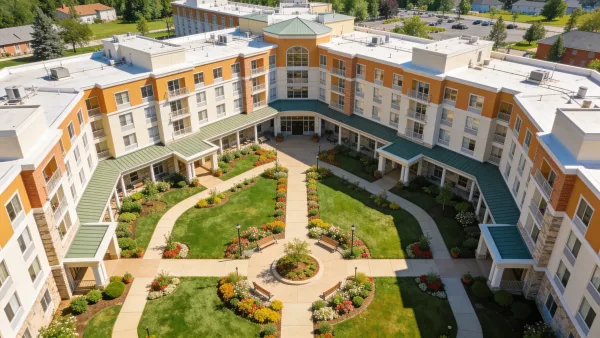
The term "all-in-one" or "continuum of care" describes senior living communities that offer multiple levels of care on a single campus. The most comprehensive version is often called a Continuing Care Retirement Community (CCRC) or Life Plan Community, though many assisted living campuses also incorporate memory care units without the full CCRC model.
The typical levels of care available on an integrated campus include:
- Independent living. Apartments, cottages, or condominiums for seniors who can manage daily life on their own but want access to community amenities, social activities, and the security of knowing higher levels of care are available if needed.
- Assisted living. Support with activities of daily living such as bathing, dressing, medication management, and meal preparation. Residents maintain as much independence as possible while receiving help where they need it.
- Memory care. A specialized, secured environment designed specifically for residents with Alzheimer's disease, dementia, or other cognitive impairments. Staff are trained in dementia care techniques, and the physical space is built to reduce confusion and prevent wandering.
- Skilled nursing. The highest level of non-hospital medical care, providing 24-hour nursing supervision, rehabilitation services, and complex medical management. Not all campuses include this level.
The key advantage of an integrated campus is continuity. A resident who enters at the independent living level and later develops dementia doesn't have to leave the community they've come to call home. They move to a different area of the same campus, often with staff members they already know and trust.
Why Integrated Campuses Are Different from Standalone Communities
It's worth understanding the distinction between a senior living community with memory care on campus and a standalone memory care facility. They serve different populations at different points in the planning process.
A standalone memory care community is designed exclusively for residents who already have a dementia diagnosis. Families typically find these communities when a parent's cognitive decline has progressed to the point where specialized care is needed. There's nothing wrong with this approach, but it often means the move happens during a crisis, into an unfamiliar environment, with staff your parent has never met.
Senior living with memory care on campus flips that timeline. The resident moves in while they're still healthy (or relatively healthy), builds relationships, establishes routines, and becomes part of a community. If cognitive decline develops later, the transition to memory care happens within that same community. The resident isn't starting over. The family isn't scrambling.
What families often underestimate is how much starting in senior living first has advantages that go far beyond convenience. Research consistently shows that people with dementia do better in environments that feel familiar. They're less agitated, less likely to exhibit behavioral challenges, and more responsive to care when the people and places around them aren't entirely new. An integrated campus gives your parent that familiarity as a foundation, built up over months or years before memory care is even needed.
How the Transition Between Care Levels Works
This is the part of integrated campus living that families have the most questions about, and rightfully so. The idea of seamless transitions sounds appealing, but what does it actually look like in practice? The answer varies by community, but the general process follows a recognizable pattern.
The Assessment Process
Most communities conduct regular wellness assessments of their residents, typically every six to twelve months or whenever a significant change in health or behavior is observed. These assessments evaluate cognitive function, physical ability, medication management, safety risks, and overall daily functioning.
When a resident in independent living or assisted living begins showing signs of cognitive decline (increased confusion, wandering, difficulty managing medications, personality changes, or safety concerns), the community's care team initiates a more formal evaluation. This usually involves the community's nursing staff, the resident's physician, and often a geriatric assessment specialist.
The goal isn't to move a resident the moment any cognitive issue appears. Mild cognitive impairment doesn't necessarily require memory care, and many residents with early-stage symptoms do well in assisted living with some additional support. The transition to memory care typically happens when the resident's safety or quality of life can no longer be adequately supported in their current level of care.
What the Transition Looks Like Day to Day
Once a transition is recommended, the community works with the family to plan the move. In a well-run integrated campus, this looks something like this:
The care team meets with the family (and the resident, when appropriate) to explain the recommendation and answer questions. This conversation often happens over multiple meetings, not a single sit-down. Families need time to process, ask questions, and sometimes get a second medical opinion.
The memory care staff begins spending time with the resident before the move. In some communities, the resident starts attending activities in the memory care area, eating meals there, or spending supervised time in the space days or weeks before officially transitioning. This gradual introduction reduces the shock of a sudden environmental change.
The resident's belongings are moved to their new living space within the memory care unit. Many communities encourage families to set up the room with familiar items (photos, favorite blankets, a recognizable piece of furniture) to create continuity.
The care plan is updated to reflect the resident's current needs, and the memory care team takes over primary responsibility. Because this team is part of the same organization, they already have access to the resident's medical history, behavioral notes, dietary preferences, and personal background. There's no starting from scratch with intake paperwork at a new facility.
When Transitions Don't Go Smoothly
Transitions aren't always seamless, even in the best communities. A resident with moderate dementia may resist the move, become agitated by the change in their living space, or experience a temporary decline in functioning during the adjustment period. This is normal, and experienced memory care staff expect it.
The advantage of an on-campus transition is that the family is nearby. A spouse in independent living can visit the memory care unit multiple times per day. Adult children who are already familiar with the campus, the staff, and the protocols don't have to navigate a brand-new facility while their parent is adjusting.
It's also worth noting that not every transition moves in one direction. Some residents who are placed in memory care after a health event (a urinary tract infection causing temporary confusion, for example) may improve and return to assisted living. Integrated campuses allow for this flexibility in a way that standalone facilities typically do not.
How Couples Navigate Different Care Levels
One of the most common and emotionally complex scenarios in senior living with memory care is a couple where one partner needs memory care and the other doesn't. On a standalone basis, this would mean the couple living in two separate facilities, possibly miles apart.
On an integrated campus, the healthy spouse can remain in their independent living or assisted living apartment while their partner receives memory care in another area of the same community. They can visit whenever they want. They can share meals when the memory care resident is having a good day. They maintain their connection without either person being uprooted.
This is one of the most compelling reasons families choose all-in-one communities. The disease separates the couple in many ways, but the campus doesn't have to.
Cost Implications of All-in-One Communities
The financial picture for integrated senior living with memory care varies significantly depending on the type of community, the contract structure, and the market. Understanding the cost model before you commit is essential.
CCRC / Life Plan Community Pricing
The most comprehensive form of integrated campus is a CCRC or Life Plan Community. These typically require an entrance fee plus ongoing monthly charges. Entrance fees can range from under $100,000 to well over $1 million, depending on the location, the size of the residence, and the contract type. The national average entrance fee is roughly $400,000 to $450,000.
Monthly fees for independent living in a CCRC averaged approximately $3,500 to $5,000 in recent years. For assisted living within a CCRC, the average was around $6,600 per month. Memory care within a CCRC averaged approximately $8,300 per month, according to data from the National Investment Center for Seniors Housing & Care (NIC).
CCRCs use three main contract types, and each one affects how memory care costs are handled:
- Type A (Life Care / Extensive). The entrance fee is highest, but monthly fees remain relatively stable even as your parent moves to higher levels of care. Memory care is included at little or no additional monthly cost beyond what you were already paying. This is the most financially predictable option.
- Type B (Modified). The entrance fee is lower than Type A, and some healthcare services are included in the monthly fee, but memory care may come at a discounted rate rather than being fully included. You'll pay more when the transition happens, but less than market rate.
- Type C (Fee-for-Service). The entrance fee is lowest, but you pay the full market rate for any care services you use, including memory care. Monthly costs can increase significantly when a transition occurs.
The right contract depends on your family's risk tolerance and financial situation. Type A offers the most protection against rising care costs but requires the largest upfront investment. Type C costs less to enter but exposes you to the full cost of memory care if it's needed.
Non-CCRC Integrated Campuses
Not all communities with memory care on campus use the CCRC entrance-fee model. Many assisted living communities offer memory care units as part of their campus without requiring a large upfront payment. In these communities, you pay a monthly rate that changes when you move between care levels.
A typical pricing structure at a non-CCRC campus might look like:
- Independent living: $2,500 to $4,500/month
- Assisted living: $4,500 to $7,500/month
- Memory care: $6,500 to $10,000+/month
These are national ranges as of 2025 and vary considerably by state and metro area. The key point is that each level of care has its own pricing, and your costs will increase as your parent's needs increase.
The Financial Advantage of Early Planning
Moving into an integrated campus while your parent is still in the independent living phase is almost always less expensive per month than entering directly into memory care. It also gives your family time to understand the community's pricing, plan for potential transitions, and explore payment options like long-term care insurance, VA benefits, or Medicaid (where applicable) before a crisis hits.
The financial risk of waiting is that your parent's cognitive decline may progress to the point where they can no longer qualify for independent living admission. Most communities require a certain level of cognitive and physical function for independent living residents. If your parent has already been diagnosed with moderate dementia, their entry point may be memory care at the highest monthly rate, without the benefit of the relationships and familiarity that come with starting earlier.
What to Look for When Evaluating Integrated Communities
Not all communities with memory care on campus are created equal. The range in quality is enormous. Here's what to focus on during your evaluation.
Is memory care truly integrated, or just co-located? Some communities technically have memory care "on campus" but operate it as a completely separate facility with different staff, different management, and little connection to the rest of the campus. True integration means shared medical records, coordinated care teams, and a genuine transition process. Ask how many residents have transitioned from independent or assisted living into memory care in the past year, and what that process looked like.
What are the memory care staffing ratios? The staff-to-resident ratio in memory care should be meaningfully higher than in assisted living. Ask about daytime ratios, nighttime ratios, and how the community handles call-outs and staffing gaps. Ask about staff training in dementia-specific care techniques and turnover rates.
What does the memory care environment look like? Walk through the memory care area. Is it designed for residents with cognitive impairment (clear sightlines, circular walking paths, secure outdoor spaces, reduced visual clutter)? Or does it look like a standard assisted living wing with a locked door? The physical environment matters enormously for people with dementia.
How are families involved in the transition decision? The best communities include families as partners in the transition process. They don't simply inform you that your parent is being moved. They discuss observations, share assessment data, invite questions, and allow time for the family to participate in the plan.
What is the pricing structure for transitions? Get the specific numbers for each care level in writing. Ask whether monthly fees increase when a resident transitions, and by how much. Ask about level-of-care surcharges within memory care (many communities charge more as dementia progresses and care needs increase). Understand what is included and what costs extra.
Can couples stay connected? If this is relevant to your family, ask specifically how couples in different care levels maintain their relationship. What visiting policies apply? Can they share meals? Is there programming that brings residents from different care levels together?
Who Should Consider an All-in-One Community
Integrated campuses aren't the right fit for every family. They tend to work best for:
- Families with a known risk of dementia (family history of Alzheimer's or other cognitive decline) who want to plan ahead rather than react to a crisis
- Couples who want to stay on the same campus even if their care needs diverge over time
- Families who value continuity and familiarity and want to minimize the disruption that comes with moving a parent to a new facility during a period of cognitive decline
- People who are financially prepared for the investment, whether through savings, long-term care insurance, retirement income, or a combination
They may not be the right fit if your parent is already in mid-to-late-stage dementia (in which case, a standalone memory care community may be more appropriate), if the upfront financial commitment is out of reach, or if your parent strongly prefers to remain in their own home for as long as possible.
The Bottom Line on Senior Living with Memory Care
The families who navigate dementia care with the least disruption and the most options are almost always the ones who planned ahead. Choosing a community with senior living and memory care on the same campus is one of the most effective ways to build that plan.
It doesn't guarantee a perfect experience. Dementia is unpredictable, and no community can eliminate the emotional difficulty of watching a parent's cognitive abilities decline. But an integrated campus removes some of the hardest logistical and emotional barriers: the frantic search for a facility during a crisis, the trauma of relocating to an unfamiliar environment, the separation of couples, and the loss of every familiar face and routine.
If you're at the point where you're researching care options for a parent, or even thinking about your own future needs, visiting a few integrated communities is worth the time. Ask the hard questions about transitions, costs, staffing, and quality. Talk to families whose loved ones have made the move from one care level to another within the same campus. Their experience will tell you more than any brochure.
The best time to explore these communities is before you need one. The second-best time is today.