
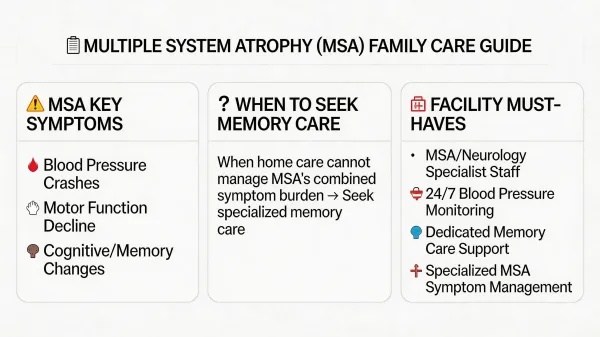
About one in five people with multiple system atrophy experience a fall during their first year after symptoms begin. That statistic alone should give families pause, but the full picture is harder to absorb: orthostatic hypotension, the sudden blood pressure drop that happens when standing, affects up to 80% of MSA patients and is responsible for many of those falls. Most families think of it as "getting dizzy when standing up." In a care setting, it's a medical event that can end with a broken hip or a head injury.
Multiple system atrophy memory care isn't something most people search for until they're already deep in a crisis. MSA is rare enough that many families have never heard of it before the diagnosis. And because it attacks multiple body systems at once, the care needs escalate in ways that catch everyone off guard. Your parent might be managing fine with some help one month, and the next, a fainting spell in the kitchen changes everything.
From nearly twenty years working in hospital settings, I've seen what autonomic dysfunction looks like up close: the blood pressure crashes, the temperature swings, the patients who faint without warning. Those clinical patterns are part of what makes MSA so difficult to manage at home and so important to understand when you're evaluating care options.
This article breaks down how MSA affects the body, when the total symptom burden tips beyond what home care can handle, and what to look for in a facility that can actually manage this disease.
What Is Multiple System Atrophy?
Multiple system atrophy is a rare, progressive brain disease that damages the parts of the nervous system controlling movement, balance, and automatic body functions like blood pressure, bladder control, and digestion. Unlike Alzheimer's or other common dementias, MSA attacks multiple systems simultaneously. The disease typically appears between ages 50 and 60, and it progresses faster than most neurodegenerative conditions.
MSA comes in two main forms. MSA-P (parkinsonian type) causes stiffness, slow movement, and tremors similar to Parkinson's disease. MSA-C (cerebellar type) primarily affects coordination and balance. Both types involve autonomic dysfunction, which is the part that creates the most dangerous day-to-day care challenges. Median survival from symptom onset ranges from 6 to 10 years, though the disease course varies significantly from person to person.
The rarity of MSA, affecting roughly 5 to 12 people per 100,000, means many healthcare providers and care facilities have limited experience with it. That gap matters when you're choosing where your parent will live.
How MSA Affects the Brain and Body
MSA doesn't follow a single track the way Alzheimer's does. It hits three systems, and each creates its own set of problems that families have to manage together.
The autonomic nervous system controls functions your body handles without conscious thought: blood pressure regulation, bladder function, body temperature, digestion, and sweating. When MSA damages this system, your parent may experience severe drops in blood pressure upon standing (orthostatic hypotension), urinary incontinence or retention, chronic constipation, and difficulty regulating body temperature. These aren't minor inconveniences. A blood pressure drop from 140 to 80 when your parent stands up can cause them to lose consciousness in seconds.
What makes autonomic dysfunction so tricky is that treating one symptom can worsen another. Medications that raise blood pressure while standing can cause dangerously high blood pressure while lying down (called supine hypertension). Increasing fluid intake to help with blood pressure can worsen bladder urgency. I've seen this balancing act play out in clinical settings more times than I can count, and it requires consistent monitoring that goes beyond what most home caregivers can provide.
The motor system is affected through either parkinsonian symptoms (rigidity, slow movement, shuffling gait) or cerebellar symptoms (poor coordination, unsteady walking, slurred speech), or both. About 60% of people with MSA need a wheelchair within five years of motor symptom onset.
Cognitive decline, once considered uncommon in MSA, is now recognized as affecting up to 37% of patients. Dementia develops in roughly 11% to 16% of cases, typically later in the disease. The cognitive changes tend to affect executive function, meaning your parent may struggle with planning, decision-making, and organizing daily tasks before obvious memory loss appears.
The Total Symptom Burden: When Multiple System Atrophy Outgrows Home Care
Here's where families get stuck. Each individual MSA symptom can seem manageable on its own. Your parent uses a cane for balance. They wear incontinence products. They sit on the edge of the bed for a minute before standing to help with dizziness. You've installed grab bars and removed throw rugs. On paper, it looks like you've got it covered.
But MSA doesn't present one problem at a time. It layers them. Your parent needs to use the bathroom urgently because of bladder dysfunction, so they stand up too quickly, which triggers a blood pressure drop, and they faint in the hallway before reaching the toilet. The urgency and the orthostatic hypotension aren't separate issues. They're a combined event that a single caregiver at home may not be able to prevent or safely respond to, especially at 3 a.m. I've watched families describe these cascading events in the ER, and the pattern is almost always the same: things were going okay until two or three symptoms collided at once.
Consider the scenario that plays out in many MSA households. A parent is managing at home with help from family and a part-time aide. Then one morning, they stand up to walk to the kitchen and faint from orthostatic hypotension. They fall, break a wrist, and hit their head on the counter. The fall itself is serious, but what the family realizes in the aftermath is that blood pressure drops upon standing make every trip to the bathroom, every walk to the kitchen, every attempt to get out of bed a potential emergency. The aide can't be there 24 hours a day. The family can't watch every transfer. The math stops working.
Signs that home care is reaching its limit include: falls happening despite safety modifications, the caregiver needing to assist with every position change, incontinence episodes that require immediate cleanup and skin care to prevent breakdown, your parent needing vital sign monitoring (especially blood pressure) before and after standing, swallowing difficulties creating choking risks during meals, and speech becoming difficult enough that communicating needs to a caregiver isn't reliable.
The shift happens when the symptom combination creates risks that can't be mitigated without continuous, trained supervision. A single fall from orthostatic hypotension can result in a fracture that accelerates the entire disease trajectory, pushing a person who was walking with assistance into wheelchair dependence permanently. That acceleration is something I've seen repeatedly in hospital settings, where elderly patients come in after a fall and never return to their previous level of function.
There's also the caregiver equation. MSA care at home demands physical strength (helping with transfers, managing incontinence), medical knowledge (understanding vital signs, recognizing aspiration risk), and emotional endurance that wears down even the most dedicated family members. If the primary caregiver burns out or gets injured, the whole arrangement collapses.
Two Types of Falls, Two Different Problems
Where this gets confusing for families is that MSA causes two completely different kinds of falls, and they look identical from the outside. Understanding the difference matters because they require different prevention strategies.
Balance-related falls happen because MSA damages the cerebellum and motor pathways. Your parent misjudges a step, their foot catches, or they can't coordinate the movements needed to recover from a stumble. These falls respond to physical therapy, assistive devices, and environmental modifications like wider doorways and clear pathways.
Autonomic falls happen because blood pressure crashes when your parent changes position. These aren't stumbles. They're syncope events, meaning your parent loses consciousness and drops. No amount of physical therapy prevents a blood pressure crash. These falls require blood pressure monitoring, medication management, hydration protocols, and staff who know to check vitals before helping someone stand. A facility that only addresses balance-related fall prevention is missing half the problem. For MSA patients, autonomic falls often cause more severe injuries because the person loses consciousness before hitting the ground, which means they can't brace for impact or protect their head.
Facility Features That Matter for Multiple System Atrophy Memory Care
Not every memory care community is equipped to handle MSA. Most facilities are designed around Alzheimer's and other common dementias, where the primary challenges are wandering, behavioral changes, and progressive memory loss. MSA demands a different skill set. When you're evaluating facilities, these are the specific capabilities that matter.
In my years working as a Radiologic Technologist across ER, orthopedics, and main radiology departments, I've taken vitals on hundreds of patients with autonomic dysfunction. You learn to read the signs before the numbers even register on the cuff: the color draining from someone's face, the way their eyes lose focus, the slight sway that tells you a blackout is coming. That clinical instinct is something trained staff develop over time, and it's exactly what MSA patients need from the people caring for them every day. A facility where aides recognize the warning signs of a blood pressure crash before it happens is qualitatively different from one where they're only reacting after your parent is on the floor. That difference is what separates adequate care from safe care.
Blood pressure monitoring protocols should be part of the daily care routine, not just a once-a-week check at the nurse's station. Staff should be trained to take blood pressure in both lying and standing positions before assisting with transfers. This is called orthostatic vital signs, and it's the single most important safety measure for an MSA patient. Ask whether the facility's aides know how to perform orthostatic checks and what the protocol is when a reading is abnormally low. Some facilities with on-site nursing staff can adjust medication timing to manage blood pressure fluctuations throughout the day, which is a level of responsiveness that protects your parent during the highest-risk moments: getting out of bed in the morning, standing after meals, and getting up during the night.
Bathroom accessibility for orthostatic patients means more than grab bars and raised toilet seats. It means the bathroom is close enough to the bed that your parent doesn't have a long walk while their blood pressure is dropping. Ideally, the room layout minimizes the distance between the bed and toilet to reduce exposure time during the highest-risk activity MSA patients face. Ask about bedside commodes and whether staff will bring one rather than walking a high-risk patient across the room at night.
Incontinence management is a dignity issue as much as a medical one. MSA causes bladder dysfunction that can range from urgency and frequency to complete incontinence, and sometimes retention that requires catheterization. Look for facilities that approach incontinence care with consistent toileting schedules, quick response times for call buttons, and skin integrity programs to prevent breakdown. The way staff talk about incontinence care during your tour tells you a lot about the culture. If they brush past it, keep looking.
Speech therapy access matters because MSA commonly affects speech and swallowing. Dysarthria (slurred, difficult speech) can make it hard for your parent to communicate pain, needs, or preferences. Dysphagia (swallowing difficulty) creates aspiration risk, which is one of the leading causes of death in MSA. A facility with speech-language pathology services, or a strong referral relationship with an outside provider, can address both communication strategies and safe swallowing techniques.
Fall prevention for MSA patients should include both types of fall risk. Ask specifically how the facility differentiates between balance-related falls and autonomic-related falls in their care plans. If the answer is blank stares, that's useful information. A bed alarm doesn't prevent an orthostatic blackout. The care plan should include position-change protocols, compression garment use, hydration tracking, and medication timing around high-risk activities.
Steps to Determine if Your Parent with MSA Needs Memory Care
Step 1: Assess the Frequency and Severity of Falls
Track falls over a 30-day period. Include near-falls (catches, stumbles, moments of losing consciousness even briefly). If your parent is experiencing two or more fall events per month despite home safety modifications, the risk of a serious injury is high enough to warrant a supervised care environment.
Step 2: Evaluate Autonomic Symptom Management
Ask whether blood pressure, bladder function, and temperature regulation are being adequately managed at home. If your parent needs vital signs checked before standing, incontinence care multiple times daily, or ongoing medication adjustments for blood pressure, consider whether a home caregiver has the training and availability to handle these tasks consistently around the clock.
Step 3: Measure Caregiver Capacity Without Sugarcoating
This step is harder than it sounds. Families often don't recognize caregiver burnout until someone gets hurt. If the primary caregiver is losing sleep, experiencing back pain from transfers, or feeling anxious about leaving the person alone even briefly, the arrangement is already unsustainable. Be honest about the math.
Step 4: Check for Cognitive Changes
MSA-related cognitive decline can be subtle at first. Problems with planning, following multi-step instructions, or making decisions may appear before obvious memory loss. If your parent is struggling to manage medications, forgetting safety precautions (like standing slowly), or showing confusion during routine tasks, cognitive involvement is adding another layer of risk to an already complex situation.
Step 5: Consult the Care Team
Bring the neurologist, primary care physician, and any therapists into the conversation. They can provide objective assessments of disease progression and help determine whether the current care setup is adequate. Don't wait for a catastrophic event to have this discussion.
What Memory Care Costs for MSA Families
As of 2025, the national median cost of memory care runs between $6,700 and $7,500 per month, depending on the source and methodology. That translates to roughly $80,000 to $90,000 per year. For a three-year stay, which is common, families should plan for $240,000 to $270,000 or more. MSA patients may face costs on the higher end of that range because their care needs are more complex than those of a typical Alzheimer's resident: more frequent vital sign monitoring, more hands-on transfer assistance, and higher fall risk that demands more staffing attention.
Some families try to reduce costs by starting with assisted living and transitioning to memory care as the disease progresses. This can work if the assisted living community has a memory care wing and can accommodate the transition, but MSA's autonomic care needs may exceed what standard assisted living provides even before cognitive decline becomes severe. The cost calculation should also account for potential increases: many communities raise rates annually, and additional charges for higher levels of care are common.
When our family first saw the cost of memory care during a loved one's cognitive decline, the number was staggering. Most families aren't prepared for that kind of expense, and MSA families face the added challenge of a disease that can require intensive facility-level care for several years.
Medicare doesn't cover memory care. Medicaid may help in some states, but eligibility rules vary and waitlists can be long. Long-term care insurance, VA Aid and Attendance benefits for eligible veterans, and personal savings are the most common funding sources. Start financial planning early, ideally at the time of diagnosis, rather than waiting until the need is urgent.
Making the Decision for Your Family
Choosing memory care for a parent with MSA is one of the hardest decisions a family can face. The disease is rare, the symptoms are complex, and the timeline is unpredictable. You may feel like no facility truly understands what your parent is dealing with, and in some cases, that feeling is justified. Not every memory care community has the training or resources to manage autonomic dysfunction alongside cognitive and motor decline. The questions you ask during tours and interviews will tell you quickly which communities have real experience with complex neurological conditions and which are operating from a standard dementia playbook.
But the right facility, one with strong nursing oversight, orthostatic protocols, and a genuine understanding of MSA's unique challenges, can provide a level of safety and consistency that's nearly impossible to replicate at home. Your parent deserves care that addresses the whole picture, not just the pieces that fit a standard dementia care model. That kind of care exists, but finding it takes persistence and the right questions.
If you're at the stage where you're searching for information about multiple system atrophy and memory care, you're already doing the right thing. The fact that you're researching, asking questions, and trying to understand this disease means your parent has someone in their corner who cares enough to get it right.