
About 42% of assisted living residents live with Alzheimer's disease or another form of dementia. Within the first two years, many families discover their loved one needs more specialized care than standard assisted living provides. Understanding exactly what assistance means in these communities can help you make better decisions about timing, placement, and long-term planning.
Assisted living sits between independent senior housing and skilled nursing care. Residents get their own apartment but receive help with daily activities they can't safely manage alone. The level of help varies dramatically from one person to another, and the services you'll actually receive depend on which care tier your parent needs.
What families often underestimate is how specific assistance levels really are. One community's "Level 2 care" can mean something completely different at another facility down the street. You can't compare care packages based on names alone. You need to understand what tasks are included, how often staff checks on residents, and what happens when needs increase.
What Assisted Living Actually Covers
Most assisted living communities bundle certain services into their base monthly rate. Room and board always comes first. Your parent gets a private or semi-private apartment, usually a studio or one-bedroom unit. This includes basic utilities, maintenance, and housekeeping services.
Three meals daily are standard, served in a communal dining room. Many communities accommodate dietary restrictions or preferences, and some offer restaurant-style dining with menu choices. Snacks are typically available throughout the day.
Transportation services help residents get to medical appointments, errands, and community outings. The schedule varies by facility. Some offer daily trips to grocery stores or shopping centers, while others provide transportation primarily for doctor visits.
Social activities and programming fill the calendar. Exercise classes, game nights, movie screenings, educational talks, and hobby groups give residents structure and connection. The quality and variety of activities differ significantly between communities.
Emergency call systems are installed in every apartment and bathroom. Staff responds 24/7, but this doesn't mean round-the-clock monitoring in individual rooms.
Daily Assistance Routines
Morning typically starts with a wellness check or wake-up call for residents who need it. Staff might knock on the door to ensure your parent is awake and okay, or they might enter the apartment to provide hands-on help.
Personal care assistance includes help with showering or bathing, usually two or three times per week unless higher care levels allow for daily bathing. Staff helps with dressing if needed, particularly with buttons, zippers, or selecting weather-appropriate clothing.
Medication management is one of the most requested services. At the basic level, staff provides reminders when it's time to take pills. At higher levels, they supervise while your parent takes medication, or they actually administer the medication directly. Communities track what's taken and when.
Mobility assistance helps residents move safely around the community. This might mean a staff member walking alongside your parent to the dining room, helping them transfer from bed to wheelchair, or providing a steadying arm on uneven surfaces.
Bathroom assistance, or toileting help, is part of higher care levels. This can mean reminders to use the restroom on a schedule, help with clothing, or complete assistance with hygiene after using the toilet.
Incontinence care is available but often marks a transition point. Many communities can manage this with regular changing and cleanliness checks, but advanced incontinence sometimes triggers discussions about higher levels of care.
Tiered Service Packages
Most assisted living communities don't charge a flat rate for all residents. They assess each person's needs and assign them to a care level that determines monthly costs. There's no universal standard for these tiers. Each facility creates its own system.
The assessment process happens before move-in and periodically afterward. A nurse or care coordinator evaluates your parent's abilities with activities of daily living, or ADLs. Can they bathe independently? Get dressed without help? Manage medications? Remember to eat? Walk safely? Handle toileting alone?
They'll also assess instrumental activities of daily living, which include things like managing money, using the phone, and following multi-step instructions. The results determine which care package fits.
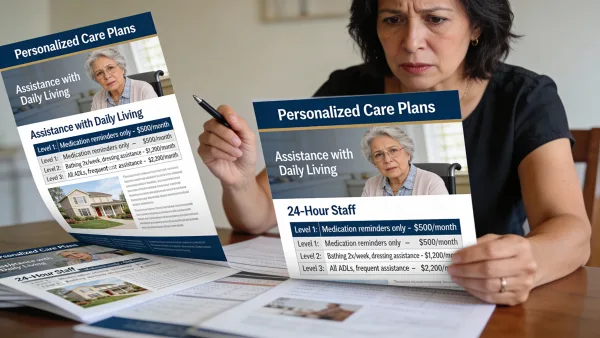
Level 1 care typically means minimal assistance. Your parent can do most things independently but needs some support to stay safe. This might include medication reminders, a morning wellness check, and help with housekeeping beyond what the base rate covers. A Level 1 resident can usually shower with minimal supervision, dress themselves, and walk to meals independently. They might need someone to set up their shower or lay out clothes, but they complete the tasks themselves.
The monthly cost for Level 1 care might add $500 to $800 above the base rate, which as of 2025 averages $5,190 to $6,129 nationally depending on location.
Level 2 or intermediate care provides moderate hands-on help. Your parent needs physical assistance with one or two ADLs. They might need someone to help them shower, or to assist with dressing each morning. They can't manage medications independently, so staff administers pills rather than just reminding. They may need help standing from a seated position or walking longer distances.
This level often includes more frequent wellness checks throughout the day, not just in the morning. Staff might check in three or four times to ensure your parent has eaten, used the bathroom, and is comfortable.
Intermediate care typically adds $800 to $1,500 per month to the base rate. In some markets, this pushes total monthly costs to $6,500 or higher.
Level 3 or advanced care means comprehensive assistance with most or all ADLs. Your parent can't bathe, dress, toilet, or move around safely without direct help. Staff provides hands-on care multiple times daily. This includes complete bathing assistance, help with every aspect of dressing, scheduled toileting assistance or incontinence care, and transfer assistance for all movements.
Residents at this level often need help eating, either with setup, cutting food, or hand-over-hand feeding assistance. They may have difficulty communicating needs clearly or remembering recent events. Behavioral issues can emerge at this level, though most assisted living communities have limits on what they can manage.
Advanced care can add $1,500 to $2,500 monthly, bringing total costs to $7,000 to $8,500 in many areas. Memory care, which is specialized care for dementia, typically costs 20% to 30% more than standard assisted living at comparable care levels.
Some facilities use four, five, or even six care levels to create more gradations between basic and advanced care. A five-level system might split intermediate care into two tiers, or create a specialized level for residents with complex medical needs but good cognitive function.
The naming conventions mean nothing. You must ask exactly what services are included at each level, how many times daily staff checks on residents, what the response time is for call buttons, and which tasks are considered routine versus requiring additional fees.
A la carte pricing is another model. Instead of packaged levels, you pay separately for each service. Medication administration might cost $200 monthly. Bathing assistance three times weekly might be $150. Dressing help could be $100. This allows for more customization but can become expensive quickly if your parent needs multiple services.
All-inclusive pricing is less common but exists, particularly in memory care units. You pay one flat rate regardless of how much care is needed. This provides cost predictability but may be more expensive upfront for residents who need less help.
Communities must reassess care needs regularly. If your parent's condition changes, they may move to a different care level with corresponding cost adjustments. These increases can happen every few months if decline is rapid, or they might stay stable for a year or more.
Most communities require 30 days' notice before changing care levels, and they should discuss changes with family before implementing them. However, sudden declines that create safety issues may trigger immediate adjustments.
Ask specific questions about the care level system: How often do they reassess? Who makes the decision about level changes? Can families contest a level change they believe is unnecessary? What happens if you can't afford the increased cost? How much notice do they provide before raising fees?
The assessment process itself varies. Some communities use standardized evaluation tools. Others rely on staff observations. The more objective the assessment, the less room there is for disagreement when they recommend a higher care level.
Staff ratios matter more than care level names. A community with one caregiver for every 12 residents can't provide the same attention as one with a 1:8 ratio, regardless of what they call their care packages. Ask about daytime, evening, and overnight staffing numbers. Higher care levels should come with better staffing ratios.
Services That Cost Extra
Even with comprehensive care packages, some services always cost more. Specialty therapy is one common add-on. If your parent needs physical therapy, occupational therapy, or speech therapy beyond what their doctor orders and insurance covers, you'll pay out of pocket. Some communities have therapists on-site who bill separately.
Salon and barber services are rarely included. Haircuts, styling, and personal grooming beyond basic hygiene cost extra.
Special dietary needs might trigger additional charges if your parent requires puréed foods, specific nutritional supplements, or meals prepared separately from the regular menu.
Guest meals allow family members to eat in the dining room during visits, usually for $5 to $15 per meal.
Cable TV, phone service, and internet often aren't included in base rates. Each apartment may need separate service accounts.
Pet care assistance, if the community allows pets, isn't typically part of standard services. Staff won't walk dogs or clean litter boxes without additional payment.
Some communities charge for escort services to activities or appointments beyond scheduled transportation times. If your parent needs staff to accompany them somewhere outside the community, expect hourly fees.
Memory Care vs. Standard Assisted Living
Memory care provides specialized services for dementia and Alzheimer's disease. The physical environment differs, with secured units that prevent wandering. Staff training focuses on dementia care techniques, communication with confused residents, and managing challenging behaviors.
Programming emphasizes cognitive stimulation, routine, and meaningful activities adapted to declining abilities. Memory care units maintain higher staff-to-resident ratios because residents need more supervision and redirection.
The cost difference reflects these enhanced services. Memory care averages 20% to 30% more than standard assisted living. In 2025, that translates to roughly $7,000 to $8,500 monthly in most markets.
Some assisted living communities have memory care units on-site, making transitions easier when residents need more specialized support. Others refer families to separate memory care facilities.
About 40% of current assisted living residents have been diagnosed with some form of dementia. Many communities provide memory support services short of full memory care. They might offer memory-specific activities, staff training in dementia communication, and closer supervision without the secured environment.
When Assistance Isn't Enough
The average assisted living stay lasts 22 months. After that time, about 60% of residents transition to a higher level of care, either memory care or skilled nursing. Understanding the signs that assisted living no longer fits helps families plan for these changes.
Wandering and elopement attempts signal that standard assisted living can't ensure safety. If your parent tries to leave the building without staff knowledge, most communities will require a move to memory care with secured doors. They can't risk the liability of a resident walking away and getting lost or injured.
Staff members might find your parent in other residents' apartments, confused about where their own room is. They might try to leave at night believing they need to go to work or pick up children from school. These behaviors indicate cognitive decline that assisted living isn't designed to manage.
Behavioral issues that disturb other residents or create safety risks exceed assisted living's scope. Aggression toward staff or other residents, including hitting, biting, or verbal abuse, usually triggers discussions about placement elsewhere. Communities can manage some agitation, but sustained combative behavior requires specialized dementia care or psychiatric support.
Significant personality changes, paranoia, or hallucinations may need interventions beyond assisted living's capabilities. If your parent accuses staff of stealing, becomes convinced other residents are plotting against them, or sees people who aren't there, they likely need memory care or medical evaluation.
Repeated falling despite interventions suggests your parent needs more supervision than assisted living provides. One or two falls might result from environmental factors that can be corrected. Five or six falls in a few weeks indicates instability that requires either physical therapy, medical intervention, or 24-hour skilled nursing supervision.
If falls result in serious injuries or hospitalizations, communities often won't allow residents to return without significant changes in their care plan. They may require memory care or skilled nursing instead.
Declining personal hygiene despite reminders and assistance indicates advancing dementia. If staff finds your parent hasn't bathed when scheduled, wears soiled clothing despite help getting dressed, or resists basic hygiene care, they may need the more intensive approach of memory care.
Incontinence alone doesn't always require a move, but resistance to changing soiled clothing or complete inability to manage bathroom routines often does. Assisted living staff can help with toileting on a schedule. They can't provide the continuous monitoring and frequent changing that advanced incontinence requires.
Refusing to eat or forgetting meals entirely creates serious health risks. Memory care staff can provide more intensive meal support, including hand-over-hand feeding assistance and constant supervision at mealtimes. Significant weight loss or dehydration may force the transition.
Some residents stop recognizing food as food, or forget they've just eaten and demand meals constantly. Others develop swallowing difficulties that require specialized dietary modifications and feeding techniques.
Medical complexity beyond basic medication management pushes beyond assisted living's scope. If your parent needs wound care, IV medications, catheter management, or other skilled nursing tasks multiple times daily, they need skilled nursing care, not assisted living.
Some communities can arrange for home health nurses to visit and provide medical care in the assisted living apartment. This works for temporary situations, like recovering from surgery. For ongoing intensive medical needs, skilled nursing is more appropriate.
Isolation and withdrawal despite available activities can indicate depression or advancing dementia. If your parent stops attending events they once enjoyed, refuses to leave their apartment, or seems unaware of their surroundings, they may need the specialized programming and closer supervision of memory care.
Staff will try to engage withdrawn residents, but they can't force participation. If isolation leads to rapid decline in function, families need to consider whether a different level of care would provide better outcomes.
The community itself will tell you when services aren't sufficient. Most facilities communicate clearly about care limits. They'll hold meetings with family when they observe concerning changes. They may give you a timeline for finding alternative placement if your parent's needs exceed what they can provide safely.
These conversations are difficult, but they protect your parent and other residents. A community that keeps residents beyond their appropriate care level creates dangerous situations for everyone.
How Communities Determine Service Needs
Before admission, most communities conduct thorough assessments. They want to ensure they can meet your parent's needs and assign the appropriate care level. This protects both the resident and the facility.
The initial assessment often includes a nursing evaluation. A registered nurse or licensed practical nurse asks about medical history, current medications, and specific care needs. They'll observe your parent walking, standing from a seated position, and completing basic tasks.
They ask questions to assess cognitive function. Can your parent state their name, date, and location? Do they understand why they're moving to assisted living? Can they follow multi-step instructions?
Some communities use standardized assessment tools like the Katz Index of Independence in Activities of Daily Living. This measures ability to perform six basic ADLs: bathing, dressing, toileting, transferring, continence, and feeding. The score helps determine appropriate care levels.
Others use the Lawton-Brody Instrumental Activities of Daily Living Scale, which assesses ability to use the telephone, shop, prepare food, do housekeeping, manage laundry, arrange transportation, take medications, and handle finances.
Doctor's orders and medical records provide additional information. Communities want to understand diagnoses, treatment plans, and medical equipment needs before committing to admission.
Once admitted, reassessments happen regularly. The frequency varies by state regulations and facility policy. Quarterly reviews are common, with more frequent assessments if health changes significantly.
Staff observations between formal assessments matter greatly. Caregivers who help your parent daily notice subtle changes in function, mood, or cognition. These observations trigger reassessments when necessary.
Questions to Ask About Services
Before selecting a community, clarify exactly what assistance looks like there. Don't accept vague descriptions of care levels. Ask for specifics.
What tasks are included in the base rate versus requiring additional fees? If medication management is included, does that mean reminders or actual administration? How many times per week does bathing assistance happen at each care level?
How do they determine when someone needs a higher care level? Who makes that decision? What's the process for families to provide input or contest a level change?
What's the staff-to-resident ratio during day, evening, and overnight shifts? How quickly do they respond to call button alerts? Is someone always within earshot of residents who might need help?
What happens if your parent's needs exceed what they can provide? Do they have memory care on-site, or will they require a move to a different facility? How much notice do they give for involuntary discharges?
Can you see a sample care plan from each service tier? What does a typical day look like for someone at Level 2 versus Level 3 care?
How often do they reassess? What triggers an emergency reassessment between scheduled evaluations?
Making the Decision
Assisted living works best for people who need help but can still participate in their own care. They should be able to follow basic directions, recognize staff members, and understand where they are most of the time.
They should be safe in their apartment for reasonable periods without staff physically present. While help is available, assisted living isn't continuous monitoring.
If your parent's needs seem borderline, tour both assisted living and memory care units. Ask staff honestly whether they think assisted living is appropriate. Communities don't want to admit residents they can't care for adequately.
Trust the community's expertise when they tell you someone needs a different level of care. They see hundreds of residents at various stages and know what works in their setting.
Plan for changes. Even if assisted living fits today, your parent's needs will likely increase over time. Understanding the service limits and transition points now makes future decisions less overwhelming. Choose communities that offer multiple levels of care when possible, or have relationships with memory care and skilled nursing facilities for seamless transitions when they're needed.