
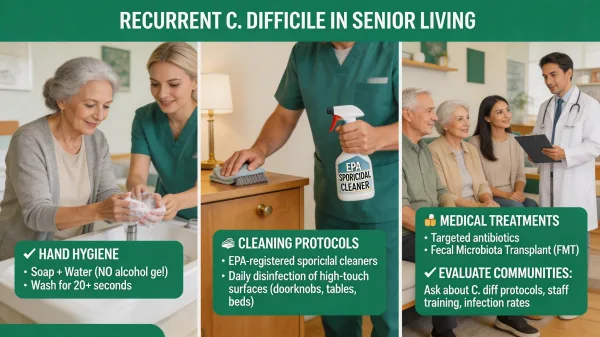
Most senior living communities clean their rooms daily. That sounds reassuring until you learn that the cleaning products most of them use don't kill Clostridioides difficile spores. Standard quaternary ammonium disinfectants, the kind used in the majority of assisted living and senior living communities across the country, leave C. diff spores completely intact on surfaces where they can survive for months. If your parent has been through multiple C. diff infections, that detail changes everything about how you evaluate a care community.
C. diff is one of the most common healthcare-associated infections in the United States, causing roughly half a million infections and approximately 13,000 deaths each year. For older adults, the stakes are even higher: recurrence rates climb sharply with age, and each new episode increases the risk of the next one. Research shows that mortality after recurrent C. diff is nearly ten times higher than after a first episode. Families dealing with recurrent C. diff are often caught between two fears, worrying that their parent will get sick again and worrying that disclosing the infection history will get them turned away from a community they need.
Having spent nearly two decades working in hospitals, I've seen how seriously infection control teams take C. diff protocols. The cleaning requirements are specific and non-negotiable for good reason. That same level of discipline is what you should expect from any senior living community your parent is considering.
This article covers what causes C. diff to keep coming back, what a community must do differently to prevent reinfection, how to ask the right questions during your search, and how to disclose your parent's history without creating unnecessary stigma.
What Is C. Difficile and Why Does It Keep Coming Back?
Clostridioides difficile (commonly called C. diff) is a spore-forming bacterium that causes severe diarrhea and inflammation of the colon. Infections typically happen after antibiotic use disrupts the normal balance of gut bacteria, giving C. diff room to multiply and release toxins. The initial infection is usually treated with specific antibiotics like vancomycin or fidaxomicin.
The problem is that treating C. diff with antibiotics can damage the same gut bacteria you need to keep C. diff in check. This creates a cycle: antibiotics clear the active infection but leave the gut vulnerable to recolonization. Research shows that 15 to 35 percent of patients experience a recurrence after their first episode, and once a person has had one recurrence, the probability of another jumps to 40 to 65 percent. That pattern is why families dealing with a third or fourth episode feel trapped.
C. diff spores are the other half of the equation. Unlike the active bacteria, spores are dormant, extremely durable, and resistant to most standard disinfectants. They can persist on surfaces for five months or longer, waiting to be ingested by a new host or re-ingested by the same person.
Why Are Seniors at Higher Risk for Recurrent C. Diff?
Adults over 65 face a disproportionate burden of C. diff infections. One retrospective study found the probability of recurrence was 58 percent for adults aged 65 and older, compared to 27 percent for those aged 18 to 64. Several factors drive this: age-related immune decline makes it harder for the body to mount a protective antibody response against C. diff toxins, older adults tend to have less diverse gut microbiomes to begin with, and seniors are more likely to be prescribed antibiotics for other conditions, which resets the cycle each time. Proton pump inhibitors, which many older adults take for acid reflux, have also been identified as an independent risk factor for C. diff.
Communal living adds another layer of risk. Long-term care facilities report some of the highest C. diff rates of any healthcare setting, with one systematic review documenting 44 CDI cases per 10,000 patient-days in long-term care. Shared bathrooms, common dining areas, and frequent contact with healthcare workers all create transmission opportunities that don't exist when someone lives alone. When I see elderly patients in the ER who have come from care facilities with recurring infections, the pattern is often the same: the infection was treated, but the environment that allowed reinfection was never addressed.
Will a C. Diff History Prevent My Parent from Being Accepted into Senior Living?
This is one of the most common fears families have, and it deserves a direct answer. Most assisted living communities will not reject a resident solely because of a C. diff history. C. diff is a common infection, not a permanent condition, and communities that serve older adults encounter it regularly.
That said, the conversation matters. Communities will want to know whether your parent is currently symptomatic, whether they're on active treatment, and what their physician recommends regarding infection precautions. A parent who has completed treatment and is asymptomatic is in a very different situation than someone with an active infection. Some communities may ask for a physician's clearance letter confirming that the active infection has resolved before move-in.
The bigger concern isn't whether your parent will be accepted. It's whether the community actually has the protocols in place to prevent reinfection once they're there.
Breaking the Reinfection Cycle: What a Community Must Do Differently
Where this gets confusing is the gap between what most communities do for routine cleaning and what C. diff spores actually require. Standard infection control protocols that work perfectly well for common bacteria are not enough for C. diff. If a community tells you they follow "standard cleaning protocols," that may sound reassuring, but it likely means they're using products that leave C. diff spores completely untouched.
Surface Cleaning: Why Bleach Is Non-Negotiable
The single most critical distinction in C. diff prevention is the type of disinfectant used on surfaces. Quaternary ammonium compounds, the standard disinfectant in most senior living communities, are not sporicidal. They kill many types of bacteria but don't destroy C. diff spores. Only bleach-based (sodium hypochlorite) products or other EPA-registered sporicidal disinfectants on EPA List K are effective. The CDC recommends a 1:10 dilution of household bleach with a minimum contact time of 10 minutes.
The data on this is striking. In one hospital study, switching from quaternary ammonium to bleach-based cleaning reduced C. diff surface contamination from 24 percent to 5 percent. Another found that daily bleach cleaning produced an 85 percent reduction in hospital-acquired C. diff cases over one year. These aren't small improvements. The cleaning product choice is often the single largest controllable factor in whether C. diff spores persist in a living environment.
In my nearly 20 years working in hospitals, I've seen how seriously infection control teams take C. diff room protocols. When a patient tested positive, the cleaning process changed completely: specific bleach-based products came out, dedicated mop heads were used and disposed of, and high-touch surfaces were cleaned twice. Verification rounds happened after the cleaning crew finished. I've also seen what happens when those protocols break down, when someone grabs the regular cleaning cart instead of the C. diff cart. The spores persist, and the next patient is at risk. In an assisted living community without that infrastructure, the margin for error is even smaller.
Hand Hygiene: Soap and Water, Not Sanitizer
This is the detail that surprises most families. Alcohol-based hand sanitizers, the kind mounted on every wall in every care community, don't kill C. diff spores. Alcohol is effective against the vegetative (active) form of C. diff but not against the spore form. The spores are resistant to alcohol, which means that every time a caregiver uses hand sanitizer instead of soap and water after caring for a resident with C. diff history, they may be spreading spores to the next room. Soap and water don't actually kill the spores either, but the mechanical action of washing physically removes them from the skin. That's the best method available.
Antibiotic Stewardship
Every unnecessary antibiotic prescription increases the risk of another C. diff episode. Communities with strong infection control programs have antibiotic stewardship practices that include reviewing whether each antibiotic prescription is truly needed, choosing narrower-spectrum antibiotics when possible, and limiting the use of fluoroquinolones and other high-risk drug classes that are strongly associated with C. diff. Ask whether the community coordinates with a pharmacist or infectious disease consultant on antibiotic decisions.
Fecal Microbiota Therapies and Probiotics
For patients with two or more recurrences, fecal microbiota-based therapies have become a recommended tool for breaking the cycle. The FDA has approved two products (Rebyota and Vowst) specifically for preventing recurrent C. diff, and the American Gastroenterological Association now recommends these for most qualifying patients. Probiotics, particularly Saccharomyces boulardii, have shown some promise when used alongside antibiotic treatment, though the evidence in older adults remains mixed. Both options are worth discussing with your parent's gastroenterologist, but neither replaces the environmental and stewardship measures described above.
What Questions Should I Ask a Community About C. Diff Prevention?
The right questions will quickly reveal whether a community understands C. diff infection control or is relying on protocols that won't protect your parent. Here are the key ones to ask:
1. What disinfectant products do you use for daily room cleaning, and are any of them EPA List K sporicidal agents?
2. Do staff use soap and water or alcohol-based hand sanitizer after providing direct care?
3. Does the community have an antibiotic stewardship program, and who oversees it?
4. How does the community handle a resident who develops C. diff symptoms, including isolation procedures and enhanced cleaning?
5. Is there an infection prevention coordinator or consulting relationship with an infectious disease specialist?
6. What is the community's protocol for notifying families if there is a C. diff case among residents?
A community that can answer these questions with specifics rather than generalities is demonstrating the kind of infection control awareness your parent needs. Vague answers like "we follow all state regulations" or "we use hospital-grade cleaners" aren't good enough. You need to hear the word "bleach" or "sporicidal" in the cleaning answer and "soap and water" in the hand hygiene answer. From years of working in healthcare, I can tell you that the facilities that take infection control seriously are the ones that can explain their protocols in detail without having to look it up.
What Medical Treatments Can Break the C. Diff Cycle?
If your parent has had three or more C. diff episodes, the conversation with their physician should include treatment options beyond standard antibiotics. Fidaxomicin is now preferred over vancomycin for treating recurrent episodes because it's associated with lower recurrence rates. A tapered and pulsed vancomycin regimen, where the dose is gradually reduced and then given every few days, is another established approach that helps the gut microbiome recover between doses.
For recurrent cases that keep returning despite antibiotic treatment, fecal microbiota-based therapies represent the strongest available tool for breaking the cycle. The FDA has approved two products specifically for preventing recurrent C. diff: Rebyota (fecal microbiota live-jslm), delivered via enema, and Vowst (fecal microbiota spores live-brpk), taken as oral capsules. Clinical trials showed Rebyota prevented recurrence in roughly 70 percent of patients compared to 58 percent with placebo. Vowst showed even stronger results, with 88 percent of patients remaining free of recurrence at eight weeks. These treatments work by restoring healthy diversity to the gut microbiome, breaking the cycle that antibiotics alone can't fix. Your parent's gastroenterologist can determine which option fits based on their medical history and overall health. These aren't experimental anymore. They're recommended by the American Gastroenterological Association as standard care for qualifying patients.
Probiotics deserve a separate note. Saccharomyces boulardii has the most evidence behind it for C. diff prevention, with some studies showing it can reduce recurrence rates by more than half when taken alongside high-dose vancomycin. But the evidence in older adults is mixed, and some research raises concerns about fungemia risk in immunocompromised elderly patients. Major medical organizations haven't issued strong recommendations for routine probiotic use in this population. Probiotics may be worth discussing with your parent's physician, but they're a complement to proven strategies, not a replacement.
How Much Does Senior Living Cost, and Does C. Diff Change the Price?
The national median cost for assisted living in 2025 is $6,200 per month, or $74,400 per year, according to the CareScout Cost of Care Survey. That figure reflects a 5 percent increase over 2024. Communities that offer enhanced infection control protocols or that specialize in residents with complex medical histories may charge more, though C. diff history alone doesn't typically trigger a higher base rate.
What can change the cost is the level of care your parent needs. If your parent requires additional monitoring, more frequent room cleaning, or coordination with outside specialists, those services may fall under a higher care tier with associated fees. Ask for a detailed care assessment and written cost breakdown before signing any agreement. I remember the financial shock my family experienced during a loved one's care transition, and the one thing that helped most was knowing exactly what we were paying for before we committed.
How Do I Disclose My Parent's C. Diff History Without Creating Stigma?
Disclosure matters. Hiding a C. diff history puts your parent at risk because the community won't know to take the precautions that prevent reinfection. But how you frame the conversation can shape whether your parent is seen as a health risk or as a well-managed resident with a documented care plan.
Consider a situation where your parent has had three C. diff infections in 18 months, each requiring hospitalization. The family is trying to find a community but worrying that disclosure will lead to rejection while also needing a community that can actually manage the risk. The most effective approach is to lead with the medical team's plan, not the infection count. Present the history alongside the treatment steps already completed, the physician's clearance, and any preventive therapies in place (such as fecal microbiota treatment or probiotic use). This positions your parent as someone whose condition is being actively managed rather than as an ongoing infection risk. If the community's admissions team responds with concern or confusion, that itself tells you something useful about their infection control readiness.
Frame it practically. You might say: "My mother has a history of C. diff that has been treated and resolved. Her gastroenterologist has recommended specific preventive measures, and we're looking for a community that understands C. diff cleaning protocols so we can reduce the chance of recurrence." That approach invites collaboration instead of defensiveness.
Protecting Your Parent While Finding the Right Community
Recurrent C. diff is frightening, and the fear of reinfection can make the search for senior living feel even more overwhelming than it already is. But the families who get the best outcomes are the ones who ask specific questions, understand what effective C. diff prevention actually looks like, and choose communities based on protocol quality rather than marketing language. The details matter here more than in almost any other part of the senior living search.
Your parent's C. diff history doesn't define them, and it doesn't have to limit their options. What it does require is a community that takes infection control seriously enough to use the right products, train their staff on proper hand hygiene, and coordinate with your parent's medical team on antibiotic decisions. Those communities exist, and finding one is worth the extra effort.
You're already doing the hardest part by researching this. Trust your instincts, ask the tough questions, and don't settle for vague reassurances. Your parent deserves a community that protects their health with the same precision you'd expect from a hospital.