
What Happens When the Falls Go Backward?
What happens when your parent's falls aren't the stumble-forward kind, but a sudden drop straight backward with no warning? Progressive supranuclear palsy creates a fall pattern that most care environments aren't designed for, and it changes everything about how daily safety has to be managed.
Progressive supranuclear palsy (PSP) is a rare brain disease that damages areas controlling balance, eye movement, swallowing, and thinking. It affects an estimated 20,000 to 30,000 Americans and progresses faster than Parkinson's disease, with most people needing full-time care within a few years of diagnosis.
Consider this scenario: your parent was diagnosed with Parkinson's disease two years ago. The medications helped at first, but the falls kept getting worse, and they weren't like typical stumbles. Your parent falls backward, suddenly, without bracing or catching themselves. After a bad fall that results in a head injury, the neurologist orders new testing and revises the diagnosis to progressive supranuclear palsy. The Parkinson's-focused care plan your family built around now doesn't match the condition you're actually dealing with. If you're in this position, you're not alone in feeling blindsided. PSP is frequently misdiagnosed in its early stages, and the shift in diagnosis means rethinking everything from daily safety to long-term care planning.
This article walks through what progressive supranuclear palsy memory care looks like in practice: how facilities adapt to PSP's specific challenges, what daily routines involve, and what questions to ask when evaluating care options. I've worked in hospital emergency rooms for close to 20 years, and I've seen the injuries PSP causes before families even have a name for what's happening. That experience shapes the practical focus of this guide.
What Is Progressive Supranuclear Palsy?
PSP is a neurodegenerative disease caused by the abnormal buildup of a protein called tau in brain cells. The brain areas most affected control balance, coordination, eye movement, speech, and swallowing. Unlike Parkinson's disease, which PSP is often confused with, this condition typically progresses faster and doesn't respond well to standard Parkinson's medications like levodopa. The hallmark symptoms include repeated falls (especially backward), difficulty controlling eye movements (particularly looking downward), slowed speech, trouble swallowing, and cognitive changes that affect planning and decision-making. Most people develop symptoms in their early 60s, though onset can happen as early as their 40s.
PSP is considered rare, affecting roughly 5 to 7 people per 100,000 in the general population. That rarity is part of what makes it so difficult for families. Many physicians see very few cases over their entire careers, which contributes directly to delayed or incorrect diagnoses. PSP isn't just a worse version of Parkinson's. It's a different disease with different risks, different progression, and different care demands.
Why PSP Is Often Misdiagnosed as Parkinson's Disease
The overlap between PSP and Parkinson's disease is significant in the early stages. Both cause stiffness, slowness of movement, and balance problems. Many people with PSP are initially given a Parkinson's diagnosis and prescribed standard medications. When those medications don't help, or when falls keep happening in unusual patterns, the clinical picture starts to shift. The backward falls are what usually changes the direction of the workup. In Parkinson's, patients tend to shuffle forward and may trip or stumble in a predictable way. In PSP, falls are sudden, almost always backward, and the person can't throw their hands out to break the impact.
Working in the ER, I've seen this difference play out in the types of injuries that come through the door: PSP patients tend to arrive with trauma to the back of the head, which looks very different from the wrist fractures and forward-impact injuries typical of Parkinson's falls. Families often describe a frustrating period of two to four years between the first symptoms and an accurate PSP diagnosis. During that time, the care plan is built around the wrong condition, which means fall prevention strategies, therapy goals, and long-term planning are all misaligned with what the disease actually requires.
How PSP Changes Over Time
PSP progresses differently from Alzheimer's or Parkinson's, and usually faster than families expect. The typical course runs five to eight years from diagnosis, though the Richardson's syndrome type (the most common form) tends to move faster than other PSP variants. Some people with PSP-parkinsonism may have a somewhat slower course of eight to twelve years. Early on, the primary issues are balance and falls. As the disease advances, swallowing becomes increasingly difficult. Research shows that about 80% of people with PSP develop dysphagia (difficulty swallowing), and symptoms typically appear within the first three to four years after onset.
Cognitive decline follows a different pattern than Alzheimer's: memory may stay relatively intact initially, while planning, judgment, and impulse control deteriorate earlier. Speech slows and becomes harder to understand. The combination of physical and cognitive decline happening on parallel tracks is what makes PSP care so demanding. In my work with elderly patients in hospital settings, the speed of functional decline with PSP catches families off guard almost every time. Planning ahead matters more with this condition than with almost any other form of dementia.
When Progressive Supranuclear Palsy Memory Care Becomes the Right Step
The decision to move a parent with PSP into memory care usually comes down to safety. When falls are happening multiple times a week despite home modifications, when swallowing difficulties make unsupervised meals risky, or when cognitive changes mean your parent can't reliably call for help after a fall, the care demands have outgrown what home-based support can realistically provide. This isn't only about memory, even though the care setting carries that name. For PSP, the combination of physical risks (backward falls, aspiration from swallowing problems) and cognitive decline creates a need for round-the-clock supervision that few families can sustain at home without severe caregiver burnout.
The timing matters. Waiting until a crisis like a serious head injury or a bout of aspiration pneumonia limits your options and puts your parent at greater risk during the transition into residential care. Start researching facilities while your parent can still participate in the decision.
Daily Life in Progressive Supranuclear Palsy Memory Care
This is where most families struggle to get a clear picture. You know your parent needs specialized care, but what does an ordinary day actually look like in a memory care setting that's properly adapted for PSP?
Adapted Meals and Swallowing Support
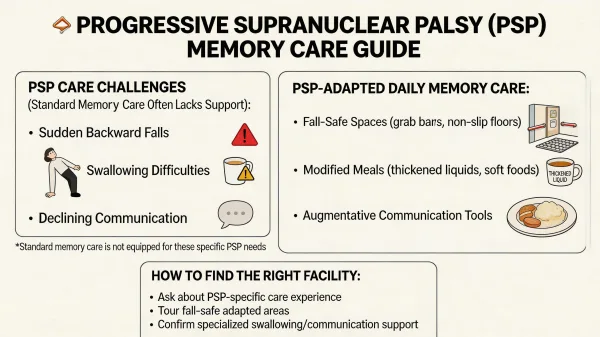
Meals in a PSP-equipped facility look different from standard dining. Because PSP impairs the muscles controlling swallowing and also affects downward eye gaze, making it hard to see food on a plate, everything from food texture to plate positioning has to be rethought. Staff trained in PSP care serve meals with modified textures based on a speech-language pathologist's ongoing assessments. Food may be pureed, minced, or soft depending on the disease stage. Thin liquids, which carry the highest aspiration risk, are thickened to a consistency that's safer to swallow. Residents sit fully upright with their chin level or slightly tucked, a positioning technique that helps protect the airway during each swallow. Plates are raised on stands or angled so the resident can see the food without needing to look down, which PSP makes progressively harder. Meals take longer than you might expect, often 40 to 45 minutes for what takes most people 15, and that extended pace is built into the schedule rather than rushed.
Staff sit with residents during meals, watching for coughing, throat clearing, food pocketing in the cheeks, or a wet-sounding voice after swallowing. These are clinical signs that the swallowing plan may need adjustment, and catching them early is what keeps aspiration pneumonia risk as low as possible. A speech-language pathologist reviews each resident's swallowing status regularly and updates texture recommendations as the disease progresses.
Fall Prevention Built for Backward Falls
Most fall-prevention programs in senior care are designed for the forward-stumble pattern common among older adults. Grab bars are mounted in front of residents, floor surfaces cushion forward impacts, and chair heights are set to help with standing. PSP requires a fundamentally different setup. When someone with PSP falls, they drop straight back without stumbling or reaching for support. One moment they're standing, and the next they're on the ground.
Memory care facilities that understand PSP address this through targeted environmental changes: impact-absorbing flooring in bathrooms and near beds where backward falls happen most frequently, furniture arranged to eliminate open space behind the resident, wheelchairs and seating with rear head support and anti-tip features, and padded wall sections in high-traffic areas. Staff are trained to walk beside or slightly behind the resident rather than in front, which is the opposite of the standard assist position used for most elderly patients. The goal isn't to stop every fall, because with PSP that isn't realistic. The goal is to reduce injury severity each time a fall happens.
Communication as Speech Declines
PSP gradually affects the muscles used for speech, and the difficulty looking downward means that communication boards placed flat on a table can be hard to use. Facilities experienced with PSP adapt by positioning communication tools at eye level and, in later stages, using eye-gaze technology that tracks where the resident is looking to select words or images on a screen. Staff learn to allow extra time for responses, ask yes-or-no questions when possible, and watch for nonverbal cues like facial expressions and hand gestures. Your parent may still understand everything being said to them even when their ability to respond verbally has declined sharply. That gap between comprehension and expression is one of the most important things for families to understand, because it changes how you approach every interaction.
What Family Visits Look Like
Visiting a parent with PSP in memory care can feel different from what you expected. Your parent may not be able to look at you directly when you speak, not because they don't want to, but because their eye muscles won't cooperate. Conversation may be slow or limited to short phrases and gestures. Families who settle into a rhythm of quiet presence often find visits more comfortable than trying to fill the silence. Sitting together, reading aloud, or playing music your parent has always loved can be more connecting than forced conversation. Staff can guide you toward the best times to visit, often mid-morning when energy and alertness tend to be highest, and suggest activities your parent responds to well.
The Fall Prevention Question Most Families Don't Think to Ask
When families tour a memory care facility, they typically ask about staff ratios, security measures, and daily activities. Very few think to ask this: how does this facility handle falls that happen backward and without warning? That question is critical, because the answer reveals whether the facility has real experience with PSP or is applying a general fall-prevention approach to a condition that doesn't fit the usual pattern. Standard fall prevention focuses on trip hazards, grab bars, and hip protectors. None of those address PSP's distinctive backward fall pattern.
In my years working in emergency rooms, I saw a specific pattern with patients who turned out to have PSP. They'd come in with injuries to the back of their head, sometimes serious ones, from falls they couldn't account for. They hadn't tripped over anything, weren't feeling dizzy, and had no explanation other than that they just went straight backward. I learned to recognize that injury pattern as something distinct from other movement disorders, because when someone falls backward repeatedly and can't brace for the impact, the resulting trauma looks different from what you see with a typical forward fall. That recognition also means the prevention approach has to look different from what most facilities have in place. A facility that understands PSP should be able to describe specific environmental modifications, staff positioning protocols during walking, and their overall approach to managing a fall pattern that most senior care programs aren't designed around. If the answer you get is vague or generic, keep looking.
Finding a Progressive Supranuclear Palsy Care Facility
Not every memory care facility has experience with PSP, and the condition's rarity means you may need to look beyond your immediate area. The goal during your search is to determine whether a facility has genuine PSP knowledge or is learning as they go. During tours, ask how many residents with PSP or atypical parkinsonism the facility has cared for and how recently. Ask about their swallowing assessment protocol and whether a speech-language pathologist is involved on a regular basis, not just when a problem becomes obvious. Find out how their fall prevention approach differs from their standard setup and what specific staff training covers beyond Alzheimer's and typical dementia presentations.
Ask whether they coordinate with a neurologist who specializes in movement disorders, because PSP management benefits from ongoing specialist input that a general practitioner alone can't provide. I've been inside many care facilities during my years doing mobile X-ray work, and the gap between what marketing materials describe and what's actually happening on the floor can be wide. Asking specific clinical questions is the fastest way to find out where a facility really stands.
What PSP Memory Care Costs
Memory care for PSP typically falls in the same cost range as memory care for other conditions, though PSP's physical care needs can push pricing toward the higher end. As of 2025, the national average for memory care runs between $5,400 and $7,900 per month depending on location, room type, and the level of care required. That's $65,000 to $95,000 per year. PSP's faster progression often concentrates the total cost of care into a shorter window compared to Alzheimer's, which may require memory care for many years. Most people with PSP need residential care for roughly three to five years, which means $200,000 to $400,000 over the course of the disease even at a mid-range facility.
Medicare doesn't cover memory care, so families typically rely on some combination of personal savings, long-term care insurance, Medicaid (if eligible), and VA benefits for qualifying veterans. When our family first faced the cost of memory care for a loved one with a progressive neurological condition, the numbers were staggering. Planning ahead, even by a few months, gives your family more options and reduces the financial pressure during an already difficult time.
Where Your Family Goes From Here
Progressive supranuclear palsy puts families in a position most aren't prepared for. The condition is rare enough that many care providers haven't encountered it, yet serious enough that it demands specialized attention to fall patterns, swallowing safety, and communication strategies that standard memory care may not offer. Facilities with movement disorder experience do exist, and the questions in this guide can help you identify them quickly.
Your parent deserves a care environment that understands why they fall the way they do, why meals need to be structured differently, and how to maintain connection even as speech fades. If you're early in this process, use the time well. Research facilities, ask the specific questions, and bring your parent's neurologist into the conversation about what kind of care setting will best serve your family. You're already doing the hard work by learning what PSP requires, and that puts you in a stronger position than you probably realize.