
You're sitting in a memory care facility lobby with a clipboard on your lap and a knot in your stomach. Across the room, your mother looks up from the chair where a staff member guided her ten minutes ago and asks, for the third time, where she is. You smile, tell her it's fine, and go back to the intake form you can barely focus on. This is the moment most families don't prepare for: not the Alzheimer's diagnosis, not the first forgotten name, but the afternoon when you're filling out paperwork to move your parent somewhere new and you aren't sure you're making the right call.
If you're reading this, you're probably somewhere in that process right now. Maybe your parent was recently diagnosed with Alzheimer's disease, or maybe the diagnosis came years ago and the decline has started accelerating. Either way, you're trying to figure out what memory care actually looks like, what it costs, and how to tell the difference between a facility that will genuinely care for your parent and one that just looks good on a brochure. You've probably already searched online and found a lot of vague advice that tells you to "do your research" without actually telling you what to look for.
This is the guide I wish had existed when my own family was going through this. With more than 7.2 million Americans aged 65 and older living with Alzheimer's in 2025, according to the Alzheimer's Association, your family is far from alone. About 1 in 9 people over 65 has this disease, and the number keeps climbing. What follows covers everything you need to make a decision you can feel confident about: how to evaluate facilities, what the costs really look like, when it's time to make the move, and what most families don't see coming until it's too late.
What Is Memory Care for Alzheimer's Patients?
Memory care is a specialized form of long-term residential care designed for people living with Alzheimer's disease and other types of dementia. It provides 24-hour supervised care in a secured environment with staff trained specifically in dementia-related behaviors, communication techniques, and safety protocols. Residents receive help with daily activities like bathing, dressing, eating, and medication management, along with structured programming that targets cognitive stimulation. Unlike standard assisted living, memory care is built around the specific and evolving needs of people with cognitive impairment.
Most memory care communities operate as dedicated wings or floors within larger assisted living campuses, though standalone memory care facilities also exist. The secured environment is a defining feature. Doors are coded or alarmed, hallways are designed in loops so residents can walk freely without reaching an exit, and outdoor spaces are enclosed. This matters because the Alzheimer's Association estimates that 6 in 10 people with dementia will wander at least once, and many will do so repeatedly. For families whose parent has already wandered or shown signs of trying to leave the house, a secured environment isn't optional. It's the baseline safety requirement.
Memory care also differs from nursing home care. Nursing homes provide skilled medical care for residents with complex health needs. Memory care focuses on cognitive support, behavioral management, and quality of life for people whose primary challenge is dementia. Some residents eventually need nursing-level care as their disease progresses, which may require a second transition later. Understanding this distinction upfront helps you plan for the long term, not just the immediate need.
When Is It Time to Consider Memory Care?
There's rarely one dramatic moment that signals it's time. More often, it's a slow accumulation of incidents that individually seem manageable but collectively paint a clear picture. Your parent leaves the stove on. Gets lost driving a familiar route. Forgets to take medications for days. Stops showering unless someone prompts them. Each one feels like something you can handle, until the day you realize you can't.
The tipping point for many families is safety. When your parent wanders from the house, falls repeatedly, or can no longer recognize the danger of everyday activities, the conversation shifts from "should we?" to "how soon?" Other common triggers include caregiver exhaustion (yours or a hired caregiver's), escalating agitation or aggression, nighttime wandering, and weight loss from forgetting to eat. Sometimes the trigger isn't a single event but a pattern: three falls in two months, a kitchen fire that was caught just in time, or a call from a worried neighbor who found your parent outside in pajamas at 5 a.m.
I've watched this play out in my own family, and what caught all of us off guard was the speed. Cognitive decline doesn't always move in a straight line. Your parent can seem stable for months, then drop noticeably in a matter of weeks. If you're already noticing daily safety concerns, the time to start researching facilities is now, not after a crisis forces a rushed decision.
Understanding Levels of Alzheimer's Care in Memory Care Facilities
Not all memory care residents need the same level of support, and most facilities structure their care in tiers. Understanding these tiers is critical because they directly affect your monthly cost and your parent's daily experience.
Early-stage residents may need reminders and light supervision. They can often participate in group activities, hold conversations, and manage some personal care tasks with minimal help. At this stage, many residents are still aware of their surroundings and may feel frustrated or sad about their situation, which makes the quality of social engagement and activity programming especially important. Mid-stage residents typically need hands-on assistance with dressing, bathing, toileting, and eating. Behavioral symptoms like sundowning, agitation, and repetitive questioning become more common at this stage, and staff training in redirection and de-escalation becomes critical. Late-stage residents require full assistance with all daily activities. Communication is severely limited, mobility may be impaired, and the focus of care shifts toward comfort, dignity, and preventing complications like pressure sores or infections.
Many facilities use an assessment tool at intake to determine where your parent falls on this spectrum, then reassess every few months. These assessments typically measure how much help your parent needs with activities of daily living (bathing, dressing, eating, toileting, mobility), along with behavioral factors like wandering risk, aggression, and sundowning severity. As your parent moves into higher care tiers, the cost goes up. This is one of the most common sources of billing surprises, so ask specifically how tiered pricing works before you sign anything. Some facilities charge $500 to $1,500 more per month for each tier increase.
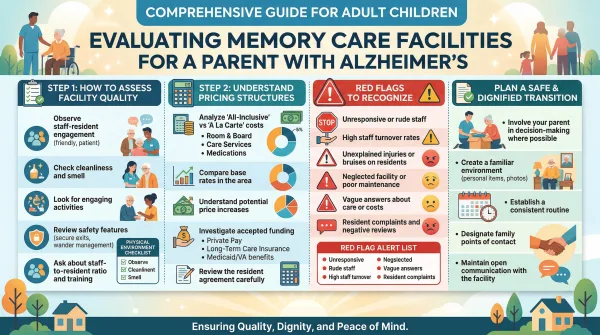
How to Evaluate a Memory Care Facility for Alzheimer's Care
Choosing a memory care facility is one of the most consequential decisions you'll make for your parent, and it deserves more than a single visit and a gut feeling. What separates a good facility from a great one often shows up in details that families don't think to look for during an initial tour. Here's what to examine closely.
Staffing Ratios and Dementia Training
Staff quality is the single biggest factor in your parent's daily life inside a memory care facility. Ask for the direct-care staff-to-resident ratio during the day, in the evening, and overnight. Ratios vary widely. Some facilities maintain 1 staff member for every 5 or 6 residents during the day, while others stretch that to 1:10 or higher. Overnight ratios are almost always thinner, which matters because nighttime wandering and agitation are common with Alzheimer's.
Beyond the numbers, ask what dementia-specific training the staff receives. There's a significant gap between a caregiver with a general CNA certification and one with specialized dementia care training. Look for facilities that require ongoing education in areas like redirection techniques, communication strategies for residents with limited verbal ability, and de-escalation approaches for agitation. Some facilities hold certifications from organizations that set standards for dementia care programming, which can be a useful signal of institutional commitment.
Secured Environment and Safety Features
Every memory care facility will tell you it's secured. What you need to verify is how. Coded or alarmed exits are the baseline. Beyond that, look for enclosed outdoor walking areas, wander-guard bracelet systems, fall-detection technology, and hallway designs that allow residents to walk freely without reaching dead ends that can cause frustration. Ask whether the facility has had any elopement incidents in the past year and how they responded. A facility that can answer that question openly and describe the corrective steps they took is more trustworthy than one that claims it's never happened. Elopement attempts happen even in well-run communities. What matters is how they handle it.
Activity Programming and Cognitive Engagement
A good memory care program doesn't just keep residents safe. It keeps them engaged. Ask to see the weekly activity calendar and pay attention to whether it includes a variety of approaches: music therapy, art activities, sensory stimulation, physical movement, and small-group social interaction. The best programs tailor activities to the individual resident's remaining abilities and interests rather than running the same generic schedule for everyone.
During your tour, watch how residents interact with staff during activities. Are staff members engaged and encouraging, or are they standing at the edges of the room on their phones? Are residents actively participating, or are they parked in front of a television? These observations tell you more than any brochure.
What to Observe During Your Visit
When I was helping my family evaluate memory care options, the most useful thing I did was visit at different times of day, not just during the scheduled tour. A facility can look very different at 2 p.m. on a Tuesday than it does at 6 p.m. when the dinner shift is starting and sundowning behaviors are peaking. If a facility resists unscheduled visits, that tells you something important.
During any visit, pay attention to how the building smells, how the common areas look, and how staff speak to residents. Notice whether residents appear clean and well-groomed. Listen for the overall noise level and the tone of staff voices. A calm, warm environment where staff address residents by name and speak at eye level is a strong indicator of good care culture. A facility where you hear staff talking over residents, rushing through tasks, or using a flat, detached tone should raise concerns.
I'll be honest: after watching a family member decline faster than any of us expected, and then facing the pressure of finding the right place in a matter of weeks, I understand how overwhelming this process feels. The urgency is real. But the worst thing you can do is rush past these evaluation steps because you're scared or exhausted. The time you invest here protects your parent for years. Take it seriously, and bring someone with you who can stay objective when your emotions make it hard to see clearly.
Questions Every Family Should Ask During a Facility Tour
Walking into a memory care facility with a prepared list of questions changes the dynamic of the visit. It shifts you from passive observer to informed evaluator, and it signals to the facility staff that you're paying close attention. Here are the questions that matter most.
Start with staffing: What is your staff-to-resident ratio on each shift? What dementia-specific training do you require? What's your annual staff turnover rate? High turnover is a red flag because consistency matters enormously for Alzheimer's patients. Familiar faces reduce anxiety and behavioral episodes. If a facility can't answer the turnover question, or gives a vague response, push back.
Move to care planning: How do you assess new residents, and how often do you reassess? Who creates the care plan, and how are families involved? What happens when my parent's needs increase, and is there a point where they would need to move to a different level of care? This last question is especially important. Some memory care facilities aren't equipped to handle late-stage Alzheimer's, which means your parent could face a second disruptive move down the road.
Ask about daily life: What does a typical day look like for a resident? Can I see last week's activity schedule? How do you handle meals for residents who need feeding assistance or have dietary restrictions? What happens at night if my parent is awake and agitated? How do you handle medical emergencies, and what hospital does the facility use? Ask about visiting policies too. You want a facility that encourages family involvement, not one that restricts it.
Ask about behavioral management: How does staff handle aggressive behavior or repeated attempts to leave? Do you use physical restraints? What's your policy on psychotropic medications, and who authorizes changes to my parent's medication? These questions feel uncomfortable to ask, but the answers reveal how the facility approaches the most challenging aspects of Alzheimer's care. A facility that relies heavily on medication to manage behavior rather than environmental and staffing strategies may not be providing the quality of care your parent deserves.
Finally, get specific about money: What's included in the base monthly rate? What costs extra? How often do rates increase, and by how much on average? What happens if we run out of private funds, and does the facility accept Medicaid? Many families skip the financial questions because they feel awkward asking. Don't. These details determine whether the facility remains affordable two or three years into the stay.
Red Flags That Should Make You Walk Away
Not every memory care facility deserves your trust. Having spent years doing mobile X-ray work inside various care facilities, I've seen what happens behind the scenes when families aren't watching. The gap between how some places present themselves and how they actually operate is something every family should be aware of before signing a contract.
The most obvious red flags are environmental. Strong or persistent odors (urine, heavy air freshener covering something worse), dirty common areas, residents sitting in soiled clothing, or visible disrepair all suggest the facility isn't maintaining basic standards. If you see these things during a scheduled tour when the building is supposed to look its best, imagine what it looks like on a normal day.
Staffing red flags are less visible but just as concerning. If you can't find a staff member in the hallway for several minutes during a tour, if residents are calling out for help with no response, or if the same person seems to be running back and forth between too many rooms, the facility is likely understaffed. Ask directly: how many call-outs happened in the past month, and how did you cover those shifts? Also pay attention to staff demeanor. Caregivers who seem burned out, irritable, or disengaged during your visit are telling you something about the work environment. Happy, well-supported staff provide better care. That's not a guess. It's a consistent pattern across every care setting I've worked in over nearly 20 years.
Watch for communication red flags too. A facility that avoids answering direct questions, pressures you to sign quickly, discourages unannounced visits, or won't provide references from current families shouldn't make your shortlist. Transparency goes both ways. A good facility will welcome your scrutiny because they have nothing to hide.
One more thing to watch for: facilities that accept every potential resident regardless of acuity level. If the admissions coordinator never asks detailed questions about your parent's current behaviors, medication regimen, or level of cognitive decline, they may be prioritizing census numbers over care quality. A thorough intake assessment protects your parent by ensuring the facility can actually meet their needs.
Understanding Memory Care Costs for Alzheimer's Patients
Memory care is expensive, and the costs are climbing every year. As of 2025, the national average for memory care runs approximately $7,500 to $8,000 per month, depending on the data source. That translates to $90,000 to $96,000 annually. The Genworth/CareScout 2025 Cost of Care Survey places the national figure around $7,908 per month for a private room. Other analyses put the national median slightly lower, around $6,690 per month, but that figure reflects a broader mix of room types and geographic areas. The range across states is enormous: from roughly $4,800 per month in lower-cost states to over $11,000 in the most expensive markets.
What catches families off guard isn't just the monthly rate. It's the extras. Many facilities quote a base rate that covers room, board, and a standard level of care. But medication management, incontinence supplies, higher-tier care as the disease progresses, specialized therapies, and laundry services may all be add-on charges. When my family went through this, the difference between the quoted rate and the actual monthly bill was significant enough to change the financial picture entirely. Always ask for a written breakdown of what the base rate includes and what triggers additional charges.
The average length of stay in memory care is two to three years, though some residents live there much longer. At $7,500 per month, a two-year stay costs $180,000. A three-year stay costs $270,000. Those numbers don't include annual rate increases, which typically run 3% to 5% per year, or the higher-tier care charges that become more likely as the disease progresses. Memory care costs have been climbing steadily year over year. Data from 2025 shows a 3.7% increase from the prior year, and there's no sign that trend is slowing down. When you're building a financial plan for your parent's care, factor in not just today's rate but a realistic projection of what the cost will look like 24 and 36 months from now. The gap between what you budgeted and what you actually pay can be tens of thousands of dollars.
Medicare, Medicaid, and Other Payment Options
Medicare does not cover memory care. This surprises many families, but Medicare is designed for acute medical care, not long-term residential support. If your parent needs skilled nursing after a hospitalization, Medicare may cover a short stay in a nursing facility, but it won't pay for ongoing memory care.
Medicaid can help, but the path is complicated and varies by state. Most states offer Home and Community-Based Services (HCBS) waivers that can cover care services in an assisted living or memory care setting, but these waivers typically don't cover room and board. You're still responsible for housing costs. Qualifying for Medicaid also requires meeting strict financial criteria: in most states as of 2025, the individual asset limit is around $2,000 and the income limit is approximately $2,900 per month. Many families need professional help from a Medicaid planner to structure finances and avoid costly mistakes during the application process. Be aware that HCBS waiver programs often have waitlists that can stretch months or even years, depending on the state. Starting the application process early, well before your parent's funds are depleted, gives you the best chance of having coverage in place when you need it.
Other payment sources include long-term care insurance (if your parent purchased a policy before the diagnosis), Veterans Affairs benefits for qualifying veterans and surviving spouses, life insurance conversions, and reverse mortgages. Most families end up paying with some combination of personal savings, retirement funds, and the sale of a home. The financial planning conversation should start well before placement becomes urgent.
What Families Often Underestimate About Alzheimer's Care
The most common mistake families make when choosing a memory care facility is planning for where their parent is right now instead of where they'll be in 12 to 18 months. Alzheimer's is a progressive disease, and care needs don't stay level. They escalate, sometimes gradually and sometimes with alarming speed.
Consider a situation where a family tours five memory care facilities over the course of two weeks. They get five different pricing structures, five different descriptions of "personalized care," and five different answers to the same questions. They're comparing options methodically, doing everything right. Then their mother walks out the front door of her apartment one evening and a neighbor finds her three blocks away, confused and unable to say where she lives. Suddenly the timeline collapses from "let's make a decision in the next month" to "we need a bed this week."
That scenario plays out constantly. The Alzheimer's Association estimates that 60% of people living with dementia will wander at least once. When it happens, the family's careful evaluation process gets compressed into a crisis response, and the facility they choose under pressure may not be the one they would have chosen with more time.
The other thing families underestimate is how quickly costs can climb after placement. A parent who enters memory care at a moderate care tier might need high-tier care within a year as the disease progresses. That can add $1,000 to $2,000 or more per month to the bill. Families who plan their finances around the initial quoted rate without building in a cushion for escalation often face painful decisions sooner than expected.
There's also an emotional dimension that catches people off guard. Many families assume that once their parent is in a good facility, the hard part is over. It isn't. You'll second-guess the decision. You'll feel guilty on days your parent doesn't recognize you. You'll worry every time the facility calls. These are normal reactions, and they don't mean you made the wrong choice. But acknowledging that the emotional weight continues after placement helps you prepare for what's ahead instead of being blindsided by it. Plan for the trajectory, not the snapshot.
Making the Transition to Memory Care
Moving a parent with Alzheimer's into memory care is emotionally difficult no matter how prepared you are. But how you handle the transition can significantly affect how quickly your parent adjusts to their new environment.
Most memory care professionals recommend a "warm handoff" approach. Bring familiar items from home: a favorite blanket, family photos, a bedside clock they've used for years. These objects provide comfort and a sense of continuity in an unfamiliar setting. Personalize the room before your parent arrives so it feels welcoming rather than institutional. If your parent has a routine they follow at home, share it with the care team in writing so they can mirror it as closely as possible during the first few weeks.
Many facilities advise families to stay away for the first few days after move-in. This feels counterintuitive, and it's hard. But your presence during the adjustment period can actually increase agitation because your parent may associate you with going home. Give the staff time to build a relationship and establish a routine. Ask for daily updates by phone or email so you know how things are going without being physically present.
Expect a rough first two weeks. Confusion, agitation, disrupted sleep, and tearful moments are all normal during the adjustment period. Most residents settle into the new routine within two to four weeks, especially in facilities with strong activity programming and attentive staff. If your parent's distress hasn't improved after a month, it's worth meeting with the care team to evaluate whether the current plan needs adjustment. Ask if the staff have tried different approaches to engagement, and whether a change in routine or room assignment might help. Some residents respond better to smaller group settings, while others do better with more one-on-one interaction. The care team should be willing to adapt.
One thing that helps during this period is staying in close contact with the facility's care coordinator or director of nursing. Establish a regular check-in schedule, whether that's a phone call every other day or a weekly email update. This keeps you informed without hovering, and it builds the kind of relationship with staff that benefits your parent long-term.
Making a Decision You Can Stand Behind
Choosing a memory care facility for a parent with Alzheimer's is one of the hardest decisions you'll face as an adult child. There's no perfect answer, and there's no way to eliminate the guilt, the worry, or the grief that comes with it. But there is a way to make a decision you can stand behind: by asking the right questions, looking past the brochures, understanding the real cost picture, and choosing a place where your parent will be safe, respected, and cared for by people who truly understand dementia. The facility that's right for your family is one where the staff sees your parent as a person, not a room number, and where you feel confident that the care won't drop off once the paperwork is signed.
Start your research before you need to. Tour more facilities than you think you should. Bring a list of questions and write down the answers. Talk to families who already have a loved one in the facilities you're considering. And trust what you see more than what you're told. The glossy brochures don't tell the whole story. Your own eyes, your own questions, and your own instincts will get you closer to the right answer than any marketing material ever could.
You're doing this because you love your parent. That doesn't make it easy. But it does mean you're exactly the right person to be making this decision.