
Your 79-year-old father went into the hospital after a fall at home. He's stable, but the nurse mentioned in passing that he's been a little confused since surgery, which is normal for his age, and that he has a "virtual sitter" watching him. You nodded like you understood, but you didn't really. You don't know whether someone is actually watching him, whether there's a camera in the room, or whether this means he's at higher risk than the nurse let on.
As of April 2026, AI-powered virtual sitting has become standard practice across most large US hospital systems, and it's expanding fast into community hospitals and skilled nursing facilities. Many families whose elderly parent is being monitored by AI during a hospital stay were never explicitly told. It's mentioned somewhere in the admission paperwork they signed at intake, often the same paperwork that covers HIPAA privacy notices and consent to treatment. Now that you know it's happening, here's what to ask.
This isn't a scandal piece, and virtual sitting has real value. In many cases it keeps patients safer than the alternative. But it isn't the same thing as having a person in the room with your parent, and the differences matter when your parent is confused, frightened, or trying to climb out of bed at 3 a.m. Inside hospitals for nearly two decades, I've watched in-person sitters sit with disoriented patients through long nights to keep them safe. Now, in many of those same hospitals, a human sitter has been replaced by a camera, an algorithm, and a remote technician watching multiple rooms at once. That isn't inherently bad, just different, and families deserve to understand what it means.
What a Virtual Sitter Actually Is
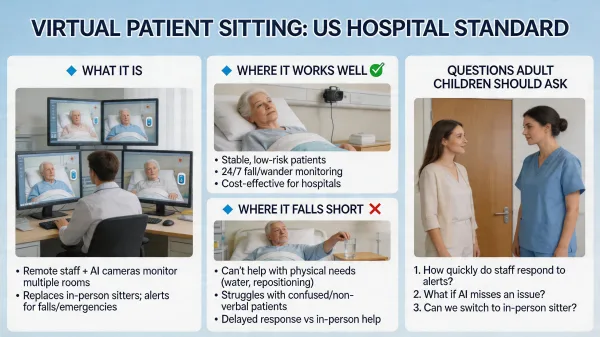
A virtual sitter is AI-powered monitoring using a camera, microphone, and sometimes additional sensors placed in a patient's hospital room, observed by a remote technician or algorithm that alerts nursing staff to falls, bed exits, agitation, or other safety concerns. It replaces or supplements the in-person continuous observation that hospitals have traditionally provided through a one-to-one sitter assigned to a single patient.
Here's how the setup typically works: a small device, usually mounted near the ceiling or on the room's TV, contains a camera and microphone. The video feed runs to a centralized monitoring center, which may be inside the hospital or operated by a third-party vendor. A trained technician sits at a station watching a wall of patient feeds, typically 10 to 16 rooms at once, sometimes more. AI software running in the background analyzes movement patterns and flags specific events: a patient swinging legs over the bed rail, a patient sitting up and reaching for an IV line, a patient who has been in the bathroom too long, signs of agitation. When the system detects one of these events, it generates an alert. The technician verifies what they're seeing, and either speaks to the patient through a two-way audio system or calls the floor nurse to intervene.
The major vendors in this space include AvaSure (the market leader, deployed in over 1,200 US hospitals), care.ai (over 1,500 healthcare sites and integrated with Stryker's SmartHospital Platform), Caregility, HelloCare, and newer entrants like Teton, a computer-vision platform that processes everything on-device and never streams video to a human at all. Each vendor handles the balance of camera, audio, AI alerts, and human oversight a bit differently.
Hospitals deploy virtual sitting for documented financial and staffing reasons. The cost of a one-to-one in-person sitter runs around $150 or more per shift, and many hospitals report annual sitter spending in the high six or seven figures. One Tennessee community hospital reported $425,000 a year for 14 sitters per day. Sitters are also hard to hire and retain, especially overnight. A virtual model lets one trained technician cover the equivalent of 10-plus rooms, and AvaSure, the largest vendor, reports a 6x return on investment for hospitals that adopt it. The financial case is strong, and that's why adoption has accelerated.
What Virtual Sitting Genuinely Does Well
The honest answer is that virtual sitting solves real problems. Human attention has a fatigue curve, and an in-person sitter at hour 11 of a 12-hour overnight shift isn't as vigilant as one at hour two. AI doesn't get drowsy, and the algorithm flags the same bed-exit pattern at 4 a.m. that it flags at 4 p.m. For patients whose primary risk is an unassisted attempt to get out of bed, that consistency matters.
The published data supports this consistency argument: in a literature review in Computers, Informatics, Nursing analyzing 12 studies, 8 showed measurable reductions in fall rates after hospitals moved from in-person to virtual sitting, and all 12 showed cost savings. A pilot at Mission Hospital in North Carolina, published in NEJM Catalyst, scaled virtual monitoring across five inpatient units and reported a 44% reduction in unassisted falls and a 40% reduction in fall-related injuries. AvaSure reports its 1,100-plus hospital customers see adverse-event reductions above 50%. Newer entrants like Teton, in a Danish hospital pilot, reported an 83% drop in falls in the first 87 days.
There's also a documentation benefit families don't usually consider: every alert is timestamped and every technician interaction is logged. If something happens overnight and you're trying to understand the sequence of events the next morning, the chart is more complete than it would be with an in-person sitter relying on memory. For the right patient, the trade-offs work in the patient's favor.
From inside the hospital, I've watched how thin the margin can be between a patient who almost falls and one who does. I've also watched in-person sitters get pulled mid-shift to cover another room, leaving a confused patient alone for stretches that nobody documents. The reality of staffing is that "one-to-one observation" doesn't always mean what families think it means, and sometimes a virtual model with reliable coverage is closer to the ideal than a stretched in-person sitter rotating between three patients on a busy night. That's a hard thing to admit after twenty years of believing the opposite, but I've watched the data shift, and I've watched the staffing shift along with it. The honest answer is that for many patients, virtual sitting really is at least as safe as what they would have had otherwise.
Two-way audio is part of the value, too. Many patients respond to a calm voice asking them to stay in bed, and the technician can do that within seconds of the system flagging movement. That isn't nothing. For a patient who is mildly disoriented but redirectable, it can be enough.
What Virtual Sitting Doesn't Do, and Why That Matters
A virtual sitter cannot put a hand on a shoulder. It cannot help a patient steady themselves on the way to the bathroom. It cannot physically catch a fall in progress. The system can alert in seconds, and a good system does, but the time between the alert and a nurse physically arriving in the room varies dramatically. On a well-staffed unit with the room near the nurses' station, response can be under 30 seconds. On a busy unit, with the assigned nurse already in another patient's room, response can stretch to several minutes. One hospital studied by Harvard's Bill of Health blog reported an average staff response time of 15 seconds after a virtual sitter alert. A nurse interviewed at Penn Medicine put it more bluntly: even 20 seconds can be too late if the patient is high-risk.
For a patient who is determined to climb out of bed and is moving fast, that gap is the difference between a near-miss and a fractured hip. A fractured hip in a 79-year-old isn't just an injury. It's a turning point. Roughly 20 to 30% of older adults who fracture a hip don't survive the year, and many who do never return to the level of independence they had before.
The patients for whom virtual sitting is most often inadequate fall into a few clear categories. Severely agitated delirium patients who are pulling at lines, ripping off telemetry leads, or actively trying to leave the unit need physical intervention, not a voice from a speaker. Patients with a strong fall history and impaired judgment may not respond to verbal redirection at all. Patients identified as high-risk for suicide still require one-to-one in-person observation under Joint Commission guidance, and a virtual sitter isn't an acceptable substitute. And there's a category that gets discussed less: patients whose confusion is partly driven by the strangeness of the hospital environment, where a calm human presence in the room actually reduces the agitation. Research on post-operative delirium consistently shows that family presence and familiar voices help reorient older patients. A speaker on the wall doesn't replicate that.
I've seen elderly patients in the ER who calmed down the moment a daughter walked in and held their hand, and I've seen the same patient escalate when left alone with monitors beeping. Virtual sitting handles the safety problem, but it doesn't always handle the human problem underneath.
Questions to Ask When Your Parent Has a Virtual Sitter
If you've been told your parent is on virtual monitoring and you want to understand what that actually means for them, these are the questions worth asking the charge nurse or unit manager.
How many rooms is the technician watching at the same time? A reasonable answer is somewhere between 8 and 16 rooms per technician. If the answer is "I don't know" or "we don't share that," push. The ratio matters. A technician watching 30 rooms cannot meaningfully attend to any single one of them.
What is the typical response time from alert to a nurse in the room? A good unit can answer this with a real number. Anything under a minute is reasonable on a well-staffed floor. If they can't give you a number, that's information too.
What specifically triggers an alert? The answer should include bed-exit attempts, falls, prolonged absence from view, signs of agitation, and on some systems, tube or line manipulation. You want to know whether your parent's specific risk pattern is something the algorithm is actually trained to catch.
Under what circumstances would you switch my parent to an in-person sitter? A specific clinical answer like "escalating agitation that doesn't respond to verbal redirection" is what you want to hear. "We don't really do that anymore" is a flag.
If I think my parent needs in-person attention right now, what does that conversation look like? You're asking for a pathway here, not a guarantee, and the pathway usually runs through the charge nurse and the attending physician. If the answer is that family advocacy doesn't change anything, that's a hospital culture issue worth knowing about before you need to act on it.
A reasonable hospital responds to these questions with patience because they've heard them before, and the answers tell you whether the unit is using virtual sitting as a thoughtful safety supplement or as a cost-saving substitute. If something feels off, you're allowed to push, and hospital policies don't override your role as your parent's advocate.
The Privacy Considerations Most Families Don't Know About
The camera in your parent's room is on continuously for the duration of monitoring. That's how the system works, and there's no on-off button the patient controls. Many hospitals also capture audio, though some vendors disable audio recording to avoid running into state wiretap laws that require all-party consent.
The footage is treated as protected health information under HIPAA, which means the hospital has legal obligations around access, storage, and disclosure. In practice, that translates to questions worth asking: Who can view the live feed and the recordings? How long is footage retained? Is it reviewed for any purpose other than safety monitoring (quality improvement, training, incident review)? What happens to the footage when your parent is discharged?
Consent for virtual monitoring is usually folded into the general admission paperwork your parent (or you, if you have power of attorney) signed at intake, and it's rarely flagged as a separate, highlighted disclosure. If your parent didn't realize they were consenting to camera monitoring, they're not alone. In my experience, most patients have no idea the camera is even there until somebody mentions it, and many never realize it stayed on the entire night. They have the right to ask for the policy in writing, and some vendors blur faces or use silhouette overlays that protect dignity while preserving the safety function, while others don't, and it's a fair question to ask about.
What This All Adds Up To
Virtual sitting isn't a downgrade and it isn't an upgrade. It's a different model of safety monitoring that works well for many patients and not as well for others. For a redirectable patient at moderate fall risk, it's likely as safe as an in-person sitter and sometimes safer because the AI doesn't tire. For a severely agitated patient, a high-suicide-risk patient, or a patient whose confusion is being made worse by isolation, it falls short of what a person in the room can offer.
The most useful thing you can do as the adult child of a hospitalized parent is ask the questions above and trust your read on the situation. If your gut says your father needs someone with him, say so. The worst that happens is the answer is no, and you've still made it clear you're paying attention, because hospitals respond to families who ask informed questions. Quietly accepting whatever's in place without understanding it is how families end up surprised after the fact.
You don't have to become an expert on hospital monitoring technology. You just have to know enough to ask the right questions and to push when the answers don't sit right. That's enough.