
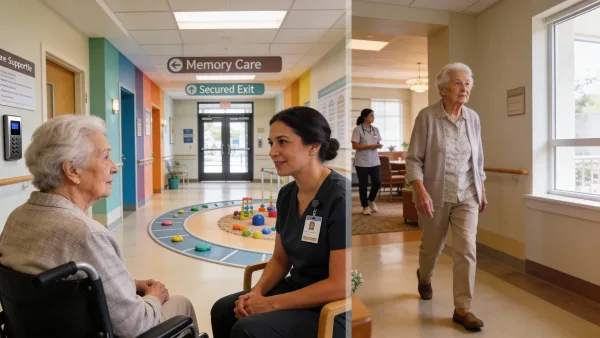
Is memory care just assisted living for people with dementia? This common misconception causes families to pursue inappropriate care options, either selecting memory care prematurely or attempting to keep loved ones in assisted living beyond safe limits. While both provide residential care and assistance with daily activities, memory care and assisted living serve fundamentally different populations with distinct needs, employ different staffing models and training requirements, and operate under different regulatory frameworks in most states.
The distinction matters because assisted living facilities lack the specialized security, training, and programming dementia patients require, while memory care's intensive supervision and higher costs may be unnecessary for seniors with mild cognitive impairment or intact cognition. Matching care level to actual needs optimizes both safety and cost-effectiveness.
This comparison examines the specific differences between memory care and assisted living across services, staffing, physical environment, costs, and regulatory requirements. The analysis provides decision criteria for determining which care level is appropriate based on cognitive status, behavioral symptoms, and safety concerns.
Assisted Living: Definition and Core Services
Assisted living facilities provide residential care with personal assistance for seniors who can no longer live independently but don't require constant skilled nursing care. These communities serve individuals needing help with activities of daily living (ADLs) including bathing, dressing, grooming, toileting, mobility, and medication management, while maintaining sufficient cognitive capacity to direct their own care and participate in community life.
Core assisted living services include private or semi-private apartments, three meals daily, personal care assistance calibrated to individual needs, medication administration and monitoring, housekeeping and laundry services, 24-hour staff availability, emergency call systems, social and recreational programming, and transportation. Staff-to-resident ratios typically range from 1:8 to 1:15 during daytime hours, with lower ratios overnight.
Assisted living operates under state-specific licensing regulations varying significantly by jurisdiction. Most states require staff training in personal care assistance, medication management, and emergency procedures, but specialized dementia care training isn't universally mandated. Physical environments emphasize accessibility and safety but don't typically incorporate the specialized design elements memory care units employ.
National median costs for assisted living range from $5,190 to $6,129 monthly ($62,280 to $73,548 annually) in 2025 depending on data source, geographic location, and care level required.
Memory Care: Definition and Core Services
Memory care facilities provide specialized residential care designed specifically for individuals with Alzheimer's disease, dementia, and other cognitive impairments requiring secured environments, specially trained staff, and dementia-specific programming. These communities operate either as standalone facilities or secured units within larger assisted living facilities, incorporating enhanced safety features, modified physical design, and therapeutic approaches addressing the unique challenges of cognitive decline.
Core memory care services include everything provided in assisted living plus secured perimeters with monitored exits preventing unsafe wandering, staff trained specifically in dementia care approaches and behavioral management, structured daily routines reducing confusion, cognitive stimulation programming including music therapy and reminiscence activities, sensory programs, lower staff-to-resident ratios (typically 1:5 to 1:6), specialized dining assistance for residents who have forgotten how to use utensils, and purpose-designed environments supporting wayfinding and reducing agitation.
Most states maintain specific regulations for memory care distinct from standard assisted living, typically requiring disclosure of specialized services, minimum staff training hours in dementia care, and physical environment standards. Forty-seven states have established memory care regulations as of 2025.
National median costs for memory care range from $6,450 to $7,785 monthly ($77,400 to $93,420 annually) in 2025, approximately 20 to 30 percent higher than assisted living in the same geographic markets.
Comprehensive Comparison: Memory Care vs Assisted Living
The following table provides side-by-side comparison of key differences between memory care and assisted living facilities:
| Category | Assisted Living | Memory Care |
|---|---|---|
| Target Population | Seniors needing help with 2-4 ADLs but cognitively intact or mild impairment | Moderate to severe Alzheimer's/dementia requiring specialized care |
| Staff-to-Resident Ratios | 1:8 to 1:15 (daytime) | 1:5 to 1:6 (daytime) |
| Staff Training Requirements | General personal care, medication management, emergency procedures | Mandatory dementia-specific training: communication, behavioral management, person-centered approaches |
| Physical Environment | Accessible apartments, safety features, emergency systems | Secured perimeters, simplified layouts, circular floor plans, visual landmarks, contrasting colors, secured outdoor spaces |
| Security Features | Standard building security, emergency call systems | Monitored/alarmed exits, secured perimeters, wandering prevention systems, sometimes GPS tracking |
| Medication Management | Administration, tracking, coordination | Same as assisted living, with enhanced monitoring for behavioral medications |
| Dining Services | Three meals daily, general assistance if needed | Three meals daily plus specialized assistance for residents with dysphagia, forgotten eating skills, or refusal |
| Activities Programming | General social, recreational, fitness activities | Dementia-specific: cognitive stimulation, music therapy, reminiscence, sensory programs, validation therapy |
| Behavioral Management | Basic redirection, staff call for assistance | Specialized training in non-pharmacological interventions, de-escalation techniques, understanding triggers |
| Family Education | General care updates, care plan meetings | Extensive dementia education, progression guidance, communication strategies, coping support |
| Regulatory Framework | State assisted living regulations | Separate memory care regulations in 47 states (specific training, disclosure, environment standards) |
| Monthly Cost (National Median 2025) | $5,190-$6,129 | $6,450-$7,785 |
| Annual Cost (National Median 2025) | $62,280-$73,548 | $77,400-$93,420 |
| Cost Premium | Baseline | 20-30% higher than assisted living |
Cost Comparison: Memory Care vs Assisted Living
Memory care consistently costs more than assisted living in every geographic market, though the premium varies by region and facility type. The following analysis examines cost differentials and factors driving the premium.
National Cost Differentials (2025)
Assisted Living: $5,190-$6,129 monthly national median Memory Care: $6,450-$7,785 monthly national median Premium: $1,000-$1,900 monthly (20-30% increase) Annual Premium: $12,000-$22,800 additional per year
State-Level Cost Comparisons
| State | Assisted Living Median | Memory Care Median | Monthly Premium | Annual Premium |
|---|---|---|---|---|
| Mississippi | $4,578 | $3,800-$4,300 | -$278 to -$778* | -$3,336 to -$9,336* |
| Georgia | $4,800-$5,300 | $3,995 | -$805 to -$1,305* | -$9,660 to -$15,660* |
| Missouri | $4,318-$4,851 | $4,200-$4,800 | -$118 to +$482 | -$1,416 to +$5,784 |
| Oklahoma | $4,200-$4,600 | $3,600-$4,200 | -$600 to -$400 | -$7,200 to -$4,800 |
| National Median | $5,190-$6,129 | $6,450-$7,785 | +$1,000-$1,900 | +$12,000-$22,800 |
| California | $7,300 | $8,000-$11,000 | +$700-$3,700 | +$8,400-$44,400 |
| New York | $6,300-$8,000 | $8,500-$11,000 | +$2,200-$3,000 | +$26,400-$36,000 |
| Massachusetts | $9,330 | $9,000-$10,500 | -$330 to +$1,170 | -$3,960 to +$14,040 |
| Hawaii | $11,650 | $13,980 | +$2,330 | +$27,960 |
| Alaska | $10,504 | $11,000+ | +$496+ | +$5,952+ |
*Note: Anomalies where memory care appears less expensive than assisted living likely reflect data collection methodology differences or limited memory care facility samples in those states.
What Drives the Memory Care Premium
The 20-30% cost increase for memory care reflects specific operational requirements:
Lower Staff-to-Resident Ratios: Memory care maintains 1:5-1:6 ratios vs 1:8-1:15 in assisted living, requiring approximately 40-60% more direct care staff per resident.
Specialized Training Costs: All staff members (including housekeeping and dietary) receive dementia-specific training, often 12-40 hours initially plus ongoing education. This specialized workforce commands higher wages.
Enhanced Security Infrastructure: Secured doors, monitoring systems, alarmed exits, enclosed outdoor spaces, and sometimes GPS tracking technology add to capital and operational costs.
Specialized Programming: Creating and implementing cognitive stimulation activities, therapeutic programs, and behavioral management approaches requires dedicated programming staff with dementia expertise.
Physical Environment Modifications: Purpose-built or retrofitted memory care units with specialized flooring, lighting, color schemes, signage, and layouts cost more to construct and maintain.
Regulatory Compliance: Meeting state-specific memory care regulations often more stringent than assisted living requirements adds operational costs.
Thomas compared facilities for his mother diagnosed with moderate Alzheimer's disease. A high-quality assisted living facility quoted $6,800 monthly. The memory care wing in the same building quoted $8,400 monthly. The $1,600 monthly premium ($19,200 annually) provided secured environment, dementia-trained staff available 24/7, specialized programming, and peace of mind that staff understood how to manage his mother's increasing confusion and exit-seeking behaviors. The cost differential reflected genuine service differences rather than arbitrary pricing.
Staffing Comparison: Training and Ratios
Staffing represents the most significant operational difference between memory care and assisted living, affecting both care quality and costs.
| Staffing Element | Assisted Living | Memory Care |
|---|---|---|
| Daytime Ratios | 1:8 to 1:15 residents per staff | 1:5 to 1:6 residents per staff |
| Evening Ratios | 1:10 to 1:20 residents per staff | 1:6 to 1:8 residents per staff |
| Overnight Ratios | 1:15 to 1:25 residents per staff | 1:8 to 1:12 residents per staff |
| Dementia Training Required | Not universally mandated; varies by state | Required in 47 states; typically 12-40 hours initial plus ongoing |
| Training Content | Personal care, medication management, emergency response | Dementia stages, communication techniques, behavioral triggers, redirection, validation therapy, person-centered care |
| Caregiver Certification | CNA or medication aide certification | CNA plus Certified Dementia Practitioner or equivalent in many facilities |
| Licensed Nurse Presence | Required on-site or on-call (varies by state) | Same requirements, though some memory care facilities maintain 24-hour nursing |
| Specialized Roles | Activities coordinator, wellness coordinator | Memory care program director, activities coordinator with dementia specialization, behavioral specialist (in larger facilities) |
The staffing differential produces tangible care differences. In assisted living, a caregiver assisting 10-12 residents during a shift can provide routine personal care but has limited time for individualized behavioral management or extensive redirection. In memory care, a caregiver assisting 5-6 residents can spend more time using specialized communication techniques, managing challenging behaviors, and providing the patient-centered approaches dementia care requires.
Where This Gets Confusing: Assisted Living Facilities Claiming to "Offer Memory Care"
Many assisted living facilities advertise that they "provide memory care services" or "welcome residents with dementia." This creates confusion because the designation "memory care" lacks uniform definition in many states, allowing varied interpretations. Where this gets confusing is distinguishing true specialized memory care from assisted living facilities willing to accept residents with mild cognitive impairment.
What "Memory Care in Assisted Living" Often Means
Scenario 1: Secured Dedicated Wing: The facility operates a true memory care unit as a separate, secured wing with specialized programming and trained staff. This represents genuine memory care meeting regulatory standards.
Scenario 2: Enhanced Services for Dementia: The facility accepts residents with mild to moderate dementia in standard assisted living apartments, providing some additional supervision and activities but without secured environment or specialized unit. This represents enhanced assisted living, not true memory care.
Scenario 3: Marketing Language: The facility accepts any resident regardless of cognitive status and uses "memory care" as marketing language to attract families researching dementia care, but provides no specialized services beyond standard assisted living.
Questions to Ask When Facilities Claim to Offer Memory Care
- "Do you have a dedicated, secured memory care unit separate from assisted living?"
- Legitimate answer: "Yes, our memory care residents live in a secured wing with alarmed exits."
- Warning sign: "Our residents with memory issues live throughout the community in regular apartments."
- "What staff-to-resident ratios do you maintain in your memory care unit?"
- Legitimate answer: "We maintain 1:5 or 1:6 during day and evening shifts."
- Warning sign: "We maintain our standard assisted living ratios of 1:10."
- "What dementia-specific training do all staff members receive?"
- Legitimate answer: "All staff complete 16 hours of dementia care training initially, plus quarterly ongoing education."
- Warning sign: "Our staff are trained in personal care and can handle memory issues."
- "How does your memory care programming differ from your general assisted living activities?"
- Legitimate answer: Describes specific cognitive stimulation, validation therapy, sensory programs, music therapy.
- Warning sign: "We include memory residents in our regular activities."
- "Are you licensed specifically for memory care in this state?"
- Legitimate answer: "Yes, we hold memory care certification under [state regulation]."
- Warning sign: "We're licensed for assisted living and accept residents with dementia."
Linda's family toured an assisted living facility advertising "memory care services." The facility had no secured unit, maintained 1:12 staff ratios throughout, and described "memory care" as willingness to accept residents with early-stage dementia in regular assisted living apartments. This represented enhanced assisted living potentially appropriate for mild cognitive impairment, but not the secured, specialized memory care moderate to advanced dementia requires. Understanding this distinction prevented inappropriate placement.
Who Belongs Where: Decision Criteria for Memory Care vs Assisted Living
Determining appropriate care level requires assessing cognitive status, safety risks, behavioral symptoms, and care needs. The following framework provides decision criteria based on specific indicators.
Choose Assisted Living When:
Cognitive Status: Cognitively intact or mild cognitive impairment not affecting safety or daily functioning. Able to recognize familiar places and people. Maintains orientation to time and place most of the time. Remembers daily routines with minimal prompting.
Safety Profile: No wandering or exit-seeking behaviors. Able to recognize and respond appropriately to emergency situations. Remembers to eat without constant supervision. Takes medications with reminders but doesn't require administration.
Personal Care Needs: Requires assistance with 2-4 activities of daily living (bathing, dressing, grooming, toileting, mobility). Can direct own care and communicate preferences clearly. Maintains continent or manageable incontinence with scheduled toileting.
Behavioral Symptoms: No significant behavioral challenges. May experience mild anxiety or depression manageable with standard support. No aggression, severe agitation, or disruptive behaviors requiring specialized intervention.
Social Functioning: Able to engage appropriately in group activities. Maintains social relationships with peers. Can follow activity instructions and participate meaningfully in programming.
Decision-Making Capacity: Retains capacity to make daily decisions (what to wear, what to eat, whether to participate in activities). Can advocate for own needs and preferences.
Example: Robert, age 79, has mild cognitive impairment causing occasional forgetfulness but manages daily life with minimal support. He needs help bathing and dressing due to arthritis and balance issues, not cognitive decline. He participates fully in activities, maintains friendships, never wanders, and doesn't exhibit behavioral symptoms. Assisted living provides appropriate support without unnecessary restrictions or costs.
Choose Memory Care When:
Cognitive Status: Moderate to severe dementia affecting safety and daily functioning. Frequently disoriented to time, place, or person. Cannot follow multi-step instructions. Forgets to eat, struggles to recognize familiar faces or places, or experiences significant confusion.
Safety Profile: Wandering or exit-seeking behaviors present or developing. History of getting lost even in familiar environments. Unable to recognize or respond appropriately to emergency situations. Forgets to eat, leading to weight loss. Medication management unsafe even with reminders.
Personal Care Needs: Requires extensive assistance with most or all activities of daily living. Cannot direct own care or may resist care due to confusion. Significant incontinence requiring frequent changes and monitoring.
Behavioral Symptoms: Aggression, severe agitation, sundowning, significant anxiety, delusions, hallucinations, or other challenging behaviors requiring specialized intervention. Behaviors that standard assisted living staff cannot safely manage.
Social Functioning: Unable to engage appropriately in standard group activities. May become agitated or confused in unstructured environments. Benefits from dementia-specific programming calibrated to cognitive level.
Decision-Making Capacity: Impaired judgment creating safety risks. Unable to recognize dangers (attempts to leave building alone, tries to operate stove despite forgetting how, opens exterior doors in winter).
Family Caregiver Concerns: Family caregivers report inadequate supervision in current setting leading to safety incidents. Current assisted living facility expresses concerns about ability to manage resident safely.
Example: Margaret, age 82, has moderate Alzheimer's disease. She wanders, has gotten lost three times in her current assisted living facility, tries to leave the building looking for her deceased parents, sometimes doesn't recognize her daughter, forgets she has eaten and insists she's being starved, and exhibits aggressive behaviors when staff try to assist with bathing. Memory care provides the secured environment, specialized staffing, and dementia expertise she requires for safety and quality of life.
Gray Area: When the Decision Is Unclear
Early to Moderate Transition: Individuals transitioning from mild to moderate dementia may fall in a gray area where enhanced assisted living might work temporarily but memory care will likely become necessary soon. Consider memory care proactively to avoid crisis-driven emergency moves when safety incidents occur.
Mild Cognitive Impairment with Behavioral Symptoms: Some individuals with relatively preserved cognition exhibit significant behavioral symptoms (anxiety, aggression, paranoia) that standard assisted living struggles to manage. Memory care's behavioral expertise may benefit these residents despite less severe cognitive impairment.
Wandering as Primary Concern: Residents who function well cognitively but have developed wandering behaviors specifically may benefit from memory care's secured environment even if they don't need other specialized dementia services.
Trial Period Considerations: Some facilities offer trial periods allowing families to assess fit. If assisted living staff report increasing difficulty managing behaviors or safety concerns, transition to memory care proactively rather than waiting for incidents.
Consulting Professionals: When decision is unclear, consult with physicians, geriatric care managers, or dementia specialists who can assess cognitive status and functional abilities objectively, providing guidance on appropriate care level.
Charles had early-stage Alzheimer's with relatively preserved functioning but one specific dangerous behavior: wandering outside at night in his pajamas. His assisted living facility, while willing to keep him, could not prevent these dangerous episodes given their building configuration and staffing model. Moving to memory care provided the secured environment addressing his primary safety risk without unnecessarily restricting other activities he could safely enjoy.
Regulatory and Licensing Distinctions
Regulatory frameworks differ between assisted living and memory care in most states, affecting standards, oversight, and resident protections.
| Regulatory Element | Assisted Living | Memory Care |
|---|---|---|
| Licensing Category | Assisted living facility license | Memory care endorsement, separate memory care license, or assisted living with specialized unit designation (varies by state) |
| Staff Training Requirements | Personal care assistance, medication management, emergency procedures | All above plus mandatory dementia-specific training (typically 12-40 hours initial, 8-12 hours annual) |
| Disclosure Requirements | General services, fees, resident rights | All above plus specific disclosure of memory care specialization, staff training, security measures, specialized programming |
| Physical Environment Standards | Accessibility, safety features | All above plus requirements for secured perimeters, specialized design elements, outdoor space specifications |
| Activity Programming Requirements | General social and recreational activities | Dementia-specific programming requirements, individualized approaches, therapeutic modalities |
| Inspection Frequency | Annual or biennial (varies by state) | Often more frequent due to specialized care nature and vulnerable population |
| States with Specific Memory Care Regulations | N/A (general assisted living regs apply) | 47 states have specific memory care regulations or requirements as of 2025 |
Three states lack specific memory care regulations, allowing facilities to designate memory care units without meeting specialized standards beyond general assisted living requirements. Families in these states must evaluate facilities particularly carefully, as "memory care" designation alone doesn't guarantee specialized services.
Transition Timing: Moving from Assisted Living to Memory Care
Many residents begin in assisted living and transition to memory care as dementia progresses. Recognizing appropriate transition timing prevents safety crises and ensures adequate support.
Indicators Transition Is Needed
- Assisted living staff report increasing difficulty managing behaviors or safety concerns
- Multiple wandering incidents or elopement attempts
- Resident becomes confused about location, repeatedly asks to "go home," tries to leave
- Aggression toward staff or other residents increases in frequency or severity
- Weight loss from forgetting to eat despite meal service availability
- Medication management becomes unsafe even with staff administration
- Falls increase due to confusion, wandering, or impaired judgment
- Family observes declining cognitive status making current environment unsafe
- Current facility suggests memory care consultation or indicates resident may need higher care level
Some continuing care retirement communities and larger senior living campuses allow residents to transition from assisted living to on-campus memory care, maintaining familiar staff, environment, and social connections while receiving appropriate specialized care. This continuity benefits residents who adapt better to environment changes when some elements remain familiar.
Conclusion
Memory care and assisted living serve distinct populations with fundamentally different needs. Assisted living provides personal care assistance for seniors needing help with daily activities while maintaining cognitive capacity to direct their own care. Memory care provides specialized dementia care with secured environments, trained staff, therapeutic programming, and enhanced supervision for individuals with moderate to advanced Alzheimer's disease or dementia.
The key differences lie in staff-to-resident ratios (1:5-1:6 vs 1:8-1:15), security features (secured perimeters vs standard building security), specialized training (mandatory dementia certification vs general personal care training), and programming (dementia-specific therapies vs general activities). These differences produce costs approximately 20-30% higher for memory care nationally, ranging from $6,450-$7,785 monthly vs $5,190-$6,129 monthly for assisted living in 2025.
Choosing appropriate care level requires assessing cognitive status, safety risks, behavioral symptoms, and care needs. Residents with intact cognition or mild cognitive impairment belong in assisted living. Residents with moderate to severe dementia, wandering behaviors, significant safety concerns, or challenging behavioral symptoms require memory care's specialized environment and expertise.
Where confusion arises is when assisted living facilities claim to "offer memory care" without providing true specialized units, appropriate staffing ratios, or dementia-specific programming. Families must evaluate carefully whether facilities claiming memory care services provide genuine specialized dementia care or simply accept residents with cognitive impairment in standard assisted living settings. Asking specific questions about secured units, staff ratios, training, and programming reveals true capability distinctions.