
If your 78-year-old mother is on nine medications across four different prescribers, you already know where this conversation usually starts. Two hospitalizations in the past year. A pharmacy that has the full list, except it doesn't, because not everything came through them. Specialists who each see a different picture, and somewhere in the middle of all of it, a parent who says she's "fine" but seems more confused than she did six months ago.
As of April 2026, AI medication management tools for seniors are being deployed across pharmacy chains, home health programs, and senior living communities at a pace that's outrunning most families' awareness of them. Smart pill dispensers track whether each dose was actually taken. Drug interaction algorithms scan medication lists in seconds. Machine learning systems flag patients at high risk of medication-related hospitalization before the next ER visit happens.
Some of these tools work. Some are marketing wrappers around basic pill bottles. The difference matters when a parent's safety is on the line. Polypharmacy is one of the leading preventable causes of senior hospitalization in the U.S., and the technology is moving fast enough that what was true a year ago may not be true today. This piece covers what AI medication management actually does for aging parents on multiple medications, where it helps, and where families would do better putting their energy somewhere else.
The Polypharmacy Problem AI Is Trying to Solve
Polypharmacy means taking five or more medications at the same time. By that definition, roughly 45% of adults over 65 in the U.S. take five or more medications, and somewhere between 9% and 23% take ten or more, depending on which study you look at. Among adults over 80, the share taking ten-plus gets even higher.
The problem isn't just the count. It's what happens at the intersections.
Adverse drug events drive an estimated 1.5 million emergency department visits and nearly 500,000 hospitalizations every year in the U.S., according to the CDC. Adults 65 and older account for more than 600,000 of those ED visits, more than twice the rate for people under 65. The most commonly implicated medications aren't exotic ones. Blood thinners (especially warfarin), diabetes drugs (insulin and oral hypoglycemics), and antiplatelet agents account for a disproportionate share of medication-related senior hospitalizations.
Three patterns make polypharmacy especially dangerous in aging parents.
Drug-drug interactions across multiple prescribers
A primary care doctor prescribes one medication. A specialist adds another. A third specialist adds a third. No single clinician is looking at the full list, and the interaction shows up two months later as confusion, a fall, or a hospitalization. The pharmacy's computer system catches what runs through that pharmacy. It doesn't catch what got filled at the urgent care two towns over.
Prescribing cascades
A new medication causes a side effect that gets misread as a new condition, which gets a new prescription. The classic example: a calcium channel blocker causes ankle swelling, treated with a diuretic, which then drops blood pressure too far. Research published in JAMA Internal Medicine found this specific cascade in roughly 9.5% of older adults newly prescribed a calcium channel blocker.
Adherence failures
Seniors with cognitive impairment, multiple daily doses, or vision and dexterity challenges miss doses, double up, or stop taking medications without telling anyone. The gap between what was prescribed and what was actually taken is often invisible until something goes wrong.
This is, on paper, an AI-shaped problem. Pattern recognition across large medication and clinical datasets is exactly what machine learning is good at. The gap between prescribed and actually taken is exactly what connected dispensing devices can close. Whether that potential is being realized is a different question.
What AI Medication Management Tools Actually Do Well
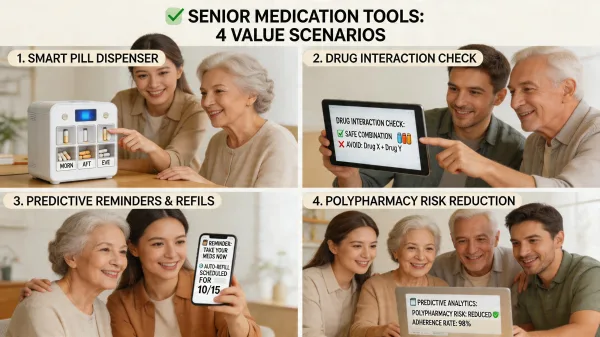
AI medication management for seniors falls into four buckets, each solving a different piece of the problem.
Drug interaction checking across multiple prescribers
Pharmacy clinical decision support systems have run interaction checks for decades, but they only see what runs through their pharmacy. AI-enhanced tools can ingest a full medication list (including supplements and OTC medications) and flag combinations any single prescriber might miss. The strongest applications sit inside pharmacy and health system platforms. A 2025 peer-reviewed evaluation in Exploratory Research in Clinical and Social Pharmacy tested ChatGPT, Google Gemini, and Microsoft Copilot against established drug interaction databases on real patient cases. None achieved the precision and sensitivity needed for reliable clinical decisions. The version that helps your parent runs quietly behind a pharmacist or geriatric care team, not the one a family member queries on a phone.
Adherence tracking through smart dispensers
Devices like Hero (around $30 to $45 per month with subscription) and MedMinder load up to a 90-day supply of multiple medications, dispense the right doses at scheduled times, and send caregiver alerts if a dose is missed. The "AI" component varies. Some devices use basic scheduling logic. Others layer in pattern detection and refill prediction. These are useful for the specific problem of "did Mom actually take her morning pills today," and the remote-monitoring features can shift cognitive load off the parent and onto a connected caregiver.
In ER settings, medication issues are the quiet emergency. An elderly patient shows up confused, sometimes with a fall or a sudden change in mental status, and one of the first checks is what they're actually taking versus what they're supposed to be taking. The list the family hands over and the list the chart shows almost never match. Sometimes a medication was added at a specialist visit nobody told the primary care doctor about. Sometimes a dose was doubled because two pharmacies filled the same prescription on different days. Twenty years of seeing this pattern, again and again, is what makes me cautious about overheated AI claims and also persuaded that there's real ground for the technology to cover. The gap is where AI has the potential to help, if it's deployed in ways that actually work.
Adherence packaging with pharmacy-side review
PillPack from Amazon Pharmacy and similar services (CVS SimpleDose, ExactCare) pre-sort prescriptions into time-stamped packets and ship them monthly. Pharmacists review the full medication list for interaction issues before each shipment. PillPack expanded to Medicare Part D in 2024 and 2025. The clinical value is consolidating multiple prescriptions through a single pharmacy that sees the full picture.
Predictive analytics for hospitalization risk
Health systems and Medicare Advantage plans are increasingly using machine learning to flag patients at high risk of medication-related ED visits. One published model (FeelBetter, evaluated in the American Journal of Managed Care in 2024) found that patients in the top 1% of predicted risk had 7.9 times the odds of an ED visit and 17.3 times the odds of a hospitalization compared to median-risk patients. These tools sit inside health systems, but they affect what kind of medication management your parent's clinicians proactively offer.
Family Scenarios Where These Tools Genuinely Help
Not every senior with polypharmacy needs every type of AI tool. Four scenarios are where the value tends to be clear.
A parent on 8+ medications across multiple specialists
This is where AI-powered interaction checking earns its keep. A geriatric pharmacist or health system program with full-list interaction screening can flag combinations that no single prescriber sees. The catch: the parent's full medication list (including supplements, OTC sleep aids, and anything filled at a different pharmacy) has to make it into the system. Bring the actual bottles to a comprehensive medication review. Pharmacists call this the brown bag method, and in my hospital experience the gap between what families think their parent takes and what's actually in the bag is often a real eye-opener.
A parent with mild cognitive impairment
Adherence-tracking dispensers shift cognitive load off a parent who's starting to forget doses. The dispenser remembers. The parent presses a button. Caregiver alerts mean a missed dose triggers a phone call rather than a quiet two-week gap nobody notices until a hospitalization. I watched this play out in my own family during a relative's dementia journey. The decline ran much faster than any of us expected, and by the time we'd worked out a system that held, we'd already missed weeks of partial adherence.
A parent recently discharged from the hospital
Care transitions are when medication errors compound. A new medication added during admission. An old medication someone forgot to restart. Doses that changed but weren't clearly communicated. Research consistently finds that medication-related harm peaks in the first weeks after discharge, and I've seen plenty of post-discharge ER returns where a quiet medication error from the hospital stay was the trigger. A follow-up Comprehensive Medication Review (free annually for eligible Medicare Part D beneficiaries) or pharmacy-side review through an adherence packaging service catches the most common post-discharge errors before they cause a readmission.
A family that lives at distance
When the adult children are in another state, remote adherence alerts and connected dispensers provide an early signal that something is shifting. A pattern of late doses or skipped evening medications can be the first sign that a parent is declining cognitively, well before a phone call would surface the issue. The technology doesn't replace in-person visits, but it closes a real gap between them. AI tools work best when they catch a specific, well-defined problem, not when families hope the technology will solve everything at once.
Where AI Medication Tools Miss the Point
There are situations where adding AI medication tools is the wrong move, or at least not the first move.
When the underlying problem is a medication that should have been deprescribed. A 78-year-old who's been on a benzodiazepine for ten years doesn't need an interaction-checker alert. She needs a clinician willing to have the deprescribing conversation. The Beers Criteria, updated in 2023 by the American Geriatrics Society, lists nearly 100 medications potentially inappropriate for adults over 65. No AI dispensing system substitutes for a clinician reviewing whether the prescription itself still makes sense.
When adherence is actually a side effect problem nobody knows about. A parent who "keeps forgetting" her statin may be skipping it because of muscle pain she hasn't mentioned. An adherence-tracking dispenser will flag the missed doses. It won't surface the muscle pain. The fix isn't more reminders. It's a real conversation with the prescriber about whether the medication is still the right one.
Alert fatigue. The same 2025 evaluation of consumer AI tools found that platforms generated thousands of potential interactions across fewer than 60 patient cases, the vast majority not clinically relevant. When a tool alerts on 40% of prescriptions, families learn to ignore alerts. The signal gets buried in noise. Pharmacy-side AI tuned by clinicians produces fewer, higher-quality alerts. Consumer-facing AI tools generally don't.
When the real intervention is a deprescribing conversation. Pharmacist-led deprescribing interventions have shown reductions in polypharmacy of 39% to 67% in published studies. That's a bigger safety lever than any current AI dispensing system. A comprehensive medication review with a geriatric pharmacist, often free under Medicare Part D MTM programs, is usually the higher-value first step. AI medication tools aren't a substitute for clinical judgment about whether the prescription should exist at all.
What a Family Might Actually Set Up
For most families dealing with a parent's polypharmacy, the right progression isn't "buy the most advanced AI dispenser." It's a sequence.
Step 1: Schedule a comprehensive medication review. Eligible Medicare Part D beneficiaries qualify for an annual CMR at no extra cost through their plan's MTM program. The 2025 eligibility threshold is $1,623 in annual out-of-pocket Part D costs, three or more chronic conditions, and two to eight Part D maintenance medications. The CMR is conducted by a pharmacist, takes about 30 minutes, and produces a written Medication Action Plan. If your parent qualifies and hasn't done one, this is usually the highest-value first move.
Step 2: Consolidate to one pharmacy if possible. A single pharmacy seeing the full prescription list lets the pharmacy's interaction-checking systems work as designed. Adherence packaging services like PillPack consolidate by definition, which is part of their value beyond pre-sorted packets.
Step 3: For parents with adherence challenges or cognitive concerns, add an automated dispenser with caregiver alerts. The choice between Hero, MedMinder, and similar systems depends on regimen complexity, ease of use, and budget. Most run between $30 and $60 per month, plus equipment costs in some cases. That works out to roughly $360 to $720 per year, less than a single avoided ED visit.
Step 4: For parents in complex clinical situations, ask whether the health system or Medicare Advantage plan offers AI-driven medication management. Some Medicare Advantage plans, especially those with high CMS Star Ratings, include predictive analytics and proactive pharmacist outreach as part of their care model. Worth asking what's already covered before paying out of pocket for tools that duplicate existing benefits.
This sequence costs little. The CMR and Medicare Advantage medication management are typically free for eligible members. The dispenser and packaging services come in well under what families spend on a single medication-related ER visit.
The Bottom Line for Families
AI medication management has real value for seniors with polypharmacy, but the value is unevenly distributed. Interaction-checking tools running quietly inside pharmacies and health systems are doing useful work. Smart dispensers and adherence packaging services are solving the daily-routine problem that derails so many medication regimens. Predictive analytics in health systems are starting to surface the highest-risk patients before something goes wrong.
What AI doesn't do is replace the clinical conversation about whether each medication still belongs on the list. Twenty years of working in hospitals has taught me that the most dangerous medication is almost never the one the family is worried about. It's the one that's been on the list so long nobody questions it anymore.
If your parent is on a complex regimen, start with a comprehensive medication review. Consolidate prescriptions where you can. Add adherence support if cognitive or routine challenges are part of the picture. The technology earns its keep when it's solving a real, specific problem, not when it's standing in for a conversation that needs to happen.