
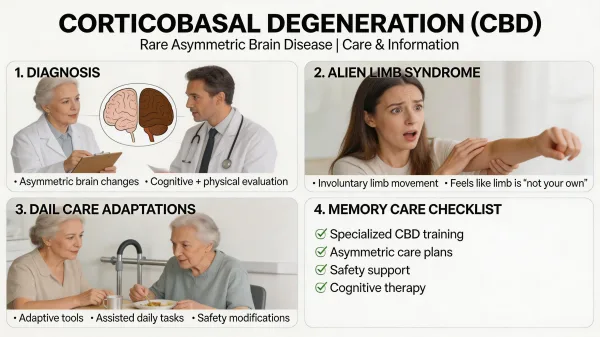
If your parent has received a diagnosis that no one seems able to fully explain, with symptoms that shift from week to week and doctors who don't entirely agree on what's happening, you're not alone. Corticobasal degeneration (CBD) is one of the rarest and most difficult neurodegenerative conditions to diagnose and manage, and the confusion you're feeling is a normal response to an abnormal situation.
CBD affects roughly 5 to 7 people per 100,000, making it far less common than Alzheimer's disease or even Parkinson's. Because of that rarity, many families find themselves explaining the condition to doctors who haven't treated it before, repeating the same questions without getting clear answers. I've watched a family member go through a diagnostic process that stretched over months, with different specialists offering different possibilities. That experience taught me that diagnostic uncertainty doesn't mean your family is doing something wrong. It means the condition itself is genuinely hard to pin down.
This article covers what corticobasal degeneration is, why it's so difficult to diagnose, what alien limb syndrome looks like in practice, and how the asymmetric physical symptoms of CBD create daily care challenges that most memory care facilities aren't specifically designed for. The goal isn't to replace your parent's medical team. It's to give you enough understanding to ask better questions and make more informed decisions about the care your parent needs.
What Is Corticobasal Degeneration?
Corticobasal degeneration is a rare, progressive brain disease that damages the cerebral cortex and basal ganglia, causing worsening problems with movement, memory, speech, and swallowing. It typically begins between ages 50 and 70 and is classified as a tauopathy, meaning abnormal buildup of a protein called tau causes brain cells to deteriorate and die.
One of the most important things for families to understand is the distinction between corticobasal degeneration and corticobasal syndrome. CBD refers to the specific brain pathology, the actual pattern of cell damage confirmed through tissue examination. Corticobasal syndrome (CBS) refers to the set of symptoms a person shows during their lifetime. Here's why that matters: a definitive CBD diagnosis can only be confirmed after death. During life, doctors diagnose CBS based on the pattern of symptoms they observe.
This isn't just a technicality. It means your parent's doctors are working with their best clinical judgment, not certainty. Other conditions, including Alzheimer's disease and progressive supranuclear palsy, can produce symptoms that look very similar to CBS. That overlap is part of why the diagnostic process feels so frustrating for families.
Why Is Corticobasal Degeneration So Hard to Diagnose?
CBD doesn't follow a single predictable pattern. Research has identified at least four different clinical presentations that can result from CBD pathology: corticobasal syndrome, frontal behavioral-spatial syndrome, a form of progressive language difficulty called nonfluent/agrammatic primary progressive aphasia, and progressive supranuclear palsy syndrome. Two people with the same underlying brain disease can look very different from each other clinically.
Imagine your parent's left hand starts reaching for objects on its own, unbuttoning clothing without any conscious intention, while the right side of the body still works normally. You take your parent to a neurologist, then another. One suspects Parkinson's disease. Another raises the possibility of CBD but can't say for certain. A third suggests further testing. That kind of diagnostic disagreement isn't uncommon with this condition, and it can go on for a year or longer.
When our family member's cognitive decline began accelerating, we spent weeks waiting for answers that kept shifting. Each new appointment brought a slightly different explanation, and the uncertainty was isolating in a way I wasn't prepared for. You feel like you should be doing something, making a plan, lining up care, but you can't build a plan around a diagnosis that keeps changing shape. I learned during that time that the in-between period, when you don't have a clear name for what's happening, is one of the hardest stretches any family faces. Patience with the diagnostic process isn't optional. It's a requirement that no one warns you about ahead of time.
What Is Alien Limb Syndrome?
Alien limb syndrome is one of the most distinctive and unsettling features of corticobasal syndrome. A person's hand or arm appears to move on its own, performing actions the person didn't intend: reaching for objects, grasping things, or interfering with tasks the other hand is trying to complete. Some people describe the feeling as though the limb belongs to someone else entirely.
Research suggests alien limb phenomena appear in roughly 30% of people with confirmed CBD pathology. The movements aren't random flailing. They're purposeful-looking actions that happen without voluntary control, which is what makes them so disorienting for both the person experiencing them and the family watching it happen.
For care purposes, alien limb syndrome creates real safety concerns. A hand that unbuttons clothing during dressing, pulls at tubes or medical devices, or grabs hot surfaces requires constant awareness from caregivers. This is one area where standard dementia care protocols don't have built-in solutions, because most memory care training focuses on cognitive symptoms rather than involuntary physical ones.
Living With Asymmetric Symptoms: What Corticobasal Degeneration Means for Daily Care
What families often underestimate is how much CBD's one-sided physical symptoms complicate the daily routines that most memory care facilities handle on autopilot. Alzheimer's and other common dementias primarily affect cognition. CBD hits both the mind and the body, and it hits them unevenly, with one side often far more impaired than the other. That asymmetry changes everything about how care staff assist with bathing, dressing, eating, and mobility.
Consider dressing as an example. A person with CBD may have a stiff, uncooperative left arm with limited range of motion and involuntary grasping, while the right arm works reasonably well. Standard dressing assistance assumes relatively symmetrical ability or limitation. With CBD, the caregiver needs to know which side to dress first (typically the affected side), how to manage a limb that may resist being guided into a sleeve, and how to handle sudden involuntary movements that interrupt the process. The same principle applies to bathing, where one-sided rigidity and an unpredictable limb create fall risks that require adapted positioning, modified transfer techniques, and sometimes two-person assistance for tasks that would normally need one caregiver. These aren't small adjustments. They require training, awareness of which side is affected, and a willingness to build individualized protocols rather than relying on a standard approach that was designed for a different set of needs.
Eating presents its own challenges. If the dominant hand is the affected one, the person may need adaptive utensils, plate guards, or help cutting food, even while their cognitive function remains relatively intact in the early-to-middle stages. That combination of physical impairment on one side with preserved awareness on the other can be emotionally difficult for your parent. They may understand exactly what they want to do but can't get their body to cooperate. I've seen how that kind of gap between intention and ability wears on a person's dignity over time, and it's something care staff need to recognize and respond to with patience rather than efficiency.
Occupational therapy is particularly valuable for CBD and should be part of any care plan from the point of diagnosis. An OT can assess which daily tasks need adaptation, recommend specific assistive devices, and train both the person with CBD and their caregivers on techniques that preserve independence as long as possible. Weighted utensils, one-handed dressing strategies, non-slip mats, and modified grooming tools can make a measurable difference in quality of life.
Mobility is the other major concern. CBD typically causes rigidity and balance problems that worsen on one side, making falls a constant risk. Gait becomes shuffling and unsteady, and many people with CBD need walking assistance within about four to five years of symptom onset. Care staff need to understand that the fall risk isn't just cognitive (forgetting to use a walker) but physical (one leg not responding the way the person expects).
The difference matters. A facility that treats CBD like standard dementia will miss the physical care needs. A facility that treats it like a pure movement disorder will miss the cognitive ones.
What Should Families Look for in a Corticobasal Degeneration Memory Care Facility?
Most memory care facilities are designed around Alzheimer's care. That doesn't mean they can't serve someone with CBD well, but it does mean you need to ask pointed questions before committing.
Start with specific questions. Ask whether the facility has cared for residents with corticobasal syndrome or similar movement-related dementias before. Ask how they handle one-sided physical impairment during ADL assistance, meaning activities of daily living like bathing, dressing, and toileting. Ask whether they have access to occupational therapy and physical therapy on site or by referral, and how often residents with complex physical needs are reassessed as symptoms change.
From my own experience with a family member's care placement, I learned that the most useful question isn't "can you handle this?" because every facility will say yes. The better question is "walk me through how your staff would assist someone who has significant rigidity on one side and involuntary hand movements." The specificity of their answer tells you far more than any brochure or website.
Look for a facility willing to develop an individualized care protocol for the physical asymmetry rather than defaulting to their standard cognitive-decline approach. CBD requires flexibility. A facility that acknowledges what it doesn't yet know about the condition is often a better fit than one that claims to have it all figured out already.
How Does Corticobasal Degeneration Progress Over Time?
CBD is progressive, and there's currently no treatment that slows the underlying brain degeneration. The average survival from symptom onset is roughly 6 to 8 years, though individual cases range widely from about 2.5 years to beyond 12 years.
The typical progression follows a rough pattern. Early symptoms usually affect one limb, often an arm, with stiffness, clumsiness, or tremor. Within the first two years, cognitive changes like memory difficulty and behavioral shifts tend to appear. Speech problems often develop around two to three years in. By about four to five years, most people need assistance walking. Swallowing difficulties usually emerge around year five, which increases the risk of aspiration pneumonia, one of the most common causes of death in people with CBD.
Every case looks different. The speed of decline caught our family completely off guard. We thought we had more time to plan, and we didn't. If your parent has a CBS diagnosis, it's worth having conversations about care levels, financial planning, and long-term placement sooner rather than later, even if the current symptoms seem manageable. The window for making deliberate, unhurried decisions is smaller than most families expect.
How Do Families Pay for Corticobasal Degeneration Memory Care?
Memory care costs in the United States averaged roughly $5,400 to $7,500 per month as of 2025, depending on the source and region. That works out to approximately $65,000 to $90,000 per year. CBD's combination of physical and cognitive care needs can push costs toward the higher end of that range, especially if additional therapies like occupational therapy or physical therapy are needed on an ongoing basis, or if a higher staff ratio is required to manage the one-sided physical impairment safely.
Some facilities use a tiered pricing model where monthly costs increase as care needs intensify. With CBD, that escalation tends to happen faster than with Alzheimer's alone, because the physical decline and the cognitive decline compound each other. A resident who needs two-person assistance for transfers, adaptive equipment for meals, and increased fall-prevention supervision will cost more than someone whose needs are primarily cognitive.
Medicare doesn't cover memory care. Medicaid may cover some costs in certain states, but eligibility requirements are strict and vary by location. Long-term care insurance, VA Aid and Attendance benefits for qualifying veterans or surviving spouses, and personal savings are the most common funding sources. Because CBD's progression can move faster than families anticipate, starting the financial conversation early gives you more options than waiting until a crisis forces the decision.
Planning Ahead After a CBD Diagnosis
A corticobasal degeneration diagnosis can feel overwhelming, partly because the condition is rare enough that even some medical professionals aren't deeply familiar with it. The diagnostic uncertainty, the physical asymmetry, the cognitive changes, and the pace of progression all create a situation where families have to become their own best advocates faster than they'd like.
But understanding the basics of CBD gives you a real foundation. You know now that a definitive diagnosis can't come during life, which means working with "probable" or "possible" is part of the process and not a failure of your medical team. You know the physical symptoms are just as important as the cognitive ones, and that care facilities need to account for both. And you know that planning early, while you still have time to research and compare options, makes every decision that follows a little easier.
You're already doing the right thing by learning about this condition. The fact that you're here, reading and researching, means your parent has someone in their corner who cares enough to figure this out.