
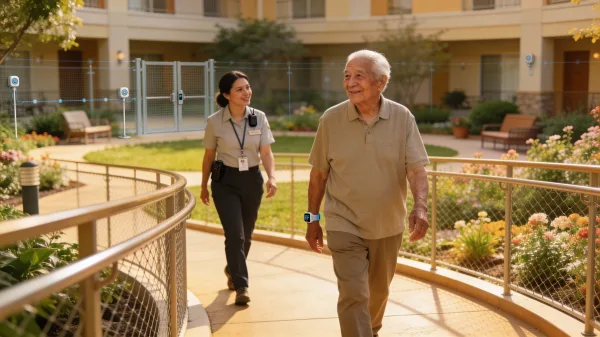
Wandering is dangerous. According to the Alzheimer's Association, 60% of people with dementia will wander at least once, and many do so repeatedly. When someone with dementia leaves a supervised environment and becomes lost, the consequences can be fatal. A 2011 study found that 32% of elopement incidents reported in newspapers ended in death.
Here's how memory care facilities prevent it.
Memory care communities face a fundamental challenge: keeping residents safe from wandering while maintaining dignity, autonomy, and quality of life. The solution isn't simply locking doors. It's creating layered security systems that allow freedom of movement within protected boundaries, use technology to monitor rather than restrict, and train staff to recognize and redirect wandering behaviors before they become dangerous.
This article explains exactly how wandering prevention works in practice, what technologies communities use, how staff respond when prevention fails, and what families should look for when evaluating whether a community's security measures are genuinely effective or just impressive-sounding marketing.
Why People With Dementia Wander
Understanding the causes of wandering helps explain why effective prevention requires more than physical barriers. Dementia damages the brain's ability to process information about location, time, and purpose. Your parent with Alzheimer's might wake up thinking they need to go to work, even though they retired 20 years ago. The brain has reverted to a time when going to work was a daily obligation, and the inability to leave for that "job" creates anxiety and distress.
Disorientation drives many wandering attempts. Your father doesn't recognize his current home as home. He wants to "go home" to the house where he raised his children decades earlier. He sees the exit door and believes walking through it will take him to that remembered place. His brain no longer processes that he's in a care community or that the home he remembers no longer exists or is hundreds of miles away.
Physical restlessness contributes to wandering. Dementia can cause an internal sense of unease that manifests as constant movement. Your mother paces hallways for hours. She's not necessarily trying to leave, she just can't sit still. But that pacing eventually leads her to exits, and without secured doors, she walks through them without understanding she's leaving a safe environment.
Sundowning intensifies wandering risk during late afternoon and evening hours. As natural light fades, many people with dementia become more confused, agitated, and prone to wandering. The person who seemed content all day suddenly becomes determined to leave as the sun sets. Memory care communities must maintain highest vigilance during these predictable high-risk periods.
Past habits and routines trigger wandering. Someone who walked to the corner store every morning for 50 years may still feel compelled to take that walk, even though they can no longer find their way back. The routine is so ingrained that the impulse persists despite cognitive decline.
Environmental factors can stimulate wandering. A window view of a parking lot might trigger the thought "I need to get my car." Seeing other people leave through an exit creates the impulse to follow. Even weather changes can affect wandering behaviors as some people become more restless or agitated with certain atmospheric conditions.
How Memory Care Communities Assess Wandering Risk
Before implementing specific security measures, communities conduct individualized risk assessments. Not everyone with dementia wanders. Not everyone who wanders faces the same risk level. Effective security starts with understanding each resident's specific vulnerabilities.
Admission assessments gather history about past wandering incidents. Has your parent gotten lost before? Have they tried to leave home inappropriately? Have they shown exit-seeking behaviors in previous care settings? Any history of wandering elevates risk assessment.
Cognitive testing evaluates ability to understand safety boundaries. Someone with mild dementia who comprehends that doors lead outside and that they shouldn't leave alone faces lower risk than someone with advanced dementia who doesn't understand the concept of leaving or its dangers.
Behavioral monitoring identifies wandering precursors. Staff watch for pacing, repeatedly checking doors, putting on coats inside, gathering belongings, expressing desire to "go home" or "go to work," or becoming agitated when unable to exit. These behaviors signal elevated wandering risk even if actual wandering attempts haven't occurred yet.
Physical capability assessment determines how mobile and determined a resident might be during wandering attempts. Someone who walks independently and can open doors faces higher risk than someone with limited mobility who needs assistance to walk and lacks the physical strength to operate doors.
Temporal patterns matter. Some residents only wander during specific times like early morning or late afternoon. Others wander consistently throughout the day. Understanding when wandering is most likely helps communities allocate staff supervision appropriately.
Based on these assessments, communities assign security levels ranging from basic supervision to intensive monitoring with RFID tracking and door alarms. These levels adjust as the person's condition changes. Someone who never wandered initially may develop wandering behaviors as dementia progresses, triggering increased security measures.
Security Systems and Monitoring: How the Technology Works
Memory care wandering prevention relies heavily on electronic monitoring systems that track resident location and prevent unauthorized exits. These systems have evolved significantly over the past decade, moving from simple door alarms to sophisticated location tracking with real-time monitoring.
RFID-based wander management represents the most common technology. Residents at risk for wandering wear lightweight bracelets or pendants containing radio-frequency identification chips. These devices are designed to be comfortable, unobtrusive, and difficult to remove. Some look like ordinary jewelry or watches to minimize the institutional feel.
The RFID tags communicate constantly with receivers installed throughout the building. Door readers mounted near exits detect when a tagged resident approaches. The system can be programmed with different response options based on individual resident needs and community preferences.
Some systems simply alert staff when a tagged resident approaches an exit. A notification appears on staff smartphones, pagers, or central monitoring stations indicating which resident is near which door. Staff then respond to redirect the resident away from the exit. This approach maintains a less restrictive environment because doors remain unlocked for other residents, visitors, and staff while still protecting at-risk individuals.
Other systems automatically lock doors when tagged residents approach. The door remains locked for a programmed period, typically 15 to 30 seconds, giving staff time to respond. The lock then releases automatically, preventing the door from remaining permanently locked and creating a fire safety hazard. Staff and visitors use keypads, key fobs, or codes to open doors immediately without delay.
More advanced systems incorporate delayed-exit mechanisms. When anyone pushes the door, an audible tone sounds and a recorded message announces "door opening in 15 seconds." This delay allows staff time to visually confirm who is leaving and whether they should be exiting. Authorized staff and visitors can override the delay with codes or credentials.
Real-time location services (RTLS) provide even more sophisticated monitoring. These systems don't just detect when residents approach exits. They track exactly where each resident is within the building at all times, displaying locations on a digital floor plan visible at nursing stations and on staff mobile devices.
Geofencing capabilities allow staff to define virtual boundaries within the community. You might create a geofence around the secured memory care wing. If a resident crosses that boundary and enters an unrestricted area, the system immediately alerts staff even if the resident hasn't approached an actual exit. This catches wandering attempts earlier in the process.
Zone monitoring tracks how long residents remain in specific areas. If someone enters a bathroom and doesn't emerge within a reasonable time, the system alerts staff to check on them. This prevents residents from getting stuck or injured in areas where they're temporarily out of direct visual contact.
The systems integrate with other building technology. When a wander alert sounds, the system can activate security cameras to provide visual confirmation, flash lights in specific colors to signal staff which type of alert is occurring, and lock down elevators to prevent residents from reaching other floors. Some systems interface with building access controls to secure all exits simultaneously during emergencies.
Battery monitoring is critical for RFID systems. The tags run on batteries that eventually deplete. Good systems track battery life and alert staff when tags need replacement, typically every 6 to 12 months depending on the technology. Without systematic battery monitoring, residents end up wearing dead tags that provide no protection.
Tag tamper detection alerts staff if a resident removes their bracelet or pendant. Some people with dementia figure out how to take off the monitoring device. If the tag separates from the resident, the system should trigger an immediate alert so staff can replace it and ensure the resident remains protected.
The technology generates data that helps communities improve security. Systems log every door approach, every wandering attempt, every alert triggered. This data reveals patterns like which exits residents prefer, which times of day see most wandering attempts, and which residents need adjusted security levels. Communities use this information to refine care plans and allocate staff supervision more effectively.
Environmental sensors supplement RFID tracking. Pressure mats placed near exits detect when someone stands in front of a door. Motion sensors in hallways alert staff to movement during overnight hours when most residents should be sleeping. These sensors catch wandering behavior even for residents who aren't wearing RFID tags.
Video monitoring provides visual confirmation of alerts and helps staff locate residents quickly. Cameras positioned at exits, in hallways, and in common areas allow staff to see what's happening without physically running to every location. However, cameras are prohibited in bedrooms and bathrooms to protect privacy, creating blind spots where only RFID tracking works.
Staff receive alerts through multiple channels to ensure response. A single alert might trigger notifications to nursing station computers, staff smartphones, handheld pagers, and overhead announcement systems simultaneously. This redundancy prevents alerts from being missed because someone's pager was in a pocket they couldn't hear or their phone was on silent.
The systems require ongoing maintenance and testing. Door sensors drift out of alignment. Software needs updates. Network connectivity issues can cause communication failures between tags and readers. Communities should have formal testing schedules where they verify every component of the wander management system weekly. They should also conduct regular drills where staff respond to simulated wandering incidents to ensure everyone knows their role.
Cost varies significantly based on system sophistication and building size. Basic RFID systems for small communities might cost $20,000 to $40,000 for initial installation. Enterprise systems with real-time location tracking and extensive integration capabilities can exceed $100,000 for large facilities. Ongoing costs include tag replacement, battery maintenance, system monitoring fees, and periodic upgrades as technology advances.
Where This Gets Confusing: Secured Doesn't Mean Locked Down
Many families worry that memory care security creates a prison-like environment where residents are confined behind locked doors with no freedom of movement. This misunderstanding comes from not recognizing the difference between secured and restricted.
Secured means exits are controlled and monitored, not that residents are locked in rooms or prevented from moving throughout the community. Residents in well-designed memory care walk freely through all common areas, access secured outdoor courtyards, participate in activities wherever they occur, and move about as they wish within protected boundaries.
The security exists at the perimeter, not within the living space. Imagine a fenced backyard where children play safely. They have complete freedom within that space, but the fence prevents them from wandering into the street. Memory care security works the same way. The entire community functions as a large, secure environment where residents can move freely while being prevented from exiting to potentially dangerous areas outside.
Outdoor access is possible in secured communities through enclosed courtyards and gardens. These spaces have fencing, walls, or architectural barriers that prevent exit while providing fresh air, sunlight, and outdoor stimulation. Residents can walk on paths, sit in gardens, and enjoy outdoor activities without staff worrying about elopement. Some communities design circular walking paths that give the sensation of going somewhere while the path continuously loops back to safe areas.
Visitors come and go freely using codes, keypads, or buzzers. Security systems are designed to recognize the difference between residents who shouldn't exit alone and visitors or staff who need regular access. Family members receive door codes or key fobs that allow them to enter and leave without difficulty.
The technology provides monitoring, not confinement. RFID systems track where residents are, not to restrict them but to ensure staff know their location if assistance is needed. Real-time tracking means residents can move throughout the building independently while staff maintain awareness of everyone's whereabouts for safety purposes.
Activities happen throughout the community, not in locked units. Residents go to dining rooms, activity rooms, therapy spaces, and social areas just like in any other senior living environment. The difference is that all these spaces exist within secured boundaries rather than in open-access buildings.
Some residents don't need monitoring devices at all. Someone with dementia who has never shown wandering tendencies and maintains good awareness of safety boundaries might not wear an RFID bracelet. Security is individualized based on actual risk, not applied uniformly to everyone simply because they have a dementia diagnosis.
The goal is creating safe freedom, not eliminating freedom for the sake of safety. Well-designed security lets residents live as normally as possible within parameters that protect them from the specific dangers their cognitive impairment creates.
Environmental Design That Reduces Wandering
Physical environment design significantly impacts wandering frequency. Smart communities build security into the environment itself rather than relying solely on technology and staff intervention.
Exit disguise reduces wandering attempts by making exits less noticeable. Doors painted the same color as walls blend into the background. Large decorative murals covering doors distract attention from the exit. Some communities install curtains or screens that hide doors from casual view. These techniques work because people with dementia often don't actively search for exits but rather wander toward doors they happen to notice.
Positive environmental distractions draw residents away from exits. An engaging activity space near the nursing station keeps residents in areas with high staff supervision. A cozy television lounge positioned away from exits provides alternative destinations for restless residents. Aquariums, bird cages, and other focal points create interesting stopping points that interrupt wandering patterns.
Strategic furniture placement guides traffic flow. Arranging seating areas to create comfortable gathering spaces naturally draws residents toward those areas and away from exit zones. Open sight lines let staff see residents throughout the space without relying entirely on electronic monitoring.
Visual barriers at exits make doors appear impassable without actually restricting them. A black mat placed in front of a door creates the appearance of a hole or void that people with dementia instinctively avoid. This optical illusion prevents many exit attempts while the door remains fully functional for emergencies.
Confusing spatial layouts naturally reduce successful elopements even when attempts occur. Communities designed with multiple corridors, turns, and intersections create an environment where someone wandering becomes lost within the building before finding an exit. While this seems counterintuitive, getting lost inside a secured building is far safer than getting lost outside in traffic, weather, or unfamiliar neighborhoods.
Abundant natural light and views reduce agitation that triggers wandering. Large windows providing outdoor views, indoor plants, and bright spaces create a less institutional environment where residents feel calmer and less compelled to leave.
Staff Training and Response Protocols
Technology and environmental design support security, but trained staff ultimately prevent most wandering incidents. Communities invest heavily in teaching staff to recognize, prevent, and respond to wandering behaviors.
Pre-wandering behavior recognition forms the foundation of prevention. Staff learn to identify signals that someone is contemplating leaving: repeatedly checking door handles, putting on coats or gathering belongings, pacing near exits, expressing desire to go home or to work, increasing agitation during certain times of day. When staff notice these behaviors, they intervene with redirection before the person reaches an exit.
Redirection techniques provide alternatives that address the underlying need driving wandering impulse. If someone wants to "go to work," staff might redirect them to a meaningful activity like folding laundry or organizing supplies, which mimics the sense of productivity they're seeking. If someone wants to "go home," staff might redirect them to their room, which is their home, while validating their feelings without arguing about reality.
Validation therapy acknowledges emotions without correcting confused beliefs. If your mother says she needs to pick up her children from school, arguing that her children are adults living across the country increases agitation. Instead, staff say "Tell me about your children" or "It sounds like you're thinking about your kids. Let's look at some photos of them." This approach validates the feeling without reinforcing the confused belief or creating conflict.
Scheduled activities during high-risk times prevent boredom-driven wandering. If data shows wandering attempts peak around 4 p.m., communities schedule engaging group activities at 3:30 p.m. to keep residents occupied during vulnerable periods.
Staff-to-resident ratios during different shifts affect wandering prevention capability. Adequate staffing means someone can redirect a resident exhibiting pre-wandering behaviors while others continue supervising the remaining residents. Understaffing creates situations where everyone is too busy to notice warning signs until someone is already attempting to exit.
Communication protocols during shift changes prevent security gaps. Day shift briefs night shift about which residents showed wandering behaviors, who needed frequent redirection, and what triggered exit-seeking attempts. Without this communication, night staff lacks awareness of elevated risks.
Emergency response training prepares staff for successful elopements. Every team member knows their role when someone goes missing: who searches which areas of the building, who contacts law enforcement, who notifies family members, who monitors remaining residents. Communities conduct regular drills to ensure response happens automatically during actual incidents.
What Happens When Someone Does Wander: The Response Protocol
Despite all prevention measures, wandering attempts occur. Effective communities have detailed protocols that minimize danger when prevention fails.
Immediate internal search begins within 60 seconds of discovering a resident missing. Staff systematically check every room, bathroom, closet, and space within the building. They verify locked maintenance areas and storage rooms where residents shouldn't have access but might have entered during brief moments when doors were open. They check outdoor courtyards and secured spaces. This rapid internal search locates many residents who wandered within the building but weren't where staff expected them.
The search expands to the building perimeter if internal search doesn't locate the resident within 5 minutes. Staff check parking areas, loading docks, outdoor equipment areas, and spaces immediately surrounding the building. Many residents don't go far when they first exit. Someone might simply be standing outside the door, confused about what to do next.
Law enforcement notification happens immediately if the resident isn't found within 10 minutes of the initial discovery. Communities provide police with recent photos, detailed physical description, health information including medications and conditions requiring treatment, likely destinations based on history and life story, and areas where the resident was previously found during past wandering incidents.
Family notification occurs as soon as the community recognizes an elopement has occurred. Facilities should not wait until the resident is found to inform families. Immediate transparency allows families to assist with the search by checking locations the resident might have been trying to reach.
The Alzheimer's Association provides registries and response services that help locate missing individuals with dementia. The MedicAlert + Alzheimer's Association Safe Return program maintains profiles of registered individuals. When someone goes missing, caregivers call a 24-hour emergency hotline that shares information with law enforcement nationwide. If the missing person is found by someone who doesn't know them, that person can call the number on the identification bracelet to connect with family immediately.
Silver Alert systems in many states broadcast information about missing elderly or cognitively impaired individuals. Similar to Amber Alerts for missing children, Silver Alerts use highway signs, media announcements, and emergency notification systems to recruit public assistance in locating missing individuals. Activation criteria and processes vary by state.
Search strategies consider known patterns and capabilities. If the resident was a postal worker for 40 years, searchers check the route to the former post office. If the resident walks slowly, searchers focus on nearby areas rather than expanding the radius too quickly. Life history information becomes crucial during search operations.
Time is critical. The first few hours after elopement determine outcomes. People with dementia who wander often lack survival skills needed to seek shelter, find water, or avoid hazards. They may not recognize danger from traffic, water, or weather. They typically don't ask for help from passersby because they don't recognize they're lost or in danger.
Statistical analysis of elopement outcomes shows why rapid response matters. According to research, up to 50% of people with dementia who aren't found within 24 hours die from exposure, dehydration, or injuries sustained during wandering. Most fatal elopements involve people who wandered for extended periods before being located.
Post-incident analysis follows every elopement. Communities conduct thorough investigations to determine how the resident exited, what security measures failed, what staff members were on duty and where they were, what could have prevented the incident. This analysis leads to policy changes, equipment upgrades, training improvements, or staffing adjustments designed to prevent similar incidents.
Families receive detailed incident reports explaining what happened, how long the resident was missing, where they were found, what condition they were in, what immediate medical attention they received, and what changes the community is implementing to prevent recurrence. Transparency during this difficult time helps families understand the incident and evaluate whether the community's response was adequate.
What Good Wandering Prevention Looks Like in Practice
Families evaluating memory care communities need concrete ways to assess whether wandering prevention is genuinely effective or just impressive-sounding technology that doesn't work well in practice.
Ask about recent elopement incidents during tours. Federal regulations require nursing homes to report elopements to the Centers for Medicare & Medicaid Services under 42 CFR § 483.25. Reputable communities should be willing to discuss their safety record, explain what happened during any recent incidents, and describe what they learned and changed as a result. Communities that claim they've never had any wandering incidents are either very new or not being transparent.
Request specific information about staff response times. How long does it typically take from when an exit alarm sounds until a staff member reaches that location? What is the target response time? How is response time monitored and documented? Good communities track these metrics and continuously work to improve response times.
Ask to see the wander management system in action. Some communities provide demonstrations during tours where they show how the RFID bracelets trigger alerts when brought near exits. Watch whether staff respond to test alerts promptly and appropriately. This demonstrates whether the technology is functional and whether staff take alerts seriously.
Observe staff awareness of resident locations during your tour. As you walk through the community, notice whether staff seem to know where residents are. Do staff members visually check on residents regularly? When residents move from one area to another, do staff notice and track that movement? High staff awareness indicates good supervision even beyond electronic monitoring.
Check staffing levels during different shifts. Ask how many staff members work during day shift, evening shift, and overnight. Divide the number of residents by the number of staff to calculate ratios. Memory care ratios typically range from 4:1 to 8:1 during daytime hours and might increase slightly overnight. Ratios higher than 10:1 suggest understaffing that compromises wandering prevention.
Look for environmental design features that reduce wandering. Do exit doors blend into walls or stand out prominently? Are there engaging activity spaces that draw residents away from exits? Do hallways provide interesting destinations rather than just corridors leading to dead ends? Good design reduces wandering motivation.
Request data on wandering attempt frequency. How many exit alerts does the system generate in an average week? How many of those represent actual wandering attempts versus false alarms? Communities tracking this data demonstrate they're actively monitoring and managing wandering risks.
Ask about individualized security levels. Do all residents wear monitoring bracelets, or does the community assess individual risk and provide graduated security? Blanket policies suggest less sophisticated assessment and care planning than individualized approaches based on actual wandering risk.
Making the Decision
Wandering prevention capabilities should rank as a top priority when selecting memory care. Your parent's safety depends on the community's ability to prevent dangerous elopements while maintaining dignity and quality of life.
Effective prevention combines technology, environmental design, and trained staff into layered security that catches wandering attempts at multiple points. The technology monitors and alerts. The environment reduces wandering impulse and makes exits less obvious. Staff recognize pre-wandering behaviors and redirect before residents reach exits.
No system prevents every wandering attempt. What matters is whether the community has robust protocols that minimize risk through multiple protective layers, respond rapidly when prevention fails, and continuously improve based on lessons learned from incidents.
The best memory care communities treat wandering prevention as an ongoing quality improvement initiative rather than a static set of installed equipment. They test systems regularly, train staff continuously, analyze data systematically, and adapt strategies based on changing resident needs and emerging best practices.
Your parent deserves a community where they can live with freedom and dignity within boundaries that keep them safe from the specific dangers their cognitive impairment creates. Effective wandering prevention makes that balance possible.