
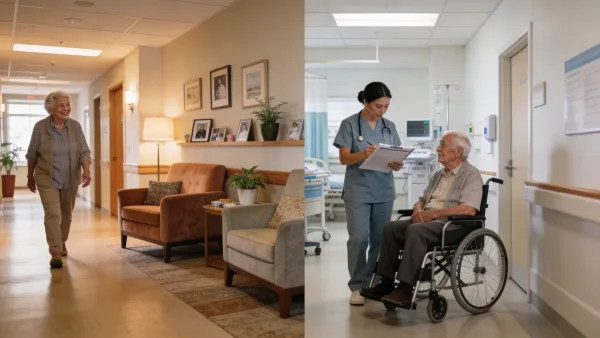
Which one does your parent actually need?
It sounds like a simple question, but for most families it isn't. The terms "senior living" and "nursing home" get used loosely, sometimes interchangeably, and the actual differences between them aren't always obvious from the outside. Both house older adults. Both provide meals and activities. Both have staff. So what's the real distinction, and how do you know which one is right for your parent?
The short answer: the difference comes down to medical care. Senior living communities provide housing, social life, and varying levels of personal assistance. Nursing homes provide 24-hour medical care under the supervision of licensed nurses and physicians. They serve fundamentally different populations with fundamentally different needs, and choosing the wrong one in either direction can mean your parent is overpaying for services they don't need, or, more dangerously, not receiving the medical attention they do.
This article gives you a clear, structured comparison. It covers what each setting actually provides, the medical capabilities that separate them, the cost and coverage differences that affect your family's finances, and a practical framework for determining which one fits your parent's situation right now.
What "Senior Living" Actually Includes
"Senior living" is an umbrella term that covers several distinct types of communities. When families compare senior living vs nursing home options, they're usually referring to one of these:
Independent living is housing designed for adults 55 and older who don't need help with daily activities. These communities offer private apartments or cottages, meals, social programming, housekeeping, and maintenance-free living. There is no medical care or personal assistance included.
Assisted living provides private or semi-private apartments with personal care assistance built in. Staff help residents with activities of daily living (ADLs) like bathing, dressing, grooming, medication reminders, and mobility. Assisted living communities have staff available around the clock, but they are not medical facilities. The care is custodial and personal, not clinical.
Memory care is a specialized form of assisted living designed for people with Alzheimer's disease or other dementias. It offers secured environments, higher staff-to-resident ratios, and programming adapted for cognitive impairment. Like assisted living, it provides personal care and supervision, not skilled medical care.
The common thread across all senior living options is that they're designed for people who need support with daily life, not people who need ongoing medical treatment or skilled nursing.
What a Nursing Home Actually Is
Where this gets confusing is that most people associate nursing homes exclusively with end-of-life care or with the worst institutional stereotypes. Neither is accurate.
A nursing home (also called a skilled nursing facility, or SNF) is a licensed healthcare facility that provides 24-hour nursing care under the direction of a physician. Registered nurses (RNs), licensed practical nurses (LPNs), and certified nursing assistants (CNAs) are on staff at all times. Nursing homes are regulated by both federal and state governments, and those that accept Medicare and Medicaid are subject to regular inspections and quality reporting requirements.
Nursing homes serve two distinct populations that families often conflate. The first is short-term rehabilitation patients: people recovering from surgery, a stroke, a hip fracture, or a serious illness who need daily skilled nursing care and rehabilitation therapies (physical, occupational, speech) before they can return home or move to a lower level of care. The average short-term stay is about 26 days. Medicare covers this type of care under specific conditions.
The second is long-term residents: people with chronic, complex medical conditions that require ongoing skilled nursing supervision. This includes individuals who need wound care, IV therapy, ventilator management, tube feeding, dialysis support, or management of conditions like advanced Parkinson's disease, late-stage dementia with medical complications, or severe chronic illness.
Not everyone in a nursing home is there permanently. And not everyone there is at the end of life. Many people enter for rehabilitation after a hospital stay and leave within weeks. Understanding this distinction changes the entire conversation about whether your parent needs nursing home care.
Medical Care Capabilities: The Core Difference
This is the section that matters most for your decision, because the medical care gap between senior living and nursing homes is not a matter of degree. It's a matter of kind. They are licensed to do fundamentally different things, staffed with fundamentally different professionals, and equipped for fundamentally different medical scenarios.
What senior living can handle medically
Assisted living and memory care communities can manage:
- Medication administration or reminders (depending on state licensing)
- Basic health monitoring (blood pressure checks, weight tracking)
- Coordination with outside physicians, pharmacies, and home health agencies
- Assistance with mobility, including transfers and wheelchair use
- Oversight of chronic but stable conditions like managed diabetes, controlled hypertension, or early to moderate dementia
Some assisted living communities have a nurse on staff during daytime hours, but this is not universal and it's typically not a registered nurse providing direct clinical care. When a resident in assisted living has a medical emergency, the community calls 911. When a resident's health deteriorates beyond what the community can manage, the resident is transferred to a hospital or nursing home.
There are hard limits to what assisted living is licensed to provide. In most states, assisted living cannot administer IV medications, manage ventilators, provide wound care for complex or non-healing wounds, deliver skilled rehabilitation therapies, or handle acute medical crises on-site. These aren't just policy decisions. They're licensing restrictions. The facility legally cannot perform these functions.
What nursing homes can handle medically
Nursing homes are equipped to deliver the following, on-site, around the clock:
- Skilled nursing care including IV therapy, injections, catheter care, and wound management
- Post-surgical care and monitoring
- Rehabilitation therapies: physical therapy, occupational therapy, and speech-language pathology, delivered daily by licensed therapists
- Pain management, including complex medication regimens
- Management of feeding tubes, tracheostomy care, ventilator support
- Dialysis coordination or on-site dialysis
- Skilled management of unstable or complex chronic conditions (diabetes requiring insulin titration, COPD requiring ongoing respiratory therapy, advanced heart failure)
- End-of-life and palliative care, including hospice support
Nursing homes are required to have RN coverage at minimum during specific hours (federal law requires at least 8 hours of RN coverage per day in facilities accepting Medicare/Medicaid), and LPN or RN coverage 24 hours a day. A physician or medical director oversees all care. New federal staffing requirements finalized in 2024 are pushing for higher staffing ratios in nursing homes that accept Medicare and Medicaid.
Where the line falls in practice
The practical question is: does your parent need skilled medical intervention that must be delivered by licensed nurses or therapists, on-site, on an ongoing basis?
If the answer is yes, your parent needs a nursing home, at least for the period during which that skilled care is required.
If the answer is no, and what your parent needs is help with bathing, dressing, medication reminders, meal preparation, and social engagement, then senior living (specifically assisted living or memory care) is the appropriate and usually more comfortable setting.
The gray area exists when a parent's medical needs are escalating but haven't yet crossed into skilled care territory. A parent with worsening diabetes who is still being managed by an endocrinologist on an outpatient basis might be fine in assisted living. A parent whose diabetes has become unstable, causing repeated hospitalizations and requiring daily insulin adjustments by a nurse, likely needs skilled nursing.
When you're unsure, ask the parent's physician a direct question: "Does my parent need daily skilled nursing or rehabilitation services that a licensed nurse or therapist must deliver?" The answer to that question will point you in the right direction.
Cost and Coverage Differences
The financial picture for senior living and nursing homes is dramatically different, not just in the dollar amounts, but in who pays. This is where insurance coverage, particularly Medicare and Medicaid, reshapes the comparison in ways that most families don't anticipate.
Monthly costs (as of 2025)
| Care Setting | National Median Monthly Cost |
|---|---|
| Independent Living | ~$3,100 |
| Assisted Living | ~$5,190 |
| Memory Care | ~$6,450 |
| Nursing Home (semi-private room) | ~$9,277 |
| Nursing Home (private room) | ~$10,646 |
Nursing homes cost roughly 45% to 80% more per month than assisted living, and about 50% more than memory care. This reflects the higher staffing ratios, the presence of skilled medical professionals, and the intensity of care being delivered. Costs vary enormously by state: a semi-private nursing home room ranges from approximately $5,500/month in Texas to over $30,000/month in Alaska.
Medicare coverage: the critical distinction
Here's where the biggest misconception lives. Many families assume Medicare will cover long-term care in either setting. It won't. But Medicare does cover short-term skilled nursing care under very specific conditions, and understanding these rules can save your family tens of thousands of dollars.
Medicare covers nursing home (SNF) care when all of the following are true:
- Your parent had a qualifying inpatient hospital stay of at least 3 consecutive days (time in observation status doesn't count, though some Medicare Advantage plans and ACOs may waive this requirement)
- Your parent enters the SNF within 30 days of the hospital discharge
- Your parent needs daily skilled nursing care or skilled rehabilitation therapy for the condition that caused the hospitalization
When these conditions are met, Medicare Part A covers:
- Days 1 through 20: $0 out of pocket (after the Part A deductible of $1,676 in 2025, which may have already been satisfied during the hospital stay)
- Days 21 through 100: a daily copay of $209.50 in 2025 (Medigap policies may cover this)
- After day 100: Medicare pays nothing. The family is responsible for the full cost.
This means Medicare can cover up to 100 days of skilled nursing care per benefit period, but only for short-term rehabilitation or skilled care needs, not for long-term custodial residence.
Medicare does not cover senior living. Independent living, assisted living, and memory care are not Medicare-covered services. Period. Medicare may cover specific medical services your parent receives while living in a senior living community (like doctor visits, outpatient therapy, or durable medical equipment), but it does not pay for the room, board, or personal care services.
Medicaid coverage
Medicaid is the primary payer for long-term nursing home care in the United States, covering over 60% of all nursing home residents. Eligibility is based on financial need: your parent must have limited income and assets (thresholds vary by state, but generally assets must fall below approximately $2,000 for an individual). Many families "spend down" assets to qualify.
Medicaid coverage for nursing homes pays for a semi-private room, meals, nursing care, and other services. It does not typically cover private rooms.
Medicaid coverage for assisted living is more limited and varies significantly by state. Many states offer Home and Community-Based Services (HCBS) waivers that can help cover some assisted living costs for eligible individuals, but these waivers often have waiting lists and may not cover the full cost of care. Not all assisted living communities accept Medicaid.
What you're actually paying for
When comparing the total cost, consider what's included. Nursing home costs include room, board, all medical care, rehabilitation, medications, and daily nursing. Assisted living costs typically include room, board, personal care assistance, and activities, but medical care, medications, and therapies are usually billed separately through your parent's health insurance.
A parent in assisted living who also needs frequent home health visits, outpatient therapy, and specialist appointments may have a combined cost that approaches nursing home rates, while still not receiving the level of medical oversight a nursing home provides.
How to Determine Which Your Parent Needs
Rather than starting with the setting, start with your parent's actual care needs. Here's a practical framework:
Your parent likely needs senior living (assisted living or memory care) if:
- They need help with daily activities like bathing, dressing, grooming, or meal preparation
- Their medical conditions are chronic but stable and managed by outpatient physicians
- They take medications but can manage them with reminders or staff administration
- They have dementia that requires supervision and structured routine but not skilled nursing
- They're socially isolated at home and would benefit from community engagement
- They need a safer living environment but not a clinical one
Your parent likely needs a nursing home if:
- They need daily skilled nursing care (IV medications, wound care, catheter management, oxygen therapy)
- They're recovering from surgery, a stroke, or a fracture and need intensive daily rehabilitation
- They have complex, unstable medical conditions that require frequent clinical intervention
- They need monitoring by licensed nurses on a 24-hour basis
- They have advanced dementia combined with significant medical complications (recurrent infections, difficulty swallowing requiring tube feeding, non-healing pressure wounds)
- Their physician has recommended skilled nursing as the appropriate level of care
Your parent may need to transition from senior living to a nursing home if:
- Their health has deteriorated to the point where the assisted living community says they can no longer meet the care needs
- They're being hospitalized repeatedly for the same condition
- They need rehabilitation after a hospital stay (this may be temporary)
- Their dementia has progressed to a stage where medical complications require skilled nursing oversight
Common Scenarios That Clarify the Decision
Scenario 1: Your mom is 79, has moderate dementia, and needs help with bathing and dressing. She takes blood pressure medication and a cholesterol pill. Her conditions are stable. She needs memory care (a form of senior living), not a nursing home. Her care needs are personal and supervisory, not medical.
Scenario 2: Your dad is 83 and just had a hip replacement. He needs daily physical therapy and nursing oversight for wound care and pain management during recovery. He needs a skilled nursing facility (nursing home), likely for 2 to 6 weeks. Medicare will likely cover a significant portion of this stay. After rehabilitation, he may be able to return home or transition to assisted living.
Scenario 3: Your mom is 85 and has advanced Parkinson's disease. She has difficulty swallowing, frequent urinary tract infections, and recurrent falls that result in skin tears requiring wound care. She needs a nursing home for long-term care because her medical needs require daily skilled nursing intervention.
Scenario 4: Your dad is 77 and has early-stage Alzheimer's. He's physically healthy but can't manage his own meals, forgets to take medication, and has started leaving the house at odd hours. He needs memory care (senior living), not a nursing home. His care needs are cognitive and supervisory, not skilled medical.
Can Your Parent Move Between Settings?
Yes, and many people do. The care trajectory is rarely a straight line.
A common path is: independent living to assisted living as personal care needs increase, then potentially to memory care if dementia develops, and finally to a nursing home if complex medical needs arise in the later stages.
Short-term nursing home stays for rehabilitation are also common. Your parent might live in assisted living, have a fall, spend a few days in the hospital, go to a nursing home for three weeks of physical therapy, and then return to assisted living. Medicare covers the nursing home rehabilitation stay. The assisted living community may hold their room during the absence (often for a fee).
The key is that these settings aren't permanent labels. They're levels of care that should match your parent's current needs, and those needs will change.
The Bottom Line
The difference between senior living and a nursing home is fundamentally about medical care. Senior living provides a home with personal support and social engagement for people who are largely medically stable. Nursing homes provide clinical care delivered by licensed nurses and therapists for people with skilled medical needs.
Neither one is inherently better or worse. They serve different purposes. The mistake families make most often is placing a parent in a nursing home because it feels safer, when assisted living would provide a better quality of life, or keeping a parent in assisted living when their medical needs have outgrown what the community can provide.
Start with your parent's actual needs. Talk to their physician. Tour both types of settings. Ask direct questions about what each facility can and cannot do medically. The right placement is the one that matches the care your parent needs today, with a clear plan for what happens when those needs change.