
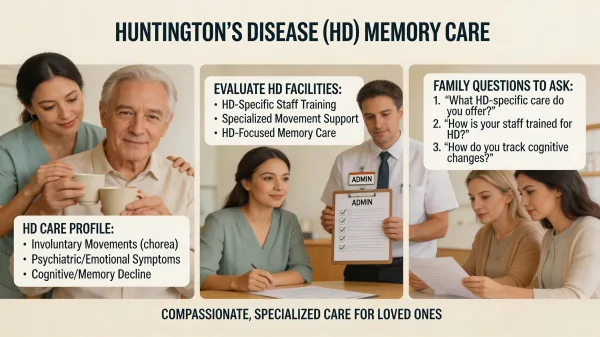
You're sitting across from a memory care admissions coordinator, trying to explain why your mother's care needs don't fit neatly into their standard assessment form. She has chorea, you tell them. The involuntary movements are constant. She needs help with swallowing, her psychiatric medications require careful monitoring, and her cognitive decline is accelerating. The coordinator pauses, then asks if chorea is related to Parkinson's. In that moment, you know this isn't the right place.
If you've watched Huntington's disease move through your family before, that scenario probably doesn't surprise you. You already know what this disease does. You've seen the progression, maybe in a grandparent or an aunt, and now you're facing it again with someone closer. The diagnosis itself isn't the shock. The shock is discovering how few memory care facilities truly understand what Huntington's disease memory care requires and how different it is from caring for someone with Alzheimer's or other common dementias.
This article is written for families like yours: people who already understand HD and are now trying to find a care setting that can handle the full complexity of this disease. We'll cover what makes Huntington's care different, what daily life looks like in a facility, the specific questions you should ask before placing your loved one, and how to find a facility that won't leave you filling in the gaps yourself. Having spent years caring for people whose needs crossed multiple categories at once, I know how critical it is to find a care team that sees the whole person, not just a checklist of symptoms.
When Huntington's Disease Memory Care Becomes Necessary
Most families caring for someone with HD at home reach a turning point where the combination of symptoms becomes unmanageable for one or two caregivers. It isn't usually a single event. It's an accumulation: falls from chorea that happen despite every safety modification, psychiatric episodes that escalate without warning, swallowing difficulties that make every meal a risk, and cognitive decline that makes your loved one unable to participate in their own safety decisions.
The transition point for HD often comes earlier than families expect, especially if the disease has a younger onset. Someone diagnosed in their 40s or 50s may still appear physically strong while their cognitive and psychiatric symptoms create dangerous situations at home. If you're spending more time managing crises than providing actual care, or if your loved one's safety needs exceed what you can deliver around the clock, it's time to start evaluating facilities. That doesn't mean you've failed. It means the disease has reached a stage that requires more hands, more training, and more structure than any home environment can provide.
What Makes Huntington's Disease Memory Care Different From Other Dementias
Huntington's disease attacks the brain differently than Alzheimer's or vascular dementia, and the care it demands reflects that difference at every level. Where most dementias primarily affect cognition (with physical decline coming later), HD hits three systems simultaneously: motor function, psychiatric stability, and cognitive ability. This triad is what makes Huntington's disease memory care so distinct and so difficult to find.
The Motor Challenge: Chorea, Falls, and Constant Movement
Chorea, the involuntary jerking and writhing movements that define HD, creates care demands that most memory care units simply aren't built for. A resident with chorea can't sit still in a standard dining chair. They may throw themselves out of bed during sleep. They bruise easily from bumping into furniture, doorframes, and other residents. Standard fall prevention protocols designed for elderly residents with balance issues don't account for a 50-year-old whose body is in near-constant unpredictable motion.
The fall risk alone changes everything about the physical environment. Padding on bed rails and furniture edges, low beds or floor-level mattresses, wider doorways and hallways to accommodate erratic gait, and staff trained to assist with mobility without restraining the involuntary movements: these aren't optional extras. They're baseline requirements. I've worked with patients in clinical settings whose movement disorders required a completely different approach to physical handling than what most staff are trained for, and the consequences of getting it wrong are serious, from fractures to head injuries.
As HD progresses, chorea may eventually give way to rigidity and akinesia, where the person moves very little or not at all. A facility needs to understand this progression and adjust its care approach as the disease shifts from a movement-heavy phase to a more rigid one. The environmental and staffing needs change with each stage, and a care team that only knows how to manage one phase will struggle when the next one arrives.
The Caloric Crisis Most Facilities Don't Anticipate
Here's something that catches many facilities off guard: a person with active chorea may need 3,500 to 5,000 calories per day just to maintain their weight. The constant involuntary movement burns enormous amounts of energy, and HD may also cause metabolic changes that accelerate weight loss independent of activity level. Research from the Huntington's Disease Society of America confirms that people with HD often have lower body weight for their height and significantly higher caloric needs than average. At the same time, swallowing difficulties (dysphagia) make eating dangerous. The person needs more calories but has a harder and harder time consuming them safely. Standard facility meal plans built around three meals a day with typical senior portions won't come close to meeting this need. Facilities caring for someone with HD need to offer high-calorie, soft-textured foods served in frequent small meals throughout the day, with speech-language pathology oversight for swallowing safety. If a facility tells you they can "accommodate dietary needs" but can't describe a specific plan for high-calorie dysphagia management, that's a red flag.
Psychiatric Symptoms That Overlap With Everything Else
Depression, irritability, impulsivity, apathy, obsessive-compulsive behaviors, and in some cases psychosis: HD's psychiatric symptoms are not secondary concerns. They're core features of the disease, and they often appear before significant motor or cognitive symptoms do. In a care setting, psychiatric management for HD requires staff who understand that a resident's agitation isn't a behavior problem to be managed with redirection alone. It may be a neurological symptom requiring medication adjustment. The interplay between psychiatric medications and chorea medications adds another layer of complexity. Some antipsychotics can help with both chorea and psychiatric symptoms, while others can worsen movement problems. A facility needs access to psychiatric oversight from someone who understands HD specifically, not just general geriatric psychiatry.
From years of working in the hospital system and from my own family's experience with cognitive decline, I've seen what happens when care teams treat each symptom category in isolation. For someone with HD, you can't separate the motor symptoms from the psychiatric symptoms from the cognitive symptoms. They feed into each other constantly. A bad chorea day increases frustration and exhaustion. Frustration triggers psychiatric symptoms. Psychiatric medication adjustments affect motor function. Cognitive decline makes it harder for the person to communicate what they're feeling, which means the care team needs to be skilled at reading nonverbal cues and anticipating needs. Growing up in a caregiving household and then running my own daycare for 10 years, I learned early that the people who need the most care often can't tell you what they need. You have to know them well enough to see it. That same principle applies to HD care, maybe more than any other condition I've encountered. The facility that understands this interconnection, and staffs accordingly, is the one worth your attention.
What Daily Life Looks Like in a Huntington's Disease Care Facility
Daily routines in a well-run HD care setting look different from a typical memory care unit. Mornings may take longer because dressing and personal care require extra time and patience when chorea is active. Meals are structured events with modified textures, high-calorie supplements, and staff who know when to assist and when to step back. Activities are adapted for motor limitations: art therapy with adapted tools, music programs (which can actually reduce chorea temporarily in some residents), and physical therapy focused on maintaining mobility and reducing fall risk.
The environment itself matters. Hallways need to be wide and clear. Furniture needs to be padded or removed where it creates injury risk. Beds may need side padding or floor-level placement. Bathrooms need extra grab bars and shower seats designed for someone whose body moves unpredictably. The best facilities for HD feel spacious and safe without feeling institutional, and they build their programming around what residents can still do rather than what they've lost.
One thing families often don't anticipate is how much the social dynamic differs from a typical memory care unit. Many memory care residents are in their 70s or 80s. A person with HD may be 50 or 55. The age gap can affect everything from activity preferences to how staff interact with them. The best HD care settings acknowledge that their residents may be younger, may have different interests, and may be more physically active (even involuntarily) than the typical memory care population. Ask about this during your evaluation. It matters more than most admissions brochures will tell you.
Questions to Ask Facilities About Huntington's Disease Care
Walking into a facility evaluation armed with the right questions can save your family months of frustration and your loved one from inadequate care. Don't settle for vague reassurances. Push for specifics.
Experience and Training
Ask how many residents with Huntington's disease they currently serve or have served in the past three years. A facility that has never cared for an HD resident isn't automatically disqualified, but you need to understand what training they'll pursue and how quickly. Ask what their staff training includes for chorea management specifically. Can they describe what chorea looks like, how it affects daily care tasks, and how their staff approach a resident whose body is in constant motion? If the admissions coordinator can't answer these questions without consulting someone else, take note.
Swallowing Safety and Nutrition
Ask whether they have a speech-language pathologist on staff or on regular contract who performs swallowing assessments. How often are those assessments repeated as the disease progresses? What does their high-calorie meal plan look like for residents who need 4,000 or more calories daily? Do they offer frequent snacks and supplemental nutrition between meals? Ask who monitors weight trends and at what point they escalate concerns about weight loss. These aren't nice-to-have features. Aspiration pneumonia from swallowing problems is one of the leading causes of death in HD. The facility's approach to dysphagia management is directly tied to your loved one's safety and lifespan.
Psychiatric Medication Management
Ask who manages psychiatric medications and how often they're reviewed. Is there a psychiatrist with HD experience involved in care, or is medication management handled by a general practitioner? How does the facility respond to acute psychiatric episodes: agitation, paranoia, severe depression? What's their protocol, and does it account for the fact that some standard interventions (like certain sedatives) can worsen motor symptoms in HD? Families often discover that the psychiatric piece is where facilities fall shortest. Get specific answers before you commit.
Staffing and Physical Environment
Ask about their staff-to-resident ratio on day shifts, evening shifts, and overnight. HD residents are high-need physically, and if staff are stretched thin, the quality and safety of care drops fast. Ask to see the rooms and common areas. Are there padded surfaces where needed? Is the furniture arranged to minimize injury from falls or involuntary movements? Is there enough space for a wheelchair or walker in the room and bathroom? Take notes on what you see, not just what they tell you.
Activity Programming
Ask how they adapt their activity programming for residents with motor limitations. Can someone with significant chorea still participate in group activities? Do they offer physical therapy, occupational therapy, and speech therapy on-site? What does their approach to engagement look like for someone whose cognitive and motor abilities are declining simultaneously? The best facilities will describe specific adaptations they've made rather than offering generic promises about individualized care.
How to Find the Right Huntington's Care Facility
What most people don't realize until they're in it is that Huntington's care needs are so specific that most standard memory care facilities can't handle them safely. That's not a criticism of those facilities. It's a reflection of how unusual HD's combination of demands is. Your search may need to go beyond the typical "memory care near me" approach.
Start with the Huntington's Disease Society of America (HDSA), which maintains a network of over 60 Centers of Excellence across the United States. These centers can connect you with facilities in your region that have HD experience, and their social workers often know which local care communities have successfully managed HD residents. The HDSA helpline (800-345-HDSA) is a practical first call. If there's no specialized facility in your area, you may need to negotiate an individualized care plan with a memory care community that's willing to learn. Bring your loved one's neurologist or HDSA Center team into those conversations. A facility that's open to collaboration and willing to train its staff on HD-specific protocols can be a good fit, even without prior HD experience.
Costs and Financial Planning for Huntington's Disease Memory Care
Memory care costs nationally average around $7,500 to $8,000 per month as of 2026, but Huntington's disease care often runs higher. The increased staffing needs, specialized dietary requirements, and additional therapy services can push monthly costs above $10,000 in some regions. That's $120,000 or more per year, and HD's progression can span 15 to 20 years from onset to end of life, though the period requiring residential care is typically shorter.
Medicare doesn't cover room and board in memory care facilities, though it may cover some therapy services ordered by a physician. Medicaid coverage varies significantly by state, and some states offer Home and Community-Based Services waivers that can help offset memory care costs. Long-term care insurance, if purchased before symptoms appeared, may cover a portion. Veterans and their spouses may qualify for VA Aid and Attendance benefits. Because HD is genetic and often diagnosed years before care is needed, families who know HD runs in their family have a window for financial planning that families facing Alzheimer's often don't. Use it.
The Genetic Reality: Planning When HD Runs in Your Family
If you're placing a parent with Huntington's disease in memory care, you may also be carrying the weight of knowing that you or your siblings could face the same diagnosis. Each child of a person with HD has a 50% chance of inheriting the gene. That reality shapes everything about how HD families approach care decisions. You're not just choosing a facility for your parent. You may be evaluating what your own future could look like.
This is where HDSA's support services and genetic counseling resources become especially valuable. Whether you've chosen to be tested or not, connecting with the HD community through support groups, Centers of Excellence, and family education programs gives you access to people who understand this specific kind of anticipatory grief. Some families find that the process of placing a parent in care is what finally prompts them to pursue genetic testing for themselves, because the experience makes the question feel less theoretical. Others decide that knowing wouldn't change how they live. There's no wrong answer. But the support exists either way, and you don't have to carry it alone.
Finding the Right Care for Your Family
Placing a loved one with Huntington's disease in memory care is harder than it should be. The disease is rare enough that most care communities don't have experience with it, and the combination of motor, psychiatric, and cognitive symptoms creates demands that standard dementia care wasn't designed to meet. But the right placement does exist, whether it's a specialized unit, a facility with HD experience, or a community willing to build an individualized care plan with guidance from your loved one's medical team.
You already know this disease. You've watched it, and you understand what's coming in ways that most families facing dementia for the first time don't. That knowledge, as painful as it is, is also your advantage. Use it to ask the hard questions, demand specific answers, and hold facilities to a standard that matches what your loved one actually needs. The work you're doing right now, researching, evaluating, advocating, is exactly what good care looks like from the family side.