
What Does It Mean When Words Lose Their Meaning?
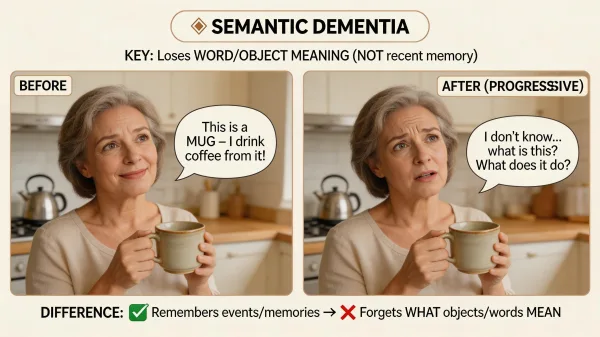
Semantic dementia is a form of frontotemporal dementia (FTD) that progressively erases the brain's ability to understand the meaning of words, objects, and concepts. Unlike typical memory loss, the person doesn't forget recent events. They lose the mental dictionary that gives language and everyday objects their meaning.
That distinction matters for families. Your parent might look at a fork and have no idea what it's for. They might hear the word "coat" and not connect it to anything. They can still speak fluently and walk through their day physically, which is part of what makes semantic dementia so disorienting for the people around them.
I've spent years working with patients who struggle to communicate what they need, whether because of pain, confusion, or cognitive decline. Semantic dementia creates a particular kind of isolation because the person isn't struggling to get words out. The words themselves have lost their meaning.
Semantic dementia falls under the FTD umbrella, a group of conditions that tends to affect people younger than Alzheimer's typically does. According to the Alzheimer's Association, most people with FTD are diagnosed between their 40s and early 60s, and there may be 50,000 to 60,000 Americans living with behavioral variant FTD and primary progressive aphasia combined. For families used to thinking of dementia as a disease of the very old, this can come as a shock.
This article explains what semantic dementia looks like, how it differs from other language-related dementias, and what semantic dementia memory care involves when the person you love is losing the ability to understand the world around them.
What Is Semantic Dementia?
Semantic dementia, known clinically as the semantic variant of primary progressive aphasia (svPPA), is a neurodegenerative condition that attacks semantic memory, the part of the brain responsible for storing the meaning of words, objects, faces, sounds, and concepts. It's caused by progressive damage to the anterior temporal lobes, usually starting on the left side of the brain.
What sets semantic dementia apart from Alzheimer's is the type of memory it targets. Alzheimer's disease typically affects episodic memory first: the ability to recall specific events and recent experiences. A person with Alzheimer's might forget what they had for breakfast or that a grandchild visited yesterday. Semantic dementia works differently. Episodic memory often stays intact in the early stages. Your parent might remember what happened last Tuesday in detail but not be able to tell you what a "Tuesday" is.
The condition is progressive. It typically begins with difficulty naming less common objects or recognizing less familiar words, then gradually extends to everyday vocabulary and common items. Because semantic dementia is a subset of FTD, and FTD itself is far less common than Alzheimer's, many families and even some physicians aren't familiar with how it presents. That unfamiliarity often delays diagnosis.
Where This Gets Confusing: Semantic Dementia vs. Other Language Dementias
Families researching language-related dementias will quickly encounter terms like "primary progressive aphasia" and "frontotemporal dementia," and the overlap can feel overwhelming. Here's the distinction that matters most for care decisions.
Nonfluent variant PPA (sometimes called progressive nonfluent aphasia) affects the ability to produce speech. The person knows what they want to say but can't get the words out smoothly. Speech becomes halting, effortful, and grammatically broken. They understand what a fork is. They just can't say the word.
Semantic dementia is the opposite problem. Speech stays fluent and grammar remains intact. The person can form sentences and speak with normal rhythm. But the words they're using are increasingly empty because the meanings behind them are eroding. They might say "the thing" for every object or use a word like "animal" when they mean "dog." Over time, they might not understand what "dog" means at all.
This difference changes everything about care. A person with nonfluent aphasia needs help expressing themselves. A person with semantic dementia needs help understanding the world around them. The communication style of staff, the physical environment, the structure of daily activities: all of it has to be adapted differently. Confusing the two leads to care approaches that miss the real problem entirely.
What Families Notice First
The early signs of semantic dementia are easy to misread. Your parent might start calling a fork "that thing" or refer to the dog as "the animal." They might ask what a common word means or struggle to follow a conversation that uses vocabulary they've had their entire life. Because they're still physically healthy, mobile, and capable of handling daily tasks, families often chalk it up to normal aging.
It isn't normal aging.
Imagine your father has always been the one who fixed things around the house. One day, he picks up a screwdriver and turns it over in his hand, unsure what it's for. He can describe its shape, the color of the handle, that it feels heavy. But the concept of "screwdriver," what it does, where it belongs in his world, is gone. He's not confused about where he is or who you are. He's lost the meaning of an object he's used thousands of times.
As the condition progresses, this pattern spreads. Common objects lose their purpose. Words that were once automatic become unrecognizable. Faces of acquaintances become harder to place. The person's speech stays fluent but grows increasingly vague, filled with placeholder words that substitute for the vocabulary that's disappearing. Having watched a family member's cognitive decline accelerate faster than any of us expected, I know how unsettling it is when someone you love starts losing pieces of their connection to everyday life.
How Semantic Dementia Memory Care Adapts
Memory care for semantic dementia looks different from memory care designed around Alzheimer's. Alzheimer's-focused programs tend to center on orientation reminders, date boards, and repetition-based memory exercises. Those tools don't help someone who has lost the meaning of the words and concepts being repeated. Semantic dementia memory care has to work around language, not through it.
Visual Cues Replace Verbal Instructions
Staff can't rely on verbal directions like "Please sit in the dining room for lunch." If the resident no longer connects "dining room" or "lunch" to their meanings, those words are noise. Effective programs use photographs, pictograms, and color-coded pathways to guide residents through their day. A picture of a plate and food on the dining room door communicates more than a sign that reads "Dining Room." Labels with both text and images on drawers, closets, and common items help residents find what they need without having to ask, reducing frustration and preserving independence longer.
Simplified Communication
Staff working with semantic dementia residents need to communicate in short, concrete phrases paired with visual context. Pointing, gesturing, and demonstrating actions matter more than explaining them. This requires patience and a willingness to let the resident process at their own speed.
I ran a daycare for 10 years, and one of the first things I learned was that when someone can't find the right word for what they need, your job isn't to correct them or finish their sentence. It's to slow down, pay attention to what they're showing you, and figure out the need behind the attempt. That same principle applies to semantic dementia care, and it's one of the hardest things for untrained caregivers to do consistently. The instinct to fill in words, to rush through a moment of confusion, comes from a good place. But for someone with semantic dementia, that kind of "help" actually increases their frustration and signals that their attempt to communicate failed. The best memory care staff for this population are the ones trained to sit with the silence, respond to gestures and context clues, and never mistake a language gap for a thinking gap.
Activity Programming Beyond Language
Group activities in semantic dementia memory care can't depend on verbal comprehension. Programs that work well include music-based activities (musical memory is often preserved longer than language), art and sensory projects, guided movement, and structured routines built around visual or physical cues rather than spoken instructions. The daily schedule itself becomes a form of communication when it follows consistent patterns the resident can rely on without needing to decode a written or verbal description.
Staff Training on FTD Variants
Not all memory care facilities train staff on FTD variants. When evaluating a semantic dementia facility, ask specifically whether caregivers receive training on frontotemporal dementia and its language subtypes. A facility that understands this condition won't try to reorient your parent with questions like "Do you know what day it is?" That approach works for some dementias. For semantic dementia, it only highlights what the person has lost.
When to Consider Semantic Dementia Memory Care
The transition to memory care is rarely a single moment. For semantic dementia, the trigger often isn't wandering or forgetting people's names. It's the point where the person can no longer safely use common objects, follow safety-related instructions, or communicate basic needs.
Ask yourself a few practical questions. Can your parent still use kitchen appliances safely? Do they understand what "hot" or "sharp" means in context? Can they follow a simple safety instruction like "don't touch the stove"? If verbal warnings no longer register because the words have lost their meaning, home-based care becomes a safety risk that's hard to manage even with a full-time caregiver present.
I've seen families stretch themselves thin trying to keep a loved one at home, convinced that the right caregiver or the right schedule will make it work. Sometimes it does, for a while. But semantic dementia is progressive, and the gap between what a person can understand and what their environment demands of them only widens over time.
The average time to receive an accurate FTD diagnosis is 3.6 years, according to the Association for Frontotemporal Degeneration. That delay means many families are already in crisis by the time they have a name for what's happening. If your parent has a confirmed diagnosis and you're noticing daily safety concerns, it's reasonable to start evaluating semantic dementia memory care options now rather than waiting for an emergency to force the decision.
What Semantic Dementia Memory Care Costs
Memory care costs for semantic dementia are comparable to memory care for other forms of dementia. The national median runs between $7,000 and $8,000 per month as of 2025, according to data from the Genworth/CareScout Cost of Care Survey. That's roughly $84,000 to $96,000 per year, with some facilities in higher-cost areas exceeding $10,000 monthly.
Medicare doesn't cover memory care. Medicaid may help in some states through Home and Community-Based Services waivers, but eligibility and covered services vary widely. Veterans and surviving spouses may qualify for VA Aid and Attendance benefits. Long-term care insurance, if purchased before the diagnosis, can offset some costs.
Because FTD often strikes younger than Alzheimer's, many families face these expenses while still in their working years, before they've had time to plan financially. That makes early planning critical.
Moving Forward from Here
Semantic dementia is one of the harder dementias for families to wrap their heads around. Your parent looks healthy. They can still walk, eat, and get dressed. But the vocabulary of daily life is disappearing, and with it, their ability to understand the world the way they once did.
The right semantic dementia memory care environment won't reverse the condition, but it can reduce daily confusion, protect your parent's safety, and preserve their dignity in ways that home-based care often can't once the disease has progressed. Look for facilities that understand FTD, train staff on language-variant dementias, and build their programming around visual and sensory cues rather than verbal instruction.
No two families experience this condition the same way, and you don't have to figure out every step right now. Start with understanding what you're dealing with, learn what good care looks like for this specific diagnosis, and trust yourself to make the right call when the time comes. You're already doing the hard work by looking for answers.