
This article provides general information about Agent Orange presumptive conditions, VA benefits, and senior living options. It isn't medical, legal, or financial advice. VA benefit amounts, eligibility rules, and senior living costs change over time and vary by state. Families should confirm current details with the VA, a VA-accredited claims agent, and the specific senior living communities they're considering before making decisions.
Your dad has diabetes, ischemic heart disease, prostate cancer that's been treated, and a knee that won't hold him up anymore. Three of those are Agent Orange presumptive conditions. The fourth isn't, but it's the one keeping him from getting around the house he's lived in for forty years. Your mom passed nine months ago, and the family has been taking shifts driving over to check on him. It isn't working anymore. Now you're trying to figure out whether he belongs in assisted living, a continuing care retirement community, or a state veterans home. And every option sounds different depending on who you ask.
This is the reality for thousands of families. Vietnam veterans are aging into care needs, often with three, four, or five service-connected conditions interacting at once. I've watched this from the hospital side of the equation for two decades, and the Vietnam veterans who come through the ER often carry a stack of diagnoses the care system struggles to treat together. Agent Orange senior living decisions are rarely clean. It's about whether a community can actually manage a veteran with multiple chronic conditions, how VA benefits change the financial math, and which option makes sense given wait lists, family proximity, and the trajectory of his conditions over the next decade.
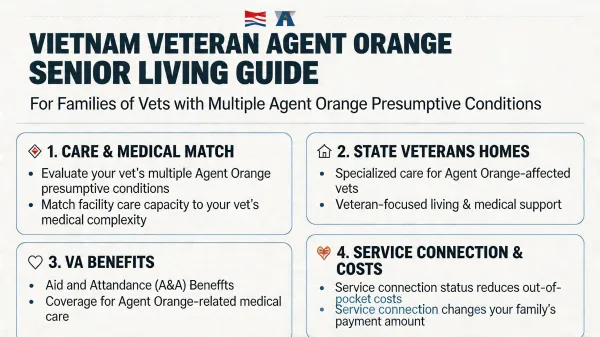
This guide walks you through how to match care capacity to medical complexity, how state veterans homes compare to Vietnam veteran assisted living options and CCRCs, and how Agent Orange service connection changes what families pay.
What Agent Orange Presumptive Conditions Mean for Care Decisions
The VA recognizes a list of conditions it presumes are connected to Agent Orange exposure for veterans who served in Vietnam, near the Korean DMZ, and at certain bases in Thailand and Laos during defined periods. The list includes type 2 diabetes, ischemic heart disease, hypertension, Parkinson's disease, Parkinsonism, early-onset peripheral neuropathy, hypothyroidism, and multiple cancers including prostate, respiratory, bladder, and several blood and lymph cancers. The PACT Act, passed in 2022, expanded both the condition list and the qualifying locations.
For senior living decisions, presumptive status matters for two reasons. First, each condition that's service-connected carries a disability rating, and those ratings drive benefit amounts. Second, once a veteran reaches a combined rating of 70% or higher, the VA covers significantly more long-term care. That single threshold changes almost everything about the financial picture.
Senior Living Options for Vietnam Veterans: Quick Comparison
Here's how the three main options compare for a veteran with multiple presumptive conditions.
| Feature | State Veterans Home | Assisted Living | CCRC |
|---|---|---|---|
| Typical monthly cost | $1,700 to $10,000+ (varies widely by state) | ~$6,200 national median | $3,700+ monthly at independent level, plus entrance fee |
| Entrance fee | None | Community fee, typically $1,000 to $5,000 | $100,000 to $1M+ |
| Clinical capacity | Skilled nursing (most homes), some domiciliary/assisted | Personal care, limited nursing oversight | Varies by tier, with progression built in |
| Who it fits best | Veterans needing skilled nursing with 70%+ rating | Veterans needing daily help but clinically stable | Veterans planning 10+ years ahead with assets to commit |
| Wait list | Weeks to months, sometimes longer | Usually immediate to a few weeks | Varies widely |
| VA payment | Federal per diem plus veteran contribution, fully covered at 70%+ service connection for skilled nursing | Aid and Attendance can offset, but VA doesn't cover room and board | Aid and Attendance may offset monthly fees |
Costs reflect 2024 to 2025 data from the CareScout Cost of Care Survey and public state veterans home fee schedules.
Matching Care Capacity to Medical Complexity
This is where most families get tripped up. A community that markets beautifully and shows well on a tour may not have the clinical capacity to manage a veteran juggling diabetes, heart disease, mobility limitations, and a cancer history. A community that looks plainer may have registered nurses on site every shift and real relationships with specialists who round through the building. The marketing doesn't tell you that. The staffing records do.
I've worked with patients across twenty years of hospital radiology, in the ER and in orthopedics, and one thing I've watched over and over is the gap between how many diagnoses a patient carries on paper and how that complexity actually gets managed day to day. A patient with six conditions needs someone who's looking at those conditions together, not six separate providers each addressing one problem in isolation. Senior living communities are no different. The question isn't whether they can handle diabetes. It's whether they can handle diabetes plus heart failure plus early Parkinson's plus a history of cancer, and whether the staff can catch when one of those conditions is quietly pulling the others out of balance. Vietnam veterans with multiple Agent Orange presumptive conditions sit squarely in that high-complexity category, and the community you choose has to be equipped for it. That's why this article exists. Too many multi-diagnosis veterans get treated as if they have one condition, and by the time somebody notices the pattern, a preventable hospitalization has already happened.
Start with staffing ratios. Ask the community what licensed nursing coverage looks like across all three shifts, not just weekdays. Many assisted living communities have strong nursing presence during the day and thin out overnight, which matters for a veteran whose heart medication timing or blood sugar swings don't respect business hours. Ask how many residents each nurse covers on the night shift. If the answer is a large number or the staff seems unsure, that's useful information.
Next, ask about on-site specialist access versus referred access. Some communities bring in a cardiologist, a neurologist, or a podiatrist on scheduled rotations. Others refer residents out to appointments, which means family members or staff coordinate transportation, wait times, and records handoffs. For a veteran with multiple presumptive conditions, coordination matters enormously. A dropped thread between a cardiologist and a primary care provider can turn a medication adjustment into a hospitalization.
Finally, ask about care conferences. Good communities pull the resident's full medical picture into one meeting every few months, with nursing, the medical director, social work, and the family together. Communities that don't do this tend to manage conditions in silos. For a multi-diagnosis veteran, that's a real risk.
When you tour, the marketing team will show you the dining room and the activities calendar. Walk past the nursing station at three in the afternoon. Watch for a minute. You'll learn more from that than from any brochure.
State Veterans Homes: What Families Should Know
State veterans homes can be the right answer for many multi-condition Vietnam veterans, but they come with tradeoffs. Most state homes offer skilled nursing, and some offer domiciliary or assisted living tiers. Admission criteria vary by state, and most require proof of honorable discharge along with either state residency or state of record at enlistment. Spouses and sometimes Gold Star parents may qualify on a space-available basis.
The financial picture is where state veterans homes often shine. For veterans with a service-connected disability rated 70% or higher, the VA's higher per diem can cover the full cost of skilled nursing care in a state home. Below that threshold, costs vary widely. Illinois caps resident contributions at $1,720 a month as of 2025. Arizona charges between roughly $5,850 and $10,695 a month depending on which of its four homes you're entering. Most other states use sliding scales based on ability to pay.
The biggest catch is the wait list. I've watched families count on a state home bed that was still months away when they needed it last week. Many state homes, particularly their memory care or Alzheimer's units, run wait lists of weeks to months. If a state home is on your list, get the application started early, even before you're sure you'll use it.
Assisted Living and the Multi-Condition Veteran
Assisted living works well for veterans who need help with a handful of daily activities but are clinically stable. The national median cost is about $6,200 a month as of 2025, or roughly $74,400 a year. For multi-condition Vietnam veterans, the question isn't whether assisted living can house them. It's whether a specific community can actually manage the complexity.
Some assisted living communities have strong nursing presence, on-site specialists, and staff trained to work with veterans. Others are primarily personal care settings with limited clinical depth. When I did mobile X-ray work inside care facilities, I saw that gap in person, and it rarely showed up in the marketing materials. For a veteran with diabetes plus heart disease plus a cancer history, the second type of community will quietly shift the clinical load onto family members and outside providers. That can work if the family is engaged and local. It often doesn't work if they're not.
Ask whether the community has experience with veterans who have three or more chronic conditions. Ask what triggers a transfer out to a higher level of care. Ask how often residents end up moving because the community couldn't manage their needs anymore. The last question is the one families forget to ask, and the answer tells you a lot.
CCRCs and the Long-Term Trajectory
Continuing care retirement communities, or CCRCs, are built around the idea that a resident moves through levels of care as their needs change. A veteran might enter at independent living, shift to assisted living in a few years, and eventually move into skilled nursing, all within the same community. That continuity is valuable for a multi-condition veteran whose trajectory is hard to predict.
The catch is the entrance fee. CCRC entry fees commonly run from $100,000 to well over $1 million, with monthly fees on top. For a Vietnam veteran with strong assets and a desire to plan far ahead, this can be a reasonable fit. For most families making decisions in a crunch, it's not the option that makes sense. Also, not every CCRC has strong clinical capacity across all tiers. Some are excellent at independent and assisted living but weaker at skilled nursing. Ask to see the nursing tier before you commit, not just the marketing center.
How VA Benefits Stack with Senior Living Payment
This is where the financial picture for Vietnam veterans with Agent Orange conditions gets interesting, and where families often leave money on the table. There are three primary VA benefits that intersect with senior living payment, and they interact in ways that aren't obvious.
Aid and Attendance is an enhancement to the basic VA pension for wartime veterans who need help with activities of daily living. As of December 1, 2025, the maximum annual pension rate with Aid and Attendance is $29,093 for a single veteran and $34,488 for a veteran with one dependent. That translates to roughly $2,424 to $2,874 a month, tax-free. Aid and Attendance can be applied toward assisted living, in-home care, or other senior living costs. The net worth limit for the benefit year running through November 30, 2026, is $163,699, which excludes the primary residence and basic personal items.
VA disability compensation is separate from pension. It's based on service-connected disability ratings and isn't needs-based. A Vietnam veteran with a 70% rating receives just over $1,800 a month; at 100%, the basic rate is nearly $3,950 a month for a veteran with no dependents. For veterans with multiple Agent Orange presumptive conditions, combined ratings often reach 70% or higher, which opens the door to the next benefit.
The big one for senior living is VA long-term care coverage. Veterans with a service-connected disability rated 70% or higher, or veterans whose nursing home need is tied to a service-connected condition, can receive skilled nursing care at a state veterans home, a VA Community Living Center, or a contracted community nursing home with the VA paying the full cost. No copay. This is the benefit that changes the math entirely for multi-condition Vietnam veterans. If Dad's combined Agent Orange rating is 70% or higher, skilled nursing at a state veterans home may cost the family nothing out of pocket. That fact is worth confirming with a VA-accredited benefits counselor before any other decision gets made. Keep in mind this coverage applies to skilled nursing and certain specialized settings, not to traditional assisted living room and board. Aid and Attendance can still offset assisted living costs, and some services delivered inside an assisted living community may be covered under VA health care benefits.
Where the Math Gets Interesting
Families often assume the state veterans home is always the right answer for a Vietnam veteran with Agent Orange conditions. Sometimes it is. Sometimes it isn't. The state home might be two hours away from family. The wait list might be six months. The specific home might have a weaker memory care unit than a private community nearby. And if the veteran's combined service-connected rating is below 70%, the financial advantage narrows.
A veteran with a 60% combined rating, strong assets, and adult children who live ten minutes from a high-quality assisted living community may do better staying local, using Aid and Attendance to offset the monthly fee, and saving the state home as a later option if skilled nursing becomes necessary. A veteran with a 100% rating and no family nearby may be better off in a state home that's a longer drive but fully covered and staffed with other veterans who share his history. Neither answer is universally right.
Questions to Ask Before You Commit
When families are weighing options, these are the questions that tend to cut through the marketing and reveal what actually matters.
What is your parent's combined VA disability rating today, and is it current? Ratings change when new conditions get added, and many Vietnam veterans are under-rated because they never filed claims for every presumptive condition they qualify for. Before picking a senior living option, get the rating updated. A jump from 60% to 70% can change what the VA pays for.
How is the community going to manage your parent's full medical picture, not just the individual conditions? Ask for a named care manager. Ask who coordinates with his cardiologist, his endocrinologist, and his oncologist. Get specifics.
What happens when his needs change? Does he move to a different wing, a different building, a different community? The transition plan matters more than families realize. I've seen too many Vietnam veterans moved three times in two years because nobody thought through the trajectory at the start.
What's the true all-in monthly cost? Ask about medication management fees, incontinence care surcharges, mobility assistance upcharges, and the community fee. The quoted base rate is rarely the final number.
A Final Word for Families
Choosing senior living for a Vietnam veteran with multiple Agent Orange presumptive conditions isn't a single decision. It's a series of them, and the right answer depends on his rating, his trajectory, your family's proximity, and how honest a given community is willing to be about its clinical capacity. The decision deserves time, and it deserves careful comparison against what the VA actually owes him for his service.
Start with the rating. Confirm it's current and accurate. Then work outward from there: figure out which benefits stack, what the true costs are, and which communities can actually manage complexity rather than just promising they can. Tour more than one. Walk past the nursing station. Ask the questions the marketing team won't volunteer answers to.
Your dad earned more than a brochure and a smile. He earned honest information and a family willing to dig in. You're already doing the harder work by reading this. Keep going.