
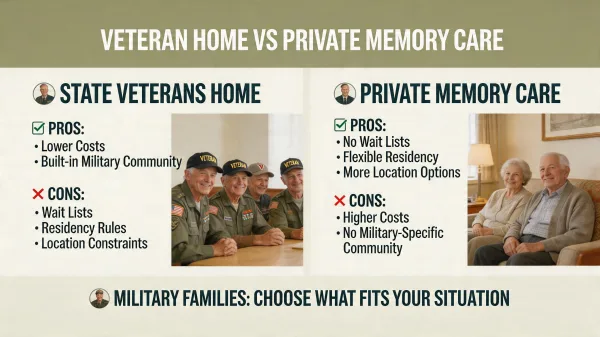
Your father has Alzheimer's. The private memory care community down the street from you quotes $10,000 a month. The state veterans home an hour north quotes $2,800. You stare at the two numbers and a question forms: is a state veterans home really that much cheaper, and if so, what's the catch?
The honest answer is yes, state veterans homes are often dramatically less expensive, and the catch is real but not as bad as most families assume. State veterans home vs private memory care is one of the most consequential comparisons military families make, and it's one where the math pushes most families toward state homes earlier than they expect. I've been inside a lot of facilities doing mobile X-ray work, and I researched the state veterans home system specifically for this article. The quality varies wildly between private and state-run options, and the answer isn't what most families expect.
This guide breaks down the real 2026 cost difference, how VA per-diem payments actually work, wait list realities, eligibility rules, and the quality and location tradeoffs. By the end, you'll have a clear framework for deciding whether the state veterans home near you is the right fit, or whether private memory care makes more sense for your family's situation.
State Veterans Home vs Private Memory Care at a Glance
Here's the short-form comparison most families are looking for before they get into the details. State veterans home vs private memory care breaks down roughly like this:
| Factor | State Veterans Home | Private Memory Care |
|---|---|---|
| Typical monthly cost to family (2026) | $0 to about $3,500 out-of-pocket | $5,430 to $11,200 median, state-dependent |
| Who pays | VA per-diem + state subsidy + resident co-pay | Private pay, LTC insurance, sometimes Medicaid |
| Wait time | Weeks to many months, varies by state | Usually available within days to weeks |
| Eligibility | Service requirement + state residency rules | Anyone who can pay and meets care criteria |
| Dedicated memory care unit | Many, but not all | Built as memory care from the start |
| Quality oversight | CMS + annual VA inspections | State licensing agency only |
| Location options | Limited: often 1-5 homes per state | Hundreds of options in most metro areas |
The table tells you the headline, but the decision usually turns on two factors: how long the wait list is at the state home nearest you, and whether your veteran qualifies for the higher VA per-diem rate that zeros out the out-of-pocket cost.
What Is a State Veterans Home?
A state veterans home is a skilled nursing facility owned and operated by a state government specifically for veterans, their spouses in some cases, and Gold Star parents. Every state has at least one, and most have several. The VA recognizes each facility that meets federal standards and pays the state a per-diem rate for every eligible veteran resident.
Three funding sources combine to keep costs low. The VA provides construction grants of up to 65% of the cost to build or renovate these facilities, the state funds the rest plus ongoing operations, and the VA pays a daily per-diem rate for each qualifying veteran. That funding model is the structural reason state veterans homes can charge a fraction of what private memory care charges. Private facilities don't get construction grants, don't receive per-diem payments, and typically operate for profit.
Most state veterans homes offer skilled nursing care, and many have dedicated memory care units for residents with dementia. Some also offer domiciliary care (closer to assisted living) and adult day health care. Not every home has a secured memory care unit, which is the first thing to check if your parent needs that level of care.
The Real Cost Comparison and What's Behind It
The cost gap between state veterans home memory care and private memory care is one of the largest in all of senior care. Understanding what drives that gap helps you evaluate whether it's real savings or hidden tradeoffs.
Private memory care in 2026 runs a national median of roughly $7,505 per month according to U.S. News analysis, with A Place for Mom data showing state medians ranging from about $4,800 in the least expensive states to $11,200 in the most expensive. Annualized, that's $90,000 to $134,000 per year, and costs typically rise 3-5% annually. Most families pay privately from savings, long-term care insurance, or home equity. Medicaid covers memory care in some states through specific waiver programs, but private memory care communities that accept Medicaid are limited.
State veterans homes operate on a completely different financial model. The VA publishes annual per-diem rates, and there are two tiers. The basic per-diem rate is paid to the state for any eligible veteran and covers a portion of the daily cost. The higher "prevailing rate" (under 38 U.S.C. 1745) is paid for veterans rated 70% or more service-connected disabled, or rated 100% based on individual unemployability, and this rate is usually enough to cover the entire cost of nursing home care. For FY2026, the VA increased prevailing rates by 3.2% over FY2025 levels. For a veteran who qualifies for the prevailing rate, the out-of-pocket cost to the family is typically zero. For veterans who only qualify for the basic rate, the state, the veteran, and sometimes Medicaid fill the gap, and the monthly cost to the family usually lands somewhere between $0 and $3,500 depending on the state and the veteran's income.
I've been inside a lot of care facilities through mobile X-ray work, including places that served veteran populations and places that didn't. The gap between what families were being told about cost and what was actually happening inside the buildings was often the biggest surprise of the whole process. When my own family went through dementia care planning, the sticker shock hit us hard. Seeing those private-pay numbers next to what a state veterans home charges for comparable or better care is genuinely one of the biggest wake-up calls in this space. It's the kind of gap that changes how you think about the decision.
That adds up fast. Over a typical three-year memory care stay, the difference between $10,000 a month and $2,800 a month is about $260,000. For families whose veteran qualifies for the prevailing rate, the difference is closer to $360,000. That money stays with the surviving spouse or the estate instead of being transferred to a facility. When you're looking at state veterans home cost versus private memory care cost, the numbers aren't close.
Wait List Reality and How to Plan Around It
The biggest practical obstacle to state veterans home memory care isn't cost or eligibility. It's the wait list. Most state veterans homes operate near full capacity, and wait times for a memory care bed specifically tend to run longer than wait times for general skilled nursing.
Typical wait times run anywhere from a few weeks to more than a year depending on the state, the specific home, and the level of care needed. Some states publish current wait times; most ask families to apply and then wait for a call. Rural states with one or two homes often have shorter waits than populous states with homes clustered around major metros. The veterans home wait list for dedicated memory care beds is almost always longer than the wait for regular skilled nursing beds, because those units have fewer rooms and longer average stays.
What moves a veteran up the list varies by state, but a few factors consistently matter. Veterans rated 70% or more service-connected disabled often get priority. Medal of Honor recipients and former prisoners of war typically go to the top in states like California. Some states prioritize by wartime era (Oklahoma still gives World War II veterans priority, with later wartime eras following). Applicants being discharged from a hospital who need immediate skilled care often jump the line ahead of routine applicants. Homelessness can also move a veteran up.
The most important strategy families often miss: apply early, even if you aren't ready to move your parent yet. Once the application is submitted and the pre-admission assessment is complete, your parent's name is on the list and the wait clock is running. Families who wait until the crisis hits spend months in the worst possible position. Most state veterans homes will let you decline the first bed offered without losing your spot in some cases, though rules vary by state, so ask.
Most families end up using some form of bridge care during the wait. That might be home care with a dementia-trained aide, a short-term stay at a private memory care community, or adult day health care combined with family caregiving. The cost of bridge care is real, but when the alternative is years of private memory care at $8,000 a month, six to twelve months of bridge care usually pencils out. Plan for it, budget for it, and don't be caught flat-footed when the wait stretches longer than you hoped.
Who Qualifies for State Veterans Home Memory Care?
State veterans home eligibility rules vary from state to state, but a few basic requirements are nearly universal. The veteran must have served on active duty for at least 90 days (some exceptions apply for service-connected disabilities incurred in shorter service). Discharge must be honorable or other-than-dishonorable. The veteran must meet the state's residency rules, which range from 90 days of current residency to entering service from the state (home of record) to three years of residency before application.
Spouses can sometimes be admitted alongside the veteran, depending on the state and bed availability. Some states require the spouse to be 55 or older, a state resident, and covered by insurance. Gold Star parents (parents of service members who died on active duty) have been eligible since 2010. Surviving spouses sometimes qualify if the marriage met minimum duration requirements.
The level-of-care requirement is a separate gate. To qualify for state veterans home memory care specifically, your parent needs a clinical assessment showing they require the level of care the facility provides. That usually means skilled nursing plus secure memory care, and the facility's admissions coordinator will schedule a pre-admission assessment as part of the application process.
Quality and Care Differences You Should Expect
State veterans homes aren't automatically better or worse than private memory care. They're different, and the quality spectrum within both categories is wide. A few structural differences matter.
Oversight is more layered at state veterans homes. The Centers for Medicare & Medicaid Services inspects them on the same schedule as any skilled nursing facility, the VA conducts its own annual inspection to verify continued recognition, and the state's health agency licenses them. Private memory care communities are regulated primarily by the state licensing agency for assisted living, which varies considerably in rigor from state to state. Serious quality problems at state homes have happened, but the inspection trail is more public.
Staff culture tends to differ too. State veterans homes often employ staff who are veterans themselves or come from military families, and the residents have a shared background that affects daily life in meaningful ways. Group activities, military commemorations, and the social environment reflect the population. For a veteran with dementia who still responds to cues from their service years, that environment can be grounding in ways private memory care often isn't.
The facility side has real variance. Doing mobile X-ray work, I've walked into facilities where the marketing brochure didn't match what I saw once I was inside. That's true of state homes and private communities alike, so tour in person, visit more than once, and stop by at odd hours when the staff isn't expecting you. The quality question isn't state vs private; it's this specific facility versus that specific facility.
Location, Distance, and Family Involvement
One of the most underestimated parts of the state veterans home decision is the location tradeoff. Most states have fewer than ten homes total, and in many states the nearest one is an hour or more from where you live. Private memory care is often five or ten minutes away.
Distance affects visits, and visits affect outcomes. Regular family contact slows behavioral decline in dementia, keeps staff attentive, and helps families catch problems early. An hour each way, twice a week, is four hours of driving plus visit time. Families with young children, demanding jobs, or their own health issues often find that a closer private facility they visit four times a week does more for their parent than a cheaper state home they visit twice a month.
On the other hand, the savings from a state veterans home can fund visits you couldn't otherwise make. Some families use the monthly difference to pay for a regular driver, a weekly gift basket delivery, or one family member flying in monthly. Think through what the actual visit pattern will look like, not what you hope it will be.
How to Decide Between a State Veterans Home and Private Memory Care
The right choice depends on specifics. A framework helps. Work through these questions with the actual details of your situation:
Service and documents: Do you have the DD-214 and any VA disability rating paperwork? Is your parent rated 70% or more service-connected? If yes, the state home cost is likely zero and the math is overwhelming. If not, the cost gap is still large but the math includes a real co-pay.
Residency: Does your parent meet the state residency rule for the state home you'd use? If not, is there a home of record from active duty that might qualify them elsewhere?
Wait time tolerance: Can your family manage 6 to 12 months of bridge care? If the answer is no, the state home option might not be reachable for this placement even if it's the better long-term fit.
Distance: Is the nearest state home within a range your family can actually sustain for regular visits? Who would be making those visits, and how often?
Memory care unit presence: Does the nearest state veterans home have a secured memory care unit, or only general skilled nursing? If your parent wanders or has significant behavioral symptoms, a facility without secured memory care isn't the right answer at any price. Walking into facilities across every tier, I can tell you the difference between a facility designed for memory care and one retrofitted to handle dementia residents shows up in every corner of the building.
If most answers point toward the state home and your family can absorb the wait, that's usually the right call. If the wait is too long, the distance is too far, or no memory care unit exists at the nearest home, private memory care with VA benefits like Aid & Attendance applied against the cost is often the better path.
Common Questions About Veteran Memory Care Options
A few questions come up in nearly every family conversation about this comparison, and they're worth addressing directly.
Can my mother live at the state veterans home with my father? Sometimes, depending on the state and bed availability. Some states admit spouses on a space-available basis with their own age, residency, and care-need requirements. Others don't. Ask the specific home.
What if the nearest state home doesn't have a dedicated memory care unit? Not every state veterans home has secured memory care, and for many dementia residents that's a problem. Some homes manage dementia residents in general skilled nursing with added staff supervision, which can work for mid-stage dementia but often doesn't work for later stages when wandering or significant behavioral symptoms appear. If the nearest home doesn't have memory care, consider whether a home in another state would qualify based on your parent's home of record.
Can I combine Medicaid with a state veterans home? Yes, in most cases. State veterans homes typically accept Medicaid for residents who qualify, which fills the gap between the VA per-diem rate and the full cost of care. Medicaid rules for long-term care eligibility vary by state and involve income and asset limits.
What if the wait is too long for our situation? Apply anyway, then use bridge care. A year of home care or short-term private memory care is almost always cheaper than permanently placing in private memory care when a state home spot would have been available six months later.
Conclusion
Choosing between a state veterans home and private memory care comes down to whether your family can get through the wait, manage the distance, and access a home that has the right level of care for your parent. When those pieces line up, the savings are extraordinary and the quality is often comparable or better. When they don't, private memory care with VA benefits applied is a reasonable path that many military families take.
The worst outcome isn't choosing one over the other. The worst outcome is not doing the homework, missing the state home option entirely, and spending $300,000 more than you had to across a multi-year stay. The comparison is worth the afternoon it takes to make it.
Start by pulling your parent's DD-214 and disability rating paperwork, then call the admissions office at the nearest state veterans home. Ask about current wait times for memory care specifically, what residency rules apply, and whether your parent would likely qualify for the prevailing per-diem rate. One phone call usually tells you whether to pursue the state option or move directly to private memory care planning. Your family deserves the full picture before you decide.