
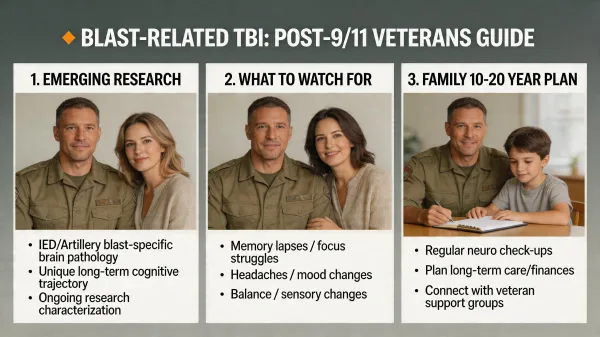
This article is for informational purposes only and is not medical, legal, or benefits advice. Blast-related traumatic brain injury is an active area of research, and findings are still evolving. If you have concerns about a veteran's cognitive health, talk with a VA clinician, a neurologist, or a neuropsychologist. For questions about disability ratings or caregiver benefits, contact a VA-accredited representative or your local VA Caregiver Support Program team.
"My husband was exposed to dozens of IED blasts in Iraq. What does that mean for his brain 20 years from now?" That question has been asked in quiet kitchens and VA waiting rooms for more than a decade. The honest answer is that researchers are still working it out, and the families living with it can't afford to wait for a clean conclusion.
The blast TBI cognitive effects seen in post-9/11 veterans look different from the impact-based traumatic brain injuries that show up after car crashes and sports collisions. Blast injuries often don't appear on standard imaging. Some symptoms don't surface for years. And the pathology emerging from autopsy studies of service members exposed to improvised explosive devices and artillery appears to involve a pattern of scarring that hasn't been described in civilian head-injury cases.
This article walks through what the research actually says about blast-related TBI and long-term cognitive health, what that may mean for care planning over the next 10 to 20 years, and what families of combat veterans can do now. I've treated acute TBI patients in emergency and orthopedic settings for nearly 20 years, but I'll say this upfront: I haven't personally followed the long-tail presentation of blast TBI. What's emerging about blast injury is different from what I see on a Friday night shift, and I wanted to make sure I was learning from the research, not extrapolating from what I already know.
What Blast-Related TBI Actually Is
Blast-related traumatic brain injury is a brain injury caused by exposure to the pressure wave from a high-explosive detonation, such as an IED, artillery round, mortar, or breaching charge. It differs from impact TBI, which results from a direct blow or a sudden acceleration-deceleration of the head. Blast TBI can occur with or without a head strike, and it often leaves no obvious external sign of injury.
Blast injury is typically divided into four categories. Primary blast injury is caused by the overpressure wave itself passing through brain tissue. Secondary injury comes from fragments and debris striking the head. Tertiary injury occurs when the body is thrown against something. Quaternary injury includes burns, inhalation effects, and toxic exposures. A single blast event often involves more than one mechanism at once, which is part of why blast TBI can be hard to characterize in a medical record.
What makes the post-9/11 experience distinct is the volume of exposure. Thousands of service members were exposed repeatedly, often to IEDs in Iraq and Afghanistan and to training blasts at home. Many of those exposures never showed up as a documented TBI diagnosis at the time.
Why Blast TBI May Be Different: The Emerging Pathology
The most-cited piece of evidence that blast TBI may have its own pathology is a 2016 post-mortem study from the Uniformed Services University of the Health Sciences and the Department of Defense Joint Pathology Center, led by Dr. Daniel Perl and published in The Lancet Neurology. The researchers examined brain tissue from five service members with chronic blast exposure, three with acute blast exposure, five civilians with chronic impact TBI, five with a history of opiate exposure, and additional healthy controls. In every chronic blast case, they found a distinctive pattern of astrocyte scarring at specific tissue boundaries: the subpial glial plate beneath the cortex surface, the grey-white matter junction, the tissue around penetrating cortical blood vessels, and the structures lining the ventricles. The civilian impact TBI cases did not show this pattern, and neither did the opiate or healthy control brains. Researchers now call this finding interface astroglial scarring, often abbreviated IAS.
The working hypothesis is that the blast pressure wave moves through the brain and concentrates stress at physical interfaces where tissue density changes, such as where grey matter meets white matter or where brain tissue meets cerebrospinal fluid. Those are the same locations where the scarring shows up. Computational modeling and follow-up neuroimaging work have supported this interface-injury idea, and a 2024 PNAS study of active-duty Special Operations Forces personnel found structural and neuroinflammation changes in the rostral anterior cingulate cortex that appear consistent with the same mechanism.
Not everyone agrees on how far to push the interpretation. A 2017 letter in the same journal from military epidemiologists pointed out that the original case series was small, the controls were limited, and no in-life diagnostic test for IAS currently exists. That's still true. You can't get an IAS diagnosis from a living person today. What researchers can measure are surrogate markers: blood tests for tau, phosphorylated tau, neurofilament light chain, and glial fibrillary acidic protein; advanced imaging such as diffusion tensor MRI and specialized PET; and neuropsychological testing. None of those is definitive on its own.
There's a second strand of research that matters for families. A growing body of work suggests that repetitive low-level blast exposure, the kind experienced by breachers, heavy-weapons operators, mortarmen, and instructors, can produce cumulative neurobiological changes even without a single diagnosable TBI event. Studies of Army Rangers firing mortars, Canadian breachers, and US Special Operations Forces have found biomarker changes, subtle cognitive slowing, and balance and sensory integration issues that look a lot like what's seen after concussion. This matters because many post-9/11 veterans were exposed to hundreds or thousands of training blasts in addition to combat.
What I keep coming back to in reviewing this literature is how different the clinical picture looks from the acute head injuries I've imaged over nearly two decades in emergency and orthopedic settings. An impact TBI usually presents with a story, a scan, and a fairly predictable recovery curve over the weeks that follow. Blast TBI often has none of those clear markers in the short term, and what it leaves behind may not fully show itself for years, sometimes decades. When I first started reading the Shively paper and the follow-up work that came out of the Perl lab, it reframed how I think about the veterans who come through the department for unrelated injuries and mention they "got rung" in Iraq but were told they were fine. Fine at the time may be a separate question from fine 20 years later.
Long-Term Cognitive Effects Seen in Combat Veterans
Research on TBI and long-term cognition in veterans has grown considerably since 2014, when a study of nearly 190,000 veterans aged 55 and older found that those with a TBI diagnosis had a substantially higher risk of developing dementia during a nine-year follow-up period than those without. More recent work on younger post-9/11 cohorts has found that even mild TBI, including cases without loss of consciousness, was associated with a roughly twofold increase in the risk of a later dementia diagnosis.
The blast TBI cognitive effects that families most often describe include slowed processing, difficulty with short-term memory and word-finding, trouble with multitasking and planning, light and sound sensitivity, sleep disruption, and increased irritability or emotional reactivity. These symptoms overlap substantially with PTSD, depression, and chronic pain, which is part of why blast TBI is hard to untangle clinically. Researchers sometimes refer to this as the "polytrauma clinical triad" of TBI, PTSD, and chronic pain.
No one can say with confidence whether a specific veteran will develop dementia decades from now. What the data does support is that the risk is higher and that cognitive changes can emerge gradually rather than all at once.
What to Watch For Over the Next 10 to 20 Years
For families of veterans in their 40s and 50s who were exposed to blasts in Iraq, Afghanistan, or in training, the next two decades matter. Early changes are often subtle. They're easy to attribute to stress, age, or a demanding job.
Patterns worth tracking include a slow decline in organizational skills, repeated word-finding problems that weren't there before, increasing reliance on lists and reminders for things that used to be automatic, new difficulty following a conversation with background noise, and personality shifts that feel outside the normal range of a hard week. Sleep problems and headaches that don't respond to usual treatment are also worth raising with a clinician.
None of these on their own means a veteran is heading toward dementia. But a pattern that gets worse year over year, especially when compared against how the veteran functioned in their 30s, is worth documenting. That's different from catastrophizing. It's the same principle a cardiologist uses when tracking slow changes in blood pressure over time.
Planning for a 20-Year Horizon
Most memory care content is written for families dealing with a parent in their 70s or 80s. That isn't the situation for post-9/11 blast-exposed veterans and their spouses. A 48-year-old Iraq veteran exposed to dozens of IEDs may have 30 more working years ahead of him, or may not. Either way, he's too young for traditional memory care today, and the planning horizon is longer than most families are used to thinking about.
The single most useful thing a family can do right now is document a cognitive baseline while the veteran is functioning well. A formal neuropsychological evaluation, ideally through the VA or a VA-affiliated provider, creates a reference point that future evaluations can be measured against. Without a baseline, subtle decline a decade from now can be explained away as normal aging or stress. With a baseline, the same change becomes measurable. Request copies of every evaluation for your personal records. After years of working around hospital records, I can tell you that VA records can be hard to retrieve after the fact, and having your own copy saves a lot of time when it matters.
Second, have the hard conversations while the veteran is the one making the decisions. Advance directives, durable power of attorney for healthcare and finances, and clear written preferences about future care settings are much easier to put in place at 48 than at 68. These documents don't assume anything bad will happen. They mean that if something does, the veteran's own voice is in the plan.
Third, build what I think of as a watchlist without catastrophizing. A simple written log that tracks sleep quality, headache frequency, mood changes, and any concerning cognitive moments can be reviewed annually with the veteran's primary provider. This kind of documentation often matters more than any single scan, because TBI long-term effects reveal themselves as patterns, not as single events. Families who wait until something is clearly wrong often lose years of useful data.
Finally, talk about money and care preferences together. Memory care and skilled nursing can cost well over $100,000 a year, and even veterans with strong VA benefits often face gaps in long-term care coverage. The financial picture for a veteran with cognitive decline in his 60s looks very different from one in his 80s, because Social Security and most retirement accounts haven't fully kicked in yet. Knowing what you're working with now is better than finding out later.
Working With the VA on Screening, Ratings, and Benefits
Since 2007, the VA has conducted mandatory TBI screening for all post-9/11 combat veterans who enroll in VA care. The screening is a four-question tool. A positive screen triggers a comprehensive TBI evaluation with a specialty provider, which may include neuropsychological testing and input from social work, speech-language pathology, and physical or occupational therapy. If a veteran hasn't had this evaluation, it's worth requesting.
VA rates TBI under Diagnostic Code 8045 in 38 CFR §4.124a, with ratings from 0 percent to 100 percent based on residual symptoms across 10 facets including memory, judgment, social interaction, and subjective symptoms. For veterans with moderate or severe TBI, the VA recognizes certain conditions as presumptive, including dementia diagnosed within 15 years of the injury, Parkinson's disease, seizures, and depression within specified windows. This means service connection for those conditions is easier to establish.
For families providing day-to-day support, the Program of Comprehensive Assistance for Family Caregivers may help. Eligibility generally requires a veteran with a service-connected disability rating of 70 percent or higher who needs in-person personal care for at least six continuous months. Benefits include a monthly stipend, health insurance for the caregiver through CHAMPVA if otherwise uninsured, mental health counseling, respite care, and legal and financial planning assistance. The VA Caregiver Support Line is 1-855-260-3274. The War Related Illness and Injury Study Center also provides second-opinion comprehensive interdisciplinary evaluations for combat-deployed veterans with unexplained persistent symptoms.
When Blast-Related Changes Overlap With Early-Onset Dementia
One of the hardest clinical situations families can face is a veteran in his 50s whose cognitive changes look like early-onset dementia. The evaluation process needs to rule out treatable causes first: sleep apnea, medication effects, severe depression, thyroid problems, and B12 deficiency can all mimic dementia and are common in veteran populations.
After reversible causes are addressed, a neurologist or neuropsychologist can help sort out whether the pattern points toward Alzheimer's disease, frontotemporal dementia, chronic traumatic encephalopathy, or a primarily TBI-related cognitive syndrome. The distinction matters for treatment planning, for VA claims, and for family expectations about the trajectory. It isn't a diagnosis a primary care appointment can reliably make on its own.
Common Questions Families Ask
Some families ask whether a normal brain MRI means everything's fine. It doesn't. Standard MRI and CT often miss blast-related changes, which is why advanced imaging and neuropsychological testing exist. A clean MRI is useful information but isn't a clean bill of cognitive health.
Others ask whether cognitive rehabilitation actually helps. The evidence is mixed and the studies are imperfect, but many veterans report meaningful functional gains from speech-language therapy, occupational therapy, and cognitive rehabilitation, especially when combined with treatment for sleep, pain, and mood. It's worth pursuing.
And many spouses ask whether they're overreacting by worrying this early. They usually aren't. The veterans I've worked with who are doing best long-term are the ones whose families started paying attention early, documented what they saw, and built a relationship with VA providers before anything was urgent.
Looking Ahead Without Panic
What the research says about blast TBI and long-term cognition is that the risk is real, the pathology may be distinct, and the full picture will take another 20 to 30 years to come into focus as post-9/11 veterans age. That's a hard thing to sit with as a family. It's also not the same as a diagnosis. Most veterans exposed to blasts will not develop dementia. Some will. The goal of planning isn't to predict which group a specific veteran ends up in. It's to make sure that whatever happens, the veteran's voice is in the plan and the family has the information and support it needs.
If you're the spouse or adult child of a post-9/11 combat veteran, you don't need to have all the answers today. You do need a baseline, a care team, and a running record. Start there. The rest gets easier to build on.