
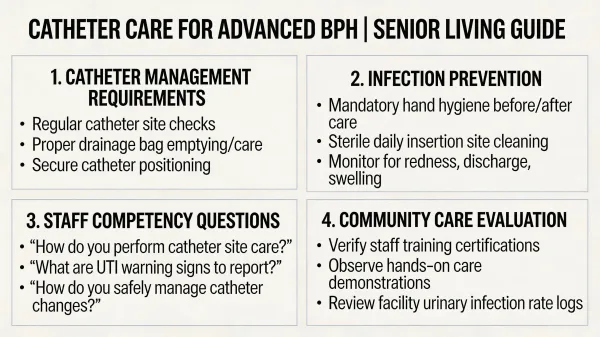
Can an assisted living community safely manage your father's urinary catheter? The answer depends entirely on the community's clinical staffing, licensing, and the specific training their caregivers have received. Not every community that says yes to catheter residents actually has the skills to manage catheter care safely around the clock.
Benign prostatic hyperplasia, commonly called BPH, is one of the most common conditions in older men. By the time men reach their 80s, up to 90% have some degree of prostate enlargement, and a significant number end up requiring a catheter when the bladder can no longer empty on its own. For families, the shift from "Dad can manage this himself" to "Dad needs someone else handling his catheter" often happens faster than expected. Maybe his hands have become too unsteady. Maybe cognitive decline has made the daily routine unreliable. Either way, the family is now looking for a care community that can take over a task that carries real medical risk if done incorrectly.
I've worked inside healthcare facilities for nearly two decades, and I can tell you that catheter care quality is one of the clearest markers of a facility's overall clinical competence. This article covers what BPH-related catheter dependence looks like, what skills a care community must have to manage it safely, and the specific questions you should ask before trusting any community with your father's catheter care.
What Is BPH and How Does It Lead to Catheter Dependence?
Benign prostatic hyperplasia is the gradual enlargement of the prostate gland. The prostate surrounds the urethra, and as it grows, it compresses the tube that carries urine out of the bladder. Over time, the bladder has to work harder to push urine through the narrowed opening, and the muscle can weaken from the strain. For many men, medications or surgery can manage BPH effectively. But for seniors who aren't candidates for surgery due to age, frailty, or other health conditions, the prostate continues to obstruct urine flow until the bladder can't empty at all. That's acute urinary retention, and it's a medical emergency.
Research published in PMC shows that 10% of men in their 70s and 30% of men in their 80s will experience acute urinary retention within five years. When retention becomes chronic and surgery isn't an option, the standard solution is catheterization. Your father may have an indwelling Foley catheter that stays in place continuously, or he may need intermittent catheterization several times a day. Both require specific care skills that go beyond what most families can sustain at home long-term.
What Types of Catheters Are Used for BPH?
The two primary catheter types families encounter with BPH are indwelling (Foley) catheters and intermittent catheters. An indwelling Foley catheter is a flexible tube inserted through the urethra into the bladder, held in place by a small inflated balloon, and connected to a drainage bag that collects urine continuously. The bag needs to be emptied regularly, the catheter site needs daily cleaning, and the entire catheter is typically replaced every four to six weeks by a nurse.
Intermittent catheterization involves inserting a straight catheter several times daily to drain the bladder, then removing it each time. This approach carries a lower infection risk than an indwelling catheter because the device isn't left inside the body permanently. However, it requires more skill and consistent timing because someone must perform the insertion procedure multiple times per day using proper sterile or clean technique. For a senior with hand tremors, cognitive changes, or limited mobility, self-catheterization may no longer be possible.
Catheter Management: The Skills a Community Must Have
This is where families need to pay close attention. Catheter care isn't a single task. It's a set of interconnected clinical skills that must be performed correctly every time, on every shift. The consequences of poor catheter management are serious: catheter-associated urinary tract infections (known as CAUTIs) account for roughly 1 million cases per year in the United States and are the most common healthcare-associated infection in long-term care. The risk of developing bacteriuria, the precursor to infection, increases 3% to 7% with each day a catheter remains in place. That daily compounding risk is exactly why every person who touches your father's catheter system needs to know what they're doing.
For an indwelling Foley catheter, competent daily care includes keeping the drainage bag below the level of the bladder at all times to prevent urine backflow, emptying the bag before it becomes more than two-thirds full using a clean technique with gloves and a disinfected spigot, cleaning the catheter insertion site daily with soap and water without pulling or tugging on the tubing, monitoring urine output for changes in color, clarity, odor, or volume that could signal infection or blockage, and securing the catheter tubing to the thigh to prevent tension on the urethra. Staff must also recognize the signs of catheter blockage, which include sudden drops in urine output, complaints of pressure or pain in the lower abdomen, and urine leaking around the catheter. A blocked catheter isn't something that can wait until morning. It requires immediate intervention, often catheter irrigation or replacement by a licensed nurse.
Staff should also know the signs of a developing CAUTI, including fever, increased confusion (which is often the first sign in elderly patients), cloudy or foul-smelling urine, and new onset of pain. I've visited care facilities where the day shift handled catheter care with gloves, proper hand hygiene, and careful documentation, then walked back through on night shifts to find drainage bags sitting on the floor, tubing kinked under mattresses, and no gloves in sight. That shift-to-shift inconsistency is what puts residents at risk, and it's more common than families realize.
If your father uses intermittent catheterization, the skill requirements are even more specific. Each insertion must follow clean or sterile technique depending on the physician's orders and the community's protocol. The person performing the catheterization needs to be trained in proper lubrication, gentle insertion without forcing past resistance, timing intervals prescribed by the urologist (often every four to six hours), and thorough hand hygiene before and after every procedure. Intermittent catheterization in a senior living setting almost always requires a licensed nurse, not a certified nursing assistant. This is a critical distinction when evaluating communities.
Before you sign any agreement, ask these specific competency questions: How many current residents does your community manage with indwelling catheters? Who on your staff is trained and licensed to perform catheter changes and intermittent catheterization? What is your CAUTI rate for the past 12 months? What is your catheter care protocol, and is it based on CDC guidelines? Is a licensed nurse present on every shift, including nights and weekends? What happens if a catheter becomes blocked at 2 a.m.? Do you have a relationship with a urology provider for urgent consultations? The answers will tell you whether this community has real clinical capacity or is simply checking a box.
Where This Gets Confusing: Acceptance vs. Competence
Many assisted living communities will tell you they accept residents with catheters. That's not the same thing as having staff trained in proper catheter management. In many states, a standard-licensed assisted living community can allow staff to empty a catheter bag as part of routine toileting assistance, but everything beyond that, including catheter changes, insertion, irrigation, and clinical monitoring, requires a licensed nurse or a third-party home health provider. Some communities outsource all catheter-related nursing care to home health agencies, which means the actual care your father receives depends on whether that agency sends qualified staff consistently.
The gap between "we accept catheters" and "we competently manage catheters" is where problems happen. Ask directly: does your community manage catheter care with your own nursing staff, or do you rely on an outside provider? If the answer is outside provider, ask how quickly that provider responds to urgent catheter issues and what happens after hours.
How Much Does Senior Living Cost for a Catheter-Dependent Parent?
The base cost of assisted living has climbed steadily. According to the 2025 CareScout Cost of Care Survey, the national median monthly cost for assisted living is $6,200, which works out to $74,400 per year. But base rate is just the starting point for a catheter-dependent resident. Most communities charge additional fees for higher levels of care, and catheter management typically falls into the highest care tier. Expect a care surcharge of $500 to $1,500 or more per month depending on the community and the type of catheterization involved.
If the community relies on third-party home health for catheter changes and clinical monitoring, those visits may or may not be included in your monthly cost. Medicare may cover some home health nursing visits if your father qualifies, but coverage has limitations and gaps. Factor in catheter supplies, which can run $100 to $300 monthly depending on the type and frequency of changes. The total cost for a catheter-dependent senior in assisted living can easily reach $80,000 to $95,000 annually. That's a number worth knowing early in the planning process.
When Is Assisted Living Not Enough?
Assisted living works for many catheter-dependent seniors, but there are situations where it falls short. If your father has frequent catheter blockages requiring emergency intervention, recurring CAUTIs that need IV antibiotics, significant cognitive decline that causes him to pull at or remove the catheter, or a need for intermittent catheterization combined with other complex medical conditions, a skilled nursing facility may be the safer option. Skilled nursing provides 24-hour licensed nursing care and has the clinical infrastructure to handle complications immediately. The staff-to-resident ratio is also higher, which means catheter issues get addressed faster.
The cost difference is significant. The 2025 CareScout survey puts the national median for a semi-private nursing home room at $315 per day, or about $114,975 per year. A private room runs approximately $355 per day, totaling around $129,575 annually. These numbers are sobering, but choosing a lower level of care to save money only works if the care is actually adequate. A preventable CAUTI that leads to hospitalization, sepsis, or worse costs far more than the difference between assisted living and skilled nursing. I've seen families caught in this exact cycle, where a few months of savings on a cheaper placement led to repeated ER visits that could have been avoided with better clinical oversight from the start.
Can Your Father Stay Home with Catheter Care Instead?
Some families explore keeping a catheter-dependent parent at home with professional support. This can work if you have reliable home health nursing visits for catheter changes and monitoring, a family caregiver or paid aide who is trained in daily catheter maintenance including bag emptying, hygiene, and output monitoring, and a plan for urgent situations like blockages or sudden signs of infection. The 2025 CareScout survey reports the national median for home health aides at $35 per hour. Assuming 44 hours of care per week, that totals $80,080 per year for aide services alone, before adding the cost of skilled nursing visits for catheter changes.
Home care gives your father familiar surroundings and one-on-one attention, but it also puts a heavy coordination burden on the family. Missed nursing visits, caregiver turnover, and middle-of-the-night emergencies are all realities of home-based catheter care. There's no wrong answer here, only trade-offs that each family has to weigh for themselves.
What Should You Look for During a Community Visit?
When you tour a potential community, look beyond the lobby. Ask to see a resident room where catheter supplies would be stored. Ask how staff documents catheter output and care tasks. Look at the staffing schedule posted on the unit and note whether licensed nurses are present on all three shifts. Ask the director of nursing how they handle catheter training for new staff and how often competency is reassessed. Find out whether the community tracks CAUTI rates and whether those numbers are available to families.
Pay attention to small details. Are hand sanitizer dispensers full and positioned near resident rooms? Do staff members wear gloves during personal care tasks? Is the nursing station organized or chaotic? These observations tell you a lot about the clinical culture of a building, and clinical culture is what determines whether your father's catheter care will be consistent or hit-or-miss.
During my years doing mobile X-ray work in care facilities, I saw everything from impeccable catheter protocols to alarming neglect. The facilities that got it right shared a common thread: nursing leadership treated catheter care as a clinical priority, not an afterthought. In those buildings, I noticed that supplies were stocked properly, documentation was current, and staff could describe the catheter care protocol without hesitating. The facilities that struggled were the ones where catheter management was treated like any other routine task, with no extra training, no auditing, and no accountability when corners were cut. You can usually tell within a single conversation with the director of nursing whether catheter management is taken seriously or treated as just another checkbox on the admission form.
Helping Your Father Adjust to Catheter-Dependent Living
The medical logistics matter, but so does your father's dignity. Living with a catheter is physically uncomfortable and emotionally difficult, especially for someone who managed independently for most of his life. A good care community respects that. Staff should be discreet during catheter care, maintain your father's privacy, and communicate with him about what they're doing rather than treating him like a task to complete.
Consider a situation where your father has been managing his own Foley catheter for months, handling the bag changes, the daily cleaning, and the drainage routine himself. Then a hand tremor starts making the process unreliable, and mild cognitive changes mean he sometimes forgets whether he emptied the bag an hour ago or six hours ago. That transition from independence to dependence is one of the hardest moments in the whole caregiving journey, and finding a community that handles it with both clinical skill and human decency makes all the difference.
Making the Right Placement Decision
Finding the right senior living community for a catheter-dependent father takes more homework than the average placement search. You're not just evaluating activities and dining programs. You're evaluating clinical competency for a care task that directly affects your father's health every single day. Ask the hard questions. Request documentation of staff training. Talk to families of other catheterized residents if the community will facilitate that. Your father deserves a community where every caregiver on every shift treats his catheter care with the same level of skill and attention.
The fact that you're reading this and asking these questions means you're already doing right by your parent. BPH and catheter dependence don't have to limit your father's quality of life, but the level of care he receives will shape everything. Take the time to find a community that earns your trust, not just one that has an open bed.