
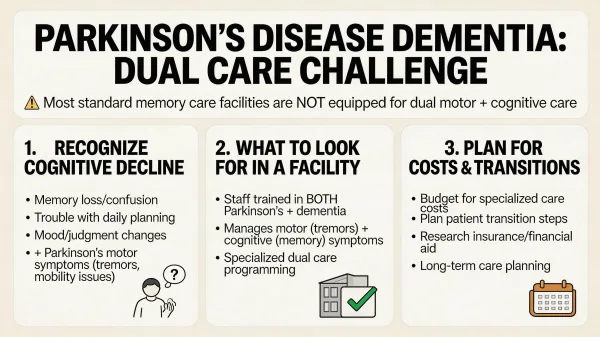
Your family has been managing Parkinson's for years. You know the medication schedule by heart. You've rearranged the house for safety, driven to countless neurology appointments, and learned more about dopamine than you ever expected to. Then something shifts. Your parent isn't just moving slowly. They're confused. They're seeing people who aren't there. They can't remember the medication routine they handled on their own for the last decade.
This is where many families hit a wall. Memory care for Parkinson's disease dementia is a different challenge from memory care for Alzheimer's or other forms of cognitive decline, because it demands a facility that can manage two complex conditions at the same time. The motor symptoms don't go away when cognition starts to fail. If anything, they get harder to manage, because the person losing cognitive function is also the person who needs precise medication timing, physical therapy, and fall prevention strategies that depend on awareness and cooperation.
The difficulty isn't just finding a memory care community that will accept a Parkinson's patient. It's finding one with the staff training, therapy integration, and medication protocols to actually keep your parent safe and supported on both fronts. This guide walks through how to recognize when Parkinson's has crossed into dementia territory, what makes PDD care different from standard memory care, and exactly what to look for in a facility that can handle both.
When Parkinson's Becomes More Than a Movement Disorder
Imagine your parent has had Parkinson's for eight years. Your family has mastered the medication timing, built physical therapy into the weekly routine, and installed grab bars in every bathroom. The tremor is managed. Falls have been rare. Then you notice something new: your parent asks the same question three times in an hour, can't follow the plot of a television show they've watched for years, or tells you about a visitor who was never there. The instinct for most families is to blame the medications. And sometimes that instinct is right, because dopaminergic drugs can cause hallucinations, confusion, and sleep disturbances. But when the cognitive changes persist, deepen, and start interfering with daily function, the more likely explanation is that Parkinson's disease dementia has arrived.
PDD affects a significant portion of people living with Parkinson's. The point prevalence of dementia in Parkinson's disease is close to 30%, and the cumulative risk is high: at least 75% of PD patients who survive for more than 10 years will develop dementia (Aarsland & Kurz, 2010). A 2024 meta-analysis in Movement Disorders estimated the annual risk of developing PDD at roughly 4.5% in a dementia-free Parkinson's population (Gibson et al., 2024). The numbers are sobering, but most families don't hear them until the cognitive changes are already underway.
The early signs are easy to miss or misattribute. Slowed thinking gets chalked up to fatigue. Trouble with spatial tasks (misjudging a doorway, struggling with a remote control) looks like worsening motor symptoms. Visual hallucinations, one of the hallmark features of PDD, are often dismissed as medication side effects, especially if they're mild and the person recognizes they aren't real. Families who have spent years learning to manage Parkinson's tend to interpret every new symptom through the lens of the disease they already know. Cognitive decline doesn't fit that frame, so it gets explained away longer than it should.
Working in the hospital for nearly 20 years, I've watched this pattern unfold many times alongside the neurology teams. A patient comes in for a fall or a medication adjustment, and the family mentions, almost as an aside, that Dad has been "a little off" lately. When the neurology team digs deeper, it becomes clear the cognitive changes have been building for months, sometimes a year or more, before anyone connects them to Parkinson's dementia. The families who catch it earlier aren't more attentive. They're just the ones who happened to learn that Parkinson's can become a cognitive disease, not only a movement disorder. That awareness is what I want every family reading this to carry with them.
Timing matters here. The earlier your family recognizes cognitive decline, the more options you have. Starting the conversation about future care needs while your parent can still participate in decisions is far better than scrambling after a crisis. If your parent's neurologist hasn't specifically screened for cognitive changes, ask for it. A Montreal Cognitive Assessment (MoCA) takes about 10 minutes and can surface deficits that casual conversation won't reveal.
PDD vs. Dementia with Lewy Bodies: Why the Distinction Matters
If you research Parkinson's dementia online, you'll quickly run into the term "dementia with Lewy bodies" (DLB), and the overlap can be confusing. Both conditions involve Lewy body pathology in the brain. Both can cause hallucinations, fluctuating attention, and movement problems. The clinical distinction rests on timing: if cognitive symptoms develop more than a year after established Parkinson's motor symptoms, the diagnosis is PDD. If dementia appears before motor symptoms, or within a year of them, the diagnosis is DLB (McKeith et al., 2017). Researchers acknowledge this "one-year rule" is somewhat arbitrary, and many specialists view PDD and DLB as different points on the same Lewy body disease spectrum.
For families, the practical significance is this: if your parent had well-established Parkinson's for years before cognitive decline started, their diagnosis is almost certainly PDD, not DLB. That distinction affects treatment strategy, because PDD patients have typically been on dopaminergic medications for years, and their motor symptoms and medication regimen create a different care equation than a DLB patient who developed cognitive and motor symptoms close together. When you're evaluating memory care facilities, make sure the staff understand this distinction. A facility that groups all Lewy body dementias together without recognizing the unique medication and motor challenges of longstanding PDD isn't equipped for your parent's needs.
The Medication Balancing Act
This is where PDD becomes one of the most complex care situations in geriatric medicine. The medications that control your parent's tremor, rigidity, and movement can worsen their cognitive symptoms. According to the Parkinson's Foundation, hallucinations are most often a side effect of Parkinson's medications and are more common in people who have problems with thinking or memory. Reducing dopaminergic drugs to improve cognition can send motor symptoms spiraling. Increasing them to restore movement can deepen confusion or trigger psychosis.
I've seen this catch-22 play out in the hospital more times than I can count. A patient's family is told to reduce the dopamine agonist because of hallucinations, and within days the patient can barely walk. The motor decline leads to a fall. The fall leads to an ER visit. The cycle repeats. This is why the article-top disclaimer isn't a formality. Medication management in PDD requires a movement disorder specialist, not a general practitioner working from standard protocols. Balancing psychotic symptoms with motor function through dopaminergic medication changes is one of the most delicate tasks in neurology. Any memory care facility your family considers must have a clear protocol for coordinating with your parent's specialist on medication changes.
Why Standard Memory Care Falls Short for Parkinson's Dementia
Most memory care communities are designed around the Alzheimer's model. That means secured environments to prevent wandering, structured activities for cognitive engagement, and staff trained to manage behavioral symptoms like agitation, sundowning, and repetitive questioning. These are all valuable, but they don't address the physical dimension of PDD.
A resident with Parkinson's dementia needs everything an Alzheimer's patient needs, plus physical therapy to maintain mobility, medication timing that accounts for both dopaminergic and cognitive drugs, fall prevention strategies designed for someone with both balance impairment and poor judgment, and activity programming adapted for people who can't hold a paintbrush or walk to a group session without assistance. In practice, this is where things break down. Many facilities will accept a PDD patient because they meet the cognitive criteria for memory care, but they don't have the physical therapy integration or medication timing protocols to manage the motor side safely. I saw versions of this during my mobile X-ray work years ago, when I'd visit care facilities and see residents with obvious Parkinson's symptoms who clearly weren't getting the physical support or medication precision their condition demanded. The gap between what a facility says it can handle and what it actually delivers is something every family needs to evaluate in person, not from a brochure.
Finding a Facility That Handles Both Motor and Cognitive Symptoms
The right memory care facility for a parent with PDD isn't just a good memory care community. It's one that has built the infrastructure to manage two complex conditions simultaneously. Here's what that actually looks like in practice.
Dual-Trained Staff
Staff members should have training in both dementia care and Parkinson's motor symptom management. This means understanding freezing episodes (where a person suddenly can't initiate movement), knowing not to rush a resident who is moving slowly, and recognizing the difference between confusion caused by cognitive decline and confusion caused by medication timing errors. Ask specifically about staff training during your tour. General dementia training isn't enough. You want to hear that staff have received instruction on Parkinson's-specific needs, including how to assist during freezing episodes, how to support safe transfers for someone with rigidity, and when to escalate a change in symptoms to the nursing team.
Physical Therapy Integration
For a Parkinson's patient, physical therapy isn't a nice-to-have. It's a core component of maintaining function. The right facility will have on-site or regularly scheduled physical therapy that continues the mobility work your parent was doing before placement. Ask whether the facility offers PT specifically for Parkinson's patients, whether it includes gait training and balance work, and how often sessions are scheduled. A facility that handles PT through occasional outside referrals rather than integrated, scheduled programming isn't set up for PDD residents. The best programs maintain a relationship with a physical therapist who understands Parkinson's progression and adjusts the plan as your parent's abilities change.
Medication Timing Protocols
Parkinson's medications, especially levodopa, are highly time-sensitive. A dose given 30 minutes late can mean the difference between a resident who can walk to the dining room and one who is frozen in place. Memory care facilities typically manage medications on a schedule, but that schedule needs to accommodate the precision that Parkinson's drugs require. Ask how the facility handles time-sensitive medications. Is there a protocol for ensuring levodopa is administered at the exact prescribed times, including during meals and overnight? What happens if a resident refuses a dose or is asleep at the scheduled time? Facilities that are serious about PDD care will have clear answers. Vague responses are a red flag.
Fall Prevention for a Dual-Risk Population
PDD residents face a compounding fall risk. They have the balance and gait problems of Parkinson's plus the impaired judgment and spatial disorientation of dementia. Standard memory care fall prevention (removing trip hazards, using bed alarms) isn't enough. Look for facilities that use motion-sensing technology, have clear protocols for nighttime supervision (when PDD patients are most vulnerable), and design common areas with wide pathways, adequate lighting, and handrails throughout. The dining room, hallways, and bathroom transitions are the highest-risk areas. Ask how the facility has designed these spaces for residents with both motor and cognitive impairment.
Activity Programming for Physical Limitations
Many memory care activity programs assume participants can use their hands, walk independently, and sit upright for extended periods. A parent with Parkinson's dementia may not be able to do any of these things consistently. The right facility adapts activities for residents with motor limitations: seated exercise programs, music therapy that doesn't require fine motor skills, and social engagement that accommodates slower movement and communication difficulties. Ask to see the activity calendar and specifically ask which programs are designed for or adapted to residents with physical limitations.
Questions to Ask Every Facility You Tour
Walking through a facility is one thing. Getting honest answers is another. Families evaluating memory care for Parkinson's dementia need to go beyond the standard tour questions and ask about the specific infrastructure PDD demands. Start with these: How many current residents have Parkinson's disease or a related movement disorder? What Parkinson's-specific training have your care staff received, and how often is it updated? Do you have on-site physical therapy, and does the therapist have experience with Parkinson's patients? How do you handle time-sensitive medications like levodopa? What is your protocol when a resident's motor symptoms change suddenly? How do you coordinate with a resident's movement disorder specialist?
Pay attention to the answers. A facility that has one or two Parkinson's residents and no structured protocol for their care is managing PDD by default, not by design. You want a community where PDD care is built into the operational structure, not improvised on a case-by-case basis. Don't skip the evening visit. Ask to see the facility during the late afternoon or early evening, when sundowning behavior and medication timing challenges are most likely to surface.
What Memory Care for Parkinson's Dementia Costs
Memory care is expensive, and PDD care often costs more than standard memory care because of the additional services involved. The national average monthly cost of memory care is approximately $7,500, or more than $90,000 annually, according to U.S. News data updated in late 2025. That's for standard memory care. Facilities with integrated physical therapy, specialized staff training, and Parkinson's-specific protocols may charge a premium above those averages, particularly in higher-cost regions. When you run the annual math on a two- to three-year stay, you're looking at $180,000 to $270,000 or more, depending on location and care level.
The financial picture gets more difficult when you factor in what insurance does and doesn't cover. Medicare doesn't cover memory care housing. It does cover some related medical services like diagnostic assessments, care planning, and short-term skilled nursing after a hospital stay, but the residential cost falls on families (NCOA). Medicaid may cover some memory care services depending on your state, but coverage varies widely and often involves waitlists. Long-term care insurance, VA Aid and Attendance benefits (for eligible veterans), and personal savings are the primary funding sources for most families. When our family faced memory care costs for the first time, the financial shock was almost as disorienting as the diagnosis itself. Start planning early, even if placement feels far away.
Signs It's Time for Memory Care
Many families try to manage PDD at home for as long as possible, and that's understandable. But there are clear signals that home care, even with professional aides, isn't enough anymore. Watch for these patterns: your parent is falling more than once a month despite home modifications. Medication errors are happening regularly, either missed doses or doubled doses. Hallucinations have become frequent and distressing, not occasional and benign. Your parent can no longer participate in their own physical therapy or daily exercise routine. Wandering or nighttime agitation has escalated beyond what one or two caregivers can safely manage.
There's no single moment that makes the decision obvious. For most families, it's a gradual accumulation of close calls and worsening incidents. The hardest part is often admitting that the level of care your parent needs has outpaced what you can provide at home, even with help. That recognition isn't a failure. It's a clear-eyed response to a disease that demands more than any single household can sustain.
Preparing Your Parent for the Transition
Moving a parent with PDD into memory care involves both logistical planning and emotional preparation, and the two don't always move at the same pace. On the logistical side, compile a complete medication list with exact dosing times, a summary of your parent's current physical therapy program, documentation of their Parkinson's stage and cognitive assessment results, and contact information for their movement disorder specialist. Bring all of this to the facility before move-in day so the care team can build a plan before your parent arrives.
The emotional dimension is harder to script. Some parents with PDD retain enough awareness to understand what's happening, and that understanding can bring grief, resistance, or relief, sometimes all three. Others may not fully grasp the change, which carries its own kind of difficulty for the family. Be honest with yourself about what your parent can process. Involve them in decisions when possible. And don't wait until the move to establish a relationship with the facility's care team. The more they know about your parent before day one, the smoother the transition will be for everyone.
Staying Involved After Placement
Placing your parent in memory care doesn't mean stepping back from their care. For PDD patients especially, family involvement after placement is a critical layer of oversight. You know your parent's baseline better than any new care team will for the first several months. Visit at different times of day so you can observe how care is delivered across shifts. Pay attention to whether medication timing is being maintained, whether your parent is attending physical therapy sessions, and whether their motor symptoms are stable or worsening.
Keep an open line of communication with the facility's nursing staff and your parent's movement disorder specialist. If you notice changes, whether cognitive, motor, or behavioral, flag them early. PDD symptoms can shift quickly, and a change in one dimension often signals a needed adjustment in the other. The families who stay engaged after placement are the ones whose parents get the best outcomes. That's not guilt. That's just how this works.
Moving Forward with What You Know
Parkinson's disease dementia is one of the most complex care situations a family can face, because it demands attention to two progressive conditions that interact with each other in ways that are hard to predict. The motor symptoms you've been managing for years don't pause while you figure out the cognitive side. Finding the right memory care facility, one that truly handles both, takes more research and more specific questions than a standard memory care search.
But you're not starting from zero. The years your family has spent learning Parkinson's give you a foundation that matters. You understand medication sensitivity. You know what good physical therapy looks like. You can spot when something is off with your parent faster than any intake team. Bring that knowledge into every facility tour, every care meeting, and every conversation with your parent's doctors. Your parent's best advocate is the person who already knows what their normal looks like, and that person is you.