
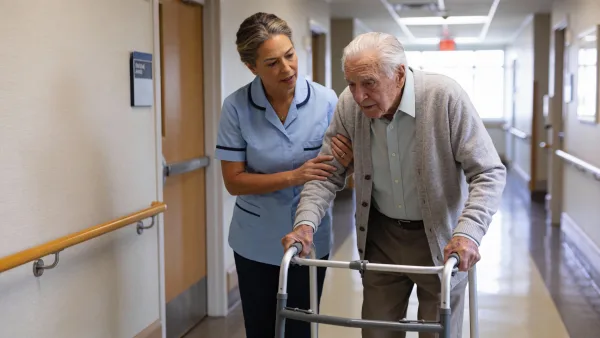
Your dad was diagnosed with Parkinson's 12 years ago. The tremor came first, then the shuffling walk, the stiffness. You learned about levodopa timing, helped him navigate freezing episodes, adapted his home to reduce fall risks. He managed surprisingly well with your support and his medications. Then about six months ago, things shifted. He started getting confused about his medication schedule. He'd forget he already ate lunch and ask for it again. Last week, he fell twice in one day, once because he froze mid-step and once because he couldn't remember to use his walker.
His neurologist confirmed what you'd been suspecting: Parkinson's disease dementia. Now you're searching for memory care, but every community you tour feels wrong. They understand dementia but seem unprepared for his movement disorder. One director admitted they'd never had a resident who needed levodopa every two hours. Another didn't know what freezing of gait meant. A third suggested he could manage fine with their standard fall prevention program.
Where this gets confusing is that Parkinson's dementia needs both specialized cognitive support and complex physical care. Your dad doesn't just need memory care. He needs staff who understand movement disorders, precisely timed medication administration, and fall prevention strategies specific to Parkinson's. Standard memory care communities often aren't equipped for this dual challenge.
This guide explains what makes Parkinson's dementia different from other dementias, the movement disorder accommodations necessary in memory care, the critical importance of medication timing, and how to find communities capable of providing this specialized level of support.
What makes Parkinson's dementia different from Alzheimer's in memory care?
Parkinson's disease dementia develops in 50% to 80% of people with Parkinson's disease, typically about 10 years after movement symptoms begin. This is fundamentally different from Alzheimer's disease, and those differences matter enormously in a care setting.
The cognitive symptoms of Parkinson's dementia affect executive function more than memory formation. Your dad might remember what he had for breakfast yesterday but struggle to plan the steps needed to brush his teeth. He can recall events from years ago but has trouble making decisions or solving simple problems. Visual-spatial difficulties are common, making it hard to judge distances or navigate familiar spaces. These cognitive challenges combine with the existing movement problems to create unique care needs.
Movement symptoms dominate the clinical picture. Unlike Alzheimer's where mobility problems develop late in the disease progression, people with Parkinson's dementia face severe movement challenges while their cognitive function is still moderate. They experience freezing of gait (feet suddenly stuck to the floor), postural instability, bradykinesia (extreme slowness of movement), rigidity, and tremors. These motor symptoms don't pause just because dementia has developed. They continue and often worsen.
Hallucinations occur more frequently in Parkinson's dementia than in Alzheimer's disease. Your dad might see people or animals that aren't there. These visual hallucinations can be vivid and detailed. Unlike the confusion common in Alzheimer's, people with Parkinson's dementia often know the hallucinations aren't real, though that doesn't make them less distressing.
The medication complexity far exceeds what's typical in Alzheimer's care. Parkinson's requires multiple medications taken at very specific times throughout the day. Levodopa, the primary Parkinson's medication, must be administered precisely on schedule, often every one to two hours in advanced disease. Missing a dose or delaying it by 30 minutes can cause dramatic symptom worsening. The timing matters more than with virtually any other condition in memory care.
Blood pressure instability creates additional challenges. Parkinson's disease affects the autonomic nervous system, causing orthostatic hypotension (sudden blood pressure drops when standing). This increases fall risk beyond what the movement disorder already creates. Staff need to help residents move slowly from lying to sitting to standing, monitor for dizziness, and recognize when blood pressure medication adjustments are needed.
The combination of cognitive and motor impairment creates compounding difficulties. When your dad's dementia causes him to forget to use his walker, his Parkinson's makes the resulting fall more likely and more dangerous. When medication wears off and his mobility worsens, his cognitive impairment makes it harder for him to communicate what's wrong or remember strategies to manage freezing episodes. These dual challenges require specialized knowledge that most memory care staff don't possess.
What movement disorder accommodations are essential in memory care?
Communities equipped to care for Parkinson's dementia must implement extensive environmental modifications and physical support strategies that go far beyond standard memory care fall prevention.
Flooring and surface modifications form the foundation of safe Parkinson's care environments. Thick carpeting creates a major hazard for people who shuffle their feet. The pile catches on shoes, causing trips and making the shuffling gait even more pronounced. Communities serving Parkinson's residents should have low-pile carpet or, better yet, hard flooring with non-slip surfaces. Transitions between flooring types need careful attention because the visual change can trigger freezing episodes. Thresholds should be flush, not raised, and ideally marked with contrasting colors to help residents see the transition coming.
Grab bars and support rails must be strategically placed beyond standard bathroom locations. People with Parkinson's need support throughout the community, not just in obviously risky areas. Hallways should have continuous handrails on both sides at appropriate heights. Dining areas need strategically placed supports for residents to steady themselves when walking to and from tables. Common areas should provide furniture arranged to create "islands" of support, allowing residents to move from one stable surface to another rather than crossing open floor space where freezing might occur.
Lighting requires specific consideration for Parkinson's care. Bright, even lighting throughout the community reduces fall risk. Shadows and dim areas can trigger freezing of gait and worsen visual-spatial difficulties. Motion-activated nightlights in resident rooms, bathrooms, and hallways prevent the disorientation and fall risk associated with navigating in darkness. Glare should be minimized because the visual processing difficulties common in Parkinson's dementia make bright reflections particularly problematic.
Doorway and threshold management addresses one of the most common freezing triggers. Passing through doorways frequently causes people with Parkinson's to freeze mid-step. Communities should paint contrasting lines or patterns across thresholds to provide visual cues that help the brain "break through" the freeze. Some facilities use colored tape across doorways. Others paint lines on the floor approaching doorways at regular intervals, creating visual cues that help maintain gait rhythm. Staff need training to recognize freezing episodes and use cueing techniques (verbal prompts, visual cues, or gentle touch) to help residents restart movement.
Furniture selection and arrangement must account for both safety and functionality. Chairs should have arms for pushing up from seated positions, because people with Parkinson's struggle to rise from armless chairs. Seat height matters significantly. Too low, and residents can't stand. Too high, and their feet don't reach the floor, creating instability. Furniture should be heavy enough that it won't slide when residents use it for support but not so heavy that staff can't move it when needed. Coffee tables and other low furniture create tripping hazards for people with reduced foot clearance and should be minimized or eliminated.
Fall prevention technology specific to Parkinson's goes beyond standard memory care approaches. Bed and chair alarms may need adjustment because the bradykinesia of Parkinson's means residents move slowly enough that alarms designed for Alzheimer's wandering might not activate in time. Some communities use specialized gait monitoring systems that detect changes in walking patterns that predict falls. Wearable fall detection devices offer peace of mind but must be comfortable enough that residents with rigidity and tremors can tolerate wearing them.
Physical and occupational therapy must be integrated into daily care, not just provided as separate sessions. People with Parkinson's benefit from specialized exercises targeting balance, strength, and gait training. The challenge in memory care is that cognitive impairment makes it difficult for residents to remember or initiate these exercises independently. Effective programs build physical activity into daily routines. Morning exercises before breakfast, walking programs integrated into activity schedules, and group movement sessions all help maintain function. The key is consistency and frequency rather than intensive but sporadic therapy.
Assistive devices and mobility aids require individualized assessment and staff training. Some residents with Parkinson's benefit from walkers with wheels, while others need standard walkers. Canes work for some but create fall risks for others. The dementia component complicates this because residents forget to use their devices or use them incorrectly. Staff must balance independence with safety, providing reminders and assistance without creating learned helplessness.
Cueing strategies represent specialized knowledge essential for Parkinson's care. When someone with Parkinson's freezes while walking, verbal cues ("March in place," "Big steps"), visual cues (stepping over a line or object), or auditory cues (rhythmic counting or music) can help restart movement. Staff need training in these techniques because untrained caregivers typically try to physically move frozen residents, which doesn't work and creates fall risk. Understanding that freezing is a neurological symptom, not hesitation or stubbornness, fundamentally changes how staff interact with residents.
Exercise and activity programming designed for Parkinson's differs from general senior fitness. Programs should include balance training, gait work, flexibility exercises for rigidity, and large-amplitude movements. Activities like adapted tai chi, boxing programs developed specifically for Parkinson's (like Rock Steady Boxing), and dance therapy have shown benefits. The cognitive impairment requires modifications to make these activities accessible, with simple instructions, visual demonstrations, and hands-on assistance.
Communities without this level of Parkinson's-specific modification simply aren't equipped to keep residents safe. Your dad's fall risk isn't just about dementia-related confusion. It's about the complex interplay between cognitive impairment and movement disorder, and that requires specialized environmental design and trained staff.
Why is medication management so critical for Parkinson's dementia?
The medication complexity in Parkinson's dementia exceeds almost anything else memory care communities handle. Getting this wrong doesn't just mean suboptimal care. It can mean rapid functional decline, severe symptom worsening, or even life-threatening complications.
Levodopa timing is absolutely critical. This isn't like most memory care medications where a few hours' variation doesn't matter much. Levodopa has a short half-life (approximately 1.5 hours when combined with carbidopa). Missing the scheduled administration time by even 30 minutes can cause dramatic symptom worsening. Your dad might go from mobile and relatively functional to frozen, rigid, and unable to move. These "off" periods (when medication effects wear off) can happen suddenly and are extremely distressing for residents and challenging for staff.
Advanced Parkinson's often requires levodopa doses every one to two hours around the clock. Think about what this means in a memory care community. Staff need systems to ensure medication administration happens precisely on time, not when it's convenient during medication rounds. A resident taking levodopa at 7 AM, 9 AM, 11 AM, 1 PM, 3 PM, 5 PM, 7 PM, 9 PM, and 11 PM cannot wait until the next scheduled round if doses are at 8 AM, 12 PM, 4 PM, and 8 PM. The medication schedule drives care delivery, not the other way around.
The complexity of multiple formulations creates potential for serious errors. Levodopa comes in immediate-release, controlled-release, and extended-release formulations. These are NOT interchangeable in the same doses. Giving extended-release when the prescription calls for immediate-release can leave your dad without adequate coverage for hours. Different strengths and combinations add to the complexity. Someone might take different doses at different times throughout the day based on when symptoms are typically worst. In memory care, where residents can't advocate for themselves and staff may not recognize subtle symptom changes, medication errors can go unnoticed until serious problems develop.
Protein timing affects levodopa absorption. This is a detail many memory care communities miss entirely. Levodopa and dietary protein compete for absorption in the small intestine. High-protein meals taken with or shortly before levodopa doses can significantly reduce the medication's effectiveness. Best practice involves taking levodopa 30 to 60 minutes before meals or waiting an hour after eating. Some people benefit from concentrating protein intake at dinner, leaving breakfast and lunch lower-protein so daytime medication works better. Implementing this in a memory care community requires dietitian involvement, kitchen coordination, and staff awareness that feeding your dad a protein shake with his morning medication defeats the purpose of the medication.
"On-off" fluctuation management requires observation skills many memory care staff lack. As Parkinson's progresses, the medication's effectiveness becomes less predictable. Your dad might experience sudden "off" periods even when taking medication on schedule. Staff need to recognize the difference between dementia-related behavior changes and medication-related symptom fluctuations. When your dad becomes rigid, shuffling, or anxious suddenly, that's likely an "off" period requiring immediate medication assessment, not an emotional crisis requiring redirection.
Medication side effects complicate dementia care. Levodopa can cause confusion, hallucinations, and dyskinesias (involuntary movements). Distinguishing between dementia symptoms and medication side effects challenges even experienced neurologists. In memory care, staff might not recognize that newly developed confusion or hallucinations could be medication-related rather than disease progression. Dose adjustments might help, but only if someone recognizes the problem and communicates effectively with the prescribing physician.
The risk of neuroleptic malignant syndrome makes medication errors potentially life-threatening. If Parkinson's medications are suddenly stopped or significantly delayed (as might happen during hospitalization or in a community unfamiliar with the condition), patients can develop this dangerous syndrome featuring high fever, severe rigidity, confusion, and unstable vital signs. Memory care staff must understand that Parkinson's medications are time-critical, not optional or deferrable.
Communication with healthcare providers becomes more complex. When your dad can't reliably report symptoms due to dementia, staff observations become crucial. But those observations require knowledge of what to watch for. Does staff recognize the difference between tremor at rest versus action tremor? Can they identify freezing of gait versus hesitation? Do they understand what "wearing off" looks like? Without this knowledge, communication with neurologists lacks the detail needed for appropriate medication management.
Communities equipped to handle Parkinson's dementia should have systems ensuring precise medication timing, staff training on Parkinson's medications and symptom recognition, communication protocols with neurologists, and awareness of diet-medication interactions. Many memory care communities claim they can "handle medications," but Parkinson's medication management requires expertise far beyond typical memory care nursing capabilities.
How do you find memory care equipped for Parkinson's dementia?
The unfortunate reality is that truly specialized Parkinson's dementia care is rare. Most memory care communities focus on Alzheimer's disease and aren't equipped for the dual challenges of cognitive impairment plus complex movement disorders. Finding appropriate care requires knowing what questions to ask and what capabilities to look for.
Start by directly asking about Parkinson's experience during your initial inquiry. Ask how many current residents have Parkinson's with dementia. If the answer is "none" or "we've had a few over the years," that's a red flag. Communities without consistent Parkinson's experience lack the expertise and systems needed for this specialized care. Ask whether they've ever had to transfer out a Parkinson's resident because they couldn't meet care needs. Honest communities will admit when they're not equipped for this complexity.
Questions about medication management reveal capability quickly. Ask how they handle medications needed every hour. What systems ensure precise timing? Can they accommodate individualized schedules that don't align with standard medication rounds? If they seem confused by the question or suggest "we'll just add it to our regular rounds," they don't understand Parkinson's medication requirements.
Tour the physical environment with movement disorders in mind. Look at flooring, hallways, bathrooms, and common areas. Are there grab bars throughout, not just in bathrooms? Is the flooring low-pile or hard surface? Are doorways marked with visual cues? Is lighting bright and even? The physical environment tells you whether the community has adapted for movement disorders or just offers standard memory care design.
Ask about staff training specifically. Do caregivers receive training on Parkinson's disease? Can they explain what freezing of gait means and how they address it? Do they understand "on-off" fluctuations? Request to speak with the nursing director about their experience with Parkinson's medications. Their knowledge (or lack thereof) will become apparent quickly.
Inquire about therapy services. Do they have relationships with physical and occupational therapists experienced in Parkinson's care? Are therapy services integrated into daily care or only provided as occasional sessions? Communities that truly serve Parkinson's residents build physical activity and movement strategies into daily routines, not just discrete therapy appointments.
Some assisted living and memory care communities market themselves as Parkinson's-friendly or have dedicated Parkinson's programs. These deserve serious consideration but still require verification. Marketing claims don't always match operational reality. Ask for specifics about what makes them Parkinson's-specialized beyond general statements about being equipped for movement disorders.
Nursing homes with skilled nursing capabilities may be more equipped for Parkinson's dementia than assisted living-based memory care. The higher nursing staff ratios and medical capabilities can better accommodate complex medication schedules and physical care needs. The trade-off is typically less dementia-specific programming and a more medical environment. For some families, this trade-off makes sense given the priority of managing the movement disorder safely.
Consider geographic limitations. You may need to expand your search radius beyond your immediate area. Specialized Parkinson's dementia care isn't available everywhere. In some regions, you might find one or two communities within 50 miles capable of providing appropriate care. Choosing adequate specialized care further from home often proves better than choosing inadequate care nearby.
When does Parkinson's dementia exceed memory care capabilities?
Understanding the limitations of even good memory care helps you recognize when your dad's needs have progressed beyond what these communities can provide.
Severe mobility impairment requiring two-person transfers typically exceeds assisted living-based memory care capabilities. When your dad can no longer walk even with maximum assistance and needs mechanical lifts or two staff members for all transfers, he may need skilled nursing care. Memory care communities usually lack the equipment and staffing ratios for this level of physical care.
Advanced swallowing difficulties (dysphagia) common in late-stage Parkinson's may require skilled nursing oversight. When aspiration risk becomes high and texture-modified diets or feeding assistance becomes complex, the nursing capabilities in memory care might be insufficient. Some residents need speech therapy evaluation, precise monitoring during meals, and potentially feeding tubes, all of which require higher-level nursing care.
Severe medication-related side effects that require frequent dose adjustments might necessitate short-term skilled nursing placement. When finding the right medication balance requires intensive monitoring and adjustments every few days, the medical oversight in memory care may not suffice. Once medications stabilize, return to memory care might be possible.
Aggressive behaviors or severe psychiatric symptoms sometimes develop in Parkinson's dementia. When hallucinations become distressing and medication adjustments fail to control them, or when behaviors pose safety risks to other residents or staff, specialized behavioral units or nursing homes with psychiatric consultation may be necessary.
Hospice care becomes appropriate when Parkinson's reaches end stage. Many memory care communities can coordinate with hospice services, allowing residents to remain in place during their final months. Others cannot accommodate hospice care and require transfer to nursing homes or hospice facilities. Ask about hospice policies during your initial community evaluation.
Finding memory care for Parkinson's dementia challenges even experienced families because the needed expertise is genuinely rare. Communities must understand both cognitive impairment and complex movement disorders, implement environmental modifications far beyond standard memory care, manage time-critical medications with precision, and employ staff trained in Parkinson's-specific care techniques. These capabilities exist, but not everywhere and not in most communities. Your search may take longer and cover a wider geographic area than you anticipated.
The effort is worth it because inadequate care doesn't just mean lower quality of life. It means preventable falls, poorly controlled symptoms, medication errors, and potentially dangerous complications. When you find a community where staff immediately understand "freezing of gait" and "off periods," where the nursing director discusses levodopa timing without prompting, and where the physical environment shows clear movement disorder modifications, you've found a community that can actually meet your dad's complex needs.