
Lewy Body Dementia is complex, but the right care makes all the difference.
LBD is the second most common form of dementia after Alzheimer's, affecting more than 1.4 million Americans. Yet it remains poorly understood, frequently misdiagnosed, and often treated with approaches designed for Alzheimer's that can be dangerous for people with LBD.
If your loved one has received a Lewy Body Dementia diagnosis, you need memory care staff who understand what makes this condition different. The hallucinations are real to your loved one. Certain medications that help other dementia patients can cause life-threatening reactions in LBD. Movement problems increase fall risk dramatically. Cognition fluctuates from hour to hour in ways that confuse even experienced caregivers.
This article explains what Lewy Body Dementia is, why it requires specialized care approaches, how to manage its most challenging symptoms, which medications are safe and which are dangerous, and what to look for in memory care facilities that claim LBD expertise.
Understanding Lewy Body Dementia
Lewy Body Dementia is an umbrella term that includes both Dementia with Lewy Bodies (DLB) and Parkinson's Disease Dementia (PDD). The distinction depends on timing: if cognitive symptoms appear before or within a year of movement problems, it's called DLB. If Parkinson's symptoms appear first and dementia develops later, it's PDD.
Both conditions involve abnormal protein deposits called Lewy bodies that accumulate in the brain. These proteins disrupt both the thinking parts of the brain and areas that control movement, creating the unique combination of cognitive and physical symptoms that defines LBD.
The disease typically affects people over age 50, with a median age of onset around 76 years. Men develop LBD at higher rates than women. Progression is often faster than Alzheimer's disease, with average survival of five to eight years after diagnosis, though some people live much longer.
Core Features That Define LBD
Three hallmark features distinguish Lewy Body Dementia from other forms of dementia. Understanding these helps explain why specialized care matters.
Fluctuating cognition means your loved one's alertness and ability to think clearly changes dramatically, sometimes within hours. They might be lucid and engaged in the morning, confused and drowsy by afternoon, somewhat clearer again by evening. This isn't gradual decline but unpredictable swings that make it hard to assess their actual cognitive baseline.
Visual hallucinations occur in most LBD patients, often early in the disease. These are detailed, formed hallucinations typically involving people or animals. Your loved one might see children playing in their room, strangers standing in the hallway, or small animals moving across surfaces. Unlike hallucinations in other conditions, LBD hallucinations are often silent, detailed, and your loved one may recognize they aren't real even while seeing them.
Movement disorders similar to Parkinson's disease appear in LBD. These include slow movements (bradykinesia), muscle stiffness, shuffling gait, tremors, and balance problems. The combination of dementia and movement problems creates significantly higher fall risk than Alzheimer's disease alone.
Other Important Symptoms
Beyond the core features, LBD causes several other symptoms that complicate care. REM sleep behavior disorder appears in many patients, causing them to physically act out dreams, sometimes violently. This can result in injuries to themselves or bed partners.
Autonomic dysfunction affects blood pressure regulation, digestion, temperature control, and bladder function. Your loved one might experience sudden drops in blood pressure when standing (causing dizziness and falls), severe constipation, urinary incontinence, or difficulty regulating body temperature.
Depression affects nearly 40% of people with LBD. Anxiety is also common, often worsening when cognitive fluctuations make the world feel unpredictable and frightening.
Hallucination Management and Movement Disorders
These two symptoms define the daily challenges of LBD care and require specialized approaches that differ significantly from standard dementia care.
Understanding LBD Hallucinations
Visual hallucinations in Lewy Body Dementia have specific characteristics that distinguish them from hallucinations in other conditions. They're typically complex and detailed. People with LBD don't see vague shapes or shadows. They see fully formed people, often children or family members, sitting in chairs or standing in doorways. They see animals like cats, dogs, or insects moving across floors or walls.
These hallucinations are usually silent. Your loved one sees people but doesn't hear them talking. The figures may appear to interact with each other but not directly engage with your loved one.
Importantly, many people with LBD retain insight about their hallucinations, at least early on. They know what they're seeing isn't real but can't stop seeing it. This creates a frustrating situation where they experience vivid visions they intellectually understand are false.
Hallucinations often worsen in low light or visually complex environments. Patterns on carpets, wallpaper, or upholstery can trigger misperceptions where your loved one sees faces or figures in the patterns. Shadows, reflections, or partially obscured objects get misinterpreted as people or animals.
Effective Hallucination Management
What families often underestimate is that managing LBD hallucinations requires a completely different approach than managing behavioral symptoms in Alzheimer's disease. You can't simply give an antipsychotic and expect improvement. In fact, that approach is dangerous.
Environmental modifications form the first line of intervention. Memory care facilities experienced with LBD make specific environmental changes: increased lighting throughout spaces, especially in the evening when sundowning worsens hallucinations; removal of visually busy patterns in carpets, wallpaper, and fabrics; minimization of shadows by using multiple light sources rather than single overhead lights; clear pathways with minimal clutter that could be misperceived; and regular vision checks since poor eyesight worsens visual misperceptions.
Response strategies that work with LBD hallucinations differ from approaches used with delusions or confabulation. When your loved one reports seeing something that isn't there, staff should never argue or insist it's not real. This creates distress and makes your loved one feel dismissed or think caregivers are part of some conspiracy.
Instead, effective responses acknowledge your loved one's experience without reinforcing it as real. A caregiver might say "I don't see that, but I understand it feels very real to you. Are you frightened?" This validates their experience while gently introducing reality. If the hallucination isn't causing distress, sometimes the best response is acceptance. Many people with LBD peacefully coexist with benign hallucinations that don't frighten or upset them.
Redirection works when hallucinations do cause distress. "Let's move to a different room where you'll be more comfortable" or "Come help me with this activity" shifts attention and often makes the hallucination fade. Asking your loved one to describe what they see in detail sometimes helps them focus and recognize inconsistencies that remind them it's not real.
Movement Disorders and Fall Prevention
The Parkinsonian features of LBD create significant safety challenges. Your loved one moves slowly, has difficulty initiating movement, shuffles when walking, and has impaired balance. Their posture becomes stooped. They may freeze mid-step or have trouble turning.
These movement problems are made worse by the cognitive impairment and hallucinations. Your loved one might see an object that isn't there and try to step over or avoid it, losing balance in the process. Fluctuating cognition means they sometimes forget their movement limitations and attempt activities beyond their current ability.
Fall prevention in LBD requires multi-layered approaches. Physical environment modifications include removal of all trip hazards like rugs, cords, and clutter; installation of grab bars in bathrooms and along hallways; adequate lighting at all times, especially at night; furniture arrangement that provides stable support as your loved one moves through spaces; and clear, wide pathways that accommodate shuffling gait and difficulty with turns.
Physical therapy plays a crucial role. Therapists experienced with LBD work on gait training, balance exercises, safe transfer techniques, and strength maintenance. They teach strategies like taking larger steps deliberately, using visual cues on the floor to overcome freezing episodes, and planning movement sequences before initiating them.
Appropriate assistive devices make a significant difference. Walkers with wheels and hand brakes work better than standard walkers since LBD patients struggle to lift and advance walker frames. Properly fitted wheelchairs may become necessary as disease progresses. Bed rails or floor mats can prevent falls when getting in and out of bed.
Staff training on LBD movement patterns is essential. Caregivers need to understand that rushing a person with LBD causes freezing and falls. They must allow extra time for all movements, provide physical support without pulling or pushing (which worsens balance), and recognize when your loved one needs rest before attempting activities.
Medication to Support Movement
Levodopa, the primary medication for Parkinson's disease, can help LBD movement symptoms. However, it must be used carefully because it can worsen hallucinations and confusion. The goal is finding the lowest dose that provides meaningful movement improvement without increasing psychiatric symptoms.
Many LBD patients need lower levodopa doses than typical Parkinson's patients. Facilities familiar with LBD work closely with neurologists to titrate medications carefully, monitoring both movement and cognitive effects.
Some Parkinson's medications should be avoided entirely in LBD. Dopamine agonists like pramipexole and ropinirole frequently cause or worsen hallucinations. MAO-B inhibitors like rasagiline can increase psychotic features. Anticholinergic medications used for tremor worsen cognition and should never be given to LBD patients.
What Families Often Underestimate: Medication Sensitivity
This is the most critical thing to understand about Lewy Body Dementia care, and the area where lack of knowledge causes the most harm.
Approximately 50% of people with LBD have severe sensitivity to antipsychotic medications. This isn't a mild side effect. It's a potentially fatal reaction called neuroleptic sensitivity syndrome that can cause irreversible worsening of symptoms or death.
Dangerous Medications
First-generation antipsychotics like haloperidol (Haldol), chlorpromazine, and fluphenazine should never be given to LBD patients under any circumstances. These medications block dopamine receptors aggressively, causing severe worsening of movement symptoms, extreme confusion, high fever, muscle rigidity, and potentially fatal complications.
Yet these medications are still sometimes administered in emergency rooms, hospitals, or facilities unfamiliar with LBD when a patient becomes agitated or confused. This is why families must advocate fiercely to prevent their use.
Second-generation (atypical) antipsychotics carry lower but still significant risks. Risperidone has been associated with neuroleptic malignant syndrome in LBD patients. Olanzapine frequently causes severe sedation, worsening of movement symptoms, and confusion. Even quetiapine, considered one of the "safer" options, can cause dangerous reactions in some LBD patients.
Other problematic medications include anticholinergic drugs (used for overactive bladder, allergies, or sleep), which worsen cognition and confusion; benzodiazepines in high doses, which increase fall risk and confusion; and certain anesthetics, which can cause profound, sometimes permanent cognitive decline after surgery.
Safer Medication Options
When hallucinations or behavioral symptoms require medication, several options carry less risk for LBD patients.
Cholinesterase inhibitors like rivastigmine, donepezil, and galantamine improve cognition and often reduce hallucinations and behavioral symptoms. These work by increasing acetylcholine, a neurotransmitter severely depleted in LBD. They're considered first-line treatment for LBD cognitive and psychiatric symptoms.
Pimavanserin (Nuplazid) is FDA-approved for Parkinson's disease psychosis and shows promise for LBD. It targets serotonin receptors rather than dopamine, avoiding the movement-worsening effects of traditional antipsychotics. When antipsychotic medication is unavoidable, pimavanserin should be considered first.
Quetiapine and clozapine remain options when other approaches fail, but require careful monitoring. Doses must be kept very low, and any worsening of movement or cognition warrants immediate discontinuation.
Protecting Your Loved One
Memory care facilities caring for LBD patients must have systems to prevent dangerous medication administration. This includes clear documentation of LBD diagnosis in medical charts, medication sensitivity alerts in electronic records, staff education about prohibited medications, protocols requiring neurologist consultation before any psychotropic medication changes, and emergency information cards for hospital transfers warning about neuroleptic sensitivity.
Families should provide written documentation of medication sensitivities to all healthcare providers, wear medical alert jewelry stating "Lewy Body Dementia - Neuroleptic Sensitivity," maintain a list of prohibited medications to show emergency personnel, and insist on consulting with your loved one's neurologist before any new psychiatric or anesthetic medications.
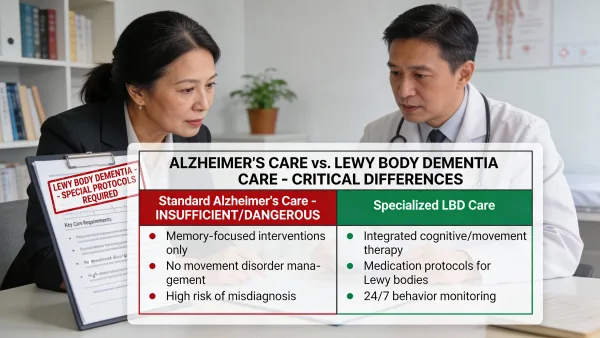
Why Standard Memory Care Isn't Enough
Many memory care facilities provide excellent Alzheimer's care but lack the specialized knowledge needed for LBD. Understanding these differences helps you evaluate whether a facility can truly meet your loved one's needs.
Alzheimer's care focuses primarily on memory support, routine maintenance, and managing confusion. Caregivers trained for Alzheimer's learn to redirect residents, provide memory cues, and create predictable environments that reduce anxiety.
LBD care requires all of that plus expertise in managing visual hallucinations without dismissing them or relying on dangerous medications, supporting movement disorders and preventing falls while maintaining mobility, recognizing and adapting to fluctuating cognition throughout the day, coordinating care between neurology, psychiatry, and primary care, understanding medication sensitivities that can be fatal if ignored, and distinguishing between problems requiring medication adjustment versus behavioral intervention.
The staff-to-resident ratios may need to be higher in LBD care due to increased fall risk and the need for movement support. Facilities should have protocols for regular neurology consultation, relationships with neurologists who specialize in LBD, access to physical and occupational therapy with LBD experience, and systems to track cognitive fluctuations and identify patterns.
Questions to Ask Facilities
When evaluating memory care options for your loved one with LBD, ask specific questions that reveal actual expertise rather than general dementia knowledge.
About staff training: How many current residents have Lewy Body Dementia? What specific training has staff received about LBD versus Alzheimer's? Can staff explain the difference between LBD and Alzheimer's symptoms? How do staff respond to visual hallucinations? What's your protocol when a resident with LBD becomes agitated?
About medication management: What's your policy on antipsychotic use in LBD residents? Do you have medication safety alerts for LBD in your system? How quickly can you reach a neurologist when medication questions arise? What happens if a resident needs hospitalization? Do you send medication sensitivity information with them?
About movement support: What fall prevention strategies do you use for residents with movement disorders? Do you have physical therapy available on-site? How do staff assist with transfers and mobility? What happens when a resident's movement ability declines?
About medical coordination: Who manages the overall care plan? How often does a physician see residents? Do you work with neurology specialists? How do you handle the fluctuating nature of LBD symptoms?
Facilities with genuine LBD expertise will answer these questions specifically and confidently. They'll have systems in place, staff training documented, and examples from current residents (respecting privacy) that demonstrate their experience. Vague answers or inability to distinguish LBD from Alzheimer's care indicates they may not have the specialized knowledge your loved one needs.
Supporting Your Loved One with LBD
Even with excellent professional care, family involvement remains important for LBD patients. Your knowledge of their history, preferences, and patterns helps staff provide personalized care.
Share detailed information about your loved one's typical cognitive patterns (when they're most alert, what triggers confusion), hallucination content and what calms them, movement abilities and limitations, effective communication approaches, and any medication reactions they've had.
During visits, respect their fluctuating abilities. Don't expect consistent performance or become frustrated when they're more confused than during your last visit. LBD's unpredictability is a disease feature, not a reflection of care quality or effort.
Advocate consistently but constructively. If you notice staff using dangerous medications, responding to hallucinations inappropriately, or ignoring movement support needs, speak up immediately. But also recognize that caring for LBD is genuinely difficult, and staff need specific, actionable feedback rather than general complaints.
The Right Care Makes the Difference
Lewy Body Dementia is more complex than Alzheimer's disease. It requires specialized knowledge about medication dangers, hallucination management that doesn't rely on antipsychotics, fall prevention for people with both cognitive and movement impairment, and flexibility to adapt as cognition fluctuates.
Not every memory care facility has this expertise. Some that claim to "accept all types of dementia" lack the specific training and systems LBD demands. But facilities with genuine LBD experience can provide safe, compassionate care that manages symptoms effectively, maintains quality of life, and protects your loved one from the dangerous medication reactions that too often harm LBD patients in settings that don't understand the condition.
Finding the right care takes research and advocacy. Ask detailed questions, observe staff interactions, review medication protocols, and trust your instincts when something doesn't seem right. Your loved one's safety and quality of life depend on choosing a facility that truly understands what makes Lewy Body Dementia different.