
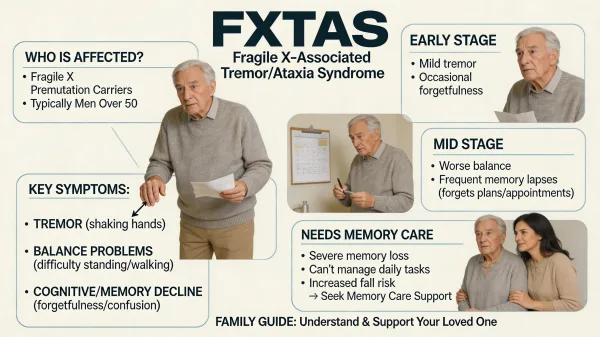
Fragile X tremor-ataxia syndrome (FXTAS) is a progressive neurological condition that affects carriers of the Fragile X premutation, typically men over age 50, causing worsening tremor, balance problems, and cognitive decline that can eventually require memory care.
For years, your father was the steady one. He drove your child to therapy appointments, stayed calm during meltdowns, and became the grandparent your Fragile X-affected son or daughter could always count on. Then, somewhere around his mid-60s, you noticed his hands shaking when he poured coffee. His walk changed. He started forgetting conversations. And when the neurologist mentioned Fragile X, you thought there had to be a mistake, because Fragile X was your child's diagnosis, not your father's.
This is how many families discover FXTAS. The condition hides in plain sight for years, overshadowed by the full Fragile X syndrome diagnosis that brought the family into the genetic testing process in the first place. Most families with a Fragile X connection have spent years focused on their affected child or grandchild. The idea that the carrier generation, the parents and grandparents who passed down the gene, could develop their own progressive neurological disease rarely enters the conversation until symptoms become impossible to ignore.
When I watched a family member's cognitive abilities change faster than any of us expected, I learned that genetic conditions don't always announce themselves on a predictable schedule. FXTAS is a condition that forces families to reconsider everything they thought they knew about their genetic story, while also making urgent care decisions for a parent who is declining.
This guide will help you understand what FXTAS is, how it progresses, when memory care becomes the right choice, and how to find a facility equipped to handle a condition most caregivers have never heard of.
What Is Fragile X Tremor-Ataxia Syndrome?
FXTAS (pronounced "fax-tass") is a late-onset neurodegenerative disorder that affects people who carry the Fragile X premutation, a specific genetic variation in the FMR1 gene on the X chromosome. It primarily affects men over 50, though women carriers can develop milder forms. The condition causes progressive intention tremor, cerebellar gait ataxia (unsteady walking), and cognitive decline that can advance to dementia in roughly half of affected individuals.
Unlike Fragile X syndrome itself, which is diagnosed in childhood and involves intellectual disability, FXTAS appears decades later and follows a completely different disease process. The premutation that causes FXTAS involves 55 to 200 CGG repeats in the FMR1 gene, while the full mutation behind Fragile X syndrome involves more than 200 repeats. Both conditions trace back to the same gene, but they affect people at different stages of life and through different biological mechanisms.
Understanding FXTAS: When Carrier Status Causes Its Own Disease
The distinction between the Fragile X premutation and the full mutation is central to understanding why FXTAS catches families so completely off guard. In most genetic counseling scenarios, carriers are told they might pass the mutation to their children, and the focus lands squarely on the next generation. What rarely gets emphasized is that the premutation itself can cause a progressive neurological condition in the carrier, one that may not show up for decades.
The premutation is common enough that FXTAS represents a real public health concern. Research estimates that roughly 1 in 200 women and 1 in 400 to 800 men carry the Fragile X premutation. For male carriers over 50, the risk of developing FXTAS symptoms increases sharply with age: approximately 17% of male carriers in their 50s develop signs of FXTAS, rising to 38% in their 60s, 47% in their 70s, and as high as 75% for those over 80. Female carriers face a lower but still significant lifetime risk of about 8 to 16%.
The typical progression follows a recognizable pattern, though timing varies widely between individuals. Tremor is usually the first motor symptom, appearing around age 60 on average. Balance problems tend to follow within a couple of years. Falls become more frequent around six years after the initial motor symptoms begin, and dependence on a walking aid develops at roughly the 15-year mark. Life expectancy after the onset of symptoms ranges from 5 to 25 years, with enormous individual variation.
Cognitive decline in FXTAS looks different from Alzheimer's disease, and that distinction matters for both diagnosis and care planning. Where Alzheimer's typically starts with memory loss, especially the inability to form new memories, FXTAS cognitive decline starts with executive function problems. Your parent may struggle with planning, organizing, making decisions, or handling tasks that require mental flexibility. Math and reading skills often decline early. Working memory, processing speed, and verbal fluency erode as the disease progresses. In roughly half of men with FXTAS, this eventually develops into a frontal-subcortical dementia that affects broader cognitive functions. This means your parent might still recognize you and remember events from years ago while being completely unable to manage a checkbook, follow a recipe, or figure out how to get home from a store they've visited hundreds of times. That pattern confuses families who expect dementia to look like what they've seen with Alzheimer's, where the defining early symptom is forgetting names and faces. FXTAS dementia erodes the ability to think through problems long before it erases memories.
I've seen how quickly a family's understanding of their situation can shift when cognitive decline enters the picture. A parent who was managing independently can start making poor financial decisions, forgetting medications, or getting confused in familiar settings within what feels like a very short window. With FXTAS, the combination of physical instability and cognitive decline creates a compounding safety risk that families need to take seriously early, not after the first serious fall.
Psychiatric symptoms are also common and often underappreciated. Studies have documented high rates of apathy, irritability, depression, anxiety, and disinhibition in people with FXTAS. Personality changes can be among the earliest and most distressing signs for family members. A father who was always patient may become irritable or withdrawn. These behavioral changes strain family relationships and complicate caregiving well before the physical symptoms become severe.
The Family Ripple Effect: Why FXTAS Changes Everything
A FXTAS diagnosis doesn't just affect the person who has it. Because the condition is genetic, it forces every member of the family tree to consider what it means for them personally. If your father is a premutation carrier with FXTAS, you may carry the premutation yourself. For daughters, this means a potential risk of developing FXTAS (though typically milder) and the possibility of passing a full mutation to your own children. For sons, the premutation isn't passed from father to son through the X chromosome, but the broader family may still be affected through maternal lines.
When our family learned that a genetic component was driving a loved one's cognitive decline, the conversation shifted from "How do we help Dad?" to "What does this mean for all of us?" That ripple effect is something most families aren't prepared for. You're processing your own genetic risk, potentially revisiting your children's health history, and making real-time care decisions for your parent, all at once. The emotional weight of discovering that a condition you associated only with your child or grandchild has a chapter that directly involves you is something I don't think any amount of genetic counseling fully prepares you for.
If your family hasn't pursued genetic testing beyond the original Fragile X diagnosis, a FXTAS diagnosis in a parent is a strong reason to talk with a genetic counselor about testing for other family members.
Recognizing the Signs That Care Needs Are Increasing
Because FXTAS involves both motor and cognitive symptoms, the signs that your parent needs more support often stack up gradually. Early on, you might notice your father's handwriting has become shaky or he avoids pouring drinks. He may grip furniture when walking through a room or hesitate on stairs. These motor symptoms are visible and concerning, but they're often manageable at first with home modifications and physical therapy.
The cognitive signs can be harder to spot. Missing appointments, repeating questions within the same conversation, difficulty following multi-step instructions, or trouble managing finances are all early flags. Personality changes, like increased irritability, withdrawal from social activities, or uncharacteristic outbursts, often get blamed on aging or stress before anyone connects them to FXTAS.
The combination is what makes FXTAS particularly dangerous at home. A person with impaired balance who also has impaired judgment is at high risk for serious falls, medication errors, and unsafe decisions about cooking, driving, or wandering.
When Memory Care Becomes Necessary for FXTAS
The decision to move a parent with FXTAS into memory care is rarely triggered by a single event, though a bad fall or a moment of dangerous confusion sometimes forces the conversation. More often, it's the accumulation of smaller failures: repeated falls, missed medications, worsening disorientation, escalating behavioral outbursts, and caregiver exhaustion at home.
Consider a specific threshold: when the combination of tremor, ataxia, and cognitive decline has outpaced what home modifications, in-home caregivers, and family support can safely manage. For many families, this point arrives when their parent needs physical assistance with mobility and 24-hour cognitive supervision simultaneously. A home caregiver can handle one or the other reasonably well. Managing both at the level FXTAS eventually demands is a different challenge entirely.
Signs that memory care should be on the table include: your parent has fallen multiple times despite home modifications and a walking aid. They can't reliably take medications without supervision. They've wandered or become lost in familiar places. Their behavioral symptoms (agitation, aggression, or paranoia) have become difficult to manage. They need help with most activities of daily living, including bathing, dressing, and eating. Or the primary caregiver at home is physically or emotionally unable to continue providing the level of care required.
When you begin evaluating memory care facilities, you'll face a challenge unique to FXTAS: staff will almost certainly have no experience with this condition. Most memory care communities are built around Alzheimer's and general dementia care. FXTAS presents differently, and the physical component, the tremor and severe balance problems, requires more intensive mobility support than a typical memory care resident needs. Many memory care residents can walk independently and primarily need cognitive supervision, redirection, and secure exits to prevent wandering. A resident with moderate to advanced FXTAS needs all of that plus hands-on mobility assistance, fall prevention infrastructure, and potentially a wheelchair-accessible room layout. Look for facilities that offer strong fall prevention protocols, physical therapy access on-site or nearby, a staff-to-resident ratio that allows for physical assistance during transfers and meals, and caregivers who are willing to learn about a condition outside their usual experience. During your tour, pay attention to hallway width, bathroom grab bar placement, and whether rooms can accommodate a walker or wheelchair comfortably.
Prepare a one-page summary of FXTAS for the facility's care team. Include the basics of the condition, how it differs from Alzheimer's, what the cognitive and behavioral symptoms look like, and what physical supports your parent needs. Having this in writing gives every shift of caregivers a reference point. It's far more effective than hoping information gets passed along verbally. I've learned from working in healthcare settings for nearly 20 years that written care information travels through a facility much more reliably than spoken instructions, especially across shift changes.
Ask the facility about their approach to fall prevention specifically. A memory care community that relies on flat, carpeted hallways and doorway alarms may be adequate for a resident with Alzheimer's who wanders but walks steadily. For a FXTAS resident who has significant ataxia, you need to ask about grab bars, wheelchair accessibility for later stages, staff training on transfer assistance, and protocols for residents who are at high risk for falls. The physical environment matters just as much as the cognitive programming.
As of 2025, memory care costs nationally average between $5,400 and $7,900 per month, depending on the source and region. That translates to roughly $65,000 to $95,000 per year. Given that FXTAS progression can span 5 to 25 years from symptom onset, and the memory care phase may represent the final several years, families should plan for a multi-year financial commitment. Medicare does not cover memory care, though Medicaid may help in some states for those who qualify, and VA benefits are available for eligible veterans.
Preparing a Memory Care Facility for a FXTAS Resident
Beyond the initial one-page summary, maintaining an active relationship with your parent's care team is critical. FXTAS progresses in a pattern that memory care staff won't intuitively anticipate. The tremor will worsen and may interfere with eating and self-care in ways that differ from the typical dementia trajectory. Balance problems will escalate, potentially requiring a transition from walking independently to using a walker to needing a wheelchair, sometimes faster than expected.
Request a care plan review at least quarterly, and more often if symptoms change noticeably. Advocate for physical therapy and occupational therapy to be part of the care plan, not just an occasional referral. These therapies can meaningfully slow the loss of mobility and help your parent maintain independence with daily tasks longer. The Fragile X Clinical and Research Consortium and the National Fragile X Foundation both offer resources that can help educate care providers.
Financial and Insurance Considerations
FXTAS creates a financial planning challenge because the disease timeline is unpredictable. Some individuals progress slowly over two decades. Others decline rapidly within five to ten years. This range makes it difficult to estimate total care costs with any precision.
Long-term care insurance, if your parent purchased a policy before symptoms appeared, may cover a portion of memory care costs. Without it, families typically pay through a combination of personal savings, retirement accounts, and Medicaid once assets are spent down. Social Security provides some income, and the 2025 cost-of-living adjustment adds a modest increase. For veterans, VA Aid and Attendance benefits can provide up to roughly $2,300 per month for eligible recipients, which won't cover the full cost but makes a real difference. Start financial planning early. The families I've seen handle this best are the ones who began the conversation about long-term care costs before the need became urgent.
Taking Care of Yourself Through This Process
Caring for a parent with FXTAS while processing the genetic implications for your own family is an unusual and heavy burden. You may find yourself grieving the parent you knew while also worrying about your own future health. That's a lot to carry.
Connect with the Fragile X community. The National Fragile X Foundation runs support groups specifically for families dealing with FXTAS, and these groups include people who understand the unique overlap of caring for an affected child and a declining parent simultaneously. A genetic counselor can help you work through questions about your own carrier status and what it means for your children. And don't underestimate the value of respite care, even a few hours a week, to protect your own health and mental clarity during what can be a years-long caregiving journey.
What to Do Next with What You Know
FXTAS is a condition that most families don't see coming, even when the genetic clues have been in the family for years. The premutation that everyone associated with the grandchild's Fragile X syndrome turns out to have its own consequences, and those consequences demand real planning and real care decisions.
If your parent is showing signs of tremor, balance problems, and cognitive changes, and there's Fragile X in the family, talk to a neurologist who is familiar with FXTAS. Early diagnosis won't change the underlying condition, but it gives you time to plan, time to find the right care setting, and time to address the financial and family implications before a crisis forces your hand.
You didn't expect this chapter of the Fragile X story. But you can prepare for it, and your parent deserves the same careful, informed advocacy you've already been providing for the rest of your family.