
Where does a young adult with a rare neurodegenerative disease go when their aging parents can no longer provide care at home? If your family has been living with pantothenate kinase-associated neurodegeneration, you already know the answer isn't simple. The care system wasn't built for someone like your loved one.
PKAN is the most common form of neurodegeneration with brain iron accumulation (NBIA), and it typically begins in childhood. But some people with PKAN, especially those with the atypical form, survive well into adulthood. The disease doesn't stop progressing just because the person ages out of pediatric care. Dystonia worsens. Swallowing becomes harder. Cognitive decline continues. And the parents who have been managing all of it for decades are getting older themselves.
I spent five years as a primary caregiver for my first husband through his cancer treatment, and one thing that experience made painfully clear is that families living with complex medical conditions often know more about their loved one's daily needs than any new provider ever will. That reality is even more pronounced with a disease as rare as PKAN, where most healthcare professionals have never encountered it.
This article covers what PKAN families need to know when home care is no longer sustainable, how to evaluate care settings that weren't designed for young adults with rare neurodegeneration, and where to find support from people who understand what you're going through.
What Is Pantothenate Kinase-Associated Neurodegeneration?
Pantothenate kinase-associated neurodegeneration is a rare genetic disorder caused by mutations in the PANK2 gene. It belongs to a group of conditions called neurodegeneration with brain iron accumulation (NBIA), and PKAN accounts for roughly 30 to 35 percent of all NBIA cases. The disease affects an estimated 1 to 3 people per million worldwide, making it extremely rare.
PKAN causes iron to build up in areas of the brain that control movement, particularly the globus pallidus. Over time, this leads to progressive dystonia, muscle rigidity, difficulty speaking, swallowing problems, and cognitive decline. The classic form appears before age 6 and progresses rapidly. The atypical form shows up later, often in the teens or early twenties, and moves more slowly but still causes significant disability over time.
There is no cure. Treatment focuses on managing symptoms with medications like baclofen for spasticity, botulinum toxin injections for targeted dystonia relief, and in some cases, deep brain stimulation. Research into iron chelation therapy and gene-based approaches continues, but as of 2025, no disease-modifying treatment has proven effective in clinical trials.
How PKAN Affects Adults Who Need Memory Care
The cognitive decline in PKAN doesn't follow the same pattern families associate with Alzheimer's or other common dementias. It tends to develop alongside worsening motor symptoms, and the combination creates a care profile that doesn't fit neatly into any standard category. An adult with advanced PKAN may need help with every physical task, from eating to repositioning in a wheelchair, while also experiencing confusion, difficulty processing information, and behavioral changes.
Many adults with PKAN lose the ability to walk, speak clearly, and swallow safely. Aspiration pneumonia is one of the leading causes of early death, which means feeding support and airway management aren't optional considerations. They're central to daily survival. For families who have been managing these needs at home for years, the idea of handing that responsibility to a facility that has never heard of PKAN can feel terrifying.
Finding Care for Adult PKAN Patients: What Families Need
This is where most PKAN families hit a wall. The long-term care system in the United States is designed primarily for elderly residents with age-related conditions. Memory care units are built around Alzheimer's and vascular dementia. Skilled nursing facilities expect patients in their 70s and 80s. A 35-year-old with severe dystonia, a feeding tube, and cognitive impairment doesn't match any standard intake profile.
Consider a situation where a 35-year-old with PKAN has been cared for at home by parents who are now in their 70s. The physical demands of daily transfers, positioning, and feeding have become too much for them. They start looking for a care setting and quickly discover that memory care facilities don't know how to manage severe dystonia, that skilled nursing facilities group their adult child with residents three or four decades older, and that specialized neurodegenerative care centers, where they exist, often focus on Huntington's or ALS rather than NBIA disorders.
The gap is real, and it's not something families are imagining. What most people don't realize until they're in it is that this care system has no default setting for a young adult with a rare, progressive neurological disease. You're building the care plan from scratch, and you're doing it while grieving the reality that home care is no longer possible.
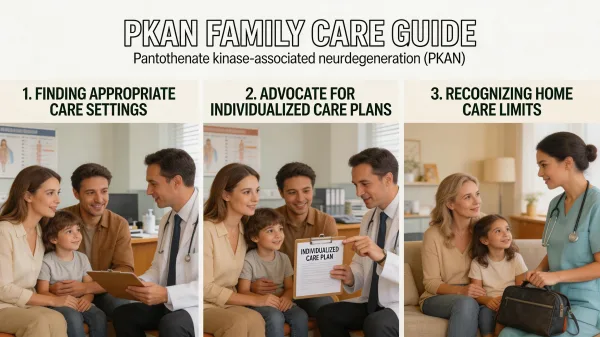
Start by identifying what your family member's care actually requires on a daily basis. Write it down in detail: repositioning schedule, dystonia management (which positions trigger spasms, which relieve them), feeding method and schedule, medication regimen and timing, communication methods they respond to, and sensory triggers to avoid. This document becomes your most important tool when evaluating any facility. I learned through my own caregiving experience that no care team, no matter how skilled, can know what you know about your person's body and routines unless you hand them that information explicitly.
When touring facilities, ask specifically about their experience with movement disorders, not just dementia. Ask how they manage severe spasticity and dystonia. Ask who provides therapy services and how often. Ask what happens during a dystonic crisis. If the staff can't answer these questions or haven't encountered these situations before, that tells you something important. It doesn't automatically disqualify the facility, but it means you'll need to build in extra training and oversight.
Younger adults placed in facilities designed for elderly residents face isolation. The activities are geared toward people in their 80s. The social environment doesn't match. Some families address this by arranging outside visitors, connecting with disability advocacy groups, or working with the facility to create individualized programming. Age-appropriate engagement matters for quality of life, even when cognitive decline limits participation.
Funding is another barrier. Many young adults with PKAN qualify for Medicaid, but Medicaid waiver programs for home and community-based services vary widely by state. Some states have waiver programs specifically designed for younger adults with disabilities that can cover residential care alternatives to nursing homes. Contact your state's Medicaid office and ask about HCBS waivers for individuals with physical disabilities or traumatic brain injury waivers, which sometimes cover progressive neurological conditions.
Advocating for Your PKAN Family Member in Any Care Setting
Families of people with PKAN often know more about the disease than the staff providing care. That's not a criticism of the staff. PKAN affects roughly 300 to 600 people in the entire United States. Most nurses and aides will go their entire career without encountering it.
Bring a written care protocol to every provider, every facility, and every hospital admission. Include the basics of PKAN (a one-page summary the staff can reference), your family member's specific symptom profile, what medications they take and why, what a dystonic episode looks like for them specifically, and what interventions help. Having worked in hospitals for close to 20 years, I can tell you that a clear, written care guide from a family member is one of the most useful things a care team can receive, especially for a condition they've never seen before.
Connect with the NBIA Disorders Association. They maintain a networking program that connects PKAN families with each other, and that peer connection can be a lifeline when you're trying to solve care problems that no professional guidebook covers. They also hold family conferences every two years and have expanded to five Centers of Excellence across the United States as of 2025, which can help connect your family to clinicians with direct NBIA experience.
When Home Care Reaches Its Limit
Deciding that home care is no longer sustainable isn't a failure. It's a recognition that the physical and emotional demands of full-time caregiving for a person with advanced PKAN exceed what one or two people can safely provide.
When I was caring for my first husband through five years of cancer treatment, I carried the same weight that PKAN families carry: the feeding tubes, the medication schedules, the physical toll of helping someone whose body was failing them. I also carried the belief that no one else could do it as well as I could. That belief kept me going for a long time, but it also made it harder to accept help when I needed it. The families I talk to who are facing a PKAN care transition often describe the same thing. Years of being the only person who truly understands their loved one's needs makes the idea of trusting a facility feel impossible. But reaching the limits of what your body and mind can handle isn't a sign of giving up. It's a sign that the disease has progressed beyond what any single household can manage.
Watch for the signs that home care is reaching its limit: caregivers experiencing injuries from transfers or positioning, the person with PKAN having more frequent aspiration events or skin breakdown, sleep deprivation becoming chronic, and other health needs of the caregivers going unaddressed. These aren't minor issues. They're safety concerns for everyone in the household.
Start the conversation with your family member's neurologist and the NBIA Disorders Association before you're in crisis. Planning a transition with time on your side gives you more options and better outcomes than waiting until an emergency forces the decision.
Your Knowledge Is the Foundation
PKAN families carry a depth of knowledge about their loved one's condition that no textbook can replicate. You've watched the progression. You've adapted routines hundreds of times. You know which position eases the spasms and which sound calms them down. That knowledge doesn't become less valuable when care moves to a facility. It becomes more valuable.
The right care setting for a young adult with PKAN may not exist as a ready-made option. But with detailed care protocols, honest conversations with facility staff, and support from organizations that understand rare neurodegeneration, families can build something that works. You've been doing that your whole life with this disease. This is one more version of the same thing.
Your family member deserves care that respects both their medical complexity and their humanity. Don't settle for less, and don't carry the weight of finding it alone.