
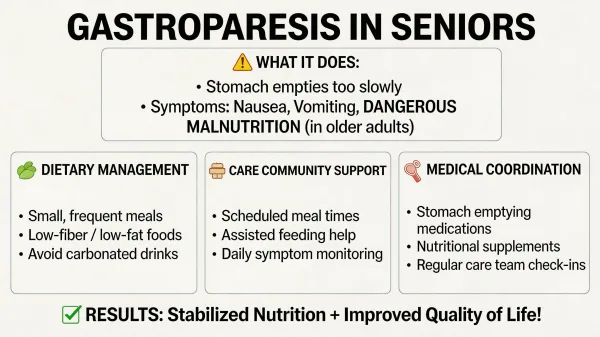
Gastroparesis is a chronic digestive disorder in which the stomach muscles don't contract normally, causing food to remain in the stomach far longer than it should. For seniors, this delayed gastric emptying can lead to severe malnutrition, dangerous weight loss, and repeated hospitalizations.
Eating is supposed to be one of the simplest parts of daily life. For a senior with gastroparesis, it becomes something closer to a medical procedure. Every meal carries the risk of nausea, vomiting, bloating, and pain, and over time, the body stops getting the calories and nutrients it needs to function. The weight loss can be dramatic. The hospital visits stack up. And for families watching their parent struggle to keep food down, the question shifts quickly from "how do we manage this at home" to "where can they get the daily support this condition demands."
I've worked in hospitals long enough to see how conditions like this slip under the radar until the consequences become serious. A parent who has been losing weight steadily for months may not mention it, or may chalk it up to "just not being hungry." By the time the family notices, the nutritional damage is already significant.
This article breaks down what gastroparesis actually does, why it's particularly dangerous for seniors, and how the right senior living environment can provide the structured dietary management that makes the difference between decline and stability.
What Gastroparesis Does to the Body
In a healthy stomach, muscles contract in coordinated waves to grind food and push it into the small intestine. Gastroparesis disrupts that process. The stomach's nerve signals weaken or fail entirely, and food sits for hours, sometimes longer, instead of moving through the digestive tract on schedule.
The symptoms are persistent and disruptive: nausea that lingers for hours after eating, vomiting of partially digested food, bloating, abdominal pain, and a feeling of fullness after just a few bites. Over time, this leads to reduced caloric intake, vitamin deficiencies, dehydration, and significant weight loss. In severe cases, undigested food can harden into a mass called a bezoar, which may require medical intervention to remove.
The most common known cause is diabetes, which accounts for more than half of all diagnosed cases. Parkinson's disease, hypothyroidism, certain medications (particularly opioids and some antidepressants), and prior abdominal surgery are also common contributors. In many cases, the cause is never identified.
For a senior living alone, the daily impact goes beyond physical symptoms. Meal preparation becomes exhausting when eating itself feels like a punishment. Social meals with friends or family turn into sources of anxiety. Grocery shopping feels pointless when most of what gets purchased ends up uneaten or triggers a bad episode. The isolation that gastroparesis creates is real, and it compounds the nutritional decline.
Why Seniors Face Greater Risk from Gastroparesis
Older adults are more vulnerable to the complications of gastroparesis for several reasons. Many seniors already have lower caloric reserves and less muscle mass, so even a modest reduction in food intake can trigger a dangerous spiral. Dehydration happens faster. Recovery from nutritional deficits takes longer. And the body's ability to compensate for missed calories diminishes with age, turning what might be a manageable annoyance at 40 into a medical emergency at 78.
Gastroparesis in older adults also presents differently than in younger patients. Research shows that seniors with gastroparesis are more likely to report early satiety and bloating rather than the dramatic nausea and vomiting younger patients describe. That subtler presentation means the condition often goes unrecognized longer, and the nutritional damage accumulates before anyone connects the dots. Your parent may tell you they just don't feel like eating much anymore. That's worth investigating.
Medications commonly prescribed to older adults, including calcium channel blockers, opioid pain medications, and certain antidepressants, can further slow gastric emptying and worsen the problem. A senior taking multiple medications for heart disease, arthritis, and depression may already have drug-induced slowing of their digestive system before gastroparesis is even part of the picture. In the ER, I've seen elderly patients come in severely dehydrated and malnourished, and the underlying cause turns out to be gastroparesis that nobody caught because the symptoms looked like normal aging.
Meal Engineering: Why Gastroparesis Requires Precise Dietary Management
Diet isn't just a recommendation for gastroparesis. It's the primary treatment. The stomach can't process food normally, so every meal has to be designed around what the stomach can actually handle. Get this wrong, and symptoms flare. Get it right, and most people with gastroparesis can maintain reasonable nutrition and avoid the worst complications.
The core dietary approach involves several modifications working together. Meal size has to shrink considerably, from three standard meals to four to six smaller ones spread throughout the day. The smaller volume reduces stomach distension, which means less nausea and faster emptying. Fat must be limited because it slows gastric motility further, so meals need to stay under roughly 40 to 50 grams of total fat per day during maintenance. Fiber requires similar restriction. Raw vegetables, fruit skins, seeds, and high-fiber grains can sit in the stomach for hours and increase the risk of bezoar formation. Well-cooked, soft, or pureed foods are easier to process. Liquids tend to empty from the stomach more readily than solids, so liquid nutrition supplements, smoothies, and soups become important calorie sources on difficult days. Meat often needs to be ground or pureed for the stomach to handle it, and carbonated drinks should be avoided because the gas increases distension.
Timing matters just as much as food composition. Meals should be spaced roughly two to three hours apart to prevent overloading the stomach. Fluids are best consumed between meals rather than during them, because drinking with food adds volume that the stomach struggles to process. Sitting upright for at least an hour after eating also helps gravity assist the emptying process. Even light activity, like a short walk after a meal, can support motility.
For seniors with diabetic gastroparesis, blood glucose control adds another layer of complexity. Research published in Diabetologia found that gastric emptying accounts for roughly 35% of the variance in post-meal blood sugar levels. High blood sugar slows gastric emptying further, and delayed emptying causes unpredictable blood sugar spikes when food finally passes into the small intestine. It's a cycle that feeds on itself: poor glucose control worsens the gastroparesis, and worsening gastroparesis makes glucose harder to control. This means that meal composition, insulin timing, and glucose monitoring all have to be coordinated, not just generally but meal by meal.
During my years doing mobile X-ray work in care facilities, I saw a pattern that concerned me more than almost anything else. Dietary needs were documented in charts, sometimes in careful detail. But the meals arriving on trays told a different story. Standard portions, three times a day, with no accommodation for the small, frequent, low-fat, low-fiber schedule that a condition like gastroparesis demands. The gap between what was charted and what was actually delivered was real, and it had consequences for residents who depended on that precision to stay nourished and out of the hospital.
What Families Often Underestimate About Gastroparesis
Many families assume that gastroparesis is manageable with a simple diet change, something like "just eat smaller meals." The reality is far more involved. Gastroparesis turns every meal into a medical decision. Meal size, composition, timing, texture, and eating order all matter. A standard three-meals-a-day schedule can actively make the condition worse by overloading a stomach that can't keep up.
The preparation demands are significant too. Six small meals a day, each low in fat and fiber, with the right texture, at the right intervals, is a full-time job for someone who feels well. For a senior battling nausea and fatigue, it's often impossible without help. Consider a parent with diabetic gastroparesis who vomits after most meals and has lost 25 pounds in four months. They've tried eating smaller portions at home, but they can't manage the preparation, the timing, or the glucose monitoring on their own. That's the point where the condition has outpaced what home management can handle.
When Senior Living Becomes the Right Choice for Gastroparesis
The tipping point for most families comes when the nutritional decline can't be reversed at home. If your parent is losing weight despite their best efforts, if they're skipping meals because the nausea is too severe, or if their blood sugar has become dangerously erratic because of unpredictable gastric emptying, it's time to consider a care environment that can deliver the daily structure gastroparesis requires.
Assisted living and senior living communities vary widely in their ability to handle complex dietary conditions. The best programs assign a specific care team that understands the resident's gastroparesis management plan and communicates with the kitchen daily, not weekly. They track weight trends, monitor hydration, and flag changes in eating patterns before those changes become a crisis. Some communities offer dining flexibility that allows residents to eat on their own schedule rather than being locked into fixed meal times.
That level of monitoring matters more than families expect. I've seen how much of a difference it makes when someone is tracking intake, noticing patterns, and adjusting before a crisis develops rather than after. The structure of a good senior living community can replace the constant worry that comes with managing this condition from a distance.
Questions to Ask a Senior Living Community
Not every community is equipped to manage a condition that requires this level of dietary precision. Before choosing a community, ask specific questions about their capabilities. Can they accommodate a six-meal-per-day schedule? Do they have a dietitian on staff or on contract who can design and adjust gastroparesis-specific meal plans? Can the kitchen prepare modified-texture meals, including pureed and soft options? How do they handle residents who can't finish meals, and what alternative nutrition sources do they offer?
Ask how dietary needs are communicated between medical staff and kitchen staff. A care plan that exists only on paper doesn't help if the information doesn't reach the person preparing the food. Find out how often care plans are reviewed and updated. Gastroparesis fluctuates, and your parent may have weeks where they tolerate soft solids well and other weeks where they can only manage liquids. The community needs a process for adapting quickly, not waiting until the next quarterly review.
If your parent has diabetic gastroparesis, ask whether the community coordinates meal timing with blood glucose monitoring and insulin administration. That coordination is central to managing both conditions together.
Medical Management Beyond Diet
While dietary management is the foundation, gastroparesis often requires medication as well. Metoclopramide is the only FDA-approved drug for the condition, but it carries a black box warning for tardive dyskinesia, and its use is heavily cautioned in adults over 65. Treatment duration is typically limited to three months. Other medications, including antiemetics for nausea and erythromycin as a short-term prokinetic agent, may be prescribed off-label.
For seniors, medication management requires careful coordination between the gastroenterologist, the primary care physician, and the care team at the senior living community. Some medications that treat other conditions your parent may have, such as opioids for pain or certain blood pressure medications, can worsen gastroparesis. A thorough medication review is one of the first steps after diagnosis.
Understanding the Cost Factor
Assisted living communities charge a national median of $6,200 per month as of the 2025 CareScout Cost of Care Survey, which comes to $74,400 per year. Specialized dietary needs, medication management, and higher care levels typically add to that baseline. The total can feel overwhelming, but families should weigh it against the cost of repeated emergency room visits and hospitalizations that result from unmanaged gastroparesis. One study found that gastroparesis patients with malnutrition had more than three times the mortality risk and significantly longer hospital stays than those without malnutrition.
I remember the financial shock when our family faced care costs for a loved one's declining health. Nothing prepares you for the numbers. But the cost of not getting the right care, measured in hospital bills, declining health, and lost quality of life, adds up faster than the monthly fee at a community that can actually manage the condition.
Taking the Next Step for Your Parent
Gastroparesis is a condition that demands daily attention to detail, and that level of attention is difficult to sustain at home when the person who needs it is also the one too sick to provide it. The right senior living community can take the burden of meal planning, preparation, timing, and monitoring off your parent's shoulders and off yours.
Start by getting a clear diagnosis and working with a gastroenterologist who understands geriatric care. Ask the doctor's office for written dietary guidelines you can share with prospective communities. Tour facilities with a specific list of questions about meal flexibility, dietitian access, and how dietary plans translate from chart to kitchen. Talk to the dining services director, not just the admissions coordinator.
Trust what you're seeing. If your parent is losing weight, avoiding food, or cycling through hospital admissions, structured care isn't giving up. It's giving them the best chance at stability and comfort. Gastroparesis is a condition that responds to consistency, and consistency is exactly what a well-run senior living community provides. You're doing the right thing by looking for answers.