
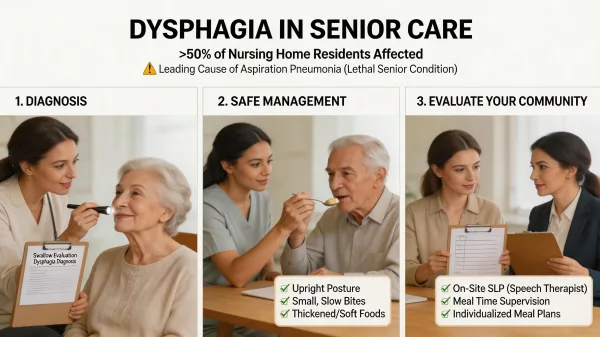
Pneumonia accounts for roughly 40% of hospitalizations and up to one-third of deaths among nursing home residents, and the majority of those cases trace back to one root cause: aspiration. When food, liquid, or saliva enters the airway instead of the esophagus, the resulting infection can be fatal within weeks. Behind most aspiration events is a condition called dysphagia, a swallowing disorder that affects more than half of all people living in care facilities. If your parent has started coughing during meals, clearing their throat constantly, or losing weight without explanation, those aren't just signs of aging. They could be warnings that every meal carries a serious medical risk.
I've worked in hospitals for close to 20 years, and I've seen what happens when swallowing problems go unaddressed. A patient comes into the ER with pneumonia, and the medical team traces it back to food particles that silently entered the lungs. By the time aspiration pneumonia shows up on a chest X-ray, the damage is already done. It's one of the most preventable causes of death in senior care, yet it remains one of the most overlooked.
This article covers what dysphagia is, why it's so dangerous for seniors in care settings, how swallowing is evaluated, what modified diets actually involve, and most critically, how to tell whether a senior living community truly manages dysphagia safely or just checks a box on the menu. If your parent has been diagnosed with swallowing problems, the community you choose could be the difference between safe meals and a medical emergency.
What Is Dysphagia?
Dysphagia is the medical term for difficulty swallowing. It can affect any part of the swallowing process, from the mouth to the throat to the esophagus, and it ranges from mild discomfort to a complete inability to swallow safely. For seniors, dysphagia most often develops as a result of neurological conditions like stroke, Parkinson's disease, or dementia, though it can also stem from head and neck cancers, medication side effects, or the gradual muscle weakening that comes with advanced age.
The swallowing process involves more than 30 muscles and multiple nerves working in precise coordination. When any part of that system breaks down, food or liquid can enter the airway instead of the stomach. This is called aspiration, and it can happen with or without any visible coughing or choking. Research estimates that dysphagia affects roughly 50% to 60% of nursing home residents, though many cases go undiagnosed because families and staff attribute the symptoms to normal aging or eating habits.
Common signs of dysphagia include coughing or choking during meals, a wet or gurgly voice after swallowing, food getting stuck in the throat, unexplained weight loss, recurring pneumonia, and taking unusually long to finish eating. If your parent shows any of these patterns, a formal swallowing evaluation is the necessary next step.
Consider a situation where your father chokes on a piece of chicken at a family dinner. Everyone pauses, he clears his throat, takes a sip of water, and the table relaxes. It happens again two weeks later, this time on bread. Then again on soup. By the fourth episode, someone finally mentions it to his doctor, who orders a videofluoroscopic swallow study. The results show severe oropharyngeal dysphagia with aspiration on thin liquids. Suddenly, the family is learning terms they've never heard, researching thickened liquids and pureed diets, and trying to find a senior living community that can manage a condition they didn't realize was life-threatening three months ago. That's how fast this moves for most families.
Aspiration Pneumonia: The Silent Killer in Senior Care
Aspiration pneumonia develops when food particles, liquids, or oral bacteria enter the lungs through the airway. Unlike a typical respiratory infection, aspiration pneumonia targets the lower lungs where gravity pulls the aspirated material, and it can progress rapidly in older adults whose immune systems are already compromised. Studies show that mortality from aspiration pneumonia is severe: roughly 30% of older adults hospitalized for aspiration pneumonia die within 30 days, and mortality reaches approximately 70% within two years of the first episode. Those numbers make aspiration pneumonia one of the most lethal conditions in geriatric care.
What makes dysphagia-related aspiration so dangerous is that much of it happens silently. Research using videofluoroscopic swallow studies has found that between 55% and 59% of people with dysphagia experience silent aspiration, meaning food or liquid enters the airway with no coughing, no choking, and no outward sign that anything went wrong. The person's cough reflex has weakened to the point where the body's natural defense mechanism simply doesn't activate. This is why a parent can appear to eat normally at every meal while slowly developing a life-threatening lung infection. By the time symptoms like fever, confusion, or breathing difficulty appear, the pneumonia may already be advanced.
Silent aspiration is particularly common in seniors with dementia. As cognitive decline progresses, both the swallowing reflex and the cough reflex deteriorate, often with a time lag between the two. A person may start having swallowing difficulty months before their cough reflex weakens enough for silent aspiration to occur. This progression means that a parent who was coughing during meals six months ago and has since "gotten better" may not have improved at all. They may have lost the ability to cough, which is far worse.
I've seen this pattern in the ER more times than I can count. An elderly patient arrives with what looks like a sudden respiratory crisis, but when the team digs into the history, the swallowing problems had been there for months. The family didn't realize how serious it was. The care facility didn't catch the silent aspiration. And now we're treating a pneumonia that could have been prevented with proper dysphagia management from the start. That gap between what families are told and what actually happens with swallowing safety is something that's stayed with me throughout my career.
Speech-language pathologists (SLPs) are the clinical professionals trained to assess and manage dysphagia. They use instrumental evaluations, primarily the videofluoroscopic swallow study (VFSS) and fiberoptic endoscopic evaluation of swallowing (FEES), to see exactly what happens when a person swallows. These tests reveal whether aspiration is occurring, at what consistency of food or liquid, and whether compensatory strategies like chin tucks or thickened liquids reduce the risk. Without these assessments, diet modifications are guesswork. A community that changes a resident's diet to pureed food without an SLP evaluation isn't managing dysphagia. They're guessing, and guessing with aspiration risk can be fatal.
Diet texture modification alone doesn't prevent aspiration. Proper positioning during meals (sitting upright at 90 degrees, chin slightly tucked), controlled pacing (small bites, adequate time between swallows), and trained staff monitoring throughout the meal are all required components. A resident eating pureed food while reclined in a wheelchair with no supervision is at significant aspiration risk regardless of the food texture. The management has to be comprehensive, or it isn't management at all.
How Dysphagia Is Diagnosed: The Swallow Evaluation
A formal dysphagia diagnosis starts with a clinical swallowing evaluation performed by a speech-language pathologist. This bedside assessment examines oral motor function, the strength and coordination of swallowing muscles, and the person's response to different food and liquid consistencies. The SLP watches for signs like delayed swallowing, coughing, voice changes after swallowing, and residual food in the mouth or throat.
If the bedside evaluation raises concerns about aspiration risk, the next step is an instrumental assessment. The two gold-standard tests are the videofluoroscopic swallow study (VFSS), sometimes called a modified barium swallow, and the fiberoptic endoscopic evaluation of swallowing (FEES). During a VFSS, the person swallows food and liquid mixed with barium while a fluoroscope captures real-time images of the swallowing process. FEES involves passing a thin endoscope through the nose to directly observe the throat during swallowing. Both tests can detect silent aspiration that no bedside evaluation can identify.
The results of these evaluations determine what diet texture level and liquid consistency a person can safely consume. They also guide recommendations for positioning, pacing, and any swallowing exercises that might improve function over time. Without this formal evaluation, no one can reliably know what your parent can safely eat. If your parent's current community made diet changes based only on a nurse's observation at mealtime, that isn't a diagnosis. It's a guess, and it may not be protecting them from the aspiration risks that only instrumental testing can reveal.
One thing families should know: these evaluations aren't one-and-done. Swallowing function can change after a hospitalization, a new medication, a urinary tract infection, or simply as a neurological condition progresses. A swallow study that was accurate six months ago may no longer reflect your parent's current risk. Ask how often reassessment is recommended, and make sure the community has a system for triggering a new evaluation when something changes.
Modified Diets and Thickened Liquids: Understanding the IDDSI Framework
Once a swallowing evaluation identifies the specific risks, the SLP prescribes a diet texture and liquid consistency matched to your parent's swallowing ability. The international standard for classifying these modifications is the IDDSI Framework (International Dysphagia Diet Standardisation Initiative), which uses a scale of 0 through 7 to categorize both food textures and liquid thickness. Thin liquids are Level 0, slightly thick liquids are Level 1, and the scale progresses through mildly thick, moderately thick, and extremely thick. For foods, Level 7 is regular/easy to chew, Level 6 is soft and bite-sized, Level 5 is minced and moist, Level 4 is pureed, and Level 3 is liquidized.
The reason IDDSI matters for families is consistency. Before this framework was adopted in the United States (recognized by the Academy of Nutrition and Dietetics as the only standard since October 2021), facilities used different terminology that varied widely. What one facility called "mechanical soft" might be completely different from another's version. IDDSI gives families a standardized language to verify that the food their parent receives matches what the SLP prescribed. If a community can't tell you what IDDSI level they're preparing, that's a concern.
Thickened liquids deserve special attention. Many seniors with dysphagia can't safely drink water, coffee, or juice at their normal thin consistency because thin liquids move too fast for a weakened swallowing mechanism to control. Thickening agents slow the liquid's flow, giving the muscles more time to protect the airway. However, thickened liquids are often unpalatable, which leads to reduced fluid intake and dehydration. This is a real and common problem that a good dysphagia program actively monitors.
Why Diet Modification Alone Isn't Enough
In practice, this is where things break down. A community may list "modified diets available" on its brochure, but serving pureed food on a tray doesn't constitute dysphagia management. Without proper positioning, a resident eating pureed food while slouched in a chair is still at risk. Without pacing, a resident who takes bites too quickly because no one is monitoring them can aspirate on any texture. Without oral care, bacteria that accumulate in the mouth become the payload that turns aspiration into pneumonia. During my time doing mobile X-ray work inside care facilities, I saw residents eating modified-texture meals with no staff member within arm's reach. The meals were technically correct on the tray. The safety around the meal was absent.
Research consistently shows that oral hygiene is a critical but often neglected component of aspiration pneumonia prevention. The bacteria that cause the infection don't come from the food itself. They come from the person's own mouth. Seniors with poor oral health, ill-fitting dentures, or inadequate dental care have significantly higher bacterial loads in their oral cavity, and when that bacteria reaches the lungs through aspiration, the infection risk multiplies. Studies of nursing home residents with severe aspiration pneumonia found that gram-negative bacteria from the oral cavity were the most commonly identified pathogens. This means that a community's oral care routine, how often residents receive dental hygiene, whether dentures are cleaned properly, and whether staff assist with brushing for residents who can't do it themselves, is directly connected to whether aspiration leads to a treatable event or a fatal infection. A dysphagia management program that ignores oral care is missing one of the most important preventive measures available.
Temperature also plays a role. Research has found that food served at distinct temperatures, either clearly warm or cold, can help trigger the swallowing reflex more effectively than food at room temperature. This is a small detail, but it illustrates a broader point: real dysphagia management involves attention to dozens of clinical details, not just menu labeling.
Evaluating a Community's Dysphagia Management Program
Finding a senior living community that manages dysphagia properly requires looking beyond the dining room and into the clinical infrastructure. Many communities will say they accommodate dietary modifications. Fewer actually have the staff training, clinical oversight, and protocols that make those modifications safe. The difference between the two can determine whether your parent eats safely or ends up in the emergency room with aspiration pneumonia.
Start with speech therapy access. Ask whether the community has a speech-language pathologist on staff or through a contracted therapy provider, how quickly a new resident with known dysphagia gets an initial swallowing assessment, and whether instrumental evaluations (VFSS or FEES) can be arranged without requiring a hospital visit. A community that relies entirely on bedside screening and never refers for instrumental assessment isn't equipped to manage severe dysphagia. Bedside evaluations miss silent aspiration. That's not a minor gap.
Next, evaluate how modified diets are actually prepared. Ask to see a meal prepared at the IDDSI level your parent needs. Pureed food should not look like indistinguishable mush on a plate. Quality dysphagia dining programs use food molds and careful preparation to make pureed meals visually appealing and nutritionally complete. If the kitchen staff can't explain what IDDSI level they're preparing or how they test food consistency, the program is operating without the precision that safe dysphagia care requires. Some communities simply run everything through a blender and call it managed. That's not the same thing.
Staff training is where most programs succeed or fail. Every aide who assists with meals should be trained on proper feeding techniques: appropriate bite size, pacing between bites, signs of aspiration to watch for, and what to do if choking occurs. Ask how often staff receive dysphagia-specific training, whether it's a one-time orientation topic or an ongoing competency. In surveys of nursing homes, approximately 25% reported that untrained or unskilled staff were involved in screening or assessing swallowing difficulties. That number should concern any family.
Ask about aspiration response protocols. If your parent does aspirate and chokes during a meal, what happens next? Is there a trained nurse available at every mealtime? How quickly can emergency suction be accessed? Is there a post-incident protocol that includes reassessment by an SLP? Communities with strong dysphagia programs have clear answers to these questions. Communities that don't may hesitate or give vague responses. Also ask whether the community tracks aspiration events and near-misses. A community that documents these incidents and reviews them as part of quality improvement is managing dysphagia proactively, not just reacting when something goes wrong.
Finally, ask how the community monitors for changes over time. Dysphagia isn't static. Your parent's swallowing function can deteriorate after an illness, a medication change, or simply as their underlying condition progresses. A good program includes regular reassessment intervals, weight monitoring as an early warning for nutritional decline, and clear communication with families when the care plan needs to change. If the community's answer to "how do you monitor swallowing changes?" is a blank look, keep searching.
The Cost Factor: What Dysphagia Care Adds to Senior Living Expenses
The median monthly cost for assisted living in the United States is $6,200 as of 2025, according to the CareScout Cost of Care Survey. That's $74,400 per year before any specialized care surcharges. Communities that offer genuine dysphagia management programs often charge additional fees for modified diet preparation, speech therapy sessions, and one-on-one meal monitoring. These add-ons can range from $200 to $800 per month depending on the level of support required.
Don't let cost be the reason you skip the questions about clinical quality. A community that charges less but doesn't manage dysphagia properly may save you $300 a month while exposing your parent to a hospitalization for aspiration pneumonia that costs tens of thousands of dollars, not to mention the physical toll. When I watched my own family go through the financial shock of specialized senior care, the hardest lesson was that the cheapest option and the safest option are rarely the same. Ask about costs upfront, but weigh them against the clinical specifics.
Steps to Take If Your Parent Has Been Diagnosed with Dysphagia
1. Get a Formal Swallow Evaluation
If your parent hasn't had a VFSS or FEES, request one through their physician. A bedside screening alone isn't sufficient for determining aspiration risk or prescribing the correct diet texture.
2. Understand the Specific Recommendations
Ask the speech-language pathologist to explain your parent's IDDSI level for both food and liquids, any positioning requirements, and any swallowing exercises that could help maintain or improve function.
3. Evaluate Communities Against Clinical Criteria
Use the questions outlined in the evaluation section above. Don't accept "we accommodate special diets" as an answer. Ask for specifics about SLP access, staff training, meal preparation practices, and monitoring protocols.
4. Tour During Mealtime
Request a visit during lunch or dinner. Watch how staff interact with residents who need feeding assistance. Are they sitting at eye level? Taking time between bites? Watching for signs of difficulty? Or are they rushing through meals to move to the next task? I've spent enough years working around patient care to know that how staff behave when they think no one is watching tells you more than any brochure ever will.
5. Review the Care Plan in Writing
Before signing any agreement, make sure the dysphagia management plan is documented in the care plan. This should include the specific IDDSI diet level, liquid consistency, positioning requirements, monitoring frequency, and the schedule for reassessment by an SLP.
6. Stay Involved After Move-In
Visit during meals periodically. Ask for updates on your parent's weight and any changes in swallowing function. Dysphagia management doesn't end at admission. It requires ongoing attention for as long as the condition persists.
When Swallowing Problems Mean a Higher Level of Care
Not every assisted living community is equipped to handle severe dysphagia. If your parent requires constant meal supervision, frequent SLP reassessment, or has a history of recurrent aspiration pneumonia, a skilled nursing facility may provide the level of clinical oversight that an assisted living setting can't match. Skilled nursing facilities typically have on-site nursing staff around the clock and better access to therapy services, though they come at a significantly higher cost (the national median for a semi-private nursing home room is $315 per day, or roughly $114,975 per year, as of 2025).
The decision between assisted living and skilled nursing for a parent with dysphagia depends on severity. Mild to moderate dysphagia with a stable diet modification can often be managed well in assisted living if the program is strong. Severe dysphagia with recurrent aspiration events, tube feeding considerations, or rapid decline typically requires skilled nursing. Your parent's SLP and physician can help guide this decision based on the specific clinical picture.
There's also a middle ground that some families overlook. Certain assisted living communities partner with home health agencies or contract with therapy companies that bring SLPs on-site multiple times per week. This arrangement can offer more clinical support than a basic assisted living program without the full cost of skilled nursing. When you're comparing communities, ask specifically about these therapy partnerships, because they can make a meaningful difference in what level of dysphagia care is realistic in that setting.
Protecting Your Parent's Safety at Every Meal
Dysphagia doesn't get the attention it deserves. It lacks the dramatic recognition of conditions like heart disease or cancer, yet it quietly contributes to thousands of preventable deaths in care facilities every year. The families who do best are the ones who take swallowing problems seriously from the first sign, get a proper evaluation, and choose a community based on clinical capability rather than aesthetics or price alone.
Your parent deserves meals that are safe, dignified, and prepared with the clinical precision their condition demands. That means asking hard questions, touring at mealtime, and holding communities accountable for the specifics of their dysphagia program. If a community can't explain how they manage swallowing safety in concrete terms, they aren't ready for your parent. Don't let anyone tell you that difficulty swallowing is just part of getting older. It's a medical condition with serious consequences, and it requires real clinical management.
You're already doing the right thing by researching this. The fact that you're reading about dysphagia and senior living means you're taking your parent's safety seriously, and that awareness alone puts you ahead of most families facing this situation. Trust what you're learning, ask the tough questions, and don't settle for vague reassurances when your parent's life depends on the answer.