
Imagine your 79-year-old mother lives alone in Phoenix. She had a minor accident last month. She backed into a pole at the grocery store, and last summer she missed a stop sign that you only learned about because a neighbor mentioned it. Her reaction time isn't what it was. She knows it. You know it. And every time you raise the conversation about her driving, she shuts it down within thirty seconds because the answer to "you should stop driving" has always been "and lose what, exactly?" You live two states away.
For most of the last fifty years, the answer to her question was brutal. Stop driving meant stop going to the grocery store on her own schedule, stop driving to her hairdresser, stop seeing her sister across town without scheduling a ride three days in advance. The "stop driving" conversation has always been a conversation about losing daily life.
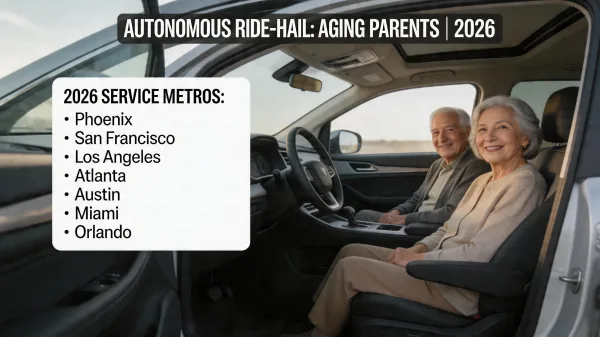
As of April 2026, that calculation has shifted in a small but meaningful number of American cities. Waymo, the autonomous ride-hail service from Alphabet, now operates in roughly ten metro areas, including Phoenix, San Francisco, Los Angeles, Atlanta, Austin, Miami, and Orlando, with rolling early-access programs in Dallas, Houston, San Antonio, and Nashville. Tesla's unsupervised Robotaxi service runs in Austin, Dallas, and Houston. For a growing slice of urban elderly Americans, "stop driving" no longer has to mean "stop going where you want to go." This article walks through what that actually means for your family, where it's available, where it isn't, and how to think about the conversation differently if you live in a city where the option exists.
The Conversation That's Been the Same for Decades
The reason this conversation has been so painful for so long is that it has never been about driving. It has been about independence. For most older Americans, the car is the grocery store, the doctor, the church, the friend's house, the pharmacy, and the freedom to leave when she's ready instead of when someone else is available. The Centers for Disease Control reports that 79% of seniors aged 65 and older live in car-dependent communities. There were almost 52 million licensed drivers aged 65 or older as of 2022. Driving isn't a habit for these families. It's the structure of the day.
The traditional alternatives haven't matched what the car gives. Paratransit usually requires booking 24 to 72 hours in advance and runs on its own schedule. Adult children can drive their parents to medical appointments, but most adult children work full-time jobs and live in different cities. Ride-share services like Uber and Lyft work for some seniors but require comfort with smartphone apps, tolerate cancellations, and often refuse short trips at off-peak hours where the elderly population most needs them. None of the standard senior transportation options have closed the daily-independence gap on their own.
So the pressure has fallen on adult children, and the choices have been narrow. Force the issue with a parent who feels their identity is at stake. Wait for a crash that takes the decision out of everyone's hands. Or live with low-grade dread for years while reaction times keep slipping. In ER waiting rooms I've sat with families talking through exactly this calculation, and there usually isn't a clean answer. That's the conversation that's been the same for decades.
What Autonomous Vehicles Actually Change in Served Cities
In a Waymo city, a typical elderly rider's experience looks like this. She opens the Waymo app on her phone, sets her destination, sees the price up front, and watches a small Jaguar I-PACE with sensors on the roof pull up at her curb a few minutes later. There's no driver. She opens the door from the app, gets in, fastens her seatbelt, and the car drives itself to her appointment. The price is what the app said it would be when she booked. Pricing data from late 2025 and early 2026 puts the average Waymo ride around $19-20 in markets like the Bay Area, with shorter rides typically in the $12-25 range depending on city, time of day, and distance. There's no driver to tip and no negotiation about the route.
For elderly riders specifically, this matters in ways that don't always match what families assume. The most useful trips are often the routine ones: standing weekly trips to the cardiologist, grocery runs, hair appointments, lunch with a friend who lives across town. Waymo introduced scheduled rides in 2025, allowing riders to book a pickup time 10 minutes to an hour in advance. That changes a once-spontaneous parent's relationship with planning. The accessibility settings include a "minimize walking time" option that makes the car park on the rider's side of the street, screen reader compatibility for vision-limited riders, in-car audio cues, and a wheelchair-accessible vehicle option in supported areas. Live trip-sharing means an adult child two states away can watch the trip in real time and know exactly when the parent arrives.
I'll be direct about why this hits me personally. In nearly two decades working in hospital ER and orthopedics, I've worked alongside the trauma teams that see what an elderly-driver crash actually looks like when it comes through the doors. I've also spent more hours than I can count standing in waiting rooms with adult children who knew, six months ago, that mom or dad shouldn't be driving anymore but couldn't figure out how to take the keys without taking the life. When my own family worked through a parent's cognitive decline, I watched how fast capability slips and how unprepared most families are for the speed of it. None of that goes away because of a robotaxi. But for the first time in my career, the answer to "and lose what, exactly?" has a real reply in some cities.
Autonomous vehicles don't solve every elder-mobility problem. They don't help a parent who has never used a smartphone and isn't going to start. They don't reach geographically isolated areas. And they don't replace the sort of door-to-door supervision that some seniors need. What they do solve, in served cities, is the routine independent trip, on the parent's schedule, without a driver in the seat to make small talk or rush a slower passenger.
The Realistic Geography of Autonomous Vehicles in 2026
This is where families have to be honest about whether the option even applies. As of April 2026, Waymo offers fully public service in Phoenix, the San Francisco Bay Area, Los Angeles, Miami, Orlando, Atlanta, and Austin. The Atlanta and Austin services run through the Uber app rather than Waymo's own app. Dallas, Houston, San Antonio, and Nashville are in early access, meaning riders can sign up but invitations are being released on a rolling basis. Tesla's Robotaxi service operates with no human in the front seats in Austin, Dallas, and Houston, with smaller geofenced service areas around 25 square miles per city.
Through the rest of 2026 and into 2027, Waymo has announced plans to launch in Denver, Detroit, Las Vegas, San Diego, Washington, D.C., and internationally in London and Tokyo. Tesla has stated it intends to bring its Robotaxi service to Phoenix, Miami, Orlando, Tampa, and Las Vegas during the same window. So the realistic picture for most American families is this: if your parent lives in or near one of these metros, the option exists or will likely exist within a year or two.
If your parent lives in a rural county, a small city, or a lower-density suburb that isn't part of one of these metro service areas, autonomous ride-hail isn't a near-term option, and probably won't be by the end of this decade. Several blue-state metros, including Boston, Seattle, and New York, have faced regulatory friction that has slowed driverless testing. The geography matters because the entire family conversation depends on whether the technology actually reaches your parent's driveway.
The "Stop Driving" Conversation This Reframes
If your family lives in a served city, the conversation you've been avoiding can change shape. The old conversation was, "You need to stop driving," which the parent heard as, "You need to give up your independence." The new conversation is, "There's a way you can stop driving without giving up your independence, and I want to walk through it with you."
That distinction sounds small but isn't. Resistance to giving up the keys is rarely about denial of decline. It's almost always about the loss of agency that follows. Removing the loss-of-agency piece changes the emotional center of the talk.
After a decade running an in-home daycare, I learned that most people don't resist a change because they object to the new thing. They resist it because they object to losing what the old thing gave them. The "stop driving" talk works the same way, and the families who handle it best understand that going in.
The practical sequence that tends to work for families: first, demonstrate the service before you ask the parent to commit to anything. If you can fly out and ride one with them, do it. Watching a Waymo pull up to the curb and drive you both to lunch is more persuasive than any sales pitch. Second, start with one specific trip your parent usually drives, ideally a short one to a familiar destination. The cardiologist on Tuesday afternoon. The grocery store on Saturday morning. Don't try to replace driving entirely. Replace one trip. Third, set up the app together with the parent's involvement, including saved addresses, payment method, and the accessibility settings. The parent should feel ownership of the tool, not handed a fait accompli. Fourth, set a budget expectation up front. At a typical $15 to $30 per ride, two trips a week run roughly $120 to $240 a month, which is generally less than the all-in cost of running an older vehicle when insurance, gas, registration, and maintenance are factored in. Annual math matters here.
The conversation works best with parents who can use a smartphone reasonably well, who have at least some openness to new technology, and who can tolerate the unfamiliarity of a car with no driver. Not every elderly parent has all three. For the parents who do, this is a different conversation than the one families were having five years ago. For parents who don't, the older calculus still applies.
What This Looks Like for Cognitively Declining Parents
The harder case is the parent whose driving needs to stop because of cognitive decline rather than physical aging. These are often the families who most need an alternative and least able to use one independently. A parent with early-to-mid stage dementia may not reliably remember to charge a phone, recognize an unfamiliar interface, or feel safe in a car with no driver to ask questions to. Smartphone-based autonomous services lean heavily on the rider's ability to manage the trip themselves.
One important constraint families need to understand: at present, Waymo's rider rules state that you cannot request a car for someone else, and you must be present at the start of the trip to open the doors. That means an adult child in another state can't simply book Waymo rides for a parent and have the parent ride alone. Trip sharing lets family monitor a ride in progress. Booking-on-behalf for solo travel by another rider isn't supported as a routine feature. This is the kind of detail families should verify before assuming a service will solve a specific care gap.
What does help, while a parent still has capacity to learn, is establishing the habit early. Practice rides while the parent can still work the app builds familiarity that lasts longer than independent use later. Standing weekly trips, set up together, become routine in a way that pure app-based booking won't. And once cognitive decline reaches the stage where door-to-door supervision is needed, autonomous vehicles aren't the right tool. That stage usually calls for in-home care, adult day programs, or memory care placement.
From the mobile X-ray work I've done inside rest homes and care facilities, I'll say plainly: by the time a parent has reached that stage, ride-hail of any kind isn't the question. The question is what level of supervised care the parent actually needs.
The Honest Limits
None of this is a fix-all. Geography is the biggest limit, as covered above. Cost is the second. A Waymo ride averages $15 to $25 in most markets, and a parent making four to six trips a week can spend $300 to $600 a month on rides. That's manageable for many families and unaffordable for others. Annual math: at $400 a month, that's $4,800 a year. Compare to the full annual cost of operating a car (insurance, fuel, maintenance, registration, depreciation) and the math often works, but families should run the numbers, not assume.
Weather is another limit. Autonomous vehicles still pull back service during severe storms, heavy fog, or unusual road conditions. Peak-hour availability can also be tight in some markets, and pricing rises during high-demand windows. Wheelchair-accessible vehicle availability varies by city and may require calling rider support to schedule. And technology failures, while rare, do happen. A vehicle that needs to pull over and wait for remote assistance is uncommon but real.
Finally, this is still an early-adopter service. The companies are expanding fast, refining the experience, and ironing out edge cases. Families who choose this path are choosing a service that will look different in 2027 than it does today, in ways that are mostly positive but not entirely predictable.
What This Actually Changes
For a specific and growing population of urban elderly Americans, the "stop driving" conversation just became a different conversation. Not an easier one in every way. The cognitive, physical, and emotional realities of aging haven't changed. What's changed is the implicit cost of saying yes. For decades, agreeing to give up the keys meant agreeing to wait for a ride, depend on family schedules, and shrink the daily map of the world. In Phoenix, San Francisco, Los Angeles, Miami, Orlando, Atlanta, Austin, and a growing list of metros, that part of the calculation has loosened.
If you're the adult child in this situation, take the geography seriously first. If your parent doesn't live in a served metro, this article is mostly background reading for what's coming. If your parent does, slow down before forcing the conversation, and consider whether a single demonstration ride could change the temperature of the next family discussion. The decision is still hard. But the trade-off your parent is being asked to make is genuinely smaller than it was even two years ago, and that matters.