
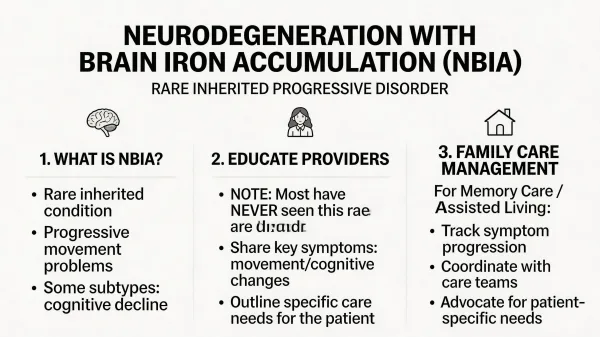
When your parent is diagnosed with neurodegeneration with brain iron accumulation, the usual playbook falls apart. There are no pamphlets in the neurologist's waiting room. The online search results are thin, clinical, and mostly written for researchers. The care facility you've been looking into has never admitted anyone with this condition. And the doctors who gave the diagnosis may have only seen it once or twice themselves.
NBIA is a group of rare inherited disorders where iron builds up in areas of the brain that control movement, gradually causing progressive damage to the nervous system. As of 2025, the estimated frequency is between one and three people per million. Most neurologists will go an entire career without encountering a single case.
I've spent a lifetime caring for others, from growing up in my parents' daycare to running my own for a decade, and one thing I've learned is that when a condition is rare, the family becomes the expert faster than anyone expects. That's not a comforting thought, but it can be an empowering one. This article is designed to give you the practical knowledge you'll need to advocate for your parent's care, educate the providers around you, and make decisions when the guidebooks don't cover your situation.
We'll cover what NBIA actually is, the subtypes that matter for care planning, how it affects memory and cognition, what daily care looks like, and how to work with facilities that have never encountered this diagnosis before.
What Is Neurodegeneration With Brain Iron Accumulation?
Neurodegeneration with brain iron accumulation (NBIA) is a group of rare, inherited neurological disorders in which abnormal amounts of iron accumulate in the basal ganglia, the brain structures that help regulate movement. This excess iron progressively damages the nervous system, causing worsening movement problems, and in some subtypes, cognitive decline. NBIA encompasses at least ten genetically distinct conditions, each caused by a different gene mutation, with varying ages of onset and rates of progression.
The hallmark features across most NBIA subtypes include dystonia (involuntary muscle contractions that cause twisting or repetitive movements), spasticity, rigidity, and difficulty with speech and swallowing. Some forms also involve vision loss, psychiatric symptoms, and seizures. Diagnosis typically involves brain MRI, which can reveal characteristic iron deposits appearing as dark regions on certain imaging sequences. One well-known MRI finding, the "eye of the tiger" sign, is specifically associated with the most common subtype, PKAN.
What makes NBIA particularly challenging for families is that no two subtypes behave the same way. Progression can be rapid or slow with long stretches of stability. The care plan that works for one NBIA subtype may not apply to another.
What Are the Main NBIA Subtypes Families Should Know About?
Where this gets confusing is that NBIA isn't one disease. It's a group of conditions that share the feature of brain iron accumulation but differ in their genetic cause, age of onset, progression rate, and symptom profile. The care plan has to be tailored to the specific subtype, and that distinction matters more than most providers realize.
The four most common subtypes account for the majority of diagnosed cases. PKAN (pantothenate kinase-associated neurodegeneration) makes up roughly 35 to 50 percent of all NBIA cases and usually begins in childhood with progressive dystonia, speech problems, and sometimes vision changes. BPAN (beta-propeller protein-associated neurodegeneration) is now recognized as the most frequently diagnosed subtype, estimated at 2 to 3 per million people, and has an unusual pattern: developmental delays in childhood followed by a sudden worsening in adolescence or adulthood with rapid-onset dystonia, parkinsonism, and dementia. MPAN and PLAN round out the more common forms, each with their own symptom patterns and timelines.
For adult children caring for an aging parent, the subtypes most likely to appear later in life are neuroferritinopathy, which typically begins around age 40 with chorea, dystonia, and gradual cognitive changes, and aceruloplasminemia, which presents with diabetes, retinal degeneration, and neurologic decline in middle adulthood. Both are exceptionally rare even within the NBIA category.
How Does NBIA Affect Memory and Cognition?
Not every NBIA subtype causes significant cognitive decline, and this is an important distinction for care planning. In some forms, thinking and reasoning remain relatively preserved even as movement deteriorates severely. In others, dementia is a central feature of the disease.
BPAN is one of the subtypes most strongly associated with cognitive decline, often progressing to dementia during the adolescent or adult worsening phase. Neuroferritinopathy can produce a pattern that resembles Huntington's disease, with chorea, psychiatric changes, and a gradual decline in memory and executive function over 10 to 20 years. Aceruloplasminemia also involves cognitive impairment as part of its neurologic presentation. In PKAN, the most common subtype, intelligence testing can be difficult because the movement disorder itself interferes with test performance, making cognitive abilities appear worse than they actually are.
I've seen in my nearly 20 years working in hospitals how easy it is for a movement disorder to be misread as a cognitive one. A patient who can't speak clearly or control their hands may be perfectly alert inside. That distinction should shape every care decision you make.
What Are the Practical Care Needs for NBIA That Facilities Should Know?
This is where the gap between your parent's needs and what most care facilities are prepared to handle becomes real. NBIA requires a care approach that blends movement disorder management, pain control, nutritional support, and communication adaptation, often all at once. Most memory care and assisted living facilities are designed around Alzheimer's and related dementias. They aren't set up for the physical complexity NBIA brings.
Dystonia management is the single biggest daily care challenge. The involuntary muscle contractions in NBIA can be severe, painful, and unpredictable. Dystonic episodes can be triggered by stress, illness, constipation, or even a change in routine. Staff need to understand that these aren't behavioral events or seizures. They're neurological, and the response protocol is completely different. Medications commonly used include oral baclofen, trihexyphenidyl, and clonazepam as first-line options. Some individuals benefit from botulinum toxin injections for localized dystonia, and in more severe cases, an intrathecal baclofen pump delivers medication directly into the spinal fluid. Deep brain stimulation is another option, though its benefits in NBIA may diminish over time as the disease progresses. Facility staff need to know what medications your parent takes for dystonia, the signs of a dystonic storm (prolonged, intense episodes that may require emergency intervention), and what not to do during an episode.
Spasticity care overlaps with dystonia management but also requires attention to positioning, range-of-motion exercises, and equipment like specialized seating or standing frames. Physical and occupational therapy should be ongoing, not just ordered once at admission. The goal shifts over time from maintaining mobility to preserving joint flexibility and comfort.
Swallowing difficulties are common across many NBIA subtypes and create real safety risks. Aspiration pneumonia is one of the leading causes of serious complications. Dietary modifications, speech-language pathology assessment, and in some cases gastrostomy tube placement are part of the care picture. Staff should know your parent's swallowing status and follow any modified diet protocols precisely.
From years of caring for people who couldn't always communicate their needs clearly, whether children in my daycare or patients in the hospital, I've learned that you have to pay attention to what the body is telling you when words aren't available. NBIA often takes speech long before it takes awareness. Your parent may understand everything happening around them even when they can't respond. Facilities need to treat every person with NBIA as fully present until proven otherwise, and communication tools like eye-tracking devices or picture boards should be explored early, not as a last resort.
Families should expect to create a written care protocol and bring it to every new provider interaction. Include the specific NBIA subtype, current medications with dosages and schedules, known dystonia triggers, swallowing precautions, communication methods, and emergency contacts including any specialist familiar with NBIA. The NBIA Disorders Association maintains resources that can help families create these documents and connect with other families managing the same condition.
Can a Standard Memory Care Facility Handle NBIA?
The honest answer is: probably not without significant education and adaptation. Memory care facilities are designed for cognitive decline with relatively stable physical health, at least in early and middle stages. NBIA flips that model. Your parent may need intensive physical care and movement disorder management alongside whatever cognitive support is required.
If memory care is the right setting based on your parent's cognitive needs, go in with a detailed care plan and be prepared to train the staff yourself. Ask whether the facility has experience with any progressive neurological conditions beyond Alzheimer's and Parkinson's. Ask about their approach to dystonia, their staffing ratios on overnight shifts (when dystonic episodes can be most distressing), and whether they'll coordinate with an outside neurologist who knows NBIA.
During my years doing mobile X-ray work in care facilities, I saw how even well-intentioned staff could miss critical details when they were caring for a condition they didn't understand. The families who stayed actively involved and kept detailed written instructions at the bedside consistently got better outcomes.
What Treatments Are Available for NBIA?
There is currently no cure for any form of NBIA, and no proven treatment that stops or reverses the iron accumulation in the brain. All treatment is focused on managing symptoms and maintaining quality of life for as long as possible.
For movement symptoms, the approach typically starts with oral medications and escalates based on response. Baclofen, trihexyphenidyl, and benzodiazepines are commonly used for dystonia and spasticity. Botulinum toxin injections can provide targeted relief for specific muscle groups, though effectiveness may decrease over time as the body builds antibodies. Deep brain stimulation has shown initial benefit in some NBIA patients, particularly those with PKAN, but results vary and may not be sustained long-term. Iron chelation therapy has been studied primarily in aceruloplasminemia and neuroferritinopathy, with mixed results. Clinical trials for newer approaches, including gene therapy, are in development but remain early-stage as of 2025.
The reality is that treatment is a moving target. What works today may need adjustment in six months. Expect frequent medication reviews and be prepared to advocate for changes when your parent's symptoms shift.
How Should Families Prepare for NBIA Progression?
NBIA progression varies enormously depending on the subtype. Some forms advance rapidly over a few years, while others progress slowly over decades with long periods of relative stability. Early-onset forms tend to move faster. Later-onset forms like neuroferritinopathy may progress over 15 to 20 years before reaching severe disability. The disease often follows a pattern of sudden deterioration lasting weeks, followed by stretches of relative stability, which makes planning feel like trying to hit a target that keeps moving.
Regardless of subtype, families should plan for eventual loss of independent mobility, increasing difficulty with speech and swallowing, possible cognitive changes, and growing dependence on full-time caregiving. The costs add up. Specialized equipment, modified diets, therapy sessions, and potential facility placement can strain a family's finances quickly. Legal and financial planning should happen early, while your parent can still participate in those decisions. Establish power of attorney, document care preferences, and have frank conversations about goals of care before a crisis forces those decisions.
I've been on the family side of watching someone's health decline faster than anyone expected. The families that do best are the ones who plan before they're forced to react.
Connect with the NBIA Disorders Association, which serves as the primary support and research advocacy organization for families. Their registry, educational materials, and family network can provide guidance that even most medical specialists can't offer for a condition this rare.
Finding Your Way Forward With an NBIA Diagnosis
An NBIA diagnosis turns families into researchers, advocates, and care coordinators overnight. That's a heavy burden to carry on top of the grief that comes with watching a parent's health change in ways you didn't expect and couldn't have predicted.
But families dealing with rare diseases develop a kind of expertise that no textbook can replicate. You will learn your parent's patterns, triggers, and needs more thoroughly than any provider who sees them for 15 minutes at a time. Trust that knowledge. Document it. Bring it to every appointment and every care facility conversation. Your parent's quality of life depends as much on your advocacy as it does on any medication or therapy.
You don't have to figure this out alone. The NBIA community is small, but it's resourceful and deeply connected. Reaching out to other families who have walked this path can make the difference between feeling lost and finding a plan that actually works.