
If you're reading this, things have probably gotten worse. Maybe your parent's hallucinations are more intense, or the falls are happening more often. Maybe the facility where your parent lives has started making medication decisions that don't sit right with you, or the overnight calls have become a weekly event instead of a rare one. You're past the point of researching what Lewy body dementia is. You already know. What you need now is a plan for finding memory care for Lewy body dementia that's equipped to handle what your family is going through.
Dementia with Lewy bodies is the second most common form of degenerative dementia after Alzheimer's disease, affecting an estimated 1.4 million Americans. But the numbers don't capture what makes DLB so difficult at the advanced stage: the combination of cognitive decline, visual hallucinations, motor symptoms that mirror Parkinson's disease, extreme medication sensitivity, and unpredictable fluctuations in alertness. That mix creates a level of complexity that many care settings simply aren't built for. Memory care for Lewy body dementia at this stage isn't just about supervision. It's about finding a team that understands the specific clinical dangers DLB presents and has the training to respond correctly.
I've been inside facilities where the staff didn't have the training to handle what DLB throws at them, and the gap between what a facility says it can manage and what it actually delivers gets wider as symptoms intensify. This guide is built around that reality. It covers the warning signs that your parent's current care arrangement is failing, what to look for in a memory care facility that can handle advanced DLB, the medication safety questions you need to ask before signing anything, and how to make the transition without making things worse. There are facilities equipped for this level of complexity. Finding them takes knowing what to look for.
What Families Often Underestimate About Memory Care for Lewy Body Dementia
Most memory care units are designed around Alzheimer's disease. That makes sense given the numbers, but it creates a dangerous assumption: that all dementias behave the same way in a care setting. They don't. Advanced DLB is one of the most challenging dementias to manage in any residential environment, and many units that do excellent work with Alzheimer's residents are genuinely not prepared for what DLB demands.
The hallucinations alone change the equation. A resident with Alzheimer's who becomes confused needs redirection and patience. A resident with DLB who is experiencing vivid, detailed visual hallucinations while also dealing with rigid muscles and balance problems needs staff who understand that the hallucination feels completely real, that the physical response to it can cause a fall, and that the wrong medication given in response could trigger a life-threatening reaction. That's three layers of complexity happening at the same time, and staff have to be trained to address all three without making any of them worse.
Families often assume that because a facility carries a "memory care" designation, it can handle any dementia diagnosis. That assumption can have serious consequences with DLB specifically, because the stakes of getting it wrong aren't just about poor quality of life. They can include catastrophic medication reactions and injuries from falls that could have been prevented. Finding out the hard way that a facility doesn't have the right skill set usually means your parent has already been harmed by the gap.
How Advanced DLB Differs from Alzheimer's in a Care Setting
Understanding the differences between DLB and Alzheimer's in a care environment isn't academic. It's the reason your parent may need a different type of facility than the one they're in now.
Alzheimer's disease typically follows a more gradual, somewhat predictable decline. Memory loss leads, and behavioral changes tend to escalate slowly over years. Staff can often develop routines that work consistently for weeks or months at a time. DLB doesn't cooperate with routines the same way. Cognitive abilities can swing dramatically within a single day, with your parent appearing lucid and engaged in the morning and deeply confused by afternoon. These fluctuations make it hard for staff to calibrate care levels, and they often catch less experienced caregivers off guard. A care plan written for your parent's Tuesday morning may not match the person staff encounter on Tuesday evening.
The motor symptoms add another dimension that most Alzheimer's-focused units aren't designed to manage. Parkinsonism in DLB, including muscle rigidity, shuffling gait, slowed movement, and impaired balance, means your parent faces a fall risk that requires specialized prevention strategies. Add visual hallucinations that can cause sudden, unpredictable movements as your parent reacts to something only they can see, and the fall risk multiplies. Research has confirmed that parkinsonism is a major risk factor for falls in DLB patients, and that the combination of motor symptoms with visuocognitive impairment creates a particularly dangerous profile.
Then there's the medication sensitivity. This is the factor that separates DLB from virtually every other dementia in a facility setting, and it deserves its own section.
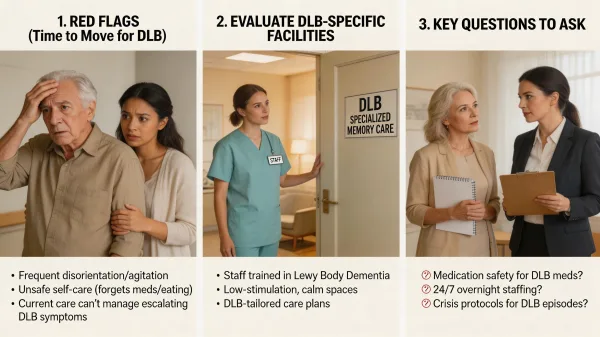
Red Flags That Current Care Isn't Working for DLB
When a care arrangement starts failing a parent with advanced DLB, the signs usually show up in clusters rather than one at a time. One problem by itself might be manageable. When several appear together, the situation is deteriorating faster than the current care team can keep up with.
Medication Decisions That Bypass the Neurologist
This is the most dangerous red flag. If a facility is making medication changes, particularly adding or adjusting antipsychotic medications, without direct coordination with your parent's neurologist, the care arrangement has become unsafe. DLB carries an extreme sensitivity to certain classes of drugs that other dementia patients tolerate without incident. Roughly half of all DLB patients experience severe adverse reactions to antipsychotic medications, according to published clinical research. These reactions can include worsened confusion, severe rigidity, inability to move or eat, dangerous drops in blood pressure, and in rare cases a potentially fatal condition called neuroleptic malignant syndrome, which causes fever, muscle breakdown, and can lead to kidney failure and death.
Typical (first-generation) antipsychotics like haloperidol should never be given to someone with DLB. But even some newer atypical antipsychotics, including olanzapine and risperidone, carry serious risks for DLB patients because of how they block dopamine receptors in an already dopamine-depleted brain. The Lewy Body Dementia Association is clear on this point: these medications can cause severe worsening of all symptoms and the reactions are sometimes irreversible.
Consider a situation where your parent has been in assisted living with memory support, but the facility has started using medications the neurologist explicitly warned against. Overnight hallucinations have led to three falls in a month, and the facility's response has been to add a sedating antipsychotic rather than consulting the specialist. That isn't a misunderstanding or a communication gap. That's a facility operating beyond its competence. If you discover this is happening, don't wait to see if it gets better.
Falls That Keep Escalating
Falls are common in DLB because of the parkinsonism, but a pattern of increasing falls, especially three or more in a month, signals that the environment or the staffing model isn't adequate. In DLB, falls aren't just about physical weakness or poor balance. They're connected to hallucinations (your parent reacts to something they see and loses balance), orthostatic hypotension (blood pressure drops when standing, a common autonomic symptom in DLB), and medication side effects that compound the motor symptoms. A facility that responds to repeated falls by adding bed rails or restricting movement rather than investigating the root cause is managing liability, not treating the person.
Staff Can't Manage Hallucination Episodes
In early to moderate DLB, hallucinations are sometimes benign. Your parent might see a child sitting in the corner or animals in the yard, and these visions may not cause distress. At the advanced stage, hallucinations often become more disturbing, more frequent, and more physically dangerous. Staff who aren't trained in DLB-specific approaches may respond with physical restraint, with sedating medications that are contraindicated, or with an approach that escalates the person's distress rather than de-escalating it.
During my years doing mobile X-ray work inside care facilities, I saw what happens when staff aren't equipped for residents with complex needs. Interventions that should have been routine turned into crises because nobody in the building had the training to handle what was happening. I remember walking into situations where the entire floor was in chaos because one resident was in distress and the staff response made everything worse. A resident experiencing a hallucination episode doesn't need someone who panics and calls 911 every time. They need someone who knows that a calm voice, gentle redirection, and patience will usually bring them through the episode, and that sometimes the best intervention is to let a non-threatening hallucination run its course. That kind of response requires training, experience, and adequate staffing ratios. A facility either has those things or it doesn't.
Signs the Facility Is Out of Its Depth
Beyond the specific symptoms above, watch for these broader warning signs: staff turnover is high on the unit where your parent lives, your calls aren't returned promptly, incident reports are vague or incomplete, the facility's response to problems is consistently reactive rather than preventive, and the care team can't explain their specific approach to DLB when you ask directly. A facility that groups all dementia residents together with one standard protocol and can't articulate how DLB care differs from Alzheimer's care is very likely out of its depth with advanced DLB.
The Antipsychotic Danger: Why Medication Safety Defines DLB Care
No single issue matters more in DLB facility care than medication management. The wrong drug, given at the wrong time, can cause irreversible damage within hours.
The pharmacological challenge with DLB is uniquely dangerous because the disease affects multiple neurotransmitter systems simultaneously. Treatments for one symptom can worsen another. Dopamine-based medications that help with motor symptoms can intensify hallucinations. Antipsychotics that might reduce hallucinations can cause catastrophic motor decline. Anticholinergic medications commonly used for bladder issues or allergies can accelerate cognitive deterioration. The Lewy Body Dementia Association describes the need for medications to be "selected cautiously" with changes made "one at a time, starting at low dose," and only after non-pharmacological interventions have been tried.
For families, the practical takeaway is this: any facility caring for your parent with advanced DLB must have a clear, documented protocol for medication changes that requires neurologist involvement before any psychiatric or neurological medication is started, adjusted, or discontinued. If a facility can't show you that protocol, keep looking. The only antipsychotics generally considered safer options for DLB patients, when treatment is necessary, are quetiapine at very low doses and, in limited cases, clozapine (which requires regular blood monitoring). Even these carry the FDA's black box warning about increased mortality risk in elderly patients with dementia and should only be used under specialist supervision.
How to Evaluate Memory Care Facilities for Advanced DLB
Finding the right memory care facility for advanced DLB requires a different set of questions than you'd ask for Alzheimer's placement. Standard memory care checklists won't cover what matters most for your parent's safety. The questions below target the specific capabilities that determine whether a facility can manage your parent's condition without putting them at risk.
Antipsychotic and Medication Policies
Ask directly: "What is your policy on antipsychotic use for residents with Lewy body dementia?" The answer you want to hear involves specific awareness of neuroleptic sensitivity, a named protocol for specialist consultation before any antipsychotic is prescribed, and documented staff training on which medication classes are contraindicated for DLB. If the response is general, something like "we work with each resident's doctor," that's not sufficient. You need evidence that the facility understands DLB medication risks as a distinct clinical concern, not just another box on a general care plan. Ask to see the facility's medication error reporting process. Ask how many times in the past year a medication was administered that a specialist had flagged as inappropriate. Their willingness to answer these questions tells you as much as the answers themselves.
Overnight Staffing for Sundowning and Sleep Disturbances
DLB frequently involves REM sleep behavior disorder, where your parent physically acts out dreams, along with sundowning, hallucination intensification at night, and severely disrupted sleep-wake cycles. These aren't occasional problems at the advanced stage. They're nightly realities that require competent, alert staffing. Ask: "What is your staff-to-resident ratio between 10 PM and 6 AM?" and "How many staff on the overnight shift have specific training in DLB or Lewy body dementia?" A memory care unit with two aides covering 30 residents overnight is very likely unable to safely manage a DLB resident who is up at 2 AM experiencing vivid hallucinations and attempting to leave the building.
Fall Prevention Protocols
I know from working inside healthcare settings for nearly 20 years that fall prevention on paper and fall prevention in practice are often very different things. Ask the facility to walk you through their fall prevention approach for residents with parkinsonism specifically. You're looking for concrete answers: how they assess gait and balance on an ongoing basis, whether physical therapy is integrated into the care plan, how they manage orthostatic hypotension, and what environmental modifications they make (lighting, non-glare flooring, furniture placement, removal of visual clutter that can trigger hallucinations) to reduce fall triggers. Vague answers like "we monitor closely" aren't good enough for a DLB resident whose fall risk is driven by multiple overlapping factors that require distinct interventions.
Neurologist Communication Procedures
Ask how the facility communicates with your parent's neurologist. Is there a defined system for regular updates, or do they only reach out in emergencies? Does the neurologist receive prompt notification of symptom changes, falls, or behavioral episodes? Can the facility accommodate telehealth neurology appointments if needed? The best facilities for DLB residents treat the neurologist as a core member of the care team, not an outside consultant they contact only when something goes seriously wrong. Ask for specifics on how this communication has worked with other DLB residents they've served.
Restraint Policies
Ask about physical and chemical restraint use. A DLB-competent facility should have a restraint-minimization philosophy and be able to describe specific non-pharmacological strategies they use for agitation and hallucination management, including environmental modifications, redirection techniques, and caregiver de-escalation training. If a facility's first response during a behavioral crisis is to restrain or sedate, that facility is not equipped for DLB.
Why Many Standard Memory Care Units Fall Short with DLB
Most memory care units in the United States are built around the Alzheimer's model. Their staff training focuses on memory loss, confusion, and wandering prevention. Their activity programming targets cognitive engagement through reminiscence therapy and structured routines. Their medication protocols assume a resident population that tolerates standard psychiatric medications without unusual risk. None of that is wrong for the population it serves. But it's incomplete for DLB, and the gaps can be dangerous.
A unit designed for Alzheimer's residents may have excellent security to prevent wandering but minimal fall prevention infrastructure for residents with parkinsonism. It may have staff trained in redirection techniques for confusion but no training on how to respond to a resident who is terrified by a hallucination they believe is real and is trying to flee from it. The physical environment matters too. DLB residents with visuospatial processing problems can be disoriented by patterned flooring, poor lighting, or mirrors that create confusing reflections. These design considerations rarely appear in standard memory care settings because they're not an issue for most Alzheimer's residents.
This doesn't mean you need to find a DLB-only facility. Those are rare. What you need is a memory care unit that acknowledges DLB as a distinct condition with its own clinical requirements and can demonstrate specific accommodations for it in staffing, medication protocols, environmental design, and crisis response.
Working with Your Parent's Neurologist During the Transition
Your parent's neurologist is the most important partner in this process, and their involvement should start well before you begin touring facilities.
Ask the neurologist for a current, detailed medication list with explicit notes about which drug classes your parent must avoid. This document should travel with your parent to every facility tour and become part of the admission paperwork. Some neurologists will provide a signed letter specifying medication restrictions, which gives the facility clear clinical authority to reference if an on-call physician unfamiliar with DLB is making overnight decisions. That letter has real protective power in situations where a well-intentioned but uninformed doctor might otherwise prescribe a dangerous medication.
Ask the neurologist whether they have experience with any local memory care facilities and whether they can recommend specific ones that handle DLB residents well. Neurologists who specialize in movement disorders or Lewy body dementias often know which facilities in the area have the right training and which ones to avoid. That knowledge can save you weeks of searching and touring facilities that look good on the surface but lack the clinical depth your parent needs.
The neurologist should also be part of the transition plan itself: reviewing the new facility's care plan before admission, establishing communication protocols with the facility's medical director, and scheduling a follow-up visit within the first two weeks after the move to assess how the transition is going.
Planning the Move: Transition Tips for a Parent with Advanced DLB
Moving a parent with advanced DLB requires more preparation than a typical memory care transition. The fluctuating cognition, hallucinations, and physical symptoms mean that the move itself carries real risk if it's not managed carefully.
Time the move during your parent's best window of the day. If they tend to be more lucid and stable in the morning, don't schedule an afternoon transfer. Bring familiar items, particularly bedding and photos, but keep the new space simple and uncluttered. Too many visual stimuli can trigger hallucinations or deepen disorientation in DLB. Familiar scents, a favorite blanket, and a few photos placed where your parent can see them from bed can provide grounding without overwhelming the visual field.
Stay present for the first several hours and, if possible, visit daily during the first week. This isn't just emotional support. You're monitoring how staff interact with your parent, whether the care plan is being followed, and how your parent is responding to the new environment. I've seen families trust a facility based on the tour and then discover within days that the reality didn't match. Being present early gives you the information you need to intervene quickly if something isn't right.
Expect some worsening of symptoms in the first one to two weeks. Changes in environment can temporarily intensify confusion and hallucinations in DLB. That's a normal adjustment. What isn't normal is symptoms that continue escalating past the second week, or staff responses that consistently make episodes worse instead of resolving them.
The Cost of Specialized DLB Memory Care
Memory care for advanced DLB is expensive, and families deserve honest numbers up front. As of 2025, the national median cost for memory care runs approximately $7,000 to $8,000 per month, according to data from Genworth and U.S. News. That translates to roughly $84,000 to $96,000 per year. In high-cost states like California, New York, and Vermont, monthly costs can exceed $10,000. For a two- to three-year stay, which is typical, that's $180,000 to $270,000 or more.
For DLB specifically, costs can run higher than the median because of the increased staffing needs and specialized training required. Some facilities charge additional fees for residents who need more intensive overnight supervision or more frequent medical coordination. Ask about tiered pricing models and what triggers a cost increase as your parent's condition progresses. Get the all-in number, not just the base rate.
Medicare does not cover memory care. Medicaid may cover some costs depending on your state, but waitlists are common and coverage varies significantly. Long-term care insurance, VA Aid and Attendance benefits for eligible veterans and surviving spouses, and life insurance conversions are all worth exploring. The families who struggle most with costs are the ones who didn't start planning until the crisis was already here. If placement is even a possibility in the next year, start the financial conversation now.
Staying Involved After Placement
Placement isn't the end of your role as your parent's advocate. It's a shift in what that role looks like.
Visit at varying times, including evenings and weekends, not just during the hours when facilities tend to have their best staffing. Pay attention to how staff address your parent, whether the room is clean and safe, and whether the care plan is being followed in practice and not just on paper. Ask for regular updates on falls, medication changes, and behavioral episodes. Request copies of incident reports and read them carefully.
Build a relationship with the staff who provide the most direct care. The aides and nurses who spend the most time with your parent are your best source of real information about how things are going day to day. Treat them as partners. When they feel respected and heard, they communicate more openly, and that communication protects your parent.
Keep the neurologist in the loop. Schedule regular follow-ups, whether in person or via telehealth, and make sure the facility knows that medication changes require neurologist approval. Put this in writing as part of the care agreement. Don't rely on verbal agreements or assume it will be remembered without documentation. If something doesn't look right, say something immediately, politely, clearly, and in writing. Families who advocate consistently get better outcomes. That's not a theory. It's a pattern I've watched play out over years of working in healthcare settings where the families who stayed engaged and asked hard questions got better care for their loved ones.
When Home Care Becomes More Dangerous Than a Move
Some families resist the idea of memory care placement because they believe they can keep managing at home with enough support. That instinct comes from love, and it deserves respect. But there's a point with advanced DLB where home care becomes more dangerous for your parent than the disruption of a move.
That point usually arrives when the hallucinations are causing physical harm through falls and injuries, when medication management has become too complex for a non-medical caregiver to handle safely, when overnight episodes are leaving both your parent and the caregiver sleep-deprived and at risk, or when the caregiver's own health is deteriorating under the weight of round-the-clock demands. Full-time in-home care with qualified aides can cost more than facility-based memory care, often exceeding $20,000 per month for 24-hour coverage, and it still may not provide the medical infrastructure and crisis response capability that advanced DLB requires.
Choosing memory care isn't giving up on your parent. It's making sure they have access to the level of care their condition demands, delivered by people trained to provide it safely.
Finding the Right Care for What Comes Next
Advanced DLB is one of the hardest conditions families face in senior care, not because the love isn't there but because the disease is relentless and the care system isn't always ready for it. You're doing the right thing by researching what your parent needs and refusing to settle for care that falls short.
The right facility exists. It's the one where staff understand DLB as a distinct condition, where medication decisions involve a neurologist, where overnight coverage is real and not just a name on a schedule, and where your parent is treated as a whole person with a complex disease that requires a specific approach. Finding it takes effort, and the questions in this guide will help you sort the capable facilities from the ones that are just checking boxes.
Trust what you've learned. Trust what you see when you visit. And know that making this decision, as painful as it feels right now, is one of the most important things you can do for your parent's safety and quality of life.