
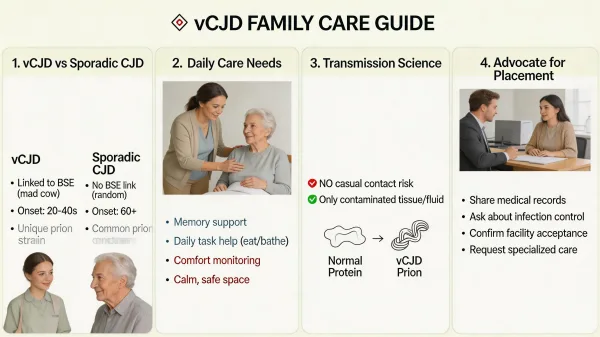
Variant CJD involves specific infection-control protocols for surgical instruments and certain body fluids, but standard daily care does not pose transmission risk to staff or other residents. While we explain common protocols, your family should request written infection-control policies from any prospective facility and have them reviewed by your parent's infectious disease specialist.
Variant Creutzfeldt-Jakob disease carries a stigma that no other form of dementia does. The link to bovine spongiform encephalopathy, commonly called mad cow disease, means your family won't just be processing a devastating diagnosis. You'll likely face facilities that hesitate to admit your loved one, staff members who are unsure how to provide safe care, and a level of social fear that has little basis in the actual science of daily caregiving. That stigma can make an already overwhelming situation feel impossible.
I've spent nearly 20 years working inside hospitals, and I've seen how fear of an unfamiliar diagnosis can change the way a patient gets treated, sometimes before anyone has taken the time to understand what the real risks are. With vCJD, that gap between perception and reality is wider than almost any other condition I've encountered.
This article answers the most common questions families face after a variant CJD diagnosis, from understanding what makes this disease different from other forms of CJD to finding a care facility that will treat your loved one with the dignity and safety they deserve. The information here is precise because precision matters when you're advocating for someone with a rare and misunderstood condition.
What Is Variant Creutzfeldt-Jakob Disease?
Variant Creutzfeldt-Jakob disease (vCJD) is a rare, always fatal prion disease first identified in the United Kingdom in 1996. It's caused by misfolded proteins called prions that destroy brain tissue, creating a sponge-like pattern of damage. Unlike bacteria or viruses, prions don't trigger an immune response, which is part of what makes them so difficult to treat. As of 2025, approximately 233 cases of vCJD have been reported worldwide, with the vast majority linked to the UK outbreak of BSE in cattle during the 1980s and 1990s.
The disease is acquired, meaning it isn't spontaneous or inherited. The primary route of exposure has been consumption of beef contaminated with the BSE agent, though a small number of cases have been traced to blood transfusions from donors who were unknowingly incubating the disease. The incubation period is believed to span a decade or longer, which means symptoms can appear years after initial exposure.
How Is Variant CJD Different from Sporadic CJD?
This distinction matters for your family because it affects everything from the care timeline to the infection-control protocols a facility should follow. Sporadic CJD, the most common form, typically affects adults over age 60 and progresses rapidly, with most patients dying within four to six months of symptom onset. Variant CJD tends to strike much younger, with a median age of onset around 28 years old. The illness duration averages about 14 months, giving families a somewhat longer but still devastating window.
The clinical presentation also differs. Sporadic CJD usually begins with cognitive decline and neurological symptoms. Variant CJD, by contrast, often starts with psychiatric symptoms: depression, anxiety, personality changes, and painful sensory disturbances that can feel like burning or tingling. Neurological signs like poor coordination, involuntary movements, and progressive dementia typically develop later. This psychiatric onset means that vCJD is sometimes initially misdiagnosed as a mental health condition, which can delay the correct diagnosis by weeks or months. In hospital settings, I've seen how a younger patient presenting with psychiatric complaints can move through the system for weeks before anyone considers a neurological cause, and by the time the right tests are ordered, the disease has progressed considerably.
Where this gets confusing for families and facilities alike is the infection-control picture. In sporadic CJD, prion proteins concentrate in the central nervous system. In vCJD, prions are also found in lymphoid tissues like the tonsils and spleen, and there is evidence of prions in the blood. That broader tissue distribution is what drives the additional precautions, and it's also what fuels the outsized fear.
What Does vCJD Progression Look Like?
The early phase, often lasting about six months, is dominated by psychiatric symptoms. Your loved one may become withdrawn, irritable, or anxious in ways that seem out of character. Many patients experience dysesthesia, a painful sensory condition that can include burning, itching, or pins-and-needles sensations across the body. These symptoms are distressing and can be difficult to manage with standard medications.
As the disease progresses, neurological symptoms take over. Coordination deteriorates, involuntary movements develop (including jerking motions called myoclonus), and cognitive decline accelerates into dementia. In the later stages, patients become dependent for all activities of daily living, lose the ability to speak, and eventually enter a state of akinetic mutism. Swallowing difficulties become a serious concern, often requiring decisions about feeding tubes and nutritional support.
The speed of decline varies. Some families have 14 months. Some have less.
What Kind of Daily Care Does a vCJD Patient Need?
The care needs of a person with vCJD mirror many aspects of other advanced dementias, but the younger age of most patients and the specific symptom profile create unique challenges. In the early months, psychiatric symptom management is the priority. Atypical antipsychotics and anxiolytics may help with agitation, psychosis, and anxiety. Pain management for dysesthesia requires close coordination with the medical team, since the sensory symptoms can be severe and don't always respond to typical pain medications.
As the disease advances, care shifts toward full physical dependency. Incontinence management, fall prevention, feeding support, and positioning for comfort become the primary concerns. Physical therapy may help maintain mobility in the middle stages, though the window for that is short. Palliative care consultation early in the diagnosis is strongly recommended, and many families find that hospice involvement well before the final weeks provides the best quality of life for both the patient and the family.
Infection Control and Facility Acceptance: Addressing vCJD Stigma
This is where families hit a wall. The words "prion disease" can trigger an outsized reaction from facilities that don't understand what the actual risks are in a daily care setting. Some memory care communities and nursing homes will refuse admission outright, citing infection-control concerns that don't align with what the science actually supports. That reaction is understandable given how unusual prion diseases are, but it often leaves families scrambling during a time when they can least afford delays.
Here's what the evidence says: there have been no reported cases of vCJD transmission through casual or environmental contact, through droplets, or through airborne routes. Standard daily care activities like bathing, dressing, feeding, repositioning, and toileting do not pose a transmission risk to caregivers or other residents. The CDC and UCSF's Memory and Aging Center both confirm that patients with prion diseases can be cared for using standard precautions, the same precautions used for every patient in every healthcare setting. A private room isn't required for infection-control purposes. Routine patient waste is handled according to standard facility policy.
The real infection-control concern with prion diseases centers on two specific situations: invasive medical procedures involving the central nervous system (brain, spinal cord, eyes) and contact with high-infectivity tissues. Prions are resistant to standard sterilization methods like autoclaving and chemical disinfectants, which means surgical instruments that contact brain or spinal tissue require specialized decontamination protocols involving sodium hydroxide or sodium hypochlorite solutions followed by extended autoclaving. In vCJD specifically, lymphoid tissues and blood also carry prions, so any procedure involving these tissues or fluids requires extra precautions. But these are medical procedure concerns, not daily care concerns.
I've visited enough care facilities during mobile X-ray work to know that infection-control practices vary enormously from one building to the next. Some facilities follow their protocols carefully and consistently. Others rely on individual staff members remembering what to do in the moment, which isn't a reliable system for any type of infection control, let alone one involving a rare disease most staff will never have encountered before. When you're evaluating a facility for a vCJD patient, the question isn't just whether they'll accept your loved one. It's whether they have the institutional discipline to follow prion-specific protocols consistently across every shift, every staff member, and every situation that might arise. That kind of consistency can't depend on one knowledgeable nurse or one good training session. It requires written policies, documented training, and a culture that takes protocol compliance seriously even when the condition is unfamiliar.
The practical precautions for daily care staff are specific but not burdensome: use disposable gloves when handling blood or body fluids (which is already standard practice), avoid needle-sticks and sharps injuries, cover any open wounds on the caregiver's hands, and dispose of materials that contact blood according to the facility's biohazard waste policy. If your loved one needs any invasive procedure, even a blood draw, the facility should coordinate with its infection-control team to ensure proper handling. These are manageable requirements that any well-run facility should be able to implement.
Imagine your parent is in their 40s, recently diagnosed after months of psychiatric symptoms followed by rapid cognitive decline. Testing suggests variant CJD, and suddenly the conversations with facilities change. Questions about infection risk replace conversations about care plans. Special handling protocols become reasons for delays. Some facilities simply say no. That experience is more common than it should be, and it usually reflects fear rather than a genuine inability to provide safe care.
How Do You Find a Facility Willing to Accept a vCJD Patient?
Start with your loved one's neurologist or infectious disease specialist. They may know which facilities in your region have experience with prion disease patients or have the infection-control infrastructure to manage one. The CJD Foundation (cjdfoundation.org) maintains a helpline at 800-659-1991 and can connect families with care resources, including guidance on facility placement. University-affiliated medical centers and their associated care networks are often more willing and better equipped to accept patients with rare diagnoses.
When speaking with a prospective facility, bring a one-page summary from your loved one's medical team that clearly outlines the daily care precautions required and explicitly states that routine care doesn't pose a transmission risk. Having a physician's written confirmation that standard precautions are sufficient for daily activities can counter the reflexive fear that many admissions teams feel. If a facility declines, ask them to put their reasoning in writing. That documentation can be useful if you need to escalate through state ombudsman programs or disability advocacy channels.
What Will Memory Care for a vCJD Patient Cost?
The costs of caring for a vCJD patient are comparable to other advanced dementia care, though the intensive nursing needs and younger patient age can push costs higher. As of the 2025 CareScout Cost of Care Survey, the national median cost for assisted living is $6,200 per month, or $74,400 annually. Memory care units typically run $1,000 to $2,500 above standard assisted living rates, placing the range at roughly $7,200 to $8,700 per month, or $86,400 to $104,400 per year. A nursing home private room, which may be more appropriate for patients in advanced stages, carries a national median of over $129,000 per year. Given the average illness duration of 14 months, families should plan for total care costs in the range of $100,000 to $150,000 or more, depending on the care setting, geographic location, and how quickly the disease progresses. These figures don't account for medical costs outside the facility, including specialist visits, diagnostic testing, and medications for symptom management.
Because vCJD patients are often younger than typical memory care residents, Medicare coverage may not apply, and Medicaid eligibility depends on income and asset thresholds that vary by state. Long-term disability insurance, if your loved one has it, and Social Security Disability Insurance (SSDI) are worth pursuing early in the diagnosis. The financial shock of these costs hits families hard, and I've seen that shock firsthand in my own family's experience with the cost of memory care. Planning early, even while you're still processing the diagnosis, gives you more options than waiting until the need is urgent.
What Support Resources Exist for Families Dealing with vCJD?
The CJD Foundation is the primary support organization for families affected by any form of prion disease in the United States. They offer a caregiving guide, a family helpline, and connections to the National Prion Disease Pathology Surveillance Center, which coordinates diagnostic testing and autopsy services. UCSF's Memory and Aging Center publishes detailed infection-control guidance written specifically for caregivers and families.
Palliative care and hospice teams are critical partners throughout the vCJD journey. Because the disease is always fatal and the timeline is relatively defined, early involvement of hospice services can provide symptom management, emotional support, and practical help that significantly improves quality of life for both the patient and the family. From my years in caregiving, I can tell you that the families who bring in palliative support early carry less of the burden alone, and that makes a real difference in how they cope through the hardest months. Don't wait until the final weeks to have that conversation.
A vCJD diagnosis changes everything for a family, quickly and permanently. The medical reality is devastating enough without the added burden of stigma and facility refusals that don't reflect the actual science. You have every right to advocate for your loved one's care, and the facts are on your side. The facilities that take the time to understand prion disease protocols, rather than reacting from fear, are the ones that will provide the care your family deserves.