
Diabetic foot care involves complex medical decisions about wound management, vascular assessment, and glucose control. While we explain common monitoring protocols and care considerations, your parent's specific diabetes status, vascular health, and wound history require individualized medical oversight. Consult with their endocrinologist and podiatrist for personalized foot care guidance.
The majority of diabetes-related amputations start with a wound so small the person didn't even know it was there. According to the CDC, roughly 80% of lower-limb amputations in the United States result from complications of diabetes, and most of those begin with a minor foot injury that went unnoticed and untreated. For a parent with diabetic neuropathy, the very condition that causes the damage also prevents them from feeling it happening.
That's the core problem families face when choosing senior living for a parent with diabetes and peripheral neuropathy. Your parent can't feel the blister forming. They can't feel the shoe rubbing. They may not notice a wound until infection has already taken hold, and by that point, the treatment timeline shrinks fast. I've seen this pattern repeat in hospital settings over nearly 20 years: a patient comes in with what started as a tiny sore on the bottom of their foot, and by the time anyone caught it, the tissue damage had spread well beyond what a simple dressing change could fix.
This article covers the specific foot care protocols a senior living community must have in place to keep your parent safe, how to evaluate whether a community can actually deliver that level of monitoring, and what the escalation from a small wound to a medical emergency actually looks like in real time. If your parent has diabetic neuropathy, the community you choose isn't just providing housing. It's providing the daily vigilance your parent's feet depend on.
What Is Diabetic Neuropathy and Why Is It So Dangerous for Seniors?
Diabetic neuropathy is nerve damage caused by prolonged high blood sugar levels. In the feet and lower legs, this damage destroys the ability to feel pain, pressure, and temperature changes. An estimated 60% to 70% of people with diabetes will develop some form of neuropathy over the course of their disease, and the risk increases with age and duration of diabetes.
For seniors, this loss of sensation creates a dangerous cycle. A healthy person who steps on a pebble feels it immediately, shifts their weight, and removes it. A person with diabetic neuropathy doesn't feel the pebble at all. It stays in their shoe, pressing into the skin with every step, creating a blister that becomes a wound that becomes an infection. The parent never complains because they feel nothing. The family doesn't know because nobody checked.
When you combine neuropathy with the poor circulation common in diabetes (peripheral artery disease), wounds that do form heal slowly or not at all. The blood supply that carries immune cells and nutrients to the injury site is compromised. This is why a wound that would heal in a week for a healthy person can persist for months in someone with diabetes, and why infection risk stays elevated the entire time.
The Foot Check Protocol: What Daily Monitoring Must Include
Daily foot inspections are the single most effective defense against diabetic amputation. The International Working Group on the Diabetic Foot recommends that anyone at moderate to high risk of foot ulceration have their feet examined every day, with skin temperature monitoring to catch inflammation before a wound even forms. In a senior living setting, this responsibility falls on trained staff, because a parent with neuropathy can't reliably do it themselves.
Here's why self-monitoring fails for most seniors with diabetic neuropathy. They can't feel the problem areas. Many older adults also have limited mobility that makes it physically difficult to see the bottoms of their feet, between their toes, or around their heels. Vision changes from diabetic retinopathy compound the issue. And cognitive changes, even mild ones, can mean a parent forgets to check or doesn't recognize what they're seeing. When I've talked with families in the hospital about how a wound got so advanced, the answer is almost always the same: "We didn't know. Mom said her feet were fine."
What a Proper Daily Inspection Covers
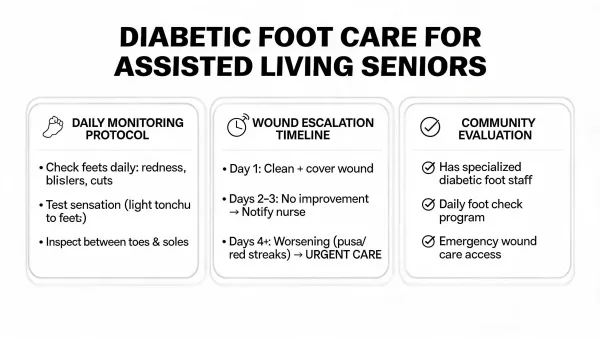
A thorough diabetic foot check takes five to ten minutes and should follow a consistent protocol every time. Staff should examine the entire surface of both feet, including the soles, between all toes, around the heels, and along the nail beds. They're looking for redness, swelling, warmth compared to the surrounding skin, blisters, calluses, cracks in the skin, discoloration, drainage, and any change from the previous day's inspection. The space between the toes is particularly important because moisture can accumulate there and create conditions for fungal infections that break down skin integrity.
Temperature matters too. A spot on one foot that feels noticeably warmer than the corresponding area on the other foot can signal inflammation before any visible wound appears. The IWGDF suggests that a temperature difference of more than 2.2°C (about 4°F) between the same area on both feet, sustained over two consecutive days, is a warning sign requiring immediate follow-up.
Signs of Developing Ulcers That Trained Staff Catch Early
The earliest signs of a forming ulcer are subtle. A small patch of redness that doesn't fade when the foot is elevated. A callus that has started to change color underneath, suggesting bleeding or tissue breakdown below the surface. A slight swelling on the ball of the foot or over a bony prominence. These are the findings that prevent amputations, and they require someone who knows what to look for and checks every single day without exception.
Blood Glucose Control and Wound Healing
Blood sugar levels directly affect how well the body heals wounds. Elevated glucose impairs immune function, slows cell repair, and creates a better environment for bacterial growth. This makes glucose monitoring an inseparable part of diabetic foot care, not a separate concern. The community should be coordinating with your parent's endocrinologist on glucose targets, not just managing their feet in isolation.
Shoes, Orthotics, and Everyday Foot Protection
Proper footwear isn't optional for someone with diabetic neuropathy. Your parent should never walk barefoot, even in their own apartment, even to the bathroom at night. Diabetic shoes and custom orthotics redistribute pressure away from vulnerable areas and reduce the mechanical stress that creates ulcers. Staff should be checking that your parent is wearing appropriate footwear at all times, inspecting shoes before they go on for foreign objects, and monitoring for signs that shoes are fitting poorly or causing friction.
Foot Care Questions to Ask During a Community Tour
When touring a senior living community for a parent with diabetic neuropathy, ask specifically: Who performs daily foot checks, and what training have they received? Is there a written protocol for what gets inspected and documented? How are findings recorded and communicated to the nursing team? What triggers a referral to a podiatrist or wound care specialist? Does the community have a relationship with a podiatrist who visits on-site? How do they handle footwear compliance for residents who resist wearing their diabetic shoes? These questions will tell you more about a community's ability to manage diabetic neuropathy than any brochure will.
When Small Wounds Become Emergencies: The Escalation Timeline
What most people don't realize until they're in it is how fast a diabetic foot wound can go from minor to limb-threatening. A wound that looks like a small, shallow sore on Monday can develop deep tissue infection by Wednesday, and by Friday, the conversation may have shifted from wound care to surgical intervention. That timeline isn't exaggeration. It's what I've watched happen in hospital settings, and it catches families completely off guard every time.
Consider a situation where your parent has a small blister on the bottom of their foot from a pebble in their shoe. They can't feel it. Nobody checks their feet that day, or the next. Within 48 hours, the blister has broken open and bacteria have entered the wound. Because neuropathy prevents pain signals, your parent walks on it normally, grinding bacteria deeper into the tissue with every step. The skin around the wound may look slightly red, but the parent reports no discomfort and no one thinks to look closer. By the time the wound is discovered, perhaps when a caregiver notices drainage on a sock or a faint odor during a bath, the infection may have penetrated through skin and soft tissue and reached the bone. What started as something a bandage could have fixed now requires aggressive medical intervention.
The Role of Peripheral Artery Disease
Peripheral artery disease (PAD), which affects a large percentage of people with long-standing diabetes, compounds every stage of this timeline. PAD narrows the blood vessels in the legs and feet, reducing the flow of oxygen-rich blood to the wound site. Without adequate blood flow, the body can't mount an effective immune response, deliver antibiotics to the infected tissue efficiently, or generate the new cells needed for healing. A wound in a foot with good circulation has a fighting chance. The same wound in a foot with compromised blood flow is on a very different trajectory, and the family may not understand why treatment that should be working isn't producing results. According to clinical guidelines, patients with ischemic diabetic foot disease complicated by infection need urgent assessment because the risk of amputation and even mortality rises sharply with delays beyond two weeks.
When Wound Care Isn't Enough
There's a point where dressing changes, antibiotics, and offloading are no longer sufficient. When infection reaches bone (osteomyelitis), when tissue begins to die (gangrene), or when the blood supply is too compromised for healing, vascular surgery or amputation enters the conversation. Osteomyelitis may require six weeks of antibiotic therapy and surgical removal of infected bone. Gangrene requires urgent debridement, sometimes within 24 to 48 hours.
Not every senior living community can manage this level of wound care. Standard assisted living handles basic health monitoring and medication management. Skilled nursing facilities have the infrastructure for complex wound care, including wound vac therapy, IV antibiotics, and coordination with vascular surgeons. If your parent has active wounds, slow-healing ulcers, or significant PAD, evaluate communities with on-site or affiliated skilled nursing capabilities.
How Does Diabetic Neuropathy Increase Fall Risk in Senior Living?
Diabetic neuropathy doesn't just threaten your parent's feet. It threatens their balance. Research shows that older adults with type 2 diabetes have a roughly 63% higher risk of falling compared to those without diabetes, and for insulin-dependent seniors, that risk climbs even higher. Peripheral neuropathy damages the nerves that tell the brain where the feet are in space, a sense called proprioception. Without accurate proprioceptive feedback, your parent's brain is left guessing about foot placement with every step.
Falls are already the leading cause of injury among older adults. Add diabetic neuropathy to the equation and you've compounded the risk with impaired sensation, muscle weakness from nerve damage, and the balance disruptions that come with not being able to feel the ground beneath you. A senior living community managing residents with diabetic neuropathy needs fall prevention protocols that go beyond the standard approach: proper lighting, non-slip flooring, grab bars, and regular gait and balance assessments specifically tailored to residents with peripheral neuropathy.
What Should a Senior Living Community Offer for Diabetic Foot Care?
A community that takes diabetic neuropathy seriously will have specific, documented protocols in place. At minimum, this means daily foot inspections by trained staff with findings recorded in the resident's care plan, on-site or regular visiting podiatry services, coordination with the resident's endocrinologist for glucose management, staff trained to recognize early warning signs of ulceration, and a clear escalation pathway for wounds that aren't responding to basic care.
Having worked inside the healthcare system for so long, I can tell you that the difference between a community with a real diabetic care protocol and one that just checks a box is enormous. Ask to see the actual documentation. Ask what happens at 2 a.m. when a CNA notices something on a resident's foot during a nighttime check. The community should have an answer, and it shouldn't be "we'll call the doctor in the morning." In my experience visiting care facilities for mobile X-ray, I saw facilities that claimed to offer specialized care but had residents with obvious foot problems that hadn't been addressed. The gap between what's advertised and what's actually happening can be significant.
How Does Blood Glucose Control Affect Long-Term Outcomes?
Blood glucose management isn't a separate issue from foot care. It's the foundation of it. Chronically elevated blood sugar impairs every phase of wound healing: it reduces white blood cell function, slows the growth of new blood vessels into injured tissue, and promotes bacterial growth in wounds. Research has shown that HbA1c levels (a measure of average blood sugar over roughly three months) directly predict healing rates in diabetic wounds.
For a parent in senior living, this means the community's meal planning, medication management, and glucose monitoring all feed directly into their foot health. A community that serves high-sugar meals, misses medication doses, or doesn't track blood sugar consistently is undermining their own wound prevention efforts. When evaluating communities, ask how they handle diabetic meal plans, whether they track blood glucose and at what frequency, and how they communicate glucose trends to the resident's physician.
When Is Assisted Living Not Enough for Diabetic Neuropathy Care?
Assisted living works well for many seniors with diabetic neuropathy, particularly those whose diabetes is well-controlled, who don't have active wounds, and whose circulation is adequate. The national median cost for assisted living runs about $6,200 per month as of 2025, and many communities can accommodate daily foot checks, medication management, and podiatry referrals within their care plans.
But there are situations where assisted living isn't equipped to provide what your parent needs. If your parent has active ulcers requiring specialized wound care (wound vac therapy, surgical debridement, IV antibiotics), if they have significant peripheral artery disease affecting healing, or if they need frequent vascular assessments, a skilled nursing facility or a community with integrated skilled nursing is a better fit. Skilled nursing runs considerably higher, with national medians around $315 per day for a semi-private room (about $115,000 per year as of 2025), but trying to manage complex diabetic wounds in a setting that lacks the clinical capability can lead to outcomes that cost far more, both financially and physically.
When our family was going through the process of evaluating care options for a loved one, I remember how overwhelming the financial side of things felt. The costs were a shock, and the pressure to make the right decision while everything was moving fast was intense. I've carried that experience with me. Families dealing with diabetic neuropathy care decisions face that same pressure, but with the added weight of knowing that the wrong choice, or a delay in making any choice, can have irreversible physical consequences. My best advice is to be honest with yourself about what level of care your parent actually needs right now, not what you hope they'll need.
What Does a Fall Prevention Plan Look Like for Diabetic Neuropathy?
A fall prevention plan for a resident with diabetic neuropathy should address the specific deficits that neuropathy creates. Standard fall prevention measures help, but they aren't enough on their own. The plan should include regular gait and balance assessments (quarterly at minimum, more often if decline is noted), appropriate assistive devices evaluated by a physical therapist, footwear checks to ensure diabetic shoes fit properly and don't create new trip hazards, environmental modifications in the resident's living space, and strength and balance exercises tailored to neuropathy-related deficits.
Medications matter here too. Many diabetes medications can cause blood sugar drops that lead to dizziness, weakness, and falls. Neuropathy pain medications like certain antidepressants and anticonvulsants carry their own fall risk through drowsiness and balance changes. The community should be reviewing your parent's full medication list with fall risk in mind, and communicating with their physician about any patterns they observe.
Conclusion: Protecting Your Parent's Feet Means Choosing the Right Level of Care
Diabetic neuropathy foot care in a senior living setting comes down to one thing: daily, consistent, trained monitoring that your parent can't provide for themselves. The right community will have documented protocols, trained staff, podiatry relationships, and a clear escalation plan for when a wound starts heading in the wrong direction. The wrong community will tell you they "handle diabetic residents" without being able to show you how.
Start with your parent's current health status. Talk to their endocrinologist and podiatrist about what level of monitoring they need. Then evaluate communities against that clinical standard, not the other way around. Ask the hard questions during tours. And if your parent's needs exceed what assisted living can safely manage, don't wait for a wound crisis to make the transition.
The fact that you're reading this means you're already paying attention, and that matters more than you might realize. The families who research, who ask questions, and who advocate are the ones whose parents get better care. Trust your instincts, get the clinical team involved early, and make the decision that fits your parent's reality today.