
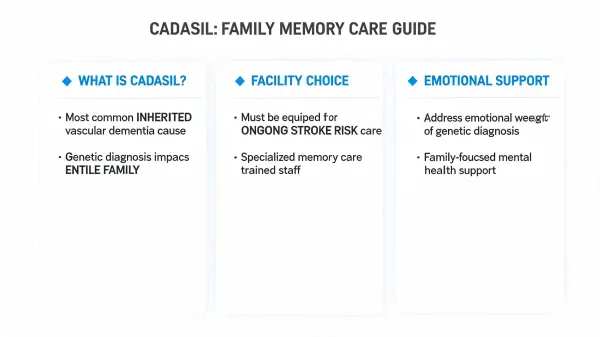
When the Diagnosis Changes Everything You Thought You Knew
You're sitting in a neurologist's office, reviewing memory care brochures for your parent, when the genetic counselor walks in with test results that reframe your entire family's future. Your mother's years of unexplained migraines, her small strokes that doctors attributed to "bad luck," her gradually worsening memory: it all has a name now. CADASIL. And because this disease is inherited, the counselor explains that you and each of your siblings have a 50% chance of carrying the same NOTCH3 gene mutation. In that moment, two very different realities collide at once. Your parent needs memory care, possibly soon, and that's the urgent problem in front of you. But somewhere in the back of your mind, a quieter question starts forming about what this might mean for your own future.
This article is about your parent's care, because that's the decision that can't wait. We'll cover what CADASIL is, how it differs from other forms of dementia, what memory care facilities need to understand about this condition, and how to make informed choices when the disease runs in the family. The genetic dimension adds a layer of complexity that most families dealing with dementia don't face, and it deserves honest attention alongside the practical care planning you're here to do.
I've watched a family member's cognition decline while doctors adjusted and readjusted medications, and I learned that treatment for cerebrovascular conditions is as much art as science. That experience shapes everything I write about memory care, and it's part of why I believe families dealing with CADASIL deserve a care team that truly understands this disease.
What Is CADASIL?
CADASIL stands for Cerebral Autosomal Dominant Arteriopathy with Subcortical Infarcts and Leukoencephalopathy. In plainer terms, it's a genetic condition that damages the small blood vessels in the brain, leading to recurrent strokes, migraines (often with aura), mood changes, and progressive cognitive decline that often develops into vascular dementia. It's caused by mutations in the NOTCH3 gene on chromosome 19, and it's the most common inherited cause of stroke and vascular dementia in adults. The term "autosomal dominant" means only one copy of the mutated gene is needed to cause the disease, so if one parent carries the mutation, each child has a 50% chance of inheriting it.
Symptoms typically appear between the ages of 30 and 50, though the severity and progression vary widely, even among family members who carry the same mutation. According to the National Institute of Neurological Disorders and Stroke, by age 65, most people with CADASIL will have cognitive impairment or dementia. The average life expectancy is roughly 64 years for men and 71 for women, though these numbers vary depending on when symptoms begin and how aggressively vascular risk factors are managed. There are currently no disease-modifying treatments available for CADASIL, which is one of the hardest realities families face. Management focuses on controlling vascular risk factors like high blood pressure and diabetes, treating migraines, and providing supportive care as the disease progresses, which makes choosing the right care environment even more critical.
How CADASIL Dementia Differs from Alzheimer's and Other Dementias
Understanding how CADASIL behaves differently from more common forms of dementia is important when you're evaluating memory care options, because the care needs aren't identical. Most people picture dementia as a slow, steady fade, and Alzheimer's disease typically does follow that pattern with memory loss gradually worsening over years. CADASIL doesn't work that way. Cognitive decline in CADASIL tends to follow a "stepwise" pattern, where function drops sharply after each stroke event, stabilizes for a period, then drops again with the next event. Between strokes, your parent may seem relatively stable, but after one, they may lose abilities they had just days before. This unpredictable rhythm makes care planning harder because the trajectory isn't smooth, and the jumps can be sudden.
CADASIL patients are also frequently younger than typical memory care residents. Strokes commonly begin between ages 45 and 59, and significant cognitive impairment can develop well before the age most people associate with dementia. Your parent may be in their late 50s or early 60s and physically capable in many ways, yet need memory care because of executive function deficits and stroke-related cognitive loss. That age gap creates social and practical challenges within facilities designed primarily for residents in their 70s and 80s. A younger resident may feel out of place among peers who are decades older, and activities geared toward older adults may not hold their interest.
The migraine component is another key difference that facility staff need to recognize. Many CADASIL patients experience severe migraines with aura, sometimes for decades before cognitive symptoms appear. These migraines can continue into the memory care stage and require ongoing management that caregiving staff need to understand and accommodate, particularly because some common migraine medications may carry additional risks for CADASIL patients.
Living With a Hereditary Diagnosis: Care Planning and Family Impact
What most people don't realize until they're in it is that hereditary dementias don't just affect the patient. Every family member carries the weight of genetic uncertainty, and care decisions get made under a cloud of personal dread that nobody talks about openly enough. When your parent is diagnosed with CADASIL, the emotional math changes in ways that other dementia diagnoses don't produce. You're not only grieving what your parent is losing, you're also quietly calculating your own odds. If you haven't been tested, every forgotten word, every unusually bad headache, every moment of brain fog becomes a source of anxiety. If you have been tested and carry the mutation, you're making decisions for your parent while wondering who will make those same decisions for you in the years ahead. That dual weight is real, and it shapes how families approach care planning in ways that don't apply to non-hereditary dementias.
This is where advance planning for the affected generation becomes more than a good idea. It becomes essential. While your parent still has the capacity to express preferences, document everything: their wishes for levels of medical intervention, their feelings about life-sustaining treatment after a major stroke, their preferences for daily routines and social engagement. CADASIL's stepwise progression means there may be windows of relative clarity between decline events, and those windows are the time to have these conversations rather than waiting for a crisis to force them.
Powers of attorney, both medical and financial, should be established early. Because CADASIL can cause sudden drops in cognitive function after a stroke, the window for legal decision-making can close faster than families expect. I've seen families caught off guard by how quickly things can change with cerebrovascular conditions, and having legal documents in place before they're urgently needed removes one source of chaos during an already overwhelming time.
The genetic counseling conversation deserves careful thought, and there's no single right answer for every family. Genetic testing for CADASIL is available, and your parent's diagnosis makes it accessible to all first-degree relatives. But deciding whether to get tested is a deeply personal choice that no one else can make for you. Some adult children want to know so they can plan ahead, pursue reproductive genetic counseling, or participate in research studies. Others prefer not to know, especially since there's no cure or proven prevention strategy available today. A certified genetic counselor can walk your family through the decision without pressure in either direction, and many academic medical centers offer this service through their neurology or genetics departments. If your family is considering testing, the protocol typically mirrors the approach used for Huntington's disease, with pre-test counseling sessions before any blood is drawn. These sessions help you think through the psychological, financial, and insurance implications of knowing your status before you commit to the test.
Balancing your parent's care with your own health monitoring matters too. If you carry the mutation or haven't been tested but remain at risk, staying on top of vascular risk factors like blood pressure, cholesterol, blood sugar, and smoking cessation is the most actionable step you can take right now. Regular neurological check-ups and baseline brain MRIs can help track any early changes, and these conversations with your own doctor don't have to happen on the same day you're handling your parent's care. Taking care of yourself while caring for your parent isn't selfish. It's practical.
What Memory Care Facilities Need to Know About CADASIL
Not every memory care facility is equipped to handle a resident with CADASIL well, and the differences matter in ways that aren't obvious from a marketing brochure. When you're evaluating facilities, you're looking for staff who understand vascular dementia specifically, not just Alzheimer's, and ideally a team willing to learn about CADASIL's unique characteristics if they haven't encountered it before. The most critical difference between CADASIL and other dementias is the ongoing stroke risk that persists throughout the disease. Unlike Alzheimer's, where decline is primarily neurodegenerative, CADASIL patients face active, recurring cerebrovascular events throughout the course of their illness. Facility staff need to recognize stroke symptoms quickly and have clear protocols for emergency response, because a memory care team that mistakes new neurological symptoms for "just a bad day" could cost your parent critical treatment hours.
When I've worked in hospital settings, I've seen how quickly outcomes change based on whether stroke symptoms are caught immediately or discovered after a delay. The difference can be enormous. Ask any facility you're considering how their staff is trained to identify and respond to acute stroke events, and whether they have a clear protocol for transporting residents to a stroke-capable hospital.
Migraine management is the second major consideration, and it's one that many memory care facilities don't have experience with. CADASIL-related migraines can be severe and debilitating, and they may look different from typical headaches. Staff should know to watch for visual disturbances, sensory changes, or unusual behavior that could signal a migraine with aura. Medication management for these migraines also requires attention, as certain common migraine treatments (particularly triptans and vasoconstrictors) may carry additional risks for patients with cerebral small vessel disease. The facility's medical director or consulting physician should be coordinating with your parent's neurologist on a migraine treatment plan that accounts for these specific risks.
The stepwise progression pattern also affects how care plans should be structured. After a stroke event, your parent may need a significantly higher level of assistance than they did the week before, which means the facility needs flexibility to adjust care plans quickly rather than waiting for a quarterly reassessment. Ask how the facility handles sudden changes in resident function. A good answer involves rapid reassessment protocols and close, ongoing communication with the resident's neurologist.
Then there's the age factor, which can affect your parent's quality of life more than families initially realize. Your parent may be decades younger than most other residents, and a 58-year-old with CADASIL has different interests, energy levels, and social needs than an 85-year-old with advanced Alzheimer's. Some facilities handle this well by offering varied activity programming that accommodates different age groups and ability levels. Others don't. Visit during activity hours and realistically assess whether your parent would have peers or feel isolated, because social connection plays a real role in quality of life even as cognition declines.
Building a Medical Team That Understands CADASIL
Memory care provides the daily living environment, but your parent's medical oversight shouldn't be limited to what the facility offers. CADASIL is rare enough that many primary care physicians and even general neurologists have limited experience with it. Ideally, your parent should be followed by a neurologist who specializes in cerebral small vessel disease or has specific experience managing CADASIL patients, and academic medical centers and university-affiliated neurology departments are the most likely places to find this expertise.
The treatment complexity with CADASIL requires a doctor who knows the condition well. There's no FDA-approved therapy for the disease itself, so management revolves around controlling risk factors, preventing strokes where possible, and treating symptoms as they arise. Blood pressure management is particularly important, as research suggests CADASIL progresses faster in patients with uncontrolled hypertension, but the approach requires balance because blood pressure that drops too low can also be harmful.
Anticoagulant medications, commonly prescribed after strokes in general populations, carry heightened hemorrhage risk in CADASIL because of the microbleeds often present in these patients' brains. Antiplatelet therapy like aspirin is sometimes used, but its benefit in CADASIL hasn't been proven, and the risk of brain bleeding must be weighed carefully. These medication decisions require a physician who understands the specific risk profile and won't default to standard stroke-prevention protocols that may not fit a CADASIL patient.
Having watched a loved one go through repeated medication adjustments for a cerebrovascular condition, I can tell you that finding the right doctor makes a measurable difference. There were stretches where one medication seemed to help, only for the next appointment to bring a change in dosage or a switch to something different because the numbers weren't where they needed to be. It taught me that treatment for these conditions isn't a straight line, and the families who fare best are the ones whose medical team is willing to recalibrate often and communicate openly about what's working and what isn't. The right specialist will tailor their approach to the specific realities of CADASIL, and they'll communicate clearly with the memory care facility's medical team so everyone is working from the same treatment plan.
Paying for CADASIL Memory Care
Memory care costs are significant regardless of the diagnosis, but CADASIL can add complications that families don't always anticipate. As of 2025, the national median cost for memory care runs between $5,000 and $7,000 per month, with wide variation depending on location and level of care. That's $60,000 to $84,000 per year, and costs typically increase as care needs grow after each stroke event. Because CADASIL patients may enter memory care younger than typical residents, families face a longer potential duration of care and, by extension, significantly higher total lifetime costs. A parent who enters memory care at 60 could need a decade or more of care that a parent entering at 80 might not.
Medicare doesn't cover the long-term residential costs associated with memory care, which catches many families off guard. Medicaid may cover nursing home care for those who qualify financially, but eligibility rules and covered services vary by state. Long-term care insurance, if your parent purchased a policy before diagnosis, may help offset costs. Veterans with CADASIL-related disabilities may qualify for VA Aid and Attendance benefits. I remember the financial shock of memory care costs during my own family's experience, and I'd encourage anyone in this situation to consult an elder law attorney early in the process, ideally before the financial picture becomes urgent.
CADASIL Memory Care: Making the Decision That's in Front of You
Choosing memory care for a parent with CADASIL means holding two truths at once. Your parent needs the best care you can find right now, and your family's relationship with this disease may not end with this generation. Both of those realities are valid, and neither has to paralyze the other.
Focus on what you can control today. Find a facility that understands vascular dementia, ask the hard questions about stroke protocols and staffing flexibility, and make sure your parent's neurologist is actively involved in their ongoing care. Get the legal and financial documents in place while you can, and have the advance care planning conversations during the windows of clarity that CADASIL's stepwise pattern often provides.
The genetic dimension is yours to address on your own timeline. Whether you choose testing or not, what matters most right now is that your parent is safe, comfortable, and receiving care from people who understand their condition. You're already doing the hard work by learning about CADASIL and what it requires. Trust that the effort you're putting in now will make a real difference in your parent's care.