
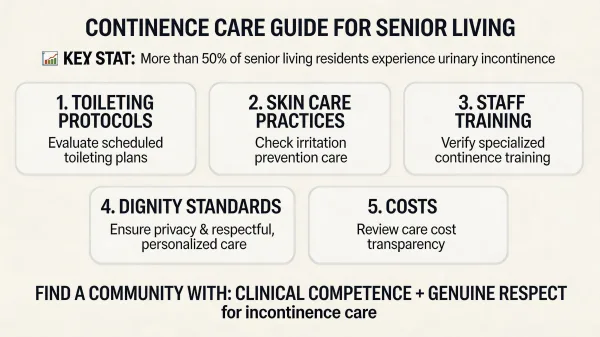
More than half of all residents in assisted living and nursing home communities deal with some form of urinary incontinence. If your parent is struggling with bladder control, they aren't facing something rare or shameful. They're dealing with one of the most common medical conditions in older adults, and it's one of the top reasons families start looking at senior living in the first place. The better communities know this, and they've built real programs around it because of the sheer volume of residents who need this support. The ones that haven't are the ones you need to identify and avoid.
What many families don't realize is how long a parent may hide the problem before anyone notices. Consider a situation where your mother has been quietly managing on her own for months, wearing dark clothing to conceal accidents, skipping outings she used to enjoy, drinking less water to reduce bathroom trips, and pulling away from family gatherings. You might not connect the dots until something forces the issue, like a fall on a wet bathroom floor or a visit where the smell in her home is impossible to ignore. That moment can feel overwhelming, but it also marks the beginning of finding better support for someone who has been suffering in silence.
This article covers what urinary incontinence looks like in older adults, how good senior living communities manage it through structured continence programs, and what to ask during a tour so you can tell the difference between a community that takes this care seriously and one that just stocks supplies. Having spent years working in healthcare, I've seen how much the quality of continence care varies between facilities, and it matters more than most families expect going in.
Understanding Urinary Incontinence in Older Adults
Urinary incontinence isn't a single condition. It shows up in different ways depending on the underlying cause, and understanding the type your parent deals with helps you evaluate whether a community can actually meet their needs. Stress incontinence causes leakage during physical activity like coughing, sneezing, or lifting. Urge incontinence, sometimes called overactive bladder, involves a sudden and intense need to urinate that's difficult to control. Mixed incontinence combines both types. Functional incontinence is especially common in senior living populations because it occurs when a person physically or cognitively can't reach the bathroom in time, even though their bladder function may be relatively normal. Mobility limitations, arthritis, and dementia all contribute to functional incontinence, and this type requires a care response that goes well beyond handing someone an absorbent pad.
Many older adults deal with more than one type simultaneously. A 2025 study published in JAMDA found that about 20% of assisted living residents had a documented urinary incontinence diagnosis, though actual prevalence is almost certainly higher because many residents underreport symptoms out of embarrassment. Among nursing home residents, prevalence reaches 50% to 70% or more. These aren't edge cases. This is standard care territory, and communities should be equipped to handle it well.
Why Urinary Incontinence Often Drives Senior Living Decisions
Incontinence is the second leading cause of institutional placement for older adults, according to the National Association for Continence. It's not just the physical management that pushes families toward senior living. The condition creates a cascade of secondary problems: falls in the bathroom, skin breakdown from prolonged moisture exposure, recurrent urinary tract infections, social withdrawal, and depression. When I work with elderly patients in the hospital, I often see the downstream effects of incontinence that wasn't being managed well at home, from skin infections to dehydration caused by deliberately restricting fluids.
Research consistently shows that older adults with urinary incontinence report higher rates of depression, anxiety, and loneliness compared to those without it. A study published in Scientific Reports found that women with incontinence had significantly higher depression and stress levels, alongside lower self-esteem, compared to continent women. The social isolation usually starts with the person themselves. They stop going to church, decline dinner invitations, and avoid any situation where an accident would be noticed. For adult children watching this unfold, the realization often comes with guilt about not noticing sooner. That guilt isn't productive. What matters now is finding the right level of support.
The same JAMDA study found that assisted living residents with urinary incontinence were significantly more likely to transfer to a nursing home, with a 14% increased probability of permanent placement. A community with a strong continence care program can help prevent or delay that transition, which has real implications for your parent's quality of life and your family's long-term finances.
Types of Senior Living That Support Incontinence Care
Most assisted living communities accept residents with urinary incontinence, but the depth of care varies enormously. Some provide basic support with product changes and reminders. Others run structured continence management programs with trained staff, scheduled toileting protocols, and access to clinical resources like pelvic floor therapy referrals. The label "assisted living" alone tells you very little about what actually happens on the care floor each day.
Memory care communities typically offer more comprehensive incontinence support because cognitive decline and bladder issues often overlap. Staff in these settings are usually trained in prompted voiding techniques and timed toileting schedules designed for residents who can't independently manage bathroom needs. Nursing homes provide the highest level of medical oversight, but they're also significantly more expensive and may not be necessary if your parent's primary need is incontinence management rather than skilled nursing care. As of the 2025 CareScout Cost of Care Survey, the national median cost for assisted living reached $6,200 per month ($74,400 annually), while a private nursing home room runs approximately $127,750 per year. That cost gap is worth understanding before assuming your parent needs the most intensive level of care.
The right setting depends on your parent's overall health, mobility, cognitive status, and the severity of their incontinence. A thorough assessment by the community's care team before move-in should address all of these factors. If a community doesn't conduct a detailed continence assessment during intake, that tells you something important about how seriously they take this part of care.
Beyond Products: What a Real Continence Care Program Looks Like
There's a significant gap between a community that manages incontinence and one that just manages products. In too many facilities, "incontinence care" means checking residents on a fixed schedule, changing pads or briefs when they're soiled, and moving on. That's product management, not continence care. The difference shows up in residents' skin health, their emotional wellbeing, and whether their condition stabilizes or gets progressively worse.
A real continence care program starts with an individualized assessment. Staff should evaluate the type and severity of incontinence, identify contributing factors like medications or mobility limitations, and build a care plan specific to that resident. This plan should include a toileting schedule based on the person's actual patterns, not a facility-wide every-two-hours rotation that ignores individual biology. Timed voiding and prompted voiding schedules, where staff encourage residents to use the bathroom at intervals matched to their bladder capacity, have been shown in clinical trials to reduce incontinence episodes significantly. Research published in Gastroenterology found that 33% to 60% of nursing home residents reduced their incontinence to less than one episode per day through prompted voiding programs alone. That's a dramatic improvement achieved without medication or surgery, just consistent, attentive care.
Pelvic floor therapy access is another marker of a serious program. Many assisted living residents can benefit from pelvic floor exercises supervised by a physical therapist, and pelvic floor muscle training is recognized as a first-line conservative treatment for both stress and urge incontinence by the American Urological Association. Yet few communities offer this service onsite or even facilitate referrals to outside providers. For residents with overactive bladder, medication management should be coordinated between the community's care team and the resident's physician. Newer beta-3 agonist medications carry fewer cognitive side effects than older anticholinergic drugs, which is an important distinction for elderly residents who may already be dealing with memory concerns. A community that actively participates in this coordination, rather than leaving medication questions entirely to the family, demonstrates real clinical engagement.
Skin care is where poor incontinence management does its most visible damage. Incontinence-associated dermatitis (IAD) is an inflammatory skin condition caused by prolonged contact with urine or stool. It affects an estimated 3% to 30% of incontinent older adults in care settings and causes pain, redness, maceration, and significantly increased risk of pressure ulcers and secondary infection. Aging skin is already thinner and more fragile, which makes it especially vulnerable to breakdown from moisture exposure. Prevention requires a structured skin care protocol: gentle pH-balanced cleansing after each incontinence episode rather than harsh soap and water that strips the skin's natural barrier, consistent application of moisture barrier creams to protect intact skin, and high-absorbency products changed at clinically appropriate intervals. Ask any community you're evaluating what their IAD prevention protocol looks like. If they don't have a specific answer, or if the response stays vague, consider that a serious red flag.
I've been inside enough care facilities during my years doing mobile X-ray work to know what poor continence care looks like up close. I've walked into rooms where residents were sitting in soiled garments with no indication anyone had checked on them recently. I've seen skin breakdown that didn't develop overnight. It happened because the daily care wasn't there, because checks were infrequent, and because the staff either didn't have the training or didn't have the time. A community's continence program is one of the most honest quality indicators you'll find, precisely because it reflects what happens during the routine moments families rarely witness. When I talk with families about choosing a community, I tell them the same thing: ask about continence care first. How a community handles this tells you everything about their priorities.
Here are specific questions that reveal whether a community takes continence care seriously: Does each resident receive an individualized continence assessment at intake? What does the toileting assistance schedule look like, and is it customized per resident? What skin care products and protocols are used to prevent IAD? Is pelvic floor therapy available onsite or arranged through an outside provider? How does the community coordinate with physicians on bladder medications? What specific training do caregivers receive on continence care? How are overnight toileting needs handled differently from daytime care?
Dignity and Incontinence: Why How Matters as Much as What
The psychological impact of urinary incontinence is severe and widely underestimated by families and care providers alike. Studies consistently link the condition to depression, anxiety, reduced self-esteem, and social alienation in older adults. Incontinence has been called "the silent epidemic" because so many older adults suffer with it privately, too embarrassed to bring it up with their own doctors. The emotional toll doesn't disappear when someone moves into a community. In many cases, it intensifies, because the person now depends on relative strangers for help with something deeply private, something they may have spent months or years trying to hide from their own family.
How staff handle toileting assistance shapes a resident's entire experience of community living. When a caregiver knocks before entering, speaks calmly, maintains eye contact, uses the resident's preferred name, and treats the entire interaction as routine rather than burdensome, the message comes through clearly: this is normal, and you have nothing to be ashamed of. When that same care is rushed, impersonal, or delivered with visible frustration or impatience, the resident internalizes a very different message. They learn that they're an inconvenience. Over time, that perception erodes their willingness to ask for help when they need it, which makes the incontinence harder to manage and the emotional consequences considerably worse. I've spent nearly two decades working with patients in clinical settings, and I can tell you that the way a caregiver responds in these moments makes an outsized difference in how a patient feels about themselves and their situation.
Privacy protections matter enormously and should be non-negotiable. Doors should be closed during any toileting assistance. Staff should never discuss a resident's incontinence status in common areas, hallways, or in front of other residents. Soiled clothing and linens should be handled discreetly, without drawing attention. These sound like basic expectations, and they should be, but they're violated regularly in communities where continence care culture hasn't been prioritized by leadership.
In practice, this is where things break down. There's often a measurable gap between how a community describes its continence care philosophy during a marketing tour at 10 AM and what actually happens on the overnight shift when staffing drops to its thinnest levels. Continence care quality declines dramatically after 10 PM in many communities, and families almost never see this reality. Residents who need toileting assistance at 2 AM may wait far longer than they would at 2 PM. That delay has real consequences for skin health, sleep quality, and emotional wellbeing. When you tour a community, ask specifically about overnight staffing ratios and how nighttime toileting requests are managed. Ask how long a resident typically waits for assistance between midnight and 6 AM. The specificity of the answer, or the inability to give one, tells you a great deal about what nightly life actually looks like there.
Evaluating a community's continence care culture during a tour means paying attention to subtleties that aren't on the brochure. Notice whether staff discuss incontinence openly and without visible discomfort when you bring it up. Ask to see where supplies are stored and whether residents can access them privately. Watch how caregivers interact with residents in common areas. Do they seem patient, unhurried, and genuinely attentive? Talk to current residents or their family members if you can. Ask directly: how does staff handle bathroom assistance, and how responsive are they? The families already living that reality can give you the most honest assessment of whether dignity is a genuine priority or just a line in the welcome packet.
Steps to Evaluate a Community's Incontinence Care Before Move-In
1. Request a Detailed Continence Assessment Process Overview
Ask the admissions team to walk you through exactly how they assess a new resident's incontinence needs. A thorough community will describe an individualized evaluation that covers the type and severity of incontinence, current management strategies, a full medication review, mobility and cognitive assessment, and a skin condition baseline. If the answer stays general or focuses only on product sizing, the program likely lacks the clinical depth your parent needs.
2. Ask About Staff Training on Continence Care
Find out what specific training caregivers receive on incontinence management beyond basic product usage. Training should cover prompted voiding techniques, skin assessment for early signs of IAD, recognition of urinary tract infection symptoms, and communication skills for maintaining resident dignity during intimate care. Ask how often training is updated and whether new staff receive it during orientation.
3. Tour During Off-Peak Hours
If possible, visit in the late afternoon or early evening rather than during a scheduled tour time. This gives you a more realistic view of staffing levels, response times, and the general atmosphere during less-polished hours. Pay close attention to odors, especially in hallways and common areas. Persistent odor can indicate that incontinence care isn't keeping pace with resident needs.
4. Talk to Families Already Living This
Current family members are your single best resource. Ask them specifically about toileting assistance response times, how skin care issues have been handled, and whether they've seen any concerns with how incontinence is managed on a daily basis. Their lived experience reflects reality far more accurately than marketing materials or a single guided tour.
The Cost Factor: How Incontinence Affects Senior Living Pricing
Incontinence care almost always increases the monthly cost of senior living, and families are frequently surprised by how quickly those charges accumulate. Most assisted living communities use tiered pricing based on the level of care a resident requires. Toileting assistance, incontinence product supply, and additional laundry service typically push a resident into a higher care tier. With the national median for assisted living at $6,200 per month as of the 2025 CareScout survey, residents requiring extensive incontinence support often pay an additional $500 to $1,500 above that base rate each month, depending on the community and the frequency of assistance needed.
That adds up fast. An extra $1,000 per month means $12,000 per year layered on top of the base cost, potentially bringing total annual assisted living expenses to $86,000 or more for a resident with significant incontinence needs. Some communities bundle incontinence supplies into their monthly fee. Others charge separately for products, creating an additional line item that can run $100 to $300 or more per month. A few communities also charge separately for laundry services related to incontinence, which can add another $50 to $150 monthly. Ask for a complete pricing breakdown during the financial conversation, and make sure you understand exactly what's included in the quoted rate versus what generates add-on charges. When I watched my own family deal with the financial reality of long-term care, the costs that weren't in the original quote created the most stress. Get the full picture up front, and ask what happens to pricing if your parent's incontinence worsens over time and they move to a higher care tier.
When Home Care Isn't Enough for Incontinence Management
Many families try managing incontinence at home before considering senior living, and that's a reasonable first step. Home health aides can assist with toileting, product changes, and skin care on a scheduled basis. But there are situations where home-based care reaches its limits. If your parent needs toileting assistance multiple times during the night, a single caregiver or a family member losing sleep will burn out quickly. If cognitive decline means your parent can't recognize or respond to the urge to urinate, they need the kind of consistent monitoring that's almost impossible to maintain at home without around-the-clock staffing, which is itself expensive. According to CareScout data, in-home care averages around $6,500 per month for eight hours a day, five days a week. Twenty-four-hour home care can easily exceed $15,000 per month, which is more than double the cost of most assisted living communities.
There are practical signals that home management has reached its ceiling. Your parent has had repeated falls related to rushing to the bathroom or slipping on wet floors. Skin breakdown keeps recurring despite consistent product use and cleaning routines. The smell in their home has become persistent regardless of cleaning efforts. They've stopped drinking adequate fluids because they're trying to reduce accidents, which introduces its own set of medical risks including urinary tract infections, dehydration, and confusion. Or you, as the family caregiver, are losing sleep, missing work, and finding yourself exhausted or resentful. Caregiver burnout is real, and it compromises the quality of care you can provide.
Skin breakdown that isn't improving at home deserves particular attention. IAD requires protocol-driven care with the right products, techniques, and timing. If it keeps coming back despite your best efforts, a community with a structured skin care program and trained staff may simply be better equipped to manage it consistently. The goal isn't to rush toward placement. It's to recognize clearly when the care needs have outgrown what home can realistically provide without compromising your parent's health or your own.
Finding Care That Respects the Whole Person
Urinary incontinence is a medical condition, not a character flaw, and it deserves the same clinical attention and compassionate response as any other health challenge your parent faces. The right senior living community treats continence care as a core component of their daily program, not an afterthought managed with minimal effort and minimal training. When a community gets this right, residents stay healthier, their skin stays intact, and their confidence holds steady in ways that affect every other part of their day.
Start the conversation early, even if it feels uncomfortable. Ask your parent's doctor about their bladder health. Research communities that specifically describe their continence care programs, not just their dining menus and activity calendars. Tour with the questions from this article ready, and pay attention to how openly and comfortably staff discuss the topic. The communities that treat incontinence as routine, because for them it truly is, are the places where your parent is most likely to receive care that protects both their physical health and their sense of dignity.
You're doing something difficult by looking into this. Most families don't plan for this particular conversation, and the fact that you're here researching it means you're already advocating for your parent in a way that matters. Trust your instincts during tours, ask the hard questions, and remember that your parent deserves a place where this very common condition is met with competence and kindness, not inconvenience.