
If your parent was functioning independently a month ago and now can't follow a conversation or get dressed without help, you are not overreacting. What you're seeing may be a rapidly progressive dementia, and it deserves urgent medical attention. Not next month. Now.
Rapidly progressive dementia (RPD) isn't the slow, years-long decline most people associate with Alzheimer's disease. It moves in weeks or months, and the speed can be terrifying for families who have no frame of reference for what's happening. One week your parent is driving to the grocery store, and three weeks later they don't recognize you at the front door. The ground shifts that fast.
I watched something similar happen in my own family. The cognitive decline accelerated so quickly that by the time we understood what we were dealing with, the person we knew was already slipping away. There was no gradual adjustment period, no time to ease into new routines. It was weeks between recognizable stages, not the months or years we'd assumed we would have. That experience changed how I think about families facing rapid decline, because I know how unprepared you feel right now.
Here's what most people don't realize until they're in it: rapid cognitive decline is a medical emergency first and a care placement question second. Some rapidly progressive dementias are treatable if caught in time, but families often skip the diagnostic step and jump straight to looking for a memory care facility. This guide will walk you through what to do right now, starting with the medical evaluation that could change everything, and then covering how to find memory care under time pressure if placement becomes necessary.
What Is Rapidly Progressive Dementia?
Rapidly progressive dementia is a term neurologists use for cognitive decline that advances from first symptoms to significant impairment in less than one to two years, though many cases progress over just weeks to months. Unlike typical Alzheimer's disease, which unfolds over years, RPD compresses that timeline dramatically. According to a 2025 systematic review published in Translational Psychiatry, neurodegenerative diseases account for about 27% of RPD cases, neuroimmune diseases about 19%, and central nervous system infections about 17%. Creutzfeldt-Jakob disease (CJD), Alzheimer's disease, and autoimmune encephalitis are the three most common individual diagnoses.
That last one matters enormously. Autoimmune encephalitis is treatable, and its prevalence among RPD cases has been rising significantly. This is why the diagnostic workup is so critical before anyone talks about long-term placement.
What to Do First When Dementia Progresses Rapidly
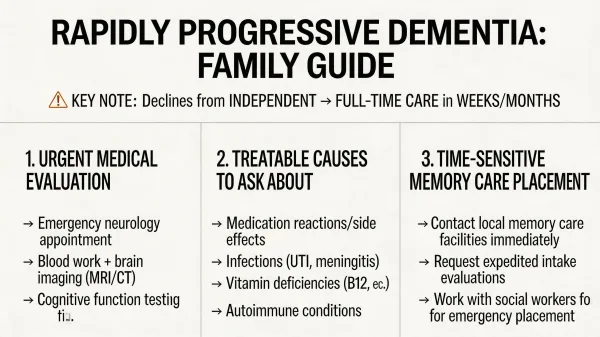
If your parent's cognitive decline has been rapid, the most important thing you can do right now is get them to a neurologist. Not their primary care doctor for a referral that takes six weeks. A neurologist, urgently. If your parent is in the hospital, request a neurology consult immediately. If they're at home, call their doctor and use the word "urgent" to get a faster appointment, or go to the emergency room if symptoms are severe or worsening by the day.
This isn't an overreaction. Rapidly progressive dementia requires a different diagnostic approach than typical dementia because the list of possible causes is wider, and some of those causes are reversible.
Step 1: Push for Comprehensive Testing Immediately
The standard diagnostic workup for RPD includes brain MRI with specific sequences (diffusion-weighted imaging and FLAIR), blood panels to check for metabolic, infectious, and autoimmune markers, cerebrospinal fluid analysis through a lumbar puncture, and an electroencephalogram (EEG) to measure brain electrical activity. Neurologists often run multiple tests at the same time rather than sequentially because speed matters. The UCSF Memory and Aging Center, one of the country's leading RPD research programs, emphasizes that an accurate early diagnosis reduces both suffering and irreversible damage, particularly for immune-mediated causes.
Step 2: Rule Out Treatable Causes Before Assuming the Worst
This is the step families miss. Not every rapid decline means CJD or an untreatable neurodegenerative disease. Treatable causes of rapidly progressive dementia include autoimmune encephalitis (where the immune system attacks the brain and can often be reversed with immunotherapy), infections such as neurosyphilis or viral encephalitis, metabolic disturbances including thyroid dysfunction and vitamin deficiencies, medication side effects or drug interactions, normal pressure hydrocephalus (a buildup of fluid in the brain that can be surgically drained), and certain cancers that trigger immune responses affecting the brain. A study from a major academic RPD program found that out of 155 RPD cases evaluated, 86 had potentially treatable causes. More than half. The majority of those were autoimmune conditions that responded to treatment when caught early enough. Having spent years working in hospital settings, I've seen how easy it is for families to accept the first thing they're told and stop pushing for answers. Don't stop. If your parent's medical team hasn't tested for autoimmune encephalitis and other reversible causes, ask them directly why not.
Step 3: Understand the ER-to-Neurology Pipeline
If your parent ends up in the emergency room because of sudden confusion, falls, or inability to care for themselves, the ER team will likely run basic labs and imaging to rule out stroke, infection, or metabolic crisis. But ER doctors aren't dementia specialists. Their job is to stabilize and triage. You need to advocate for a neurology consult before discharge. If the hospital doesn't have a neurologist on staff, ask the social worker to help arrange a transfer or an urgent outpatient referral. Don't leave without a clear next step in writing.
Imagine your parent was living independently two months ago and is now unable to dress, can't follow conversations, and doesn't recognize family members. The medical team mentions possibilities like Creutzfeldt-Jakob disease or autoimmune encephalitis. The names alone are frightening. But the critical point is this: while the diagnostic team works to identify the cause, your family needs a care plan for right now, because your parent can't be left alone while test results come back over the next days or weeks.
What to Expect During the Diagnostic Process
RPD diagnostic workups don't happen in a single afternoon. Some blood tests return quickly, but cerebrospinal fluid analysis, specialized antibody panels, and advanced imaging can take days to weeks. During this period, your parent's condition may continue to change. Expect multiple appointments or, if symptoms are severe enough, a hospital admission for observation and testing. Some families find that their parent is admitted through the ER and stays inpatient while the neurology team runs the full evaluation. This can feel chaotic, but it's often the fastest path to answers.
Ask the medical team for a timeline. Ask which tests have been ordered and which are still pending. Write everything down. You're going to be processing a lot of information under stress, and having a written record helps when you're talking to other family members or making care decisions. If the neurologist mentions specific conditions they're testing for, ask what the treatment would look like if that test comes back positive. This isn't about getting ahead of yourself. It's about being ready to act the moment results arrive.
One reality families aren't always told: some RPD cases never receive a definitive diagnosis during the patient's lifetime. Prion diseases like CJD, for instance, are sometimes confirmed only through autopsy. That uncertainty is painful, but it doesn't mean treatment decisions have to wait. The care your parent needs right now is based on their current symptoms and functional abilities, not a final diagnosis.
Emergency Placement: Finding Memory Care Under Time Pressure
If the diagnostic workup confirms an untreatable or slowly treatable condition, or if your parent simply can't be safe at home while testing continues, you may need to find memory care fast. Most families have weeks, not months, to research options when RPD is involved. That's a different situation than the gradual transition most senior living guides describe, and it requires a different approach.
Start with the Hospital Social Worker
If your parent is hospitalized, the discharge planning team becomes your most important resource. Hospital social workers and case managers know which memory care facilities in your area have current availability, accept urgent admissions, and can handle the level of care your parent needs. They coordinate placements every day. Tell them you need options quickly and be specific about what's happening: the speed of decline, any behavioral changes, and whether your parent needs medical monitoring alongside memory care.
I've worked alongside hospital social workers for close to 20 years, and I can tell you they are often the most underused resource families have during a crisis. They know things about local facilities that you won't find on any website.
What to Prioritize When You Can't Take Weeks to Research
When time is short, you won't be able to visit ten facilities and compare activities calendars. Focus on what matters most for safety and immediate care quality. Does the facility have a secured memory care unit with 24-hour staffing trained in dementia care? Can they handle the specific behaviors your parent is exhibiting (wandering, agitation, inability to perform daily tasks)? What is their staff-to-resident ratio during overnight hours, not just daytime? Is a physician or nurse practitioner available on-site or on-call? What does the first week look like for a new resident, especially one arriving in crisis?
Call ahead before visiting. Ask these questions by phone to narrow your list quickly. If a facility can't answer basic questions about their memory care capabilities clearly and confidently, move on.
Consider Temporary Placement
You don't have to make a permanent decision right now. Many memory care communities offer short-term or respite stays, typically 30 days, that give your family time to complete the medical workup, assess how your parent responds to a structured environment, and make a longer-term decision without the pressure of a crisis. Respite care can also bridge the gap if the facility you ultimately want has a waiting list. Some families discover that their parent stabilizes significantly in a structured memory care setting, which itself provides useful information about what level of ongoing care they'll need.
How Much Does Emergency Memory Care Cost?
Memory care in the United States costs between $5,000 and $8,000 per month on average as of 2025, though prices range from about $4,000 in lower-cost states to over $11,000 in expensive metro areas. That's $60,000 to $96,000 annually at the national average. Emergency or short-notice admission doesn't typically carry a premium over standard rates, but you may have fewer options to negotiate move-in specials or choose the most cost-effective facility when speed is the priority.
Medicare does not cover memory care. Medicaid may help in some states through waiver programs, but eligibility rules and waiting lists vary. If your parent is a veteran, VA Aid and Attendance benefits can offset some costs. Long-term care insurance policies, if one is in place, may cover memory care depending on the specific terms. The financial shock hits hard. When my family member needed memory care, the cost conversation happened at the worst possible time, when we were already overwhelmed. Start gathering financial documents now: insurance policies, bank statements, any long-term care coverage. You'll need them faster than you think.
For context on what those numbers mean over time: a two-year stay at the national average runs roughly $120,000 to $192,000. If your parent's RPD is caused by a condition like CJD, the trajectory is often measured in months rather than years, which limits total costs but intensifies the monthly financial pressure. For treatable causes where your parent may need memory care during treatment and recovery, costs depend entirely on how long placement is necessary.
Questions to Ask Yourself Right Now
When everything is moving this fast, a simple decision framework helps cut through the noise. Ask yourself these questions and give yourself real answers.
Has your parent been evaluated by a neurologist, or just an ER doctor or primary care physician? If not, that's the first call to make. Has the medical team specifically tested for autoimmune encephalitis and other treatable causes? If you don't know, ask. Can your parent be safe at home right now, today, while diagnostic testing continues? If the answer is no, or even "probably not," temporary placement or in-home care needs to happen immediately. Do you have legal authority to make medical and financial decisions for your parent? If power of attorney isn't in place, talk to an elder law attorney this week. Who else in your family needs to be part of these decisions, and have you looped them in?
The legal piece deserves special attention because it becomes urgent fast. If your parent's cognitive decline has progressed to the point where they can't understand or sign legal documents, establishing power of attorney gets significantly more complicated and may require a court-appointed guardianship instead. That process takes time and money you don't have right now. If there's any remaining window where your parent can participate in legal decisions, use it today.
The answers to these questions will tell you whether your next step is medical, logistical, legal, or all three at once.
You're Not Overreacting
Rapidly progressive dementia is rare, frightening, and nothing you could have prepared for. The speed of your parent's decline is real, your fear is justified, and the urgency you feel is the right instinct. Trust it.
The most important thing you can do today is make sure the medical evaluation is happening, and happening thoroughly. Push for neurology, push for comprehensive testing, and push for answers about treatable causes. If placement becomes necessary while that process unfolds, lean on hospital social workers, ask for respite options, and know that choosing a safe place quickly is not the same as choosing carelessly.
Families facing RPD don't get the luxury of a long planning timeline. But acting fast with the right information is better than waiting with none at all. You're already doing the hardest part by looking for answers. Keep going.