
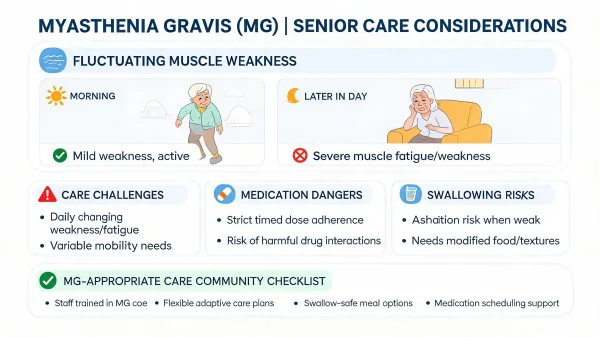
How do you plan care for a parent whose abilities change dramatically throughout the same day? That's the question families dealing with myasthenia gravis face, and it doesn't come with an easy answer. Your mother might walk to the kitchen and pour her own coffee at 8 a.m., then struggle to hold her head up or swallow safely by 6 p.m. If you've watched that happen, you already know this isn't a condition that follows a predictable pattern.
Myasthenia gravis (MG) is an autoimmune neuromuscular disorder where antibodies attack the connection between nerves and muscles, causing weakness that worsens with activity and improves with rest. It affects roughly 20 out of every 100,000 people in the United States, with late-onset MG (diagnosed after age 50) becoming increasingly common. Research published in 2024 found that about two-thirds of Americans living with MG are over 65, making this very much a condition that families encounter during the senior living conversation.
What makes myasthenia gravis senior living decisions so difficult is the fluctuating nature of the weakness. Unlike conditions that follow a steady decline, MG shifts throughout the day. That unpredictability creates real problems for families trying to figure out how much help their parent actually needs, and for care communities trying to deliver it. I've worked in hospitals long enough to know that MG sits on a short list of conditions where the wrong medication given at the wrong time can trigger a genuine emergency. That awareness shapes everything I want families to understand about finding the right care environment.
This article covers what makes MG fatigue different from ordinary tiredness, the specific risks families and caregivers need to watch for, and how to evaluate whether a senior living community can actually handle your parent's needs.
What Is Myasthenia Gravis and Why Does It Affect Seniors Differently?
Myasthenia gravis is an autoimmune condition where the body produces antibodies that block acetylcholine receptors at the neuromuscular junction, the point where nerve signals tell muscles to contract. With fewer working receptors, muscles tire quickly and recover only with rest. The name itself translates from Latin and Greek as "grave muscular weakness," which captures the seriousness of what families observe.
Late-onset MG, sometimes called "very late-onset" when diagnosed after age 65, presents unique challenges. Older adults already contend with age-related muscle loss, reduced respiratory reserve, and multiple other health conditions. MG compounds all of those. A 70-year-old with MG doesn't just have weaker muscles. They have muscles that actively fail as the day progresses, and a body with fewer reserves to compensate. Diagnosis is frequently delayed in older patients because doctors attribute early symptoms like drooping eyelids, slurred speech, or difficulty swallowing to stroke, normal aging, or other common conditions. That diagnostic delay matters because untreated MG tends to progress, and bulbar symptoms (affecting swallowing and speech) are more common in late-onset cases. Older patients also take more medications for other conditions, increasing the risk that a drug contraindicated for MG gets prescribed without anyone making the connection. Families often realize something is wrong before the diagnosis catches up, watching their parent fluctuate in ways that don't match any single explanation.
The Fluctuation Problem: Why MG Doesn't Follow a Schedule
This is where MG gets confusing for families and care providers alike. Most chronic conditions present a baseline your family can plan around. MG doesn't work that way. The weakness follows a pattern called fatigable weakness, meaning muscles grow progressively weaker with repeated use and recover after rest. Your parent isn't being dramatic or inconsistent. Their muscles are literally running out of the chemical signal they need to contract.
In practical terms, this means your parent may eat breakfast without help, walk to the living room, hold a conversation, and appear entirely fine. By mid-afternoon, after hours of using those same muscles, the picture can look completely different. Their eyelids droop, their speech becomes slurred or nasal, they struggle to lift their arms, and swallowing becomes difficult or unsafe. A rest period can partially reset things, but each cycle of exertion and recovery tends to produce slightly less recovery as the day wears on.
Where this gets confusing is the gap between what care staff see in the morning and what the family describes from evening visits. I've seen this disconnect in hospital settings too. A patient who presented as alert and capable during morning rounds looked like a completely different person by the time the evening shift arrived. Without understanding MG's fundamental mechanism, it's easy for caregivers to doubt what they're hearing from the family, or for the family to wonder if their parent is exaggerating. Neither is the case.
MG Fatigue vs. General Tiredness
General fatigue in older adults feels like being tired. You rest, you feel better, and your capabilities stay roughly consistent regardless of which muscles you use. MG fatigue is specific, progressive, and directly linked to the muscles being used. If your parent talks for 20 minutes, the muscles controlling speech and swallowing fatigue. If they climb stairs, their leg muscles weaken. And here's the critical distinction: MG weakness isn't just feeling tired. It's actual muscle failure. The muscle physically stops responding the way it should.
This matters enormously for care planning. A tired person can push through with encouragement. A person in MG fatigue cannot, and asking them to keep going can make the situation dangerous, especially when the muscles involved control swallowing or breathing.
Bulbar Symptoms: The Swallowing and Breathing Risk
Bulbar symptoms refer to weakness in the muscles of the face, throat, and tongue. For families, these are the symptoms that create the most immediate danger. Research shows that swallowing dysfunction eventually affects 15 to 40 percent of patients with generalized MG, and the risk of silent aspiration (food or liquid entering the lungs without triggering a cough) is a serious concern. Studies of elderly men with MG found that pharyngeal swallowing dysfunction was often worse than patients or caregivers realized from symptoms alone.
Your parent may cough during meals, need multiple swallows for each bite, speak with a nasal quality, or have food seem to get "stuck" in the back of their throat. These symptoms tend to worsen as the day progresses. Dinner is typically more dangerous than breakfast. That time-of-day pattern is something every caregiver in your parent's community needs to understand and plan around.
Breathing difficulty follows a similar pattern. The diaphragm and chest wall muscles are skeletal muscles, and MG can weaken them. Your parent may not notice gradual respiratory decline because it happens slowly throughout the day. By evening, their breathing may become shallow, and if an infection, medication change, or emotional stress pushes things past a tipping point, the result can be myasthenic crisis.
Myasthenic Crisis: Recognizing the Emergency
Myasthenic crisis occurs when respiratory muscle weakness becomes severe enough to require ventilatory support. It affects an estimated 15 to 20 percent of MG patients over their lifetime, and older adults are most vulnerable. The in-hospital mortality rate for myasthenic crisis in the U.S. runs under 5 percent with proper treatment, but older age is the single strongest predictor of poor outcomes. Common triggers include infections (particularly respiratory infections), surgery, emotional stress, and certain medications.
Signs that a crisis may be developing include increasing difficulty breathing, inability to swallow saliva, very weak or absent cough, and worsening weakness despite rest. This is a 911 call. Not a "wait until morning" situation.
Medications That Are Dangerous for MG Patients
This is the section I want every family to read carefully. From nearly 20 years in hospital settings, I can tell you that certain medications considered safe for most patients are genuinely dangerous for people with MG. The Myasthenia Gravis Foundation of America maintains a cautionary drug list, and some of these medications carry FDA black box warnings specifically for MG patients.
The highest-risk categories include aminoglycoside antibiotics (gentamicin, streptomycin, neomycin), which are contraindicated because they further impair neuromuscular transmission. Fluoroquinolone antibiotics (ciprofloxacin, levofloxacin, moxifloxacin) carry an FDA black box warning for MG and have triggered crisis in patients who were otherwise stable. Telithromycin, another antibiotic, carries the strongest FDA warning and should not be used in MG patients at all. Beta-blockers used for blood pressure and heart conditions (propranolol, metoprolol, atenolol) can worsen muscle weakness. Botulinum toxin in any form, including cosmetic Botox, is dangerous. Intravenous magnesium can be particularly harmful, and even oral magnesium supplements warrant caution. Statins prescribed for cholesterol management have been linked to worsened MG symptoms in multiple studies.
I've seen situations in hospital where a patient's MG wasn't flagged in the system, and a commonly prescribed antibiotic nearly created a crisis. Working in the ER taught me early that certain conditions demand their own mental checklist before any medication gets ordered, and MG is one of the most unforgiving on that list. The margin between "routine prescription" and "respiratory emergency" can be a single dose of the wrong antibiotic. That awareness stays with you after you've watched it happen, and it's the reason I believe any care community housing an MG patient must maintain an actively enforced contraindicated medication list. Not buried in a file. Posted where every staff member who administers medications can see it.
What to Look for in an MG-Appropriate Senior Living Community
Most assisted living communities aren't designed for conditions that fluctuate within the same day. Their staffing models, meal schedules, and care plans assume a relatively stable baseline. For a parent with MG, you need a community that can deliver variable care intensity on any given day without treating it as an anomaly or an overreaction.
Ask specific questions during your evaluation. Does the community adjust assistance levels based on time of day? Can staff modify meal textures or provide supervised meals during high-risk periods? Is there a protocol for monitoring swallowing safety, not just at intake but as an ongoing practice? Does the medication administration team know what drugs are contraindicated for MG, and is there a system to prevent them from being prescribed by an outside provider or administered by a fill-in nurse? During my years doing mobile X-ray work in care facilities, I saw how wide the gap can be between what a community promises during the sales tour and what actually happens on the floor. For MG, that gap can be life-threatening.
Consider communities with on-site or closely affiliated nursing staff who have experience with neuromuscular conditions. A community where your parent's neurologist can communicate directly with the care team (not just through you as the middleman) provides an extra layer of safety.
One approach that helps: visit the community at different times of day, not just the scheduled tour slot. Ask to observe the dining room during dinner service. Talk to the nursing staff on the evening shift, not just the daytime director. The evening and nighttime team will be the ones managing your parent during their most vulnerable hours, and their training and awareness level matters as much as the daytime staff you'll meet during the marketing visit.
Daily Life Adjustments That Protect Quality of Life
Living well with MG in a care community requires planning around the fatigue cycle, not fighting it. Your parent's strongest hours are typically morning through early afternoon. Schedule the activities that matter most (socializing, physical therapy, outings) during those windows. Save low-demand activities for later in the day when fatigue peaks.
Meals deserve special attention. Breakfast is usually the safest meal because swallowing muscles are rested. Dinner carries the highest aspiration risk. Practical adjustments include eating the main meal earlier in the day, choosing softer food textures for evening meals, allowing longer meal times so your parent isn't rushing through each bite, and ensuring someone is present during meals when swallowing symptoms are active. These aren't dramatic interventions. They're the kind of common-sense scheduling that prevents emergencies.
Rest periods built into the daily schedule aren't laziness. They're medical management. Even 20 to 30 minutes of genuine rest (not just sitting, but lying down with eyes closed) can partially restore muscle function and make the difference between a manageable evening and a dangerous one.
Temperature matters too. Heat can worsen MG symptoms, and many families notice their parent struggles more during warm weather or after a hot shower. If the community your parent lives in has outdoor activities during summer months, make sure staff understand that heat intolerance in MG isn't a preference. It's a physiological reality that can accelerate muscle fatigue and increase the risk of a bad evening. Air-conditioned common areas and the ability to opt out of outdoor activities without judgment are small details that make a real difference.
Working With Your Parent's Neurology Team
MG management requires a neuromuscular specialist, not just a general practitioner. Your parent's neurologist adjusts medications like pyridostigmine (Mestinon), which improves nerve-to-muscle communication, along with immunosuppressive therapies that address the underlying autoimmune attack. Dosing and timing of these medications is precise, and changes in your parent's weight, activity level, or other health conditions can require adjustments.
Make sure the care community has a clear communication pathway with your parent's neurology team. The community should know when to call the neurologist versus when to call 911, and staff should be trained to recognize the early signs of worsening that precede a crisis. Written protocols matter. Verbal assurances don't hold up during a shift change at 11 p.m.
The Cost and Care Level Question
MG doesn't fit neatly into standard assisted living pricing tiers. Your parent may qualify as "minimal assistance" on their morning assessment but need "full assistance" by evening. Many communities charge based on a single assessment score, which means your parent either gets placed at too low a level (unsafe) or too high a level (expensive for services they only need part of the day).
Ask communities how they handle variable care needs. Some offer flexible pricing models based on actual hours of assistance provided. Others use a tiered system with a supplemental charge for specific services like supervised meals or evening mobility assistance. As of 2025, the national median cost for assisted living is approximately $5,350 per month, but MG-specific needs like medication management oversight and swallowing precautions can push monthly costs $500 to $1,500 higher depending on the community and location. That's $6,000 to $18,000 in additional annual costs that families rarely anticipate when they first start looking.
When Assisted Living Isn't Enough
Some MG patients reach a point where assisted living can't provide the level of monitoring they need. If your parent experiences frequent myasthenic crises, has severe bulbar symptoms that make every meal a choking risk, or requires regular respiratory monitoring, a skilled nursing facility or a community with an on-site nursing unit may be the safer choice. This isn't a failure. It's an honest recognition that your parent's safety requires a higher clinical capability than most assisted living communities can deliver.
The transition point often arrives gradually. Watch for increasing frequency of "bad days," meals being skipped because swallowing feels unsafe, or emergency room visits related to breathing difficulty or aspiration. Those patterns tell you the current care level isn't matching what your parent needs.
Putting the Pieces Together
Myasthenia gravis makes care planning harder than most conditions because the target keeps moving. The parent you visit at 10 a.m. may not resemble the parent the evening staff assists at 7 p.m., and both versions are equally real. Understanding that fluctuation isn't a mystery or an exaggeration, but the defining characteristic of the disease, gives you a framework for making better decisions.
Focus on three things: a care community that understands and plans for variable weakness throughout the day, a medication safety system that prevents contraindicated drugs from ever reaching your parent, and a communication structure that connects the community directly to your parent's neuromuscular specialist. Those three elements won't eliminate every worry, but they build a foundation that keeps your parent safer. You're doing the research, asking the hard questions, and showing up. That matters more than you probably realize right now.