
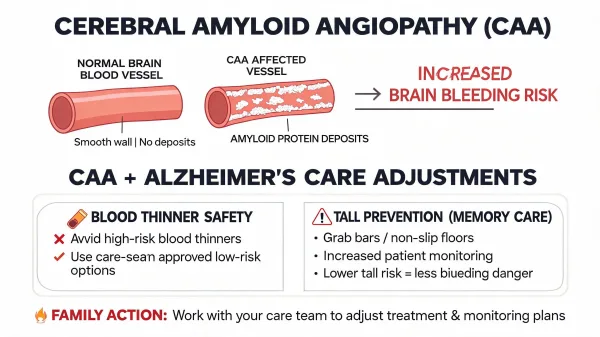
What if the most dangerous part of your parent's Alzheimer's isn't the memory loss, but a hidden condition in their blood vessels that makes them vulnerable to brain bleeds? Cerebral amyloid angiopathy (CAA) is a condition where amyloid proteins, the same type involved in Alzheimer's disease, build up inside the walls of blood vessels in the brain. Over time, these deposits weaken the vessel walls, making them prone to leaking or rupturing. The result can range from tiny, silent microbleeds to life-threatening hemorrhagic strokes.
Research suggests that CAA is present in roughly 48% of Alzheimer's patients based on pathological studies, and as many as 80% to 90% in some autopsy series. Yet most families caring for a parent with Alzheimer's have never heard of it. When my own family was going through a dementia diagnosis with a loved one, nobody mentioned the possibility that the blood vessels themselves could be part of the problem. We were focused entirely on the memory loss, not the vascular risks hiding underneath.
That gap in awareness matters. CAA changes how your parent should be medicated, how falls should be evaluated, and what kind of monitoring a memory care facility needs to provide. This article answers the questions families don't think to ask about CAA, from what it is and how it's diagnosed to the medication risks and care decisions that make it different from Alzheimer's alone.
What Is Cerebral Amyloid Angiopathy?
Cerebral amyloid angiopathy is a condition in which amyloid beta proteins accumulate in the walls of small and medium-sized blood vessels in the brain. These are the same amyloid proteins that form plaques in brain tissue in Alzheimer's disease, but in CAA, they target the blood vessels rather than the neurons. As amyloid deposits build over years, the vessel walls become stiff, fragile, and increasingly likely to develop microscopic cracks. Blood seeps through those cracks into surrounding brain tissue, causing damage that ranges from clinically silent microbleeds to large, symptomatic hemorrhages.
CAA primarily affects the outer regions of the brain (the cortex and the area just below it) rather than the deeper brain structures. This lobar distribution is one of the key features that distinguishes CAA-related bleeding from bleeds caused by high blood pressure, which tend to occur deeper in the brain. The condition is strongly age-related, with prevalence increasing sharply after age 60 and becoming common in people over 80.
How Is CAA Different From Alzheimer's Disease?
Alzheimer's and CAA share a common culprit, amyloid beta protein, but they attack different targets. Alzheimer's is defined by amyloid plaques in brain tissue and tangled tau proteins inside neurons, leading to progressive memory loss and cognitive decline. CAA damages blood vessels instead. The two conditions frequently coexist because the same amyloid protein is involved, but they aren't the same disease, and having one doesn't guarantee the other.
The practical difference for families comes down to risk. An Alzheimer's diagnosis alone carries a predictable trajectory of cognitive decline. Adding CAA to the picture introduces a vascular threat: the possibility of brain bleeds that can cause sudden neurological changes, accelerate cognitive decline, or create medical emergencies that demand fast decisions about medications. From my time working in hospital settings, I've seen how quickly a sudden bleed can change a patient's clinical picture. For families already managing Alzheimer's, an unexpected hemorrhagic event can feel like the ground shifted beneath them.
What Are the Signs of CAA in Someone With Dementia?
CAA can be silent for years, with only tiny microbleeds detectable on specialized MRI sequences. Many people with early-stage CAA have no symptoms beyond their existing dementia. That's part of what makes it so easy to miss.
When CAA does cause symptoms, they can include sudden severe headache, new or worsening confusion that comes on abruptly rather than gradually, one-sided weakness, difficulty speaking, vision changes, or seizures. These are signs of a brain bleed and require emergency evaluation. Imagine your father, already living with Alzheimer's in a memory care community, suddenly develops a severe headache and becomes noticeably more confused than his baseline. Imaging at the ER reveals a lobar hemorrhage. The medical team identifies signs of CAA on the MRI. Suddenly, the family is learning about a condition they didn't know existed alongside his Alzheimer's, and the entire medication plan needs rethinking.
Gradual worsening that seems faster than expected can also hint at CAA involvement. Repeated small bleeds accumulate damage over time, and families may notice cognitive steps downward that don't follow the typical slow Alzheimer's curve. Recent research also connects CAA to neuropsychiatric symptoms like depression, apathy, and irritability, which can emerge before major bleeding events and may be mistaken for normal progression of Alzheimer's. If your parent's behavior seems to be changing in ways that feel different from the expected memory decline, mention that to their neurologist.
How Is CAA Diagnosed?
Definitive CAA diagnosis requires a brain biopsy or autopsy examination, which obviously limits its use in living patients. In clinical practice, doctors rely on the Boston criteria (updated to version 2.0 in 2022) to diagnose "probable CAA" based on MRI findings combined with clinical presentation. The criteria look for two or more strictly lobar hemorrhagic lesions, such as intracerebral hemorrhages, cerebral microbleeds, or cortical superficial siderosis, on specialized MRI sequences like susceptibility-weighted imaging (SWI) or gradient-recalled echo (GRE).
If your parent has Alzheimer's and their neurologist orders a brain MRI, ask whether the results showed any microbleeds or signs of vascular disease. This is the question no one thinks to ask. Most families accept the Alzheimer's diagnosis and stop looking. But identifying CAA specifically changes the care approach for everything that follows.
How Does CAA Affect Bleeding Risk and Medication Management?
This is where CAA becomes a genuinely dangerous complication. The weakened blood vessels in CAA create an ongoing risk of hemorrhage, and several categories of commonly prescribed medications can make that risk significantly worse.
Anticoagulants (blood thinners like warfarin, apixaban, rivaroxaban, and other direct oral anticoagulants) are the most concerning. These drugs reduce the blood's ability to clot, which is exactly what you want if you're preventing a stroke caused by a blood clot. But in a brain full of fragile, amyloid-damaged vessels, reducing clotting ability increases the chance that a weakened vessel will bleed and that the bleeding won't stop quickly. Warfarin carries the highest risk of intracranial hemorrhage in CAA patients. Direct oral anticoagulants (DOACs) have a somewhat lower bleeding risk than warfarin, but they still raise the danger above baseline for someone with CAA.
The dilemma becomes acute when a patient with CAA also has atrial fibrillation (AFib), an irregular heart rhythm that dramatically increases the risk of clot-based strokes. AFib patients are typically placed on anticoagulants to prevent those clots. But for a patient who also has CAA, the very medication protecting them from a clot-based stroke could trigger a hemorrhagic one. Research has shown that CAA patients with prior lobar hemorrhage have an annual recurrence rate of nearly 9%, and that rate climbs higher with anticoagulant use. For patients with cortical superficial siderosis, the annual risk of lobar hemorrhage reaches approximately 19%, making anticoagulation an even more precarious choice.
Even antiplatelet medications like aspirin, which are milder than full anticoagulants, aren't without risk for CAA patients. While the bleeding increase from aspirin alone is smaller, combining antiplatelets with other factors (like advanced CAA with multiple microbleeds on MRI) can tip the balance. I remember learning that not all blood thinners carry the same weight of risk, and that realization changed how I thought about every medication my family member was prescribed. It stopped being a simple list of pills and became a set of calculated trade-offs.
For families caught in this medication dilemma, the conversation needs to happen between the neurologist (who understands the CAA and bleed risk), the cardiologist (who manages the AFib and stroke prevention), and the primary care physician (who sees the whole picture). No single specialist should be making this call alone. The discussion should cover the severity of CAA on imaging, the number and location of microbleeds, the patient's specific stroke risk score for AFib, whether there's a history of prior hemorrhage, and what alternatives exist. Families should ask for a clear explanation of the risk on both sides: the risk of a clot-based stroke without anticoagulation versus the risk of a brain bleed with it. One option gaining attention for patients who truly can't tolerate anticoagulation is left atrial appendage closure (LAAC), a procedure that physically seals off the part of the heart where most AFib-related clots form. Early research in CAA patients suggests this may be a reasonable alternative, though the evidence is still growing.
Care facilities managing a resident with CAA and AFib need to understand this medication complexity. Staff should be trained to recognize early signs of a bleeding event (sudden confusion beyond the patient's baseline, new headache, one-sided weakness, slurred speech) and have a protocol for emergency response. If your parent is on any anticoagulant or antiplatelet medication and has known or suspected CAA, make sure the care facility has documented the specific bleeding risk and the emergency steps that should follow a neurological change.
Why Does CAA Change How Falls Should Be Assessed?
Falls are common in memory care. Residents with dementia have impaired balance, may become disoriented, and are often unsteady on their feet. In most cases, a fall without a head strike gets documented and monitored. But for a resident with CAA, the stakes are higher because their blood vessels are already compromised. A fall that would be a minor concern for someone without vascular disease could trigger bleeding in a brain where the vessel walls are weakened by amyloid deposits. Even falls where the head contact seems insignificant can lead to slow-developing bleeds that don't produce symptoms for hours or sometimes days. This delayed presentation makes CAA-related bleeding after falls especially tricky to catch, because by the time symptoms appear, the hemorrhage may have expanded considerably. Families and care staff should understand that for a resident with CAA, a fall isn't just a documentation event. It's a potential neurological emergency that demands closer monitoring, including watching for new confusion, headache, drowsiness, one-sided weakness, or any change from the person's dementia baseline in the 24 to 48 hours that follow.
In the ER, I've seen elderly patients come in after what the family thought was a "small bump," only for imaging to reveal bleeding that had been slowly expanding for hours. With CAA, the threshold for concern after a head injury needs to be lower. Families should ensure the memory care facility knows about the CAA diagnosis and has a care plan that specifies how falls are assessed differently for their parent.
What Should Families Ask a Memory Care Facility About CAA?
If your parent has been diagnosed with or is suspected of having CAA, there are specific questions that should be part of your conversation with any memory care community you're evaluating or already using.
Ask how the facility handles neurological changes. Do staff know the difference between a resident's normal dementia baseline and an acute change that could signal a bleed? Ask about their fall protocol for residents with documented bleeding risks. Find out whether the facility communicates with your parent's neurologist directly or relies on the family to relay information. Ask whether medications are reviewed regularly with attention to bleeding risk, and whether the care plan specifically flags your parent's CAA status. These aren't standard questions, and that's exactly the point. CAA requires a level of monitoring specificity that goes beyond routine dementia care.
Is There Treatment for CAA?
There is no cure for CAA, and no medication can reverse the amyloid deposits already in the blood vessel walls. Treatment focuses on reducing factors that increase bleeding risk: carefully managing blood pressure (since hypertension adds stress to already-weakened vessels), minimizing or eliminating medications that impair clotting when safely possible, and preventing falls. In some cases where CAA triggers an inflammatory response (called CAA-related inflammation or CAA-ri), corticosteroids may be used to reduce brain swelling.
For families, this means the focus shifts from treating CAA itself to managing the environment and medications around it. That's a different kind of care conversation than most Alzheimer's families expect to have. The condition can't be fixed, but its worst consequences can be made less likely with the right precautions.
How Does CAA Affect Long-Term Memory Care Planning?
A CAA diagnosis alongside Alzheimer's changes the trajectory of care planning in a few concrete ways. First, it makes the medication review conversation more complex and more important. Every new prescription, and every existing one, needs to be evaluated through the lens of bleeding risk. Second, it raises the urgency of fall prevention from a standard concern to a critical safety priority. Third, it means your parent may be more likely to experience sudden clinical changes that require emergency medical intervention, which affects where they live and how quickly emergency services can reach them. Families should also factor CAA into advance directive conversations, since a significant hemorrhagic event can cause rapid decline that leaves little time for decision-making in the moment.
During my family's experience with dementia, we learned the hard way that understanding the specific type and cause of cognitive decline isn't just an academic exercise. It shapes every decision that follows, from which medications are safe to how a care facility should respond when something goes wrong. CAA is one of those hidden factors that can sit behind an Alzheimer's diagnosis and change the math on everything.
If your parent has Alzheimer's and you haven't asked whether CAA could be part of the picture, now is the time to have that conversation with their neurologist. Ask about the MRI findings. Ask whether there are signs of vascular damage alongside the Alzheimer's pathology. The answer may not change the diagnosis, but it could change the care plan in ways that directly protect your parent's safety. You don't need to become an expert in vascular neurology. You just need to know enough to ask the right questions, and knowing that CAA exists is where that starts.