
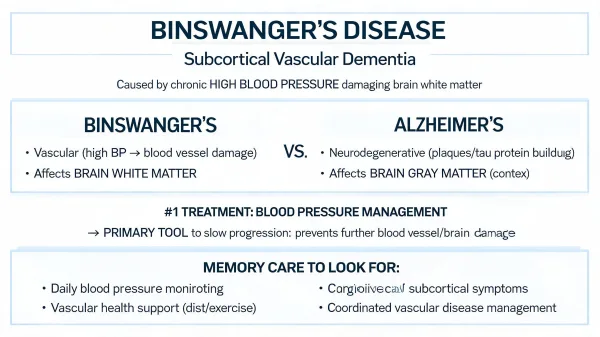
Nearly three out of four adults over 60 in the United States have high blood pressure, according to data from the CDC's National Health and Nutrition Examination Survey (2021-2023). Among those with chronic, poorly controlled hypertension, MRI studies consistently show white matter damage accumulating in the brain, often years before any cognitive symptoms appear. When that damage becomes extensive enough to cause dementia, the condition has a name most families have never heard: Binswanger's disease.
Binswanger's disease is a form of subcortical vascular dementia caused by widespread damage to the brain's white matter, the deep nerve fibers that connect different brain regions. Unlike Alzheimer's, which attacks memory centers directly, Binswanger's disease disrupts the brain's communication highways. The result is a dementia that looks different from what most people expect, one built on slowed thinking, poor planning, and personality changes rather than the classic "forgetting names and faces" pattern. And here's what makes this condition particularly frustrating and hopeful at the same time: because it's driven by blood pressure, families may have more ability to influence its progression than with almost any other form of dementia.
This article covers what Binswanger's disease is, how it differs from other dementias, why blood pressure management is the single most important treatment strategy, and what to look for when a memory care facility becomes necessary.
What Is Binswanger's Disease?
Binswanger's disease, also called subcortical vascular dementia or subcortical arteriosclerotic encephalopathy, is a type of dementia caused by chronic damage to the small blood vessels that supply the brain's white matter. White matter is the tissue deep inside the brain made up of nerve fibers coated in myelin, a protective insulation layer that allows signals to travel quickly between brain regions. When the arteries feeding these deep structures become thickened and narrowed from years of high blood pressure, blood flow decreases and brain tissue slowly dies.
The condition typically develops after age 50 and progresses over years. According to the National Institute of Neurological Disorders and Stroke (NINDS), the damage creates a characteristic pattern visible on MRI scans as bright white patches scattered through the deep brain tissue. Vascular dementia as a category accounts for roughly 15% to 20% of all dementia cases, making it the second most common type after Alzheimer's. Binswanger's disease falls within that category as a specific subtype, though it's considered underdiagnosed because its symptoms don't match the memory loss pattern most families associate with dementia.
How Binswanger's Disease Differs from Alzheimer's
Where this gets confusing for families is the gap between what they expect dementia to look like and what Binswanger's disease actually does. Most people picture dementia as forgetting recent conversations, repeating questions, or getting lost in familiar places. That's a cortical dementia pattern, where damage hits the brain's outer layer (the cortex) and disrupts memory storage and retrieval directly. Alzheimer's disease is the most familiar example of this cortical pattern.
Binswanger's disease is a subcortical dementia, meaning the damage occurs in the deeper structures below the cortex. Instead of memory loss being the headline symptom, the early signs are problems with executive function: difficulty planning a meal, trouble managing finances that used to be routine, slower processing of information, and noticeable changes in motivation or personality. Your parent might still remember your name and recall events from last week, but they can't organize their day or follow through on a two-step task the way they used to.
I've spent nearly two decades reviewing imaging alongside radiologists in hospital settings, and one thing that still strikes me is how much white matter damage can accumulate on a brain MRI before anyone in the family notices a cognitive problem. The scans tell a story that's been building for years, often decades, while the person seemed fine on the surface. By the time symptoms show up, the imaging is already extensive.
Other differences families should watch for include gait changes (a slow, shuffling walk that wasn't there a year ago), urinary problems that seem unrelated to the brain, and mood shifts toward apathy or depression. These physical symptoms are common with subcortical dementias and rare with early Alzheimer's, so they can actually be a useful diagnostic clue if you know to look for them.
What Causes Binswanger's Disease?
The primary cause is chronic, long-standing hypertension that has gone poorly managed for years or decades. Elevated blood pressure damages the tiny arteries that feed the brain's deep white matter, causing them to thicken, narrow, and eventually restrict blood flow to the point where brain tissue dies. Diabetes, smoking, and heart disease can compound the damage, but hypertension is the driving factor in the majority of diagnosed cases.
Imagine your parent has had poorly controlled blood pressure for two decades. Their doctor has adjusted medications, but compliance has been inconsistent, and their numbers have run high more often than not. Over those years, MRI scans would show a slow accumulation of white matter lesions, areas where the blood supply has been choked off. By the time slowed thinking and apathy become noticeable enough for a family member to say "something isn't right," the neurologist orders an MRI and sees extensive damage. The conversation that follows is often painful: much of this could have been prevented, or at least slowed, with earlier and more aggressive blood pressure control. That pattern is far more common than most families realize when they first hear the diagnosis.
Blood Pressure Management as Binswanger's Disease Treatment
This is the section that matters most, and it's the reason families dealing with Binswanger's disease have something that families facing most other dementias don't: a direct, actionable treatment target. The relationship between blood pressure control and Binswanger's disease progression is well-established. Controlling blood pressure won't reverse damage that's already done. The dead white matter tissue isn't coming back. But aggressive, consistent blood pressure management can slow or halt further damage, which means the cognitive abilities your parent still has can potentially be preserved for longer.
Population-based MRI studies have shown that people with untreated or uncontrolled hypertension develop significantly more white matter lesions over time compared to those whose blood pressure is well managed. One longitudinal study published in Hypertension found that participants with 20-plus years of uncontrolled high blood pressure had dramatically higher rates of both subcortical and periventricular white matter damage compared to those with successfully treated hypertension. The treated group still showed more damage than people who never had high blood pressure, but the difference between treated and untreated was substantial. That gap between treated and untreated groups represents real cognitive function that was preserved.
For families, this translates into a very specific priority: your parent's blood pressure needs to be monitored and managed every single day. If your parent is in a memory care facility, confirm that blood pressure monitoring is part of their daily care routine, not just an occasional vital signs check during a monthly nursing assessment. Ask how often readings are taken, what the target range is, who reviews the numbers, and what happens when readings are consistently elevated. A facility that treats blood pressure monitoring as an afterthought for a Binswanger's patient is missing the single most important tool for slowing the disease.
Medication adherence is the other critical piece, and it's the one most likely to break down in practice. Many older adults take antihypertensive medications along with several other prescriptions, and missed doses are common, especially in someone with cognitive impairment who may not remember whether they've already taken their pills. In a memory care setting, medication management should be fully staff-administered with documented tracking. If your parent is still living at home or in assisted living, a pill organizer alone isn't sufficient. You need a system where someone verifies that the medication was actually taken every day, whether that's a family member, a home health aide, or an automated dispensing device. For Binswanger's patients specifically, a single class of antihypertensive often isn't enough, and the dosing may need periodic adjustment as their doctor reviews trends over weeks and months.
The frustrating reality is that this information often arrives too late. By the time someone is diagnosed with Binswanger's disease, decades of poorly managed blood pressure have already done significant damage. But "too late to prevent" is not the same as "too late to help." Every month of well-controlled blood pressure from this point forward is a month where new damage is minimized.
From my years working in hospital radiology, I've seen the imaging progression in patients who get their blood pressure under control versus those who don't. The difference between the two groups on follow-up scans is visible and significant. It won't erase what's already there, but it can slow the accumulation of new lesions considerably. Families who take blood pressure management seriously after a Binswanger's diagnosis are giving their parent the best available tool for preserving remaining function.
What Does Binswanger's Disease Progression Look Like?
Unlike Alzheimer's, which tends to follow a somewhat predictable staged decline, Binswanger's disease often progresses in a stepwise pattern. Your parent may remain stable for weeks or months, then experience a noticeable decline, often following a small stroke or a period of poorly controlled blood pressure. This step-down pattern can be disorienting for families who expect a gradual, steady slide.
Early stages typically involve slowed thinking, difficulty with complex tasks, and subtle personality shifts. As the disease progresses, walking difficulties become more pronounced, speech may slow, and emotional regulation becomes harder. In later stages, significant physical and cognitive disability usually requires full-time care. The overall course varies widely, which is one more reason why aggressive blood pressure management matters. Each period of good control is a period where that next step-down might be delayed.
When Does Binswanger's Disease Require Memory Care?
The transition point is different for every family, but there are patterns worth knowing. With Binswanger's disease, the need for memory care often comes not from memory loss alone but from the combination of executive dysfunction and physical symptoms. Your parent may still recognize everyone in the family but can't safely manage their medications, maintain their balance on stairs, or respond appropriately when something goes wrong, like a stove left on or a fall in the bathroom. When daily safety becomes a consistent concern rather than an occasional worry, it's time to start evaluating memory care options seriously.
I've talked with families who waited because "Dad still knows who we are," not realizing that Binswanger's disease creates a different kind of danger than the memory-centered confusion they were watching for. The risks with this condition aren't about forgetting who people are. They're about falls, medication errors, and an inability to handle emergencies when no one else is in the room.
What to Look for in a Binswanger's Disease Facility
Not all memory care facilities are equally equipped to handle vascular dementias, and Binswanger's disease comes with specific needs that go beyond standard dementia programming. The blood pressure management protocols discussed earlier should be your first screening question. Ask every facility how they handle daily blood pressure monitoring and what their process is for responding to elevated readings. If the answer is vague, keep looking.
Physical therapy and fall prevention matter more here than in most other dementia types because gait disturbance is a core feature of Binswanger's disease, not a late-stage complication. Look for facilities with on-site or regularly scheduled physical therapy, accessible walking paths, and staff trained to assist residents with mobility challenges. During my mobile X-ray work visiting care facilities, I saw how much the physical environment varied from one place to the next, and for someone with balance and gait issues, those differences directly affect safety and quality of life.
How Much Does Memory Care Cost for Binswanger's Disease?
Memory care costs for Binswanger's disease are generally in line with memory care costs for other dementias, since most facilities charge based on care level rather than diagnosis. As of 2025, the national average for memory care runs between $6,500 and $8,500 per month, depending on location and the level of services included. That works out to roughly $78,000 to $102,000 per year. When our family first encountered memory care pricing during a relative's dementia journey, the annual math was the number that really hit home. Monthly figures can feel abstract until you multiply by twelve.
Medicare doesn't cover long-term memory care. Medicaid may help through state waiver programs if your parent meets income and asset requirements, and VA benefits can supplement costs for eligible veterans and surviving spouses. Long-term care insurance, if your parent has an active policy, is one of the most valuable resources available. Start the financial conversation as a family early, well before a crisis forces a rushed decision under pressure.
Can Binswanger's Disease Be Prevented?
Prevention comes down to the same factor that drives treatment: blood pressure control. Adults who maintain healthy blood pressure throughout midlife and into older age significantly reduce their risk of developing the kind of white matter damage that leads to Binswanger's disease. The research connecting midlife blood pressure control to reduced white matter damage is clear and consistent. Diabetes management, regular physical activity, not smoking, and managing cholesterol all contribute to vascular health and reduce risk further.
If your parent already has hypertension, prevention shifts to damage limitation. Consistent medication use, regular monitoring, and honest conversations with their doctor about what the numbers actually look like (not just whether they're "on medication") can make a real difference in whether white matter damage stays mild or becomes severe enough to cause dementia.
Supporting a Parent with Binswanger's Disease
Living with a Binswanger's diagnosis in the family requires adjusting expectations, both about what the disease looks like day to day and about what you can control. The executive dysfunction can be harder to accommodate than memory loss in some ways, because your parent may seem "fine" in conversation but can't follow through on tasks, manage their finances, or make safe decisions independently. That gap between how they present and how they function is one of the most confusing aspects for families.
My experience as a caregiver taught me that the conditions you can partly manage feel different from the ones where you're just watching. Binswanger's disease falls somewhere in between those two experiences, and that matters. You can't undo the damage, but you can fight for the best possible blood pressure control, choose a facility that takes vascular dementia seriously, and stay involved in monitoring the one treatment that actually slows this disease down. That level of influence won't fix everything, but it's more than most dementia diagnoses offer. Hold onto that.