
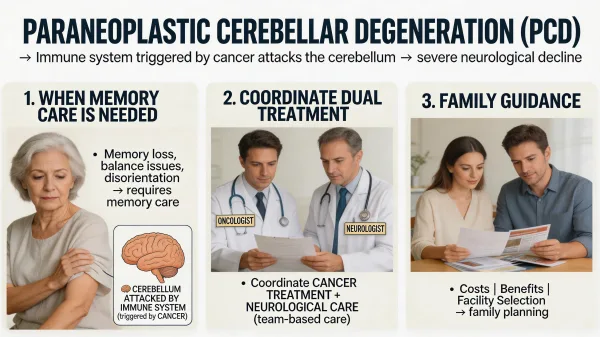
What happens when the treatment for cancer triggers a completely separate disease in the brain? For families already reeling from a cancer diagnosis, paraneoplastic cerebellar degeneration (PCD) delivers a second blow that few people see coming. Your parent's immune system, doing exactly what it should by fighting cancer, accidentally destroys part of the brain responsible for balance, coordination, and, in some cases, memory and thinking.
PCD is rare, affecting fewer than 1% of cancer patients. But for the families caught in it, the rarity doesn't soften the impact. You're suddenly managing chemotherapy schedules alongside a neurological condition that can leave your parent unable to walk or speak clearly within weeks. The oncologist is focused on the tumor. The neurologist is focused on the brain. And you're the one trying to make sure both sides are actually talking to each other.
I watched something similar unfold during my years as a spousal caregiver for my first husband's cancer battle. When a disease attacks the body from more than one direction at the same time, the hardest part isn't any single treatment decision. It's making sure the whole care plan works together instead of pulling in opposite directions. That lesson shapes everything in this article.
This piece covers what PCD is, how it collides with cancer treatment, when memory care enters the picture, and what your family can do to stay ahead of a condition that moves fast and forgives slowly.
What Is Paraneoplastic Cerebellar Degeneration?
Paraneoplastic cerebellar degeneration is a neurological condition triggered by the body's immune response to cancer. The immune system produces antibodies to fight a tumor, but those antibodies also attack healthy Purkinje cells in the cerebellum, the part of the brain that controls balance, coordination, and fine motor movement. The result is severe, rapidly progressive ataxia that often leaves patients unable to walk unassisted within weeks of symptom onset.
PCD is most commonly associated with ovarian, breast, and lung cancers, as well as Hodgkin lymphoma. In roughly 60% to 70% of cases, neurological symptoms actually appear before the cancer itself is diagnosed, which means PCD can be the first signal that a malignancy exists. The condition develops over days to weeks, not months or years, which is part of what makes it so disorienting for families.
Symptoms include unsteady gait, slurred speech, difficulty swallowing, involuntary eye movements, and tremor. About 20% of patients also develop what's called cerebellar cognitive affective syndrome, which involves memory problems, difficulty with reasoning, and emotional changes. Some patients also experience emotional lability, where they cry or laugh without a clear trigger, which can be deeply unsettling for families who don't understand what's happening. This cognitive and emotional component is what eventually brings some PCD patients into memory care conversations.
Several different antibodies are associated with PCD, and the specific antibody type influences both the likely underlying cancer and the prognosis. Anti-Yo antibodies are the most common, found primarily in women with ovarian or breast cancers. Anti-Hu antibodies are more often linked to small-cell lung cancer. Patients with anti-Yo antibodies tend to have more severe neurological outcomes and are less likely to respond to immunotherapy. Your parent's antibody profile matters because it affects how aggressively the medical team should pursue neurological treatment and what to expect over the coming months.
How PCD Differs from Other Causes of Cognitive Decline
PCD doesn't follow the slow, gradual trajectory families associate with Alzheimer's or other forms of dementia. The onset is fast. A parent who was functioning independently two months ago may now need full-time assistance with mobility, eating, and communication. The cognitive effects, when present, tend to overlap with severe physical disability rather than appearing on their own.
This distinction matters because it changes how you evaluate care options. With typical dementia, families often have months or years to research facilities, compare costs, and plan transitions. PCD compresses that timeline dramatically. You may be looking at memory care or skilled nursing options while your parent is still undergoing active cancer treatment, which adds layers of medical complexity that most senior living communities aren't built to handle.
The physical symptoms often overshadow the cognitive ones. A parent who can't walk, has slurred speech, and struggles to swallow may also be experiencing confusion and memory loss that gets attributed to medication side effects or emotional distress rather than recognized as a separate neurological problem. Families and even some clinicians can miss the cognitive component because the mobility and speech issues are so dramatic and immediate. If your parent seems confused or forgetful on top of the physical symptoms, raise it with the neurologist specifically. Don't assume it's just the stress of the situation.
Navigating Dual Care: Cancer Treatment and Neurological Decline
This is where PCD becomes unlike almost any other condition families face in senior care. Your parent isn't dealing with cancer or neurological decline. They're dealing with both simultaneously, and the treatment for one directly affects the other. Families are often stunned to learn that curing the cancer doesn't automatically reverse the brain damage. The immune system may stop producing the harmful antibodies once the tumor is treated, but the Purkinje cells already destroyed don't regenerate.
Imagine your mother has been undergoing treatment for ovarian cancer. She's been managing side effects, keeping appointments, and pushing through. Then she develops trouble walking, her speech starts to slur, and she seems confused in ways that go beyond chemo brain. Testing reveals PCD. Now her oncology team is trying to shrink a tumor while her neurologist is trying to stop her immune system from destroying more of her cerebellum. Those two goals can work against each other. Cancer treatment often involves boosting or modulating the immune system. PCD treatment requires suppressing the very same immune response that's fighting the cancer.
The treatment options for PCD itself are limited and the evidence for their effectiveness is mixed. Oncologists typically prioritize treating the underlying cancer, since removing the tumor can sometimes stabilize the neurological symptoms by eliminating the trigger for the antibody production. Immunotherapy approaches for PCD include corticosteroids, intravenous immunoglobulin (IVIG), and plasma exchange. Some patients show partial improvement, particularly when treatment begins within the first month of neurological symptoms. But multiple studies have shown that patients with anti-Yo antibodies, the most common type in PCD associated with gynecological cancers, tend to have worse neurological outcomes regardless of treatment timing. By the time most patients receive a PCD diagnosis, substantial Purkinje cell loss has already occurred. The damage tends to stabilize around six months after onset, but by that point, the majority of patients are wheelchair-dependent or bed-bound.
Here's the conversation families don't expect to have this early: palliative care. When you hear "cancer," you think treatment, remission, survival. PCD forces a different kind of reckoning. Even if the cancer responds to treatment, the neurological damage may be permanent. Families celebrating a cancer victory sometimes face a second grief when the ataxia and cognitive decline don't improve. Palliative care in this context isn't about giving up. It's about managing symptoms, preserving quality of life, and being realistic about what recovery looks like when two conditions are pulling in different directions.
The coordination question is critical. Your parent needs an oncologist, a neurologist with experience in paraneoplastic syndromes (not just any neurologist), and ideally a palliative care specialist who understands both sides. From my own caregiving experience with a multi-system illness, I can tell you that the single most valuable thing you can do is make sure these providers are communicating directly with each other. Request that they share notes. Ask for joint treatment planning. If one specialist doesn't know what the other is prescribing, your parent pays the price.
Memory Care During and After Cancer Treatment
Finding the right care setting for a parent with PCD is harder than a typical memory care search because the medical needs go well beyond cognitive support. Your parent may be immunocompromised from chemotherapy, physically dependent due to ataxia, dealing with swallowing difficulties that require modified diets or feeding assistance, and experiencing cognitive changes all at the same time. That combination of needs narrows the field considerably.
Not every memory care community is equipped for this level of complexity. When evaluating facilities, families should ask specifically about experience with immunocompromised residents. A parent undergoing or recently completing chemotherapy has a suppressed immune system, which means infection control protocols matter more than they would for a typical memory care resident. Ask about the facility's flu and respiratory illness policies, how they handle outbreaks, and whether they can accommodate isolation precautions if needed. Some families find that a skilled nursing facility with a memory care unit offers a better fit than a standalone memory care community, because skilled nursing provides the medical oversight that PCD's physical complications demand.
Coordination with the oncology team doesn't stop at the facility door. The memory care or skilled nursing community needs to be able to manage ongoing cancer treatment logistics: transportation to chemotherapy or radiation appointments, monitoring for treatment side effects, and communicating changes in condition back to the oncology team. Ask whether the facility has experience coordinating with outside specialists and whether they have a system for sharing medical updates. I've seen firsthand, through years of working in hospitals, how easily communication breaks down between care settings. The facility that says "we handle everything" without specifics is the one to question hardest.
What happens when cancer treatment ends but the neurological damage remains is the scenario that catches families off guard. Your parent may be declared cancer-free, which is wonderful news. But if PCD has left them wheelchair-bound, unable to speak clearly, and experiencing cognitive difficulties, they still need substantial daily care. The cancer chapter may close while the neurological chapter stays open indefinitely. Memory care becomes a long-term plan, not a temporary bridge. This is the point where families need to shift their thinking from "treatment and recovery" to "management and quality of life," and where the right facility makes the difference between a parent who is merely housed and a parent who is engaged, supported, and as comfortable as possible given the circumstances.
When Memory Care Becomes Necessary for a Parent with PCD
Not every PCD patient needs memory care. The cognitive effects occur in roughly 20% of cases, and some patients' primary challenges are physical rather than cognitive. Memory care becomes the right conversation when your parent is showing persistent confusion, difficulty with short-term memory, or behavioral changes that go beyond what physical rehabilitation alone can address.
Watch for these shifts: trouble recognizing familiar people, inability to follow conversations or instructions, emotional outbursts or personality changes that seem disconnected from the situation, and wandering or disorientation in familiar settings. Having worked in hospitals for nearly 20 years, I've seen how quickly families go from "maybe we should start looking" to "we need a bed tomorrow." If your parent's neurologist confirms cerebellar cognitive affective syndrome or a concurrent paraneoplastic process affecting other brain regions, memory care provides the structured, secure environment that keeps them safe while supporting whatever cognitive function remains.
The timing question is urgent with PCD. Don't wait for a crisis. If the trajectory is pointing toward increasing cognitive and physical dependence, start researching facilities now, even if your parent isn't ready for placement today. PCD moves faster than most families expect. Having a shortlist of vetted facilities means you can act within days rather than scrambling during a hospitalization or a sudden decline at home. Ask the neurologist directly: based on the current rate of progression, what's a realistic timeline for needing 24-hour care?
Financial Realities and Benefits to Know About
The financial burden of PCD is compounding in the worst sense. Your family is already managing cancer treatment costs, co-pays, medications, and possibly reduced income if your parent can't work. Adding memory care at a national median of roughly $6,700 to $7,500 per month (as of 2025) creates a financial picture that requires immediate, honest planning. That's approximately $80,000 to $90,000 per year for memory care alone, layered on top of cancer treatment expenses that may include hospital stays, chemotherapy infusions, imaging, and specialist visits. The numbers are staggering, and pretending otherwise doesn't help anyone.
One piece of good news that many families miss: paraneoplastic cerebellar degeneration is on the Social Security Administration's Compassionate Allowances list. This means that if your parent applies for Social Security Disability benefits, the application is fast-tracked, often approved in days or weeks rather than the typical months-long process. This can provide critical income during the transition period when care costs are climbing and your parent is no longer able to work. Don't delay this application. File as soon as the diagnosis is confirmed.
Medicare covers cancer treatment but doesn't cover memory care residence costs. Medicaid may cover long-term care in some states, but eligibility requirements and waiting lists vary widely. If your parent has long-term care insurance, review the policy immediately, because many policies have elimination periods and specific triggers for benefit activation. Veterans may qualify for Aid and Attendance benefits through the VA, which can offset some costs. Contact a financial planner who specializes in elder care to map out the full picture. I remember the financial shock during my own family member's memory care search, and I'll tell you this: the families who plan early, even when it feels premature, always end up in a stronger position than those who wait.
What Families Can Do Right Now
If your parent has been diagnosed with PCD, or if you suspect the neurological symptoms alongside their cancer may point in this direction, there are concrete steps to take immediately.
First, make sure your parent is being seen by a neurologist experienced in paraneoplastic syndromes. A general neurologist may not have the specialized knowledge to manage this condition effectively. Ask the oncology team for a referral, or contact a major academic medical center with a neuro-oncology department. Second, request that all treating physicians communicate with each other directly. You can facilitate this by signing medical release forms that allow records to be shared across providers and care settings. Third, start the Social Security Disability application now if your parent meets the criteria. The Compassionate Allowances designation means PCD qualifies for expedited processing. Fourth, begin researching care facilities before you need one. Look for skilled nursing communities with memory care units that have experience handling immunocompromised residents and coordinating with oncology teams. Tour early and ask the hard questions about infection control, specialist coordination, and what happens if care needs increase.
Keep a centralized binder or digital file with every medical record, test result, provider contact, and insurance document. When you're managing two major medical conditions simultaneously, organization isn't optional. It's survival.
Moving Through the Impossible
Paraneoplastic cerebellar degeneration puts families in an impossible position: managing cancer treatment while watching neurological function decline in real time, knowing that beating the cancer may not undo the brain damage. There's no gentle way to frame that reality, and you deserve honesty about what lies ahead.
But honest doesn't mean hopeless. Early treatment of the underlying cancer can stabilize PCD. The right care facility can provide safety, dignity, and quality of life even when recovery is limited. Financial planning and benefits like the Compassionate Allowances program can ease the burden, and coordinated care across specialties can prevent the kind of fragmented treatment that makes everything harder.
What most people don't realize until they're in it is that beating cancer doesn't always mean the neurological damage reverses. PCD damage is often permanent, and families who expected a full recovery after successful cancer treatment may face an extended chapter of caregiving they didn't plan for. That second grief is real, and it deserves acknowledgment. You didn't choose this situation, and your parent didn't either. What you can choose is how you respond to it: with information, with planning, and with the kind of fierce, practical love that gets families through the hardest seasons of caregiving. You're already doing that by being here and reading this.