
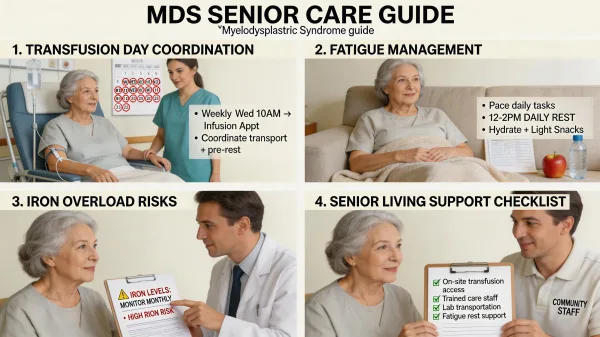
When your parent has myelodysplastic syndrome and depends on regular blood transfusions, medical care stops being something that happens at occasional appointments. It becomes the structure around which every week is built. A transfusion every two to four weeks means a full day at the infusion center, pre-procedure bloodwork, hours in the chair, and then a day or two of fatigue that limits what your parent can do. That cycle doesn't pause, and it doesn't slow down on its own.
For families trying to find a senior living community that can support a parent with MDS, the real question isn't whether the community offers "medical coordination." It's whether they can commit to the logistics of recurring, predictable, time-intensive medical appointments week after week, month after month, without things falling through the cracks. Most communities are set up for occasional doctor visits and pharmacy runs. Transfusion dependence is a different kind of demand.
I spent years as a caregiver managing recurring medical appointments for a loved one with a serious illness, and I can tell you that the logistics of ongoing treatment become the architecture of your daily life. It's not just the appointment itself. It's the preparation, the recovery, the way everything else has to flex around it. That experience shapes how I think about what families with a transfusion-dependent parent need from a care community.
This article walks through what MDS means for senior living, how transfusion schedules affect daily routines, what a community must coordinate on transfusion days, and how to evaluate whether a community can actually deliver on those promises over time. If you're in the early stages of exploring options for a transfusion-dependent parent, this is the practical framework you need before you start touring communities.
What Is Myelodysplastic Syndrome and Why Does It Require Ongoing Transfusions?
Myelodysplastic syndrome is a group of blood cancers in which the bone marrow doesn't produce enough healthy blood cells. The condition is most common in older adults, with a median age at diagnosis around 70 to 77 years and an incidence rate of roughly 26 per 100,000 in people 65 and older. Between 10,000 and 55,000 new cases are estimated in the United States each year, and that number is expected to grow as the population ages. Most families haven't heard of MDS until the diagnosis, which makes the learning curve steep at exactly the moment when decisions need to happen quickly.
For many people with lower-risk MDS, the primary problem is chronic anemia. The bone marrow produces red blood cells that are defective or too few in number, leaving the body without enough oxygen-carrying capacity. Treatments like erythropoiesis-stimulating agents can help some patients, but 50% to 90% of people with MDS will eventually need red blood cell transfusions, and many become transfusion dependent. That means regular trips to an infusion center, typically every two to four weeks, for the rest of their lives or until the disease progresses to a different stage. I've worked in hospitals for nearly two decades, and I've seen how diagnoses like this catch families completely off guard. One week your parent seems fine. A few months later, transfusions are running the calendar.
How Does Transfusion Dependence Affect Daily Life in MDS Senior Living?
Transfusion dependence reshapes your parent's week in ways that aren't obvious until you live with the schedule. Each transfusion session typically takes three to five hours, not counting travel time and the pre-transfusion blood draw that confirms the current hemoglobin level. That's a full day committed to the appointment alone. For a parent who also has other medical appointments, therapy sessions, or simply wants to participate in community activities, that one lost day has a ripple effect on everything else.
Then comes the recovery. Many MDS patients feel a temporary boost in energy after a transfusion, but that initial lift is often followed by a day or more of fatigue. In the days before the next transfusion, hemoglobin levels gradually drop again, and fatigue, shortness of breath, and low energy return. This creates a predictable wave pattern in your parent's week: a period of relative stability after the transfusion, then a slow decline until the next one. Activities, social events, and meals all need to flex around this rhythm. A senior living community that doesn't understand this pattern will schedule your parent for activities on their worst days and miss the windows when they feel best.
Imagine your parent needs transfusions every three weeks. That means roughly 17 to 18 transfusion days per year, each one requiring transportation, monitoring, and at least a day of adjusted care afterward. Over the course of a year, that's more than a month of days directly shaped by the transfusion schedule. The community you choose needs to treat this as a core part of the care plan, not a series of isolated appointments.
Transfusion Day Logistics: What the Care Community Must Coordinate
This is where things break down in practice. A senior living community might tell you they handle medical appointments. But coordinating biweekly or triweekly transfusions is a logistical commitment that goes far beyond calling a taxi to the doctor's office. Here's what a single transfusion day actually requires from the community, and why each step matters.
Before the transfusion, your parent needs pre-procedure lab work. Many hematologists require a complete blood count drawn the day before or the morning of the appointment so they can confirm that hemoglobin has dropped enough to warrant the transfusion and order the correct blood type match. The community needs to coordinate this lab draw, whether it happens on-site through a mobile phlebotomy service or requires a separate trip to a lab. Missing this step can delay or cancel the transfusion entirely, which throws off the whole schedule. Some communities with on-site nursing staff can handle the blood draw themselves and send it to the lab, but this needs to be confirmed before move-in, not assumed.
Transportation is the next piece. Transfusion appointments aren't quick errands. Your parent needs reliable, scheduled transportation to the infusion center, and someone has to account for the fact that the return trip might not happen for four to six hours. Many community transportation services operate on fixed schedules or shared routes that aren't designed for appointments lasting half a day. Ask specifically whether the community offers dedicated medical transport or partners with a non-emergency medical transportation provider that can handle extended appointment windows. If the answer is "we'll call a ride when they're ready," that's a red flag. Your parent shouldn't be sitting in an infusion center lobby waiting for a ride while they're exhausted from the procedure.
During years of managing a loved one's recurring treatments, I learned that the real test of a care system isn't whether they can get someone to one appointment. It's whether they can do it reliably every two to three weeks, month after month, without the coordination breaking down. The scheduling, the reminders, the backup plans for when a driver cancels or a lab result is delayed: that's the work that either holds together or doesn't. I've watched well-intentioned systems fail at exactly this kind of ongoing, unglamorous coordination, and it's the patient and family who absorb the consequences.
After the transfusion itself, monitoring is critical. Transfusion reactions, while uncommon, can occur within minutes to hours after the procedure. Symptoms can include fever, chills, shortness of breath, hives, or a rapid drop in blood pressure. The community's nursing staff needs to know that your parent received a transfusion that day and should be checking on them more frequently during the first few hours after they return. This isn't optional monitoring. It's a safety requirement. Ask the community whether their staff are trained to recognize transfusion reactions and whether they have a protocol for post-transfusion observation.
There's also the question of iron overload, a cumulative risk from repeated transfusions. Each unit of transfused blood delivers roughly 200 to 250 milligrams of iron, and the human body has no effective way to excrete excess iron on its own. Over months and years of regular transfusions, iron accumulates in the liver, heart, and endocrine organs. The hematologist will monitor ferritin levels and may prescribe iron chelation therapy, which is an additional medication with its own side effects and monitoring requirements. The community needs to be aware of this medication, administer it on schedule, and report any side effects (nausea, abdominal discomfort, changes in kidney or liver function) to the treatment team. Iron overload isn't something that shows up after one or two transfusions. It builds gradually, and the community's role in medication management is part of the long-term picture.
What Should You Ask a Senior Living Community About MDS Care?
The questions that matter most aren't about whether the community "supports" medical needs in general. They're about specifics. Ask how they handle recurring appointments that require half-day transportation commitments. Ask whether they have experience coordinating with hematology or oncology offices. Ask who is responsible for tracking the transfusion schedule and making sure pre-procedure labs are completed on time. And ask what happens when something goes wrong: the lab results come back late, the transport service cancels, or your parent has a reaction after returning from the infusion center. The answer to that last question tells you more about the community's readiness than anything in the brochure.
Find out whether the community has a dedicated staff member or care coordinator who manages ongoing medical logistics for residents with complex conditions. If the answer is "the front desk helps with appointments," that's not enough for a transfusion-dependent resident. You want to know that someone is tracking dates, communicating with the infusion center, and adjusting care plans around the transfusion cycle. Ask for specifics about their transportation, and don't accept vague answers. Request references from families of residents who've had similarly complex medical schedules. The difference between a community that can manage this and one that can't often comes down to whether they've done it before.
How Does Iron Overload From Repeated Transfusions Affect MDS Seniors?
Iron overload is one of the most underrecognized complications of long-term transfusion therapy. After 10 to 20 units of transfused blood, the risk of clinically significant iron buildup increases sharply. In patients receiving chronic transfusions, iron deposits in the liver, heart, and endocrine system, and these deposits cause real damage over time: liver fibrosis, cardiac dysfunction, diabetes, and hormonal imbalances.
For a parent in senior living, iron overload management adds another layer to the care plan. The hematologist will order periodic ferritin level checks and may prescribe oral chelation therapy, typically deferasirox. This medication is taken daily and requires regular blood tests to monitor kidney and liver function. The community's medication management team needs to treat chelation therapy with the same attention they give blood pressure or diabetes medications. It's not optional, and skipping doses undermines its effectiveness. If your parent's hematologist recommends chelation, confirm that the community can handle the daily dosing, the lab monitoring, and the communication loop back to the prescribing physician.
Can Assisted Living Communities Handle Transfusion-Dependent Residents?
Some can. Many can't. The answer depends heavily on the community's staffing model, nursing availability, and willingness to integrate complex medical coordination into their daily operations. Assisted living communities with licensed nurses on staff are better positioned than those relying entirely on caregiving aides, because nurses understand transfusion reactions, medication interactions, and the clinical significance of changing lab values.
From my years working in healthcare, I've seen how quickly things can fall apart when a care setting isn't equipped for the level of coordination a condition requires. A community that manages well with routine medication reminders and occasional doctor visits may not have the infrastructure for biweekly transfusions, chelation therapy, and the kind of ongoing hematology communication that MDS demands. That doesn't make them bad communities. It means they're not the right fit for this particular situation.
How Do You Manage MDS Fatigue in a Senior Living Setting?
Fatigue is the most persistent symptom of MDS, and it follows a pattern tied directly to the transfusion cycle. In the days immediately after a transfusion, your parent may feel noticeably better as their hemoglobin rises. But as the weeks pass and hemoglobin drops again, fatigue returns. This isn't ordinary tiredness. MDS-related fatigue affects concentration, mobility, appetite, and motivation. Your parent may not want to leave their room on low-hemoglobin days, and that's not a behavioral issue. It's a physical limitation tied to the blood disorder itself.
A good senior living community will work with this rhythm rather than against it. That means scheduling physical activities and social events during the window when your parent feels strongest, typically the first week after a transfusion. It also means recognizing that in the days leading up to the next transfusion, your parent may need more rest, shorter walks, and lighter meal options. Staff who understand this cycle can adjust daily care without your parent having to explain it every time. From years of caregiving, I know how draining it is to repeatedly explain a loved one's condition to people who should already understand it. A community that builds the transfusion cycle into the care plan eliminates that burden for both your parent and your family.
What Does MDS Senior Living Actually Cost?
The base cost of assisted living in the United States reached a national median of $6,200 per month as of 2025, which works out to $74,400 annually. But for a transfusion-dependent parent, the real cost is higher. You'll likely need to factor in additional charges for enhanced care coordination, medication management for chelation therapy, and non-emergency medical transportation for recurring appointments that standard community transport doesn't cover.
Transportation alone can add up quickly. Non-emergency medical transport for half-day appointments typically runs $75 to $200 per round trip depending on your location, and at two to three transfusions per month, that's $150 to $600 in transport costs that aren't included in the community's base rate. Some communities offer enhanced medical coordination packages for residents with complex conditions, which can add $500 to $1,500 per month to the base rate. The total can easily reach $7,500 to $9,000 per month when you combine the community fee, transportation, and any additional care charges. That's $90,000 to $108,000 annually, and it doesn't include the transfusions themselves, which are typically covered by Medicare Part B.
Pulling It All Together: Finding the Right Fit for a Transfusion-Dependent Parent
Finding senior living for a parent with MDS isn't about finding a community that checks a box for "medical support." It's about finding one that understands recurring, time-intensive medical coordination and has the staff, systems, and willingness to sustain it over months and years. The transfusion schedule will become the backbone of your parent's weekly routine, and the community needs to build around it, not treat it as an inconvenience.
Start by asking direct questions about transportation, lab coordination, post-transfusion monitoring, and medication management. Ask whether they've supported residents with transfusion-dependent conditions before. Pay attention to how specific their answers are. A community that responds with detailed protocols and named staff members is telling you something very different from one that offers vague reassurances about "handling medical needs." The specificity of the answer is the answer.
Your parent deserves a care environment that matches the reality of their condition, not just the brochure version of "personalized care." The right community will treat the transfusion schedule as a central part of the care plan, not an afterthought. That level of coordination exists, but you have to look for it deliberately, and you have to ask the hard questions before move-in day.