
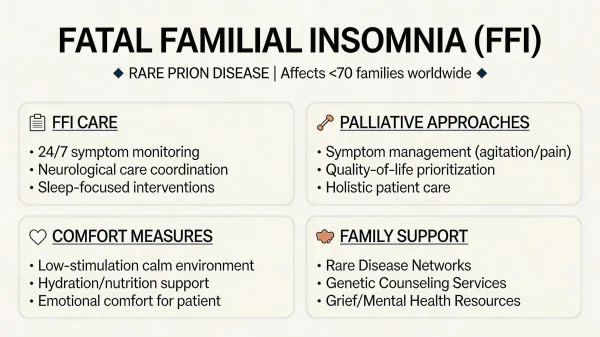
What Is Fatal Familial Insomnia?
Fatal familial insomnia (FFI) is an extremely rare, inherited prion disease that progressively destroys the brain's ability to regulate sleep. Caused by a mutation in the PRNP gene on chromosome 20, FFI damages the thalamus, the region of the brain responsible for controlling sleep cycles, body temperature, heart rate, and other automatic functions. The disease is always fatal, with an average course of about 18 months from symptom onset to death.
If your family is facing this diagnosis, you're dealing with a situation that fewer than 70 families worldwide have ever confronted. There may be no treatment that can stop this disease, but there is a way to ensure your parent's remaining time is as comfortable and as dignified as possible. That's what this article is for: not a molecular biology lecture, but a clear guide to what care looks like when the medical system has no cure to offer. You won't find false hope here, but you will find honest information about how to build a care plan that centers on what your parent actually needs right now.
I spent five years as the primary caregiver for my first husband through a terminal cancer battle, and that experience taught me something I carry into every article I write: when medicine can't fix the problem, the quality of care your loved one receives becomes everything. For families facing FFI, the mission shifts to comfort, presence, and dignity from the very first day.
How Fatal Familial Insomnia Affects the Brain and Body
FFI typically appears between the ages of 30 and 60, with an average onset around age 50. Because it's autosomal dominant, a parent with the mutation has a 50% chance of passing it to each child. As misfolded prion proteins accumulate in the thalamus, the effects spread across multiple body systems.
Consider a situation where your father, who has always been a reliable sleeper, starts complaining that he can't fall asleep no matter what he tries. Over-the-counter sleep aids don't help. His doctor prescribes a sleep medication, but it makes no difference. Weeks pass, and you notice he's losing weight. He's sweating through his shirts during the day. He seems confused about things he'd normally handle without thinking. Eventually, a neurologist orders genetic testing, and the results come back with the FFI mutation. The family sits in a room and is told there is no treatment.
That pattern, ordinary insomnia that resists every intervention, is how FFI typically reveals itself. The sleep loss worsens until it becomes total. Alongside it come autonomic problems: sweating, rapid heart rate, rising blood pressure, and weight loss. Cognitive decline follows, progressing from confusion and memory problems to hallucinations and eventually dementia. In later stages, speech and swallowing fail, coordination breaks down, and the person may progress to coma. Having worked in the ER for years, I've seen how quickly families can go from "something seems off" to a life-changing diagnosis, and few hit harder than this one. The full course ranges from 7 to 36 months, with an average of about 18 months. Some research suggests that specific genetic variations at codon 129 of the PRNP gene may influence how quickly the disease progresses, though the trajectory is devastating regardless.
Fatal Familial Insomnia and Memory Care: When Treatment Isn't an Option
In practice, this is where things break down for families. The medical system is designed around treatable conditions. When a disease has no treatment, families often feel abandoned by the very system they expected to help them. Doctors may confirm the diagnosis and then have little else to offer beyond a referral. Finding a care environment that focuses entirely on comfort and dignity becomes the family's central mission, and it often falls on the family to build that support structure themselves.
For FFI, care is entirely palliative from the moment of diagnosis. That doesn't mean nothing can be done. It means everything that is done centers on reducing suffering, preserving quality of life for as long as possible, and supporting both the person with the disease and the family around them. Standard sleep medications, including benzodiazepines and barbiturates, are generally ineffective against FFI-related insomnia. Some clinicians have reported limited, temporary benefit from certain medications, but no drug therapy has proven reliable. Medications that may worsen confusion or memory problems, such as anticholinergics, should be discontinued. The focus shifts instead to managing each symptom as it appears: controlling excessive sweating and body temperature fluctuations, monitoring blood pressure and heart rate, providing nutritional support as swallowing becomes difficult (which may eventually require a feeding tube), and using physical therapy to maintain mobility and comfort for as long as the person is able to participate.
I remember what it felt like when my husband's doctors told us there was nothing more they could do. You feel like the floor drops out. But what I learned during those years is that "nothing more we can do" is a lie, even if the doctors don't mean it that way. There's always more you can do for someone's comfort. There are always ways to make someone feel less alone. The families I think about when I write about FFI are in that same space, hearing that same devastating sentence, and they deserve to know that care doesn't end when treatment does.
Hospice integration should begin early with FFI, not as a last resort but as a proactive framework for managing the disease's progression. Hospice teams bring expertise in pain management, symptom control, and emotional support that most general medical teams aren't equipped to provide over an extended period. For a disease that progresses as aggressively as FFI, having hospice involved from the beginning means fewer crises, fewer emergency room visits, and more time spent focused on what actually matters to the family. Palliative care teams can also help with advance care planning, documenting the person's wishes while they're still able to communicate, and guiding the family through decisions about feeding support, hospitalization preferences, and end-of-life care.
The emotional weight on caregivers can't be overstated. You're watching someone you love lose the ability to sleep, then think, then speak, then move, and there's no hope of reversal. Counseling for both the person with FFI and their family should be part of the care plan from the start, not something that gets mentioned only when the caregiver is already in crisis. Because the disease progresses so rapidly, families often don't have time to process one stage of loss before the next one arrives. Building emotional support into the care plan early gives everyone a better foundation for what's ahead.
Genetic Testing and What It Means for Your Family
Because FFI is inherited in an autosomal dominant pattern, genetic testing is a significant consideration for the entire family once one member is diagnosed. A simple genetic test can identify the PRNP mutation at codon 178 that causes FFI. If one parent carries the mutation, each child has a 50% chance of inheriting it, and those who inherit it will almost certainly develop the disease. I've seen families in the hospital wrestle with whether to pursue testing for conditions with no good treatment options, and there's no easy answer.
The decision to pursue genetic testing is deeply personal. Knowing your status can allow for advance planning, participation in research studies, and reproductive options like IVF with preimplantation genetic testing to prevent passing the mutation to the next generation. But for some family members, the prospect of learning they carry an untreatable, fatal genetic condition is more than they can process, and that's a valid choice too. There's no right answer here. Genetic counseling is strongly recommended for any family member considering testing, both to understand the medical implications and to prepare emotionally for the results. A genetic counselor can also help you think through what you'd do with the information before you have it, which is often the hardest part of the decision.
Finding Support When the Diagnosis Is This Rare
One of the hardest parts of an FFI diagnosis is the isolation. Your parent's doctor may never have seen this disease before. Your local hospital may have no protocol for it. The people in your life, no matter how caring, won't fully understand what you're going through because almost nobody has been through it.
Organizations like the CJD Foundation provide resources specifically for families affected by prion diseases, including FFI. The Prion Alliance offers education and connects families dealing with prion conditions. The National Prion Disease Pathology Surveillance Center at Case Western Reserve University is a key resource for both diagnosis and family guidance. These organizations exist because families before you recognized that prion disease caregivers were falling through the gaps in a system that wasn't built for conditions this rare. Reaching out early, even before you know exactly what you need, can make a real difference in how supported you feel through the months ahead.
Research into prion diseases is ongoing, and being connected to this community can keep you informed about developments that might affect your family. From my years in healthcare, I've seen how much it helps families just to have someone who understands the medical terminology and can translate what's happening. Don't underestimate the value of connecting with even one other family who has been through this. That single point of contact can provide practical guidance that no medical textbook covers.
Caring for Your Parent Through FFI
If your parent has been diagnosed with fatal familial insomnia, you're carrying a weight that very few people in the world truly understand. This is a disease with no treatment and no happy outcome, and facing that truth directly is the first step toward making the time that remains as good as it can be.
Focus on what you can control: building a care team that prioritizes comfort, getting hospice and palliative support involved early, seeking genetic counseling for your family, and connecting with the small but real community of families who have walked this road before you. Start those conversations now, while your parent can still participate in decisions about their own care. Document their wishes. Ask what matters most to them. Those conversations will be painful, but they'll also be among the most important ones you ever have.
Your parent deserves care that's centered on dignity, presence, and relief from suffering. You deserve support too. There is no roadmap for a diagnosis this rare, but you aren't as alone as it feels right now. The fact that you're researching care options for your parent tells me you're already doing more than you think.