
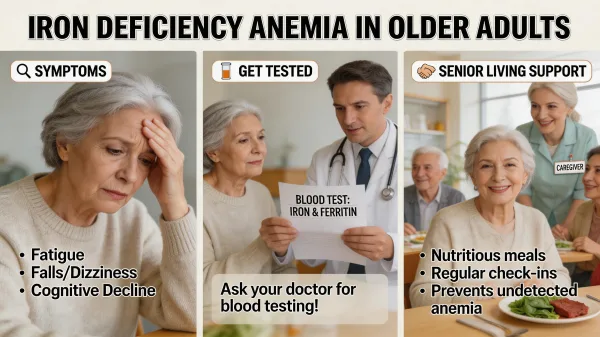
Could your parent's fatigue, confusion, and falls be caused by something as treatable as iron deficiency? If you've watched your mom or dad grow weaker over the past several months, losing energy they once had, becoming unsteady on their feet, or seeming foggier than usual, you might assume it's just aging. But iron deficiency anemia is one of the most common and most overlooked conditions in older adults, and it can mimic the kind of general decline that leads families to believe their parent needs more care than they actually do.
Iron deficiency anemia in senior living is a condition where the body doesn't have enough iron to produce adequate hemoglobin, the protein in red blood cells that carries oxygen to tissues and organs. In seniors, this shortage starves the brain, muscles, and heart of oxygen, causing fatigue, weakness, dizziness, confusion, and an increased risk of dangerous falls.
Consider a parent whose energy has been fading for months. They stopped going on their daily walk, started napping most of the afternoon, and had two falls in the kitchen within a few weeks. The family figured it was age catching up. But blood work told a different story: their hemoglobin was dangerously low. Once their doctor started iron therapy, their energy came back, the dizziness faded, and they were steadier on their feet within weeks. The family wishes they'd pushed for that blood test sooner, because the months of decline they'd accepted as permanent were actually reversible.
What most people don't realize until they're in it is that iron deficiency anemia can produce symptoms severe enough to look like dementia or warrant placement in a care facility. But it's treatable, and families should make sure it's been ruled out before accepting functional decline as permanent. I've seen this pattern from the clinical side, working in hospitals where elderly patients arrive weak and confused, and a simple blood panel reveals hemoglobin levels that explain everything.
When Fatigue Isn't Just Aging: How Severe Iron Deficiency Anemia Mimics General Decline
The symptoms of severe iron deficiency anemia in seniors overlap so closely with what families expect from aging that the condition often goes undiagnosed for months or longer. Fatigue is usually the first sign families notice, and it tends to creep in gradually. Your parent may stop doing things they used to enjoy, sleep more during the day, or seem too exhausted to hold a conversation by early afternoon. That kind of bone-deep tiredness isn't a normal part of getting older. It's the body struggling to deliver oxygen to muscles and organs that need it to function, and it gets worse over time if the underlying iron deficiency isn't addressed.
Falls are one of the most dangerous consequences of chronic anemia in older adults. When hemoglobin drops below normal levels, the body can't maintain adequate blood pressure during position changes, like standing up from a chair or getting out of bed. That sudden lightheadedness leads to stumbles, and for a senior, even one fall can mean a broken hip, a head injury, or a hospitalization that changes the entire trajectory of their independence. Research consistently links anemia in older adults to an increased risk of falls, fractures, longer hospital stays, and reduced physical performance. The fall risk alone makes regular hemoglobin monitoring essential for any senior who seems unsteady or has recently become more prone to losing their balance.
What catches many families off guard is the cognitive impact. Chronic low hemoglobin means the brain isn't getting enough oxygen, and over time, that oxygen deprivation can cause confusion, difficulty concentrating, slower processing speed, and memory problems that look remarkably like early dementia. A meta-analysis published in Brain Sciences found that older adults with anemia had roughly a 40% higher risk of developing cognitive impairment compared to those without anemia. The critical detail for families is that anemia-related cognitive decline is often reversible once hemoglobin levels are restored, which makes it very different from neurodegenerative dementia.
The underlying causes in seniors are important to understand because iron deficiency in older adults is rarely just about not eating enough spinach. The most common culprits include slow, chronic bleeding in the gastrointestinal tract from ulcers, polyps, or medications like aspirin and NSAIDs that many seniors take daily for pain or heart health. Poor iron absorption is another frequent driver, often caused by low stomach acid (which becomes more common with age), H. pylori infection, or conditions like celiac disease that are increasingly diagnosed in adults over 65. Chronic kidney disease and chronic inflammation also interfere with how the body uses and recycles iron. In many seniors, two or three of these factors are happening simultaneously, which is why identifying the root cause matters as much as replacing the iron itself.
This is one of the most treatable conditions on the decline checklist, and that's worth repeating to any family watching a parent fade.
How Iron Deficiency Anemia Is Diagnosed in Seniors
Diagnosis starts with a simple blood test that most doctors can order during a routine office visit. A complete blood count (CBC) measures hemoglobin levels and red blood cell size. The World Health Organization defines anemia as hemoglobin below 13 g/dL in men and below 12 g/dL in women. A serum ferritin test helps confirm whether iron deficiency is specifically the cause, with levels below 30 ng/mL being a strong indicator. Your parent's doctor may also check transferrin saturation and reticulocyte count to get a fuller picture of how the body is producing and handling iron.
If iron deficiency is confirmed, the next step is finding out why it's happening, and this part shouldn't be skipped. For seniors, this often means an endoscopy or colonoscopy to check for GI bleeding, since occult blood loss from the digestive tract is the most common source of iron depletion in older adults. That investigation matters because iron deficiency in an older adult can sometimes be the first clue to something more serious, including colon polyps or cancer. I've seen elderly patients come through the ER with what looked like simple weakness, only to have blood work reveal severe anemia that led to a GI workup and an early cancer diagnosis. A treatable finding caught early can prevent a much harder problem down the road.
Treatment Options That Can Restore Function
Iron deficiency anemia responds well to treatment, and many seniors see noticeable improvements within weeks of starting. Oral iron supplements, typically ferrous sulfate, are the standard first-line treatment. They're inexpensive and widely available, though GI side effects like constipation, nausea, and stomach upset cause some seniors to stop taking them prematurely. Recent evidence suggests that taking a lower dose every other day can reduce those side effects while still being effective at rebuilding iron stores. Hemoglobin should start to rise within two to three weeks of consistent treatment, with full correction expected by about eight weeks for most patients who tolerate the medication well.
When oral iron doesn't work, or when a senior can't tolerate it or absorb it properly due to GI conditions, intravenous (IV) iron infusions are the next step. IV iron bypasses the digestive system entirely and can restore levels much faster than pills. A single infusion session typically takes 15 to 30 minutes, and most patients notice symptom improvement within a week. I've watched patients in the hospital go from barely able to sit up in bed to walking the hallway after their iron levels were corrected over a few days. The turnaround can be remarkable.
Treating the underlying cause is just as important as replacing the iron, because without addressing the source of the deficiency, hemoglobin levels will drop again. If your parent is on daily aspirin or NSAIDs and has chronic GI bleeding, their doctor may need to adjust medications or explore alternatives. If poor absorption is the problem, IV iron may become a recurring treatment rather than a one-time fix. The goal is to both correct the anemia and prevent it from coming back.
Why Regular Hemoglobin Checks Matter in Senior Living
One of the biggest risks for seniors living in care facilities is that progressive fatigue, confusion, and weakness get charted as "age-related decline" without anyone ordering the basic lab work that could reveal a treatable cause. I saw this pattern repeatedly during my years doing mobile X-ray work inside rest homes and nursing facilities. Residents who were clearly declining, losing weight, becoming confused, falling more often, and the chart would note the changes as expected progression. A simple CBC hadn't been ordered in months, sometimes longer. The gap between what families were being told about their loved one's condition and what basic blood work could have revealed was, in too many cases, a failure of basic monitoring. When I think about what drives my commitment to helping families ask the right questions, those experiences are at the top of the list. A hemoglobin check is one of the cheapest and fastest tests in medicine, and it can completely redirect a senior's care plan when the results come back low.
If your parent is in assisted living or a nursing facility, ask specifically how often their blood work is being done. Hemoglobin should be checked at least annually for healthy seniors, and more frequently for those with risk factors like chronic kidney disease, GI conditions, or regular use of medications that can cause bleeding. Don't assume it's being monitored just because your parent is in a care setting. Ask to see the results, and if hemoglobin is trending downward, push for a follow-up plan.
When Iron Deficiency Anemia Signals a Need for Senior Living Support
For some families, discovering iron deficiency anemia in a parent becomes a broader wake-up call about how much daily support that parent actually needs. If your parent has been living alone and wasn't eating well enough to maintain adequate iron levels, or if they've been falling and nobody was there to recognize the pattern, that's a signal worth paying attention to. From my years of caregiving, I know how easy it is to miss gradual changes when you're not with someone every day. The anemia itself is treatable, but the conditions that allowed it to go undiagnosed for months, like social isolation, poor nutrition, or skipped medical appointments, may point to a larger gap in daily support that won't resolve on its own.
Senior living communities with on-site health monitoring can catch conditions like anemia early through routine blood work, ensure your parent is eating balanced meals that include iron-rich foods, and manage medication schedules that affect iron absorption. That kind of consistent, daily oversight is difficult to replicate when you're coordinating care from a distance. The goal isn't to move your parent into senior living because of anemia alone. It's to make sure conditions like anemia don't go undetected until a fall or hospitalization forces a more urgent and emotional conversation about care.
What Families Can Do Right Now
If your parent has been unusually tired, dizzy, short of breath, or confused, ask their doctor for a CBC and ferritin test at their next appointment. It's a simple, inexpensive request, and the results can rule in or rule out one of the most fixable causes of decline in older adults. Don't wait for a fall to be the thing that finally prompts the conversation about blood work.
Pay attention to your parent's diet as well. Iron-rich foods like red meat, spinach, lentils, and fortified cereals can support healthy iron levels, though diet alone usually can't correct established anemia. Vitamin C helps the body absorb iron more effectively, so pairing iron-rich foods with citrus fruits or tomatoes at meals makes a real difference. If your parent is taking calcium supplements or antacids regularly, those can block iron absorption, and the timing of these medications relative to meals may need to be adjusted by their doctor.
Keep a written log of the symptoms you're observing. Tracking when your parent feels most fatigued, how often they report dizziness, and whether they've had any near-falls or actual falls gives their doctor concrete, specific information to work with rather than vague concerns about them "slowing down." That documentation can be the difference between a doctor ordering blood work and a doctor attributing the symptoms to normal aging.
Your Parent's Decline May Not Be Permanent
Iron deficiency anemia is common in older adults, it causes real and sometimes severe functional decline, and it responds to treatment. The fatigue, the falls, the confusion: these don't have to be the new normal for your family. Families who push for a simple blood panel often discover that their parent's decline has a cause and a solution that doesn't require a major life change. Treatment can restore energy, improve balance, sharpen thinking, and give your parent back months or years of independence they might otherwise have lost to a condition nobody thought to test for.
If something doesn't feel right about how quickly your parent is declining, trust that instinct. Ask for the blood work. The answer might be simpler than you think, and the difference it makes could change everything for your family.