
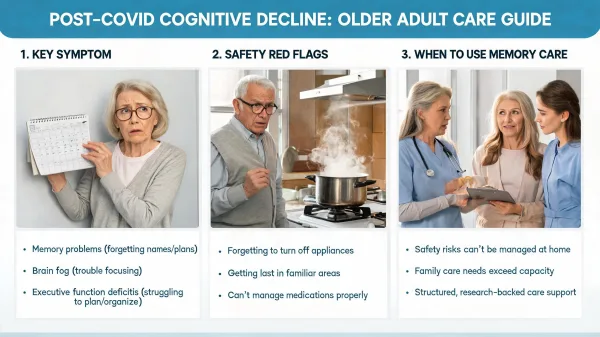
Post-COVID cognitive decline is persistent difficulty with memory, concentration, and executive function that develops after a SARS-CoV-2 infection and continues for months or longer. For some older adults, these cognitive changes are severe enough to affect daily safety and independent living, raising the question of whether structured memory care is needed.
Your parent survived COVID. Maybe they were hospitalized, maybe it was a rough few weeks at home, but either way, they pulled through. The family exhaled. Weeks later, though, something felt off. Your mom couldn't follow a recipe she'd made for thirty years. Your dad missed two doctor's appointments in a row and didn't remember scheduling them. Then came the call you didn't expect: your parent got disoriented while driving a route they'd taken a thousand times and ended up in a parking lot fifteen minutes away, unsure how they got there.
When you brought it up with their primary care doctor, the answers were vague. "We're still learning about long COVID." "Give it time." "It could improve." Those responses aren't wrong, but they don't help you figure out what to do right now, especially when what you're watching at home doesn't look like it's getting better.
I've seen this play out from inside the hospital. During and after the worst waves of COVID, patients came back through the ER and into imaging with complaints that didn't fit the usual boxes. They weren't having strokes. Their scans looked mostly normal. But something had clearly changed in how they processed information and responded to questions. The disconnect between how they looked on paper and how they functioned in real life was unsettling to witness, and I know it's even more unsettling to live with as a family.
This article covers what the research currently tells us about post-COVID cognitive decline, how to tell the difference between temporary brain fog and something more concerning, and when the level of impairment warrants considering memory care.
What We Know and Don't Know About Post-COVID Cognitive Decline
Research into the cognitive effects of COVID-19 has accelerated since the early days of the pandemic, and the picture is becoming clearer, though far from complete. Multiple large-scale studies have now confirmed that SARS-CoV-2 infection can cause measurable cognitive impairment that persists well beyond the acute illness. A multicenter study from Wuhan, China found that 35.7% of severely infected patients over age 60 showed cognitive impairment, including dementia and mild cognitive impairment, at six months after discharge. A UK-based cohort of over 2,300 patients found that nearly 47% reported slowed thinking and about 45% reported short-term memory loss a full year after hospitalization. A systematic review and meta-analysis published in The Lancet in 2024 found that COVID-19 was associated with a 58% higher risk of developing new-onset dementia compared to adults without COVID-19 infection, with the incidence rate of new dementia at 1.82% in the COVID group versus 0.35% in controls. A separate meta-analysis in Age and Ageing found the risk even higher, at 49% increased likelihood of dementia among COVID survivors. A broader systematic review estimated that memory loss prevalence among long COVID patients ranges from 21% to as high as 61%, depending on how memory was defined and assessed across studies. These aren't small numbers. They represent millions of older adults and their families confronting cognitive changes they never anticipated.
The neurological mechanisms behind these problems involve several pathways that researchers are still working to untangle. The leading theories include neuroinflammation, where the body's immune response to the virus triggers persistent inflammation in the brain even after the virus itself has been cleared. Inflammatory molecules called cytokines can cross a weakened blood-brain barrier and activate microglia, the brain's immune cells, which then disrupt normal neural communication. Research published in Brain Communications in 2025 identified widespread increases in AMPA receptor density in long COVID patients, providing some of the first molecular-level evidence of what's happening in the brain during persistent brain fog. Other mechanisms under investigation include direct viral damage to brain tissue, disruption of blood flow through microvascular injury, and autoimmune responses where the body's immune system mistakenly attacks components of the nervous system.
The critical question for families is why some patients recover their cognitive function and others don't. Age is a significant factor: older adults are more vulnerable to lasting impairment, and those over 65 face compounding risk because age-related cognitive decline may already be underway when the virus hits. Severity of the initial infection matters too, with hospitalized patients showing higher rates of persistent problems. But even mild infections have produced lasting cognitive changes in some people, which complicates the assumption that only the sickest patients are at risk. Pre-existing conditions like diabetes, hypertension, and obesity appear to increase the risk. Loss of smell during the acute infection has also emerged as a notable predictor of later cognitive problems, according to research led by the Biggs Institute. Vaccination before infection has been linked to lower rates of long-term cognitive symptoms in several studies, though it doesn't eliminate the risk entirely. The honest answer, as of 2025, is that researchers still can't reliably predict which patients will recover and which won't. That uncertainty is one of the hardest parts for families trying to plan ahead.
Where This Gets Confusing for Families
Here's the distinction that makes all of this so difficult to plan around. Post-viral brain fog, the kind where your parent feels mentally sluggish, loses words mid-sentence, or struggles with focus, is common after many serious infections and often improves over weeks or months. It's real, it's frustrating, and it's usually temporary. Persistent post-COVID cognitive impairment is something different. When memory problems, disorientation, and executive function deficits continue beyond 12 months and are getting worse or staying the same, the picture shifts from "recovery in progress" to "this may be the new baseline."
The problem is that there's no clean line between those two categories. No test at the six-month mark can tell a family with certainty which trajectory their parent is on. I've watched families hold onto hope that things will improve, sometimes for longer than they probably should, because the medical guidance is so uncertain. That waiting period is where safety risks tend to creep in. A parent who seems mostly fine on a good day can have a terrible day where they leave the stove on, wander outside at night, or get dangerously confused while driving. The lack of a definitive prognosis makes planning feel impossible, but it doesn't make planning less necessary.
When Post-COVID Cognitive Problems Require Structured Care
The shift from "my parent is struggling a bit" to "my parent isn't safe living independently" usually isn't a single dramatic event. It's a pattern. Families should watch for consistent trouble with activities their parent used to handle without thinking, things like managing medications, preparing meals, handling finances, keeping appointments, and maintaining personal hygiene. Any one of these in isolation might be manageable with support. When several of them are happening together and not improving, that's a signal worth paying attention to.
Safety is the most urgent concern. Disorientation while driving is a major red flag. So is getting lost in familiar places on foot, leaving appliances running, or being unable to remember whether they've taken their medication (especially for conditions where a missed or doubled dose is dangerous). Falls related to cognitive rather than physical decline, like tripping because they misjudged a step they've taken thousands of times, are another indicator. Watch for personality or behavioral changes too: increased agitation, withdrawal from activities they used to enjoy, or new patterns of confusion in the evening hours (sometimes called sundowning, even when there's no formal dementia diagnosis). If your parent has had one or more safety incidents related to cognitive function, the conversation about structured care should happen sooner rather than later, even if the diagnosis is still uncertain.
Evaluating whether the impairment is stable or progressive is important for care planning, even though it's difficult with post-COVID cases. A neuropsychological evaluation provides a baseline measurement of cognitive function across multiple domains: memory, attention, processing speed, executive function, and language. Repeating that evaluation six to twelve months later reveals whether function is holding steady, declining, or (in some cases) slowly improving. This kind of objective tracking is far more reliable than family observations alone, which are colored by good days and bad days, emotional exhaustion, and the natural tendency to normalize gradual changes.
Memory care becomes the right consideration when cognitive impairment has reached a level where 24-hour supervision is needed to keep your parent safe, when the care demands exceed what family members or in-home aides can realistically provide, and when the structured environment, secured exits, and trained staff of a memory care community would materially reduce risk. That threshold doesn't require a formal dementia diagnosis. Many memory care communities accept residents based on functional impairment and care needs rather than requiring a specific label. Families sometimes feel they need a definitive answer before making a move, but waiting for certainty that may never come carries its own risks. If your parent can't safely be left alone for several hours and the cognitive problems have persisted beyond 12 months without meaningful improvement, memory care deserves serious consideration regardless of whether the underlying cause has been definitively identified.
How Post-COVID Cognitive Decline Differs from Traditional Dementia
Families often ask whether post-COVID cognitive decline "counts" as dementia, and the answer isn't simple. Traditional dementia, whether Alzheimer's disease or vascular dementia, follows a progressive trajectory where function declines over time and doesn't return. Post-COVID cognitive impairment doesn't always follow that pattern. Some patients plateau and stabilize. A smaller number gradually improve, even after a year or more of impairment. Others, particularly older adults, do progress in ways that look very similar to traditional dementia, and some researchers have found evidence that COVID may trigger or accelerate neurodegenerative processes that were already developing.
A UK Biobank study published in 2025 found that the increased dementia risk among COVID survivors was primarily driven by vascular dementia rather than Alzheimer's disease, suggesting the virus may cause damage through blood vessel injury rather than the amyloid plaques associated with Alzheimer's. That distinction matters for families because vascular-related cognitive decline sometimes responds differently to treatment and may stabilize with proper cardiovascular management. The takeaway isn't that post-COVID cognitive decline is less serious than dementia. It's that the trajectory is less predictable, which is exactly what makes family planning so hard.
Getting the Right Diagnosis
If your parent is experiencing persistent cognitive problems after COVID, a thorough evaluation is the most important first step. Start with their primary care physician, but don't stop there. Ask for a referral to a neurologist with experience in post-infectious cognitive conditions or a post-COVID clinic if one exists in your area. Many academic medical centers have established long COVID clinics that bring together neurologists, neuropsychologists, pulmonologists, and rehabilitation specialists in a coordinated approach.
The evaluation should include brain imaging (MRI at minimum) to rule out strokes, tumors, or other structural causes, along with blood work to check for treatable contributors like thyroid dysfunction, vitamin deficiencies, or uncontrolled diabetes. A formal neuropsychological evaluation is the most detailed tool available for documenting exactly which cognitive functions are impaired and to what degree. I'll be direct: many families have to push for this level of evaluation. Primary care doctors are stretched thin and may not initiate a comprehensive workup unless the family specifically requests it. Advocate for your parent. The results give you something concrete to work with, rather than relying on vague observations and guesswork.
What Memory Care Offers Post-COVID Patients
Memory care communities are designed for people whose cognitive impairment creates safety risks and daily care needs that can't be met at home or in standard assisted living. For post-COVID patients with significant cognitive decline, these communities provide 24-hour supervision by staff trained in cognitive impairment care, secured environments that prevent wandering, structured daily routines that reduce confusion, medication management, and therapeutic activities designed to support remaining cognitive function.
One concern families raise is whether memory care is "appropriate" for someone whose condition might still improve. That's a fair question. The answer depends on safety. If your parent's cognitive impairment creates real danger, waiting for a recovery that may or may not come isn't a safe strategy. Some families use memory care as an interim step: a safe, supervised environment while the brain heals, with the possibility of transitioning to less intensive care if function improves. That's a legitimate approach, and many communities are willing to work with families who are facing an uncertain timeline. Ask about short-term contracts or month-to-month arrangements if committing to a long-term stay feels premature.
Cost Considerations When the Diagnosis Is Uncertain
Memory care costs in 2025 range from approximately $5,000 to over $10,000 per month depending on location, with national median estimates falling between $6,450 and $7,900 per month depending on the source and methodology. That translates to roughly $77,000 to $95,000 per year. The financial weight of that commitment is significant under any circumstances, and it's even harder to justify when the diagnosis is unclear and the trajectory is uncertain.
I remember the financial shock when our family faced memory care costs during a loved one's decline. Nothing quite prepares you for those numbers, and that was with a clear Alzheimer's diagnosis and a known prognosis. Families dealing with post-COVID cognitive decline face the added burden of not knowing how long care will be needed. Medicare doesn't cover memory care. Medicaid may cover some costs in some states, but eligibility rules are strict and waiver programs often have waitlists. Long-term care insurance, if your parent has it, may cover memory care, though policies vary widely in what they require for activation. Planning a conversation with a financial advisor or elder law attorney early, before the situation becomes urgent, gives your family more options than scrambling at the last minute.
Supporting Recovery While Planning for What's Next
Even while evaluating whether memory care is needed, there are steps families can take to support cognitive recovery and manage daily safety. Cognitive rehabilitation, including occupational therapy focused on compensatory strategies and cognitive training exercises, has shown some promise in smaller studies, though the NIH's large-scale RECOVER-NEURO trial published in 2025 found that no single intervention significantly outperformed others. That finding was disappointing for many patients and families, but it doesn't mean recovery support is worthless. All groups in the trial showed modest improvement over time, suggesting that structured activity and engagement matter even if no specific program has proven superior. Regular physical exercise, consistent sleep routines, social engagement, and cardiovascular health management have all been associated with better cognitive outcomes in long COVID patients. If your parent has untreated high blood pressure, poorly controlled diabetes, or other vascular risk factors, getting those under control may be one of the most impactful things you can do for their cognitive trajectory.
At home, practical accommodations matter more than you might expect. Simplified routines, written reminders posted in visible locations, medication organizers with alarms, and removing driving privileges when disorientation has occurred can all reduce risk while your family works through the evaluation process. These adaptations don't replace professional care when the impairment is severe, but they buy time and reduce the chance of a safety crisis forcing an emergency decision.
Making a Decision Your Family Can Live With
Post-COVID cognitive decline puts families in one of the most difficult positions imaginable: making high-stakes care decisions with incomplete information. You're likely balancing hope that your parent will recover with the reality of what you're seeing day to day. That tension is normal, and there's no formula that resolves it perfectly.
What you can do is gather as much objective information as possible through proper medical evaluation, track changes over time rather than making judgments based on single good or bad days, and be honest with yourself about safety. The families I've seen handle this best are the ones who start planning early, even when they're hoping they won't need the plan. They research memory care communities before there's a crisis. They talk with their parent about preferences while communication is still possible. They line up financial resources. They ask hard questions and sit with uncomfortable answers.
Your parent deserves the same careful, informed approach to post-COVID cognitive care that any family member with a neurological condition would receive. The uncertainty around this condition is real, but it doesn't have to mean paralysis. Start with a good evaluation, watch for safety signals, and trust what you're observing at home. You know your parent better than any scan or test result does.