
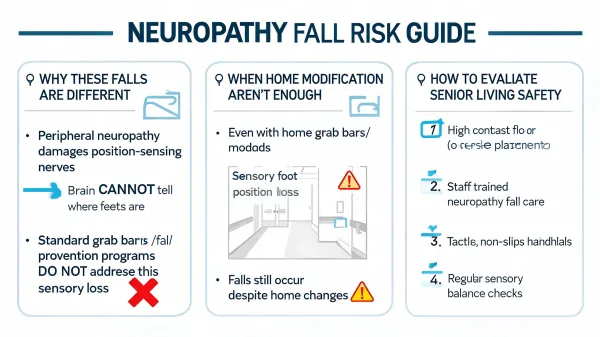
Roughly one in three seniors over 65 with peripheral neuropathy will fall in any given year, and their falls tend to be more dangerous, more frequent, and harder to prevent than the falls that affect the general elderly population. Research confirms that peripheral neuropathy is an independent risk factor for falls in older adults, with studies showing that seniors with neuropathy are up to 2.3 times more likely to fall than those without it. If your parent has been stumbling more often, catching their toe on carpet edges, or losing their footing on stairs they've used for decades, the problem may not be what you think. It may not be weakness, poor balance, or even aging itself. It may be that they simply can't feel the ground beneath their feet anymore.
Peripheral neuropathy, which affects an estimated 26% to 39% of adults over 65, damages the nerves that carry sensory information from the feet and legs to the brain. That damage creates a very specific kind of fall risk, one that standard grab bars and general fall prevention programs weren't designed to address. I've seen this pattern play out repeatedly in the ER over my years as a Radiologic Technologist. An elderly patient comes in after a fall they can't explain. They didn't trip on anything obvious, and they weren't dizzy. They just didn't feel the step, the curb, or the threshold beneath their foot, and down they went.
This article covers why neuropathy falls are fundamentally different from other types of falls, what home modifications can and can't do for someone with significant sensory loss, and how to recognize when your parent's fall risk has crossed the threshold where supervised living becomes the safer option.
What Peripheral Neuropathy Actually Does to Your Parent's Feet
Peripheral neuropathy is nerve damage that typically starts in the longest nerves in the body, the ones running to the toes and feet. Diabetes is the most common cause, responsible for roughly 30% to 40% of cases, but it can also result from chemotherapy, autoimmune conditions, vitamin deficiencies, kidney disease, and sometimes no identifiable cause at all. The damage usually progresses in a "stocking-glove" pattern, starting at the toes and gradually moving up the feet and lower legs over months or years.
For your parent, this means the sensory signals that once told their brain exactly where their foot was, how much pressure it was applying, and what kind of surface it was touching are getting weaker, delayed, or lost entirely. That loss may start with occasional tingling or patches of numbness that come and go. Over time, it can progress to the point where they genuinely can't tell whether their foot is flat on the floor or hanging off the edge of a step.
Why Neuropathy Falls Are Different: The Sensory Feedback Loop That's Broken
Most fall prevention programs are designed around two common causes of falls in seniors: muscle weakness and vestibular (inner ear) balance problems. Both are real and serious. But neuropathy falls happen through a completely different mechanism, one rooted in sensory loss rather than physical frailty, and understanding that difference is critical for making the right care decisions about your parent's living situation.
Your body stays upright through a constant feedback loop involving three systems: vision (your eyes see where you are in space), vestibular input (your inner ear senses orientation and motion), and proprioception (sensors in your muscles, joints, and skin tell your brain where your limbs are and what surfaces they're touching). Most healthy adults rely heavily on proprioception every moment of the day without ever being aware of it. When you walk across a room in the dark, your feet are sending thousands of micro-signals per second to your brain about pressure, surface texture, angle, and position. Your brain uses that data to make tiny, automatic adjustments to your posture and gait with every single step.
Peripheral neuropathy attacks this third system directly. When the nerves in the feet are damaged, those micro-signals get weaker or disappear. Your parent's brain stops receiving accurate information about where their feet are, how much weight each foot is bearing, and what the surface beneath them feels like. The brain doesn't go blank, though, it compensates by shifting more reliance onto the other two systems, especially vision. This is why many seniors with neuropathy seem to do relatively well during the day, in familiar, well-lit environments, but fall apart (sometimes literally) when conditions change. Dim lighting, an unfamiliar room, getting up at night, walking on uneven ground, or even just closing their eyes in the shower can all strip away the visual compensation strategy that's been keeping them upright.
This compensation pattern explains something families often find confusing: their parent seems fine most of the time, so the falls feel random and unpredictable. They're not random. They're happening in exactly the situations where visual compensation breaks down, and those situations are far more common than most people realize. A 2024 study in the Journal of the Peripheral Nervous System confirmed that neuropathy is an independent fall risk factor regardless of age, frailty, or dizziness scores, and that the impaired voluntary stepping control in neuropathy patients is a distinct mechanism from general age-related balance decline.
This distinction matters for your care decisions because it means the interventions that work for general fall risk (strength training, balance exercises, medication adjustments) won't address the root problem. A senior with neuropathy doesn't fall because they're weak. They fall because their feet can't feel the ground. That's a fundamentally different problem, and it requires a fundamentally different safety approach.
I learned to spot this pattern in the ER long before I fully understood the neurology behind it. Patients would come in with fractures from seemingly minor incidents, stumbling off a curb, catching a toe on a carpet edge, missing the last step on a staircase. When I'd ask what happened, the answer was almost always the same: "I don't know, I just didn't feel it." After years of seeing this, I started connecting the dots: these were sensory failures, completely different from the falls caused by dizziness or leg weakness that I saw in other elderly patients. The patients themselves often didn't realize their numb feet were the problem. They'd blame the carpet, the lighting, or just "getting old," when the real issue was that their nervous system had stopped giving them the information they needed to stay upright.
The environmental triggers for neuropathy falls are also specific and predictable. Irregular surfaces are a major culprit, with one study finding that over 90% of falls in older adults with peripheral neuropathy were associated with surface irregularities. Thresholds between rooms, transitions from carpet to tile, outdoor walkways with minor cracks, gravel driveways, and curb edges are all high-risk zones. Standard fall prevention focuses on removing loose rugs and improving lighting, which helps, but doesn't address the core problem: the person can't feel surface changes even when they can see them, because their proprioceptive system isn't confirming what their eyes are telling them.
Recognizing the Warning Signs: When Neuropathy Is Driving Your Parent's Falls
Not every fall your parent experiences is neuropathy-related, and not every case of neuropathy has progressed to the point where supervised living is necessary. The key is watching for the specific pattern that signals sensory loss rather than general decline.
Watch for falls that happen at transitions: stepping off a curb, crossing a door threshold, moving from one floor surface to another, or going up or down stairs. Notice whether falls are more frequent in dim lighting, at night, or in unfamiliar settings. Pay attention if your parent has started watching their feet while walking, looking down constantly rather than ahead. That visual monitoring is the compensation strategy at work, and it's a strong signal that proprioception is failing. Imagine your parent stepping off a curb and not feeling the ground contact, stumbling forward into the street. If they've had four falls in two months, all in situations involving surface changes or low lighting, that pattern points directly to neuropathy-related sensory loss rather than weakness or dizziness.
Ask their doctor specifically about a monofilament test, a simple screening where a thin fiber is pressed against the bottom of the foot to check sensation. It takes less than five minutes, it's completely painless, and it can give you a clear, objective picture of how much feeling your parent has lost in their feet. The results provide a concrete starting point for the conversation about safety, because they turn an invisible problem into something measurable.
Home Modifications vs. Supervised Living: Where the Safety Line Falls
Home modifications are the right first step for many families dealing with early to moderate neuropathy. Removing throw rugs, improving lighting throughout the house (especially in hallways, bathrooms, and stairways), installing contrasting color strips on stair edges, and adding textured non-slip surfaces in the bathroom can reduce fall risk meaningfully. Grab bars in bathrooms and along hallways cost $100 to $350 per bar installed, and a comprehensive home safety modification package typically runs $10,000 to $25,000 as a one-time investment. That's a fraction of the $74,400 annual median cost of assisted living (as of 2025, per CareScout's Cost of Care Survey).
But here's where neuropathy creates a problem that home modifications can't fully solve. Grab bars work by giving a person something to hold onto when they feel themselves losing balance. The key word is "feel." A person with significant proprioceptive loss may not realize they're off-balance until they're already falling. By the time they reach for the grab bar, it's too late. Similarly, non-slip surfaces reduce the chance of sliding, but they don't help if the person can't feel the surface at all. Motion-sensor nightlights improve visibility, but if the person's nervous system isn't processing foot position data, better lighting only partially compensates. I've watched families pour thousands of dollars into home modifications and still end up in my ER because the modifications addressed the environment but not the underlying sensory deficit.
The safety line typically shifts toward supervised living when you see multiple falls despite home modifications already being in place, falls happening in well-lit, modified environments (meaning the modifications aren't enough), your parent needing someone physically present to walk safely, nighttime falls or near-falls becoming regular, or neuropathy progressing to the point where your parent can't feel their feet at all during a clinical exam. At that point, the math changes. No amount of grab bars replaces having a trained person nearby who can notice when your parent is unsteady and intervene before a fall happens, not after. Assisted living communities with strong fall prevention programs provide 24-hour staffing, monitored common areas, and level, well-maintained flooring designed to minimize the exact surface transitions that cause neuropathy falls.
The question no one thinks to ask when evaluating a senior living community is whether their fall prevention program addresses sensory loss specifically. Most of these programs focus on strength training, balance exercises, and medication management, all of which matter but none of which address sensory loss. Very few are designed for residents who can't feel the ground beneath them. When touring communities, ask directly: how do you adapt fall prevention for residents with peripheral neuropathy? What flooring transitions exist between rooms and common areas? How are hallways and bathrooms lit at night? If the staff can't answer those questions, their program may not be equipped for your parent's specific risk profile.
What to Look for in a Senior Living Community for Neuropathy Safety
When evaluating communities for a parent with peripheral neuropathy, the physical environment matters as much as the care program. Look for single-level layouts or elevator-accessible buildings with minimal stairs. Flooring should be consistent throughout, with flush transitions between rooms rather than raised thresholds. Hallways and bathrooms should have continuous handrails and strong, even lighting around the clock. Textured flooring in bathrooms and shower areas provides tactile feedback that can partially substitute for lost foot sensation.
Ask about staffing ratios during overnight hours, since nighttime is the highest-risk period for neuropathy falls. Find out whether the community conducts regular fall risk assessments and whether those assessments include sensory testing, not just balance and strength evaluations. A community that takes neuropathy seriously will know the difference between a fall caused by weakness and a fall caused by sensory loss, and will adjust its prevention approach accordingly.
The Cost Comparison: Staying Home vs. Moving to Assisted Living
Families often try to weigh the cost of home modifications against the cost of assisted living, but for neuropathy, the calculation includes a third factor that changes everything: the cost of falls themselves. A hip fracture in a senior over 65 averages $30,000 to $40,000 in medical costs, and up to 40% of seniors who fracture a hip never regain their previous level of independence. When neuropathy is causing repeated falls, the question isn't just "can we afford assisted living?" It's "can we afford the next fall?"
Home modifications costing $10,000 to $25,000 can reduce general fall risk by up to 38% in adults over 75, according to research published in 2026. That's a strong return on investment for families dealing with early-stage neuropathy where some sensation remains. But for advanced neuropathy, where sensation is largely or completely gone below the ankles, home modifications hit diminishing returns. The median cost of assisted living in 2025 was roughly $6,200 per month nationally, or about $74,400 per year. That's significant. But if your parent is falling multiple times per month despite a modified home, the medical costs, rehabilitation expenses, and potential for a catastrophic injury like a hip fracture or head trauma can quickly surpass that annual figure.
Talking to Your Parent About Neuropathy and Safety
This conversation is rarely easy, and there's no perfect way to start it. Many seniors with neuropathy have adapted so gradually that they don't recognize how much sensation they've lost. They may insist they're "just clumsy" or that the falls are accidents that won't happen again. Coming at this from a place of data rather than emotion tends to work better. Track their falls in a simple log: date, time, location, lighting conditions, and what surface they were on. After a few weeks, the pattern often becomes clear enough to share without it feeling like an accusation.
From my years in healthcare, I've learned that the families who have the most productive conversations are the ones who frame it as solving a problem together rather than taking something away. "Your feet aren't giving you the information you need to stay safe, and that's not your fault. Let's figure out what kind of support would keep you on your feet" goes further than "you keep falling and you need to move."
When the Decision Can't Wait
Some situations signal that the conversation needs to happen now, not next month. If your parent has had a fall resulting in a fracture, a head injury, or an ER visit, the urgency is immediate. If they've fallen more than twice in 30 days, the frequency is accelerating. If they're starting to restrict their own movement (avoiding stairs, not going outside, staying in a chair most of the day) because they're afraid of falling, the neuropathy is already reshaping their life in ways that will lead to muscle loss, isolation, and faster overall decline.
The progression of peripheral neuropathy varies, but it rarely reverses. Diabetic neuropathy can sometimes be slowed with tight blood sugar control. Other forms may stabilize with treatment of the underlying cause. But the sensory damage that's already occurred typically doesn't come back. That means the fall risk your parent has today is likely the best it will be. Planning ahead, while there's still time to tour communities, compare options, and make a thoughtful choice, is always better than making a rushed decision in a hospital room after a serious fall.
Making the Decision with Clarity
Peripheral neuropathy creates a fall risk that's invisible to most people, including the person experiencing it. Your parent may look steady, walk normally on good days, and insist they're fine. But if the nerves in their feet are damaged, they're walking on a feedback system that's failing, and every surface change, every dim hallway, every nighttime bathroom trip is a moment where that system can let them down.
The right path forward depends on where your parent is on that spectrum. Mild neuropathy with preserved sensation in most of the foot can often be managed safely at home with proper modifications and good lighting. Moderate to severe neuropathy, especially when falls are already happening, calls for a more serious evaluation of supervised living options that understand the specific challenges of sensory loss. You don't have to make this decision alone, and you don't have to make it all at once. Start with the monofilament test, track the falls, and tour some communities where you can ask the hard questions about neuropathy-specific care. The families who do their homework before a crisis are the ones who end up with options instead of emergencies. Your parent deserves that kind of planning, and so do you.