
Your father reaches for his coffee at a family brunch, and before the cup clears the table, coffee is shaking over the rim and pooling on the tablecloth. He sets it down quickly, wipes his hand on his napkin, and says nothing. But you catch the look on his face: a quiet humiliation that tells you this isn't new. He's been hiding it. Later, you notice he doesn't eat much. He picks at his food, keeps his hands in his lap, and leaves early. On the drive home, it hits you: he's not just dealing with shaky hands. He's pulling away from the people and meals he used to enjoy, and you're not sure when it started.
Essential tremor is the most common movement disorder in adults, affecting up to 5% of people over age 65. It's far more prevalent than Parkinson's disease, yet most families know almost nothing about it until they watch a parent struggle to hold a fork or sign their name. The tremor typically worsens with movement, which means the tasks your parent does every day (eating, drinking, writing, buttoning a shirt) are exactly the ones that become the hardest. Over time, the frustration and embarrassment can drive seniors to withdraw from meals, skip social gatherings, and eat alone in ways that are slower, less nutritious, and deeply isolating.
This article covers what essential tremor actually is, how it disrupts the daily tasks families often take for granted, and what kind of care environment can help your parent eat, dress, and live with dignity when their hands won't cooperate.
What Essential Tremor Is (and Why It's Not Parkinson's)
Essential tremor and Parkinson's disease both cause visible shaking, and families regularly confuse the two. But they are different conditions with different patterns, different progression, and different implications for daily care. Understanding the distinction matters because it shapes what kind of support your parent actually needs.
Parkinson's tremor is a resting tremor. It shows up when the hand is still and often decreases during movement. Essential tremor works the opposite way. It's an action tremor, meaning it kicks in when your parent reaches for something, lifts a glass, or tries to write. That's the cruel part: the tremor activates precisely when your parent is trying to do something with their hands. Parkinson's also brings additional symptoms like muscle rigidity, slowness of movement, and balance problems that essential tremor typically doesn't cause. Essential tremor is at least eight times more common than Parkinson's, and while it isn't life-threatening, severe cases can make basic self-care nearly impossible. I've seen elderly patients in the ER and orthopedic settings whose tremor was so advanced that they couldn't hold a pen to fill out their own intake forms. The condition is real, progressive, and too often dismissed as "just getting old."
When Shaking Steals Independence: The ADLs Essential Tremor Compromises
The daily tasks that essential tremor disrupts aren't dramatic medical events. They're the ordinary, repeated activities that define whether your parent can live independently or needs help. Occupational therapists call them activities of daily living, or ADLs, and essential tremor can quietly erode nearly all of them.
Eating and Drinking
This is where families usually notice the problem first. Your parent's hand shakes when they lift a spoon, and soup spills before it reaches their mouth. Coffee sloshes over the rim of a mug. Cutting meat becomes a two-handed struggle that draws attention at the dinner table. Many seniors with moderate to severe essential tremor begin avoiding certain foods entirely, sticking to things they can eat with their fingers or skipping meals that feel too difficult. The calorie loss adds up. Imagine your mother used to cook full meals and now she eats crackers and cheese alone in the kitchen because she's too embarrassed to sit at the table with the family. That pattern, repeated over weeks and months, leads to weight loss, nutritional deficits, and a shrinking world.
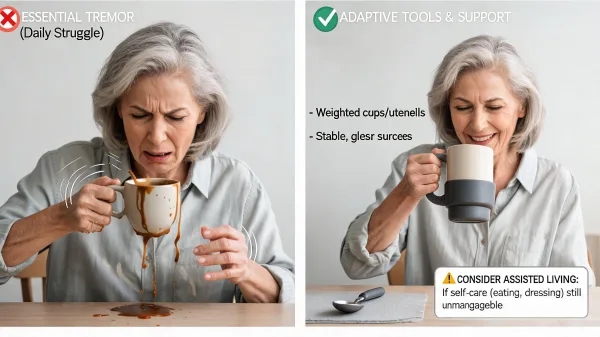
Adaptive equipment can make a real difference here. Weighted utensils (typically around 8 ounces each) help stabilize the hand by counteracting tremor movement. Weighted cups with wide bases reduce spills. Plate guards create a raised edge so food can be scooped onto a fork without sliding off the plate. Swivel spoons use a self-leveling mechanism that keeps the bowl of the spoon horizontal regardless of hand movement. These aren't luxury items. A set of weighted utensils costs $20 to $40, and they can mean the difference between a parent who eats a full meal and one who picks at food and gives up. In a care community, the best approach combines adaptive tools with unhurried dining. Staff who understand essential tremor give residents extra time, serve foods that are easier to manage, and never rush or draw attention to spills.
I spent a decade running a daycare where kids had different abilities and different needs at the table. Some needed special cups. Some needed more time. What I learned during those years is that mealtime dignity has nothing to do with speed or neatness. It's about patience, the right tools, and an environment where nobody feels judged for how they eat. That philosophy applies directly to seniors with essential tremor. A dining room where staff hover impatiently or clear plates too quickly sends a message: you're a problem to manage. A dining room where adaptive utensils are set out without fanfare and staff sit with residents who need encouragement sends a completely different message. The right care community understands that difference.
Writing and Fine Motor Tasks
Essential tremor often makes handwriting illegible. Your parent may struggle to sign checks, fill out medical forms, or write birthday cards. Weighted pens and ergonomic grips help some people, but for many seniors with advanced tremor, writing by hand becomes impractical. This loss matters more than families realize. Signing documents, managing finances, and even jotting a grocery list are tied to independence and identity. When those abilities slip away, seniors can feel stripped of control over their own lives. Technology can help fill part of this gap. Voice-to-text software, digital signatures, and tablet apps reduce the need for handwriting. But not every senior is comfortable with technology, and some tasks (signing legal documents, for example) still carry emotional weight that a digital workaround doesn't fully address.
Dressing and Personal Hygiene
Buttoning a shirt, zipping a jacket, clasping a necklace: these fine motor tasks require the precise hand control that essential tremor takes away. Many seniors quietly switch to elastic-waist pants and pullover tops long before they tell anyone they're struggling. Personal hygiene tasks present similar challenges. Brushing teeth with a shaking hand, shaving without nicking your skin, and applying makeup all require steadiness that the tremor won't allow. Adaptive aids like button hooks, electric razors, and pump-style soap dispensers can help, but the emotional toll of needing these workarounds shouldn't be minimized. Your parent may feel a deep sense of loss when they can no longer do things they've done independently for 70 or 80 years. That grief is valid.
What Families Often Underestimate: The Social Cost of Essential Tremor
Families tend to focus on the physical symptoms because the shaking is visible. But what often causes the most damage is something you can't see: the slow withdrawal from social life. Your parent stops going to restaurants because they're afraid of spilling in public. They skip the church potluck because eating in front of others feels humiliating. They stop hosting holiday meals because their hands shake too much to serve food. Over weeks and months, the world gets smaller. Meals happen alone. Invitations get declined. The tremor didn't just take away steady hands. It took away connection.
Consider a parent who used to eat dinner with the family every Sunday. They start making excuses: they already ate, they're not feeling well, they'll come next time. Eventually, the invitations slow down. The adult child might think their parent is just getting older and less social. What they don't realize is that the parent is too embarrassed to eat in front of anyone because their fork shakes so badly that food falls off before it reaches their mouth. That isolation compounds. Seniors who eat alone tend to eat less, and the nutritional decline accelerates other health problems. I've watched this pattern from inside the healthcare system, and families are almost always surprised when I point out that the social withdrawal and the weight loss are connected to the tremor, not just to aging.
Medication: What Helps and What Doesn't in Older Adults
The two first-line medications for essential tremor are propranolol (a beta-blocker) and primidone (an anticonvulsant). Both can reduce tremor amplitude by roughly 50% in some patients, but neither works for everyone. Studies show that 25% to 55% of patients don't respond to these medications at all, and the response tends to diminish over time as tolerance builds. Stress, fatigue, and caffeine can all make tremor worse, which means a parent's shaking may look dramatically different from one day to the next depending on how they're feeling.
For older adults, medication choices get more complicated. Propranolol can lower blood pressure and heart rate, which is risky for seniors who already take cardiac medications or have respiratory conditions like COPD. Primidone may be better tolerated in older patients, but it can cause sedation, dizziness, and cognitive effects that raise fall risk. A parent who trades tremor for drowsiness and unsteadiness hasn't gained much. I've seen older patients in the hospital come in with injuries from falls, and their medication list includes primidone or propranolol for tremor. The tremor medication may have reduced the shaking, but the side effects created a new set of problems. It's a tradeoff that families and doctors have to weigh carefully with each individual patient. This is why medication alone rarely solves the problem for elderly patients with essential tremor. The best outcomes usually combine medication (when tolerated) with adaptive equipment, environmental modifications, and a care setting that accounts for what medication can't fix.
When Essential Tremor Points Toward Assisted Living
Not every senior with essential tremor needs a care community. Mild tremor that responds well to medication can be managed at home with adaptive tools and occasional help. But there are clear signals that the current living situation isn't working anymore. Weight loss from difficulty eating is one of the biggest red flags. If your parent is losing weight because meals have become too hard, that's a safety issue, not a convenience issue.
Other signs include burns or cuts from cooking with unsteady hands, medication errors from difficulty opening bottles or handling pills, and increasing social isolation. When your parent's daily routine has narrowed to what their tremor allows, rather than what they actually want to do, it's time to explore options. The goal isn't to take independence away. It's to create an environment where more independence is possible, not less.
Having that conversation with your parent can feel difficult, and many adult children avoid it because they don't want to imply their parent can't manage. Try framing it around what your parent is missing rather than what they can't do. "I've noticed you don't come to Sunday dinners anymore, and I miss you there" opens a different door than "I think you need help eating." Most parents know they're struggling. What they need is permission to accept support without feeling like they've failed.
What to Look for in a Tremor-Friendly Care Community
Not all assisted living communities are equipped to support residents with significant essential tremor. When you visit, pay attention to the dining experience first. Ask whether the community provides adaptive utensils and non-slip dinnerware. Watch how staff interact with residents who eat slowly. Are they patient, or do they rush through meals to stay on schedule? The dining room culture tells you more about a community's values than any brochure will. During my years doing mobile X-ray work in care facilities, I could tell within minutes whether a building was a place where residents were treated with patience or where they were processed through routines. The difference showed up most clearly at mealtimes.
Ask about occupational therapy access, either on-site or through partnerships. An OT can assess your parent's specific limitations and recommend the right combination of adaptive tools and techniques. Look for communities that offer flexible dining times rather than rigid meal schedules, since rushing a resident with essential tremor defeats the purpose of mealtime support. Activities programming matters too. Your parent needs opportunities to stay socially engaged in ways that don't center on fine motor tasks they can no longer do comfortably. A good community adapts activities to residents' abilities rather than expecting residents to adapt to a fixed program.
Understanding the Cost of Tremor-Related Care
Assisted living costs vary widely, but the national median sits around $6,200 per month as of 2025, according to the CareScout Cost of Care Survey. That comes to roughly $74,400 per year. If your parent needs additional personal care services beyond the base rate (help with dressing, meal support, medication management), expect a higher tier that can add $500 to $1,500 per month depending on the community's pricing model.
Most families pay for assisted living through a combination of personal savings, long-term care insurance (if they have it), and sometimes VA benefits for eligible veterans. Medicare doesn't cover assisted living, and Medicaid coverage varies by state through waiver programs. The financial math is worth doing early. A two-year stay at the national median rate adds up to nearly $150,000 before any add-on care charges. Waiting until a crisis forces the move almost always limits your options and increases stress. Start researching costs in your area now, even if a move feels far off. Ask communities specifically how they handle residents who need extra mealtime assistance, and whether that support is included in the base rate or billed as an additional service.
Giving Your Parent Back What the Tremor Took
Essential tremor is frustrating, exhausting, and isolating in ways that families don't always see until the damage is already done. The shaking is the visible part. The lost meals, the skipped gatherings, the quiet humiliation at the dinner table: those are the parts that shrink your parent's world.
But that world doesn't have to keep shrinking. The right adaptive tools can make eating possible again. The right care environment can make meals social again. And the right community can give your parent back the dignity that the tremor has been quietly stealing. You don't have to solve this all at once. Start by watching your parent eat a meal and really paying attention to what's hard for them. Ask what they've stopped doing and why. The answers will tell you where to begin.
Your parent deserves to eat without apology, dress without frustration, and spend time with people who don't make them feel self-conscious about something they can't control. That's not too much to ask. It's the baseline of good care.