
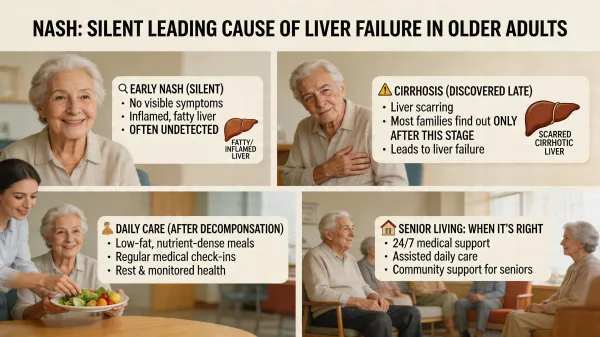
Fatty liver disease has quietly become one of the most common causes of liver failure in the United States, and most families don't find out their parent has it until it's too far along to reverse. By the time symptoms show up, the liver is often already scarred beyond repair. If your parent has just been diagnosed with advanced NASH or NASH-related cirrhosis, you're likely reeling from a diagnosis you didn't see coming, because there was nothing obvious to see.
NASH stands for non-alcoholic steatohepatitis. It's the inflammatory form of fatty liver disease, and in 2023 the medical community renamed it MASH (metabolic dysfunction-associated steatohepatitis) to better reflect what causes it. You'll still see both terms used, sometimes interchangeably, in hospital charts and discharge paperwork.
This article walks through how NASH progresses from a silent metabolic condition into the kind of organ failure that reshapes senior living decisions. You'll learn why the disease hides for decades, what daily care looks like once cirrhosis sets in, and when home care typically stops being enough. The goal is to give you a clear picture of what you're actually dealing with, so you can make decisions from a place of understanding instead of panic.
What NASH Is and Why Most Families Haven't Heard of It
NASH is a liver condition in which excess fat triggers chronic inflammation and scarring. It develops without alcohol as a cause, which is why the name specifically excludes it. Roughly 1.5% to 6.5% of American adults have NASH, and the number is climbing fast alongside obesity and type 2 diabetes rates.
Most families have never heard of it because, until recently, doctors rarely screened for it. NASH doesn't produce chest pain or a lump you can feel. It produces slightly abnormal liver enzymes on a blood panel, which most primary care offices wouldn't flag as urgent. In my years in hospital radiology, I've seen NASH show up on abdominal imaging ordered for something unrelated, long before anyone suspected the liver was in trouble.
The word "fatty" also makes the condition sound mild, almost harmless. It isn't. Once inflammation becomes steady scarring, the clock is ticking. The fact that your parent isn't yellow, doesn't look sick, and has no obvious symptoms doesn't mean the liver is healthy. It often means the disease is doing exactly what it does best: progressing quietly.
From Fatty Liver to Liver Failure: How NASH Progresses Silently
NASH sits on a spectrum of liver conditions. At the earliest stage, the liver simply accumulates fat (steatosis), which is extremely common and usually causes no harm. Roughly 25% to 38% of American adults have some degree of fatty liver. The majority will never progress past that stage. For a subset of people, though, that stored fat begins to trigger inflammation, and that's the point at which simple fatty liver becomes NASH.
Inflammation damages liver cells. The body responds with scar tissue, a process called fibrosis, which is graded in stages from F1 (mild) through F4 (cirrhosis). Early fibrosis doesn't cause symptoms and usually isn't detected unless someone specifically looks for it with imaging, elastography, or biopsy. Your parent can move from F1 to F3 over a decade or longer without a single noticeable change. This is why screening matters, and why so many families discover NASH only after cirrhosis is already in place.
Cirrhosis itself has two phases. Compensated cirrhosis means the liver is heavily scarred but still doing enough of its job to keep the body running, and people at this stage may still feel fine or notice only vague symptoms like fatigue. Decompensated cirrhosis is when the liver can no longer keep up with the body's demands. That's when ascites (fluid buildup in the abdomen), hepatic encephalopathy (brain dysfunction from toxin buildup), variceal bleeding from swollen veins in the esophagus or stomach, and other serious complications start showing up. The shift from compensated to decompensated cirrhosis is the inflection point that changes everything about care planning. Median survival drops from more than 12 years to around 2 years once decompensation occurs, according to long-standing research summarized by the American Association for the Study of Liver Diseases. An infection, dehydration, constipation, a new medication, or a GI bleed can all trigger the transition, and once it happens, the road back to compensated status is rarely a straight line.
What families often underestimate is this: once decompensation hits, the daily care needs for NASH cirrhosis look identical to alcohol-related cirrhosis. The same low-sodium diet, the same lactulose regimen, the same risk of hepatic encephalopathy, the same need for constant monitoring. Families feel guilty for not catching it earlier. But NASH is typically asymptomatic until advanced stages, and there's no reliable early-warning symptom that would have told you to push for liver testing years ago. The guilt is understandable and also misplaced.
During the years I spent doing mobile X-ray work in nursing and rest homes, one thing that stayed with me was how often metabolic conditions went unmonitored. Staff focused on the problems they could see: a pressure sore, a fall, an infection. Silent diseases like fatty liver, pre-diabetes, and undiagnosed cirrhosis kept progressing in the background because they didn't cause visible symptoms. That quiet deterioration is exactly why so many NASH cases are discovered late, and it's also why metabolic screening in aging parents matters so much more than most families realize.
The metabolic syndrome connection is the heart of why NASH happens at all. Insulin resistance, type 2 diabetes, high cholesterol, central obesity, and high blood pressure cluster together and drive fat accumulation in the liver. Roughly 65% of people with type 2 diabetes have some form of fatty liver disease, according to research published in recent hepatology literature. Your parent didn't have to be a heavy drinker to end up with cirrhosis. They just had to live with the metabolic conditions that quietly wore down their liver over two or three decades.
Daily Care Requirements for Advanced NASH
Once NASH progresses to decompensated cirrhosis, daily care becomes structured around preventing complications. The core elements are diet, medications, fluid management, and monitoring.
Sodium restriction sits at the top of the list. Most specialists recommend keeping sodium under 2,000 milligrams per day to reduce ascites and swelling. That sounds doable until you realize most processed foods, restaurant meals, deli meats, canned soups, and even bread contain hidden sodium. Someone has to cook most meals from scratch, read every label, and track intake.
Medication management gets complicated quickly. Lactulose is a syrup taken multiple times daily to reduce ammonia buildup in the blood, and the dose isn't a fixed prescription. It's adjusted based on how many bowel movements your parent has, with the target typically two to three soft stools per day. Too few stools and toxins build back up, triggering confusion. Too many and dehydration can tip them into an encephalopathy episode from a different direction. Diuretics like spironolactone and furosemide manage fluid and require close monitoring of electrolytes, kidney function, and daily weight. Some patients add rifaximin, an antibiotic that works in the gut to further reduce encephalopathy episodes. NSAIDs like ibuprofen and naproxen have to be avoided because they can trigger kidney injury in cirrhotic patients, and that rules out most over-the-counter pain relievers families reach for without thinking. Acetaminophen at low doses is usually the preferred option, but the total daily limit is lower than what healthy adults tolerate.
Protein intake actually needs to stay adequate (not restricted, which is a common mistake some well-meaning relatives make) to prevent muscle wasting. Weight, abdominal size, mental status, and stool patterns all need daily attention. In my experience, the families who do best have one person clearly designated as the medication manager, rather than splitting the responsibility across several people who each think the other is tracking it. Missed doses or a few days of poor eating can tip a stable patient into a crisis.
How Hepatic Encephalopathy Changes Daily Life
Hepatic encephalopathy (HE) is the complication that most often pushes NASH families toward higher levels of care. When the liver can no longer clear ammonia and other toxins, those substances reach the brain and cause cognitive changes. About 70% of people with cirrhosis develop some form of HE during their illness, according to the American Liver Foundation.
Minimal HE can look like forgetfulness, poor concentration, sleep-wake reversal, or subtle personality changes. Families often chalk it up to normal aging. Overt HE brings confusion, disorientation, slurred speech, and a distinctive hand tremor called asterixis. Severe episodes can progress to coma. Falls are more common because HE affects coordination, and older adults with cirrhosis have been shown to have higher rates of frailty, sarcopenia, and hospitalization.
In the ER, I've seen families bring in a parent they thought was having a stroke, only to learn it was an HE episode triggered by constipation or dehydration. The symptoms come on fast and can reverse just as quickly with the right treatment, but they're frightening to witness and easy to misread. What makes HE especially tricky in senior care settings is that it mimics dementia closely enough that staff who aren't familiar with liver disease can miss it, and the window to correct a flare before it escalates is sometimes only hours.
When NASH Makes Home Care Unsustainable
Home care usually stops being enough when a few things start happening together. Hepatic encephalopathy episodes become more frequent or harder to manage. Ascites requires repeated drainage procedures (paracentesis) at the hospital. Medication management becomes too complex for an aging spouse to track reliably. Falls increase. Confusion makes your parent unsafe alone, even briefly.
Consider a situation where your parent who was never a heavy drinker is diagnosed with NASH cirrhosis at age 78. For a year, they manage at home with a spouse helping. Then a bout of HE lands them in the hospital. They return home, and a few weeks later it happens again, this time triggered by a missed lactulose dose. Each episode chips away at cognition. The spouse, exhausted, starts missing their own medications. At that point, home isn't safe anymore.
Families often find the turning point isn't a single dramatic event but a pattern: two or three hospital admissions in six months, growing confusion between episodes, or a caregiver at the end of their capacity. I've watched spouses try to hold the line for as long as they can, and I can tell you the moment they stop eating and sleeping normally themselves, home care is already past its limit. When that pattern shows up, it's time to consider higher levels of care.
Evaluating Senior Living Communities for NASH Care
NASH at the decompensated stage requires more than standard assisted living. Your parent needs a community equipped to handle medical complexity, dietary restrictions, and cognitive fluctuations. The level of care depends on where your parent is on the disease trajectory.
Assisted living may work for someone with compensated cirrhosis who still manages most activities of daily living and hasn't had serious complications. Staff can help with medication reminders, meal modifications, and transportation to specialist appointments. Once decompensation begins, especially with recurring HE, most assisted living communities aren't staffed to monitor the cognitive changes that come and go throughout the day.
Memory care is sometimes a fit when HE has caused persistent cognitive decline that looks like dementia. Staff are trained for the confusion, wandering, and behavior changes that HE can produce, and the secured environment keeps a disoriented parent safe. Skilled nursing is appropriate for patients with frequent decompensations, feeding tube needs, or end-stage disease. When you tour a community, ask specifically whether they've managed cirrhosis before, how they handle lactulose titration and sodium-restricted meals, whether their kitchen can consistently keep meals under 2,000 milligrams of sodium per day, and how they coordinate with an outside hepatologist. Also ask how they respond when a resident shows sudden confusion, because an HE episode can look like a stroke or a UTI, and the treatment approach differs. A community that can't answer these questions clearly probably isn't equipped for the level of complexity NASH brings.
Costs and Financial Realities of NASH Care
Costs vary by care level and location. As of 2025, national median figures from long-term care surveys put assisted living around $5,900 per month, memory care closer to $7,500 monthly, and skilled nursing over $9,700 for a semi-private room. Annually, that's roughly $71,000 for assisted living, $90,000 for memory care, and well over $116,000 for nursing home care. Those figures don't include the specialist co-pays, transportation for paracentesis appointments, or the ongoing cost of medications like rifaximin, which can run several hundred dollars a month depending on insurance coverage.
Medicare covers hospital stays, specialist visits, and short-term skilled nursing after a qualifying hospitalization, but it doesn't pay for long-term residential care. Medicaid covers long-term nursing home care for those who qualify financially, and each state has its own income and asset rules. Some NASH patients on a transplant list will face additional travel, lodging, and medication costs that add up quickly. Veterans may have access to VA Aid and Attendance benefits if they qualify. A long-term care insurance policy purchased years earlier can help, but most families discover they either don't have one or the coverage is thinner than they remembered.
Questions Families Frequently Ask
"Can NASH be reversed at this stage?" Once fibrosis has progressed to cirrhosis, reversal is unlikely, though the first FDA-approved NASH treatment (resmetirom) was approved in 2024 and more therapies are in development. The realistic goal at advanced stages is slowing progression and managing complications.
"Why didn't anyone catch this earlier?" Because NASH typically produces no symptoms until advanced stages, and routine bloodwork often shows only mildly elevated liver enzymes that primary care may not investigate further. Screening practices are changing, but your parent's care reflected the standards in place when they were being seen.
"Is a liver transplant an option?" Age, comorbidities like heart disease and kidney function, and overall frailty factor heavily into transplant eligibility. Many older adults with NASH cirrhosis aren't candidates because the surgery is too risky or the recovery too demanding, but hepatologists make that determination individually, not by age alone. A transplant evaluation is worth asking about if your parent is otherwise in reasonable health, and some transplant centers are more willing to consider older patients than others. The evaluation itself involves extensive testing and takes months.
"How long does someone with decompensated NASH live?" The honest answer is that it depends on the specific complications, how well they respond to treatment, and overall health. Research puts median survival around two years once decompensation occurs, though many patients live longer with good care and some decline faster than expected.
What to Take From an Advanced NASH Diagnosis
A NASH diagnosis at an advanced stage rearranges the family's whole understanding of what's next. The disease that caused it didn't look like a disease for years. There was nothing obvious to catch, no clear warning, no single decision that would have changed the outcome. That's worth sitting with, because the guilt that comes with a late diagnosis can keep families stuck when they need to be planning.
The decisions ahead are practical ones. What level of care does your parent need now, and what will they likely need in six months? Who's handling the medication schedule? Is the home environment still safe? Is the primary caregiver holding up, or running on empty? These are the questions that move a family forward.
Take the diagnosis seriously, but don't let it paralyze you. NASH has gotten much more attention in the last few years, and care standards are improving. Whatever you're facing right now, you're not the first family to face it, and the right combination of medical care, dietary support, and senior living placement can give your parent stability and comfort. One step at a time is enough.