
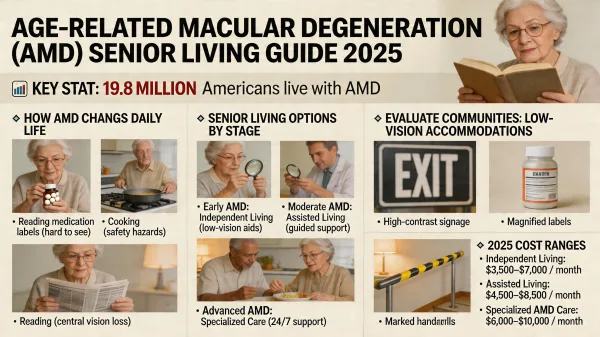
About 19.8 million Americans are living with some form of age-related macular degeneration, and prevalence climbs sharply with age, reaching nearly half of all adults over 85. For families watching a parent lose central vision, those numbers aren't abstract. They describe a parent who can't read prescription bottles, who stops recognizing faces in family photos, who stands at the stove unsure whether the burner is on.
I've spent nearly 20 years working inside hospitals, including shifts in the ER and Orthopedics where falls tied to poor vision are a regular part of the workload. The pattern I see over and over: a parent's vision has been declining quietly for years, and the family only realizes how unsafe home has become after something goes wrong. A burn. A missed medication. A fall that turns into a hip fracture.
Macular degeneration is different from other drivers behind senior living placement because it rarely presents as a single crisis. Central vision fades, peripheral vision stays intact, and parents often compensate by memorizing their environment and relying on habit. That compensation works until it doesn't. When it breaks down, families are usually making decisions about senior living quickly, and they're doing it without knowing which communities are actually equipped for low-vision residents and which just claim to be.
This guide covers what macular degeneration does to daily life, how to tell when living alone is no longer safe, what senior living options fit different stages of vision loss, how to evaluate a community through a low-vision lens, and what the financial picture looks like in 2025.
What Is Macular Degeneration?
Macular degeneration is a progressive eye disease that damages the macula, the central part of the retina responsible for sharp, detailed vision. It causes loss of central vision while peripheral vision usually remains intact, making tasks like reading, recognizing faces, and driving increasingly difficult.
There are two forms. Dry AMD accounts for 80 to 90 percent of cases and progresses gradually over years. Wet AMD, the less common form, involves abnormal blood vessel growth under the retina and can cause sudden, severe vision loss within weeks if untreated. Any stage of dry AMD can convert to wet AMD, and about 10 to 15 percent of dry AMD cases eventually do.
The condition is the leading cause of vision loss in Americans 65 and older. The National Eye Institute and CDC estimate that AMD affects about 1.49 million Americans at the vision-threatening late stage, with roughly 10 percent of adults 65 and older carrying a diagnosis.
Because AMD doesn't cause total blindness, families sometimes underestimate how disabling it becomes. A parent can still walk and talk and think clearly but can no longer read a pill bottle, see facial expressions across a table, or tell whether the front burner is lit. That's the gap that makes this condition so specifically dangerous for seniors living alone.
Wet vs. Dry AMD: Two Very Different Timelines
The difference between wet and dry AMD matters enormously for senior living planning, because the two forms follow very different trajectories.
Dry AMD progresses in three stages: early, intermediate, and late. The typical path from diagnosis to meaningful vision impairment spans five to ten years, though some people stay in early or intermediate stages indefinitely without significant vision changes. This slow trajectory gives families time to plan. You can introduce low-vision aids, modify the home environment, and evaluate senior living options while your parent still has usable vision.
Wet AMD is different. When abnormal blood vessels grow beneath the retina and leak fluid or blood, central vision can be damaged within days to weeks. Anti-VEGF injections can preserve remaining vision in many cases, but they require monthly or bimonthly office visits indefinitely, and any delay in treatment can cost vision permanently.
Some families are caught off guard by wet AMD. A parent who'd been managing reasonably well with dry AMD suddenly can't read at all, and what had been a gradual decline becomes an emergency. That compressed timeline is when senior living conversations turn urgent.
It's also common for AMD to affect each eye differently. One eye may have advanced wet AMD while the other still has good central vision, or both eyes may be at different stages. Parents sometimes don't realize how much vision they've lost because their stronger eye compensates. An eye exam can quantify what's actually happening in each eye, which matters when you're assessing whether independent living is still safe.
How Macular Degeneration Changes Daily Life: The ADLs Vision Steals
Central vision is what your parent uses for almost every important daily task, and losing it affects far more of daily life than most families initially grasp.
Reading and Information Access
The first task to go is usually reading. Mail, medication labels, thermostats, microwave buttons, appointment reminders, and phone screens all require central vision. A parent who used to read the newspaper with breakfast loses that routine. Bills pile up because addresses and amounts are unreadable. Medical instructions can't be followed because the print is too small to decipher even with reading glasses.
Cooking and Kitchen Safety
Kitchen tasks become dangerous. Your parent can't tell whether a burner is on, whether food is cooked through, or whether they grabbed salt or sugar. Oven temperatures become a guessing game. Knife work gets riskier. Families often notice this shift when they find a pan left on a cool burner, scorch marks on pot handles, or evidence of a small fire that was caught in time.
Medication Management
Medication management is where the safety picture turns urgent. Prescription bottle labels are impossible to read without magnification. Pills of similar shape and color become indistinguishable. A parent taking multiple medications can easily double-dose blood pressure medication while missing a diabetes pill. This is often the point where adult children realize vision loss has crossed from inconvenience into active hazard.
Facial Recognition and Social Connection
What most people don't realize until they're in it is how isolating vision loss becomes. Your parent can't see the faces of visitors clearly. They stop recognizing grandchildren in photos. Social visits become less satisfying because expressions, smiles, and subtle reactions disappear. Television and streaming content lose much of their value because facial details are gone. Reading, which for many seniors was a primary source of mental engagement, stops being possible. That combination of lost connection and lost stimulation accelerates cognitive and emotional decline. Research has linked vision impairment to higher rates of depression, social isolation, and cognitive decline in older adults.
When I helped family through our own dementia journey, I watched how quickly independence can unravel once one major input, whether memory or vision, starts to fail. Vision loss moves slower than cognitive decline in many cases, but the end result, loss of autonomy, is similar.
Driving and Mobility
Driving usually ends earlier than families expect with AMD. Most states require 20/40 vision or better for an unrestricted license, and AMD commonly drops central acuity well below that threshold. The loss of driving privileges alone can trigger a senior living conversation, because a parent who can no longer drive also can't easily get to medical appointments, grocery stores, or social activities.
Financial Management
Financial tasks quietly become impossible. Checkbook registers, bank statements, bill stubs, and credit card receipts all rely on small print and legible numbers. Parents may start relying on memory alone for balances, or they may stop opening mail because reading it feels futile. Late payments and missed bills are often the first external sign a family notices that something has shifted.
Increased Fall Risk
The fall risk is substantial. CDC data shows adults 65 and older with severe vision impairment are nearly twice as likely to fall as their peers with normal vision, with about 47 percent reporting a fall in the previous year compared to 28 percent of those without severe vision impairment. Poor contrast sensitivity, which AMD affects directly, is an independent predictor of falls even when visual acuity measurements look acceptable.
When Vision Loss Makes Living Alone Unsafe
Families often ask how to tell when vision loss has crossed the line from manageable to unsafe. The honest answer is that the line varies by parent, by home, and by support system, but specific patterns signal the threshold has been reached.
Consider a situation where a parent with wet AMD can no longer read medication labels or see the stove burner clearly, and has started confusing pills between bottles. The vision loss itself may have progressed gradually, but the safety picture shifts quickly once medication errors and kitchen hazards enter the picture. That combination, impaired vision plus daily exposure to medication errors, falls, and cooking risks, is the signal families need to act on.
In the ER, vision-related falls are one of the most common admissions I see for adults over 75. Most of them happen at home, in a hallway or bathroom the patient could have walked through in their sleep five years earlier.
Common markers that living alone is no longer safe include a recent fall, especially one that caused injury or required medical attention (falls are the single strongest predictor of future falls, and vision-related falls tend to recur), medication errors that have actually happened rather than hypothetical ones, evidence of kitchen close calls like scorched pans or unexplained burns, weight loss that often traces back to your parent giving up on cooking, bills and mail piling up or missed medical appointments, and isolation markers like your parent pulling back from activities and friends because they can't read contact information or see screens.
Any one of these can usually be addressed with home modifications and support services. When three or more cluster together, the home environment has stopped working for your parent's vision level.
Senior Living Options for a Parent with AMD
Choosing a senior living setting for a parent with macular degeneration depends on where they fall on the vision loss trajectory and whether other conditions are also in play.
Independent Living
Independent living communities can work well for parents in early or intermediate AMD who still have usable central vision, particularly those with good contrast sensitivity and no significant cognitive issues. Meals, housekeeping, and transportation are typically included, which removes several of the most vision-dependent daily tasks.
Assisted Living
Assisted living is the most common placement for parents whose AMD has reached a stage where ADLs, particularly medication management and kitchen safety, have become unsafe. Staff administer medications, meals are prepared by the community, and help with bathing and dressing is available when needed. For many families, this is the setting that buys back independence by removing the specific tasks that vision loss has compromised.
Memory Care
Memory care is appropriate only if your parent has co-occurring dementia, not for AMD alone. Low-vision residents with intact cognition don't belong in memory care environments, which are designed for people whose primary challenge is cognitive rather than sensory. Some families assume memory care is the next step after assisted living regardless of the reason, but for AMD without dementia, this would be over-placement and usually leaves parents frustrated by the pace and structure of a memory care setting.
Skilled Nursing
Skilled nursing facilities are reserved for seniors with complex medical needs beyond what assisted living can handle. Vision loss by itself rarely requires this level of care, though a parent with AMD plus significant mobility limits, chronic wound care, or post-surgical recovery might need skilled nursing temporarily.
For most families, the central question is whether assisted living is the right fit, and whether the specific community they're considering has actually adapted for low-vision residents.
Evaluating a Community Through a Low-Vision Lens
Most assisted living communities claim to serve residents with vision impairment. Far fewer have actually adapted their environment, training, and technology for low-vision residents. The difference becomes obvious within the first 20 minutes of a serious tour.
Years ago, doing mobile X-ray work in rest homes and nursing facilities, I walked into rooms where the overhead lighting wasn't bright enough to read by, where signage near the elevators used small gray print on cream-colored walls, and where the only magnifying aid available was a handheld lens sitting forgotten in a drawer because staff didn't know where it was. Residents who'd been told during the tour that the community "fully accommodated" low vision were actually pushing through their day with no tools, no training, and no thought given to what the environment looked like through their eyes. The gap between how these places were marketed to families and what I saw inside was wide. That experience is exactly why families need to evaluate vision-specific accommodations separately from general care quality. A community can score well on staffing, food, and activities and still fail a low-vision resident badly on the details that matter most.
Lighting Quality and Adjustability
Ambient lighting for low-vision residents should reach around 300 lux in common areas, with task lighting capable of much higher illumination, up to 2,000 or 3,000 lux for reading. Tour the community and look at hallways, dining areas, and resident rooms. Are light levels consistent, or do you hit dim stretches? Can residents adjust lighting at their own seating and reading areas? Does the dining room have glare-free task lighting at individual tables? A community that hasn't thought about low-vision lighting will feel subtly dim for the whole tour.
Contrast Design
Look at edges and thresholds. Stair nosings should contrast with stair treads. Door frames should contrast with walls. Plates and tablecloths should contrast with food and the dining surface. Grab bars should contrast with bathroom walls. These aren't decorative choices. They're functional accessibility, and communities that understand low vision build contrast into the environment deliberately.
Large-Print Resources
Ask to see the monthly activities calendar in large print. Ask whether menus, newsletters, and resident handbooks come in large-print or audio versions. Communities that serve low-vision residents well produce these materials as a matter of course. Communities that don't will scramble to find you a printed page that meets your request.
Low-Vision Technology Access
Ask what magnification tools, screen readers, and adaptive technology residents have access to. Some well-equipped communities maintain a low-vision area with CCTV magnifiers, talking book players, and adjustable-contrast tablets. Many communities have none of this. Also ask whether staff are trained to help residents set up accessibility features on personal phones and tablets, which matters because your parent likely already owns devices that can help.
Staff Communication Approaches
Staff who work well with low-vision residents identify themselves by name when entering a room, describe food on a plate using a clock-face reference, and explain changes to room layout before making them. Ask the executive director how staff are trained in low-vision communication, and listen for a specific answer rather than a general reassurance about person-centered care.
Adaptive Technology That Supports Low-Vision Residents
Low-vision adaptive technology has advanced quickly. Your parent doesn't need to lose access to reading, communication, and entertainment just because central vision is gone. The key is whether the community supports these tools and helps residents use them.
Magnification Tools
Handheld magnifiers with built-in lighting remain useful for quick tasks like reading mail or checking pill bottles. Video magnifiers (sometimes called CCTVs) display magnified text on a screen and work well for longer reading. Smartphone magnifier apps can work as a pocket solution for grocery labels, restaurant menus, and medication bottles.
Audio Alternatives
Talking book players, available free through the Library of Congress National Library Service for the Blind, give low-vision readers access to thousands of titles on simple-to-use players. Audiobooks through commercial services work similarly. Smartphones and tablets include built-in text-to-speech that can read any document aloud.
Voice-Controlled Assistants
Voice-controlled devices like smart speakers can set medication reminders, play music, control lighting, check the weather, and answer basic questions without any reading required. For a parent with AMD, this category of technology genuinely restores daily function that vision loss took away.
Accessible Smartphones
iPhones and Android phones include accessibility features that many low-vision users don't know exist. Large text, screen magnification, high-contrast display modes, and VoiceOver or TalkBack screen readers can make a phone usable again. Communities that employ a staff member or volunteer who can help residents set up these features provide a service most families don't realize is available. The patience this takes isn't extraordinary, but it's specific. After running an in-home daycare for a decade, I can usually tell within a few minutes whether a caregiver is paying attention to nonverbal cues or going through the motions. Low-vision residents rely on that attention more than most.
VA Blind Rehabilitation Services
Veterans with vision loss from AMD qualify for VA Blind Rehabilitation Services at no cost, which provides low-vision aids, adaptive technology training, and in-home orientation support, regardless of whether the vision loss is service-connected. Any veteran enrolled in VA health care is eligible, and the VA operates 13 Blind Rehabilitation Centers, more than 20 low vision clinics, and a Blind TeleRehabilitation program for veterans who can't travel.
What Senior Living Costs for a Parent with Vision Loss
Senior living for a parent with macular degeneration costs about the same as for any other assisted living resident. The national median monthly cost for assisted living was $6,200 per month in 2025, or $74,400 annually, according to the CareScout Cost of Care Survey. That's up about 5 percent from 2024, when the national median was $5,900 per month, or $70,800 per year.
Costs vary widely by state. Families in Mississippi and South Dakota may see monthly rates closer to $4,400, while New Jersey and Massachusetts routinely run $8,500 or more per month.
Assisted living typically charges an additional care services fee on top of the base monthly rate based on the level of assistance a resident needs. For low-vision residents, this fee usually reflects medication administration (which most parents with AMD cannot safely manage themselves) and help with specific ADLs. Ask how much the care services fee adds to the base rate for a resident at your parent's level.
Memory care, which costs about 20 to 30 percent more than assisted living, is not appropriate for AMD without dementia. Paying a memory care premium for a cognitively intact parent is both unnecessary and often counterproductive.
What Medicare and Medicaid Cover
Medicare does not cover assisted living room and board, though it covers medical care delivered at the community like physician visits, certain therapies, and durable medical equipment. Medicaid coverage of assisted living varies by state through Home and Community-Based Services waivers, with waiting lists in many states.
VA Aid and Attendance
Eligible wartime veterans and surviving spouses with vision impairment can access VA Aid and Attendance benefits to help offset assisted living costs, and VA Blind Rehabilitation Services cover low-vision aids and training at no charge.
Questions to Ask Before Placing a Parent with AMD
A useful tour for a low-vision parent looks different from a standard tour. The questions below move past general quality markers and get at whether a specific community actually works for AMD residents.
On lighting and environment: What lux level do you maintain in resident rooms and common areas? Can residents adjust lighting at their own seating? Do stair edges, door frames, and bathroom fixtures use contrast design?
On materials: Do you produce the activity calendar, menu, and newsletter in large print or audio? Is the resident handbook available in an accessible format?
On technology: What magnification tools are available to residents? Where are they stored? Who helps residents use them? Does the community help residents set up accessibility features on personal phones and tablets?
On staff training: How are staff trained to communicate with low-vision residents? Can you give a specific example? How does dining staff describe menu items and food placement to low-vision diners?
On medications and safety: What is the protocol for medication administration for a resident who can't read labels? How does the community track and respond to fall incidents?
On specialist access: Does the community have established relationships with low-vision specialists, optometrists, and ophthalmologists? Are there transportation arrangements for anti-VEGF injection appointments, which are critical for wet AMD residents?
On activities: Which activities are actually accessible to low-vision residents? Visual-dependent activities like crafts, card games, and screen-based programs may need adaptation.
Getting specific answers to these questions separates communities that are truly equipped for low-vision residents from those that assume general care quality covers everything.
Putting It Together
Macular degeneration is one of the slowest-moving reasons families end up making senior living decisions, yet by the time the decision arrives, it can feel like there's no time at all. Your parent's independence has usually been eroding for years before a fall, a medication error, or a kitchen close call forces the issue.
Assisted living, when the community has actually adapted for low vision, can restore much of what AMD has taken away. Medications get managed. Meals are prepared safely. The building is built to work with impaired vision. Social contact becomes possible again because residents don't have to get themselves out of an inaccessible house to find it.
The hard part is finding a community that's truly equipped rather than one that only claims to be. Visit during different times of day. Ask specific questions. Trust your eyes when the lighting feels dim or the signage feels unreadable, because what you notice on a tour is what your parent will live with as a resident.
Vision loss is frightening for the person experiencing it and painful for the family watching. Getting the environment right won't reverse the condition, but it gives your parent back much of the daily life AMD has been taking away. That's worth the work.