
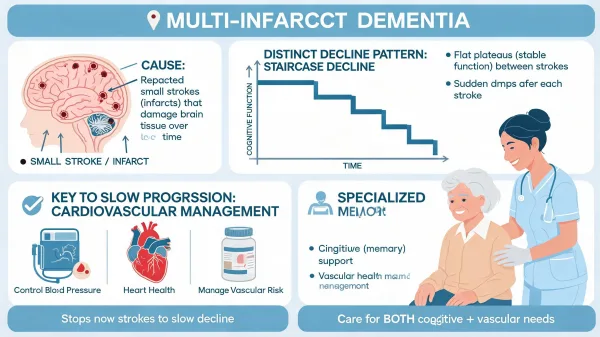
Multi-infarct dementia is a form of vascular dementia caused by multiple small strokes that accumulate over time, each one destroying a small area of brain tissue and gradually eroding memory, reasoning, and daily function. Unlike Alzheimer's disease, which develops through protein buildup in the brain, multi-infarct dementia results from repeated disruptions in blood flow that many families never see coming.
Here's the hard truth: your parent may have been having strokes for years without anyone knowing it. The memory lapses you noticed last Thanksgiving, the personality shifts your siblings have been arguing about, the confusion that seemed to appear out of nowhere and then partly resolve. Those weren't just aging. They may have been the visible effects of cumulative brain damage happening in real time, one small stroke after another, each one stealing a little more.
The medical term for these undetected events is "silent strokes," and research suggests they're far more common than most people realize. Studies show that 10% to 30% of healthy older adults have evidence of silent strokes on brain imaging, with the prevalence climbing to 30% or higher in adults over 70. For every stroke with obvious symptoms, an estimated ten more occur without any noticeable signs at all. By the time a pattern of cognitive decline becomes clear enough for the family to act, years of damage may have already accumulated.
I've watched this exact pattern in my own family, and the thing that haunts me is how long we attributed the changes to "just getting older." We lost time we didn't know we were losing. That experience is a big part of why I write about this topic with the urgency I do.
This article covers what multi-infarct dementia is, how its distinctive staircase pattern of decline differs from other forms of dementia, why cardiovascular management is central to care, and how to find a memory care facility equipped to handle both the cognitive and vascular sides of this condition. If your family is just starting to make sense of a new diagnosis, or if you've been managing it for a while and wondering whether the care your parent is getting is enough, this is the information you need.
What Is Multi-Infarct Dementia?
Multi-infarct dementia (MID) is a type of vascular dementia caused by a series of small strokes, each of which damages a portion of brain tissue. "Multi" means many, and "infarct" refers to an area of tissue death caused by blocked blood flow. Together, these repeated events produce a pattern of progressive cognitive decline that worsens with each new vascular event.
Vascular dementia as a whole is the second most common cause of dementia after Alzheimer's disease. According to the World Stroke Organization's 2026 fact sheet, pure vascular dementia accounts for roughly 15% of all dementia cases worldwide, with an additional 16% involving mixed vascular and neurodegenerative pathology. Multi-infarct dementia is the classic subtype within that category. Many people with MID also have some degree of mixed pathology, meaning the vascular damage coexists with early Alzheimer's changes or other neurodegenerative conditions. When both are present, the cognitive effects tend to be worse than either condition alone, and the clinical picture can be harder to sort out.
What makes MID different from Alzheimer's is both its cause and its trajectory. Alzheimer's involves a slow, steady decline driven by amyloid plaques and tau tangles inside the brain. Multi-infarct dementia follows a different path entirely. The decline isn't gradual. It happens in sudden drops, each one triggered by a new stroke event, followed by a period of relative stability before the next event hits. That pattern is the key to understanding everything else about this condition, from how it's diagnosed to how it's managed in a care setting.
The Step-Down Pattern: Understanding How Multi-Infarct Dementia Progresses
If you've been watching your parent's cognition change over months or years, you may have noticed something that didn't quite make sense. There were bad weeks followed by stretches where things seemed almost normal. Then another drop, sharper this time, and a new baseline that was clearly lower than before. This is the hallmark of multi-infarct dementia, and clinicians often describe it as a "staircase" pattern of decline.
Each step down on that staircase corresponds to a new stroke event. When blood flow to a section of the brain is interrupted, even briefly, the brain cells in that area are damaged or destroyed. The effects depend on where in the brain the stroke occurs. One event might affect word-finding ability. Another might impair short-term memory. A third could change personality or emotional regulation. The damage from each individual stroke may seem minor on its own, but the cumulative effect builds over time into what eventually looks like broad cognitive decline.
The plateau periods between strokes are what confuse families the most. After a noticeable decline, your parent might stabilize for weeks or even months. They may seem to improve slightly as the brain adapts to the damage. Families often interpret these stable periods as signs that whatever happened was temporary, or that the situation isn't as serious as they feared. It is serious. The plateau doesn't mean recovery. It means the brain is compensating for damage already done, and it will hold that ground only until the next vascular event.
I saw this with my own family member. There were stretches where we convinced ourselves things were getting better, that maybe we'd overreacted. Then another drop would come, sometimes overnight, and the new normal was noticeably worse than before. Each time, it took the whole family a few days to accept that the ground had shifted again. That cycle of hope and loss repeated itself more times than I can count, and it's one of the hardest parts of this disease for families to endure.
Recognizing transient ischemic attacks (TIAs) is critical because they're often the warning that more damage is coming. A TIA is sometimes called a "mini-stroke," and its symptoms, which can include sudden confusion, difficulty speaking, weakness on one side of the body, or vision changes, typically last only minutes to hours before resolving. Many people dismiss these episodes entirely. They assume their parent was just tired, dehydrated, or having an off day. But a TIA is a medical emergency. It means blood flow to the brain was temporarily blocked, and it sharply increases the risk of a full stroke in the following days and weeks.
The accumulating damage model is important for families to understand because it reframes how you think about treatment. With Alzheimer's, the focus is often on slowing progression through medication. With multi-infarct dementia, the most powerful intervention isn't a dementia drug. It's stroke prevention. Every stroke prevented is brain tissue saved. Every vascular risk factor controlled is another step down that doesn't happen. This is one of the few dementias where aggressive medical management of the underlying cause can genuinely change the trajectory. Not reverse it, but slow it in ways that matter. That distinction gives families something concrete to work toward, which is rare in dementia care.
The speed of this disease can vary enormously from person to person. Some people experience a slow accumulation of minor events over a decade. Others face rapid, clustered strokes that produce dramatic decline in a matter of months. The only reliable way to slow either pattern is to prevent the next stroke from happening.
Silent Strokes: The Hidden Cause Families Miss
What families often underestimate about multi-infarct dementia is how invisible most of the damage is while it's happening. The term "silent stroke" refers to a stroke that occurs without any symptoms the person or their family would recognize. There's no sudden weakness, no slurred speech, no facial drooping. The stroke happens, destroys a small area of brain tissue, and life continues as if nothing occurred. The only evidence shows up later on brain imaging.
The numbers on silent strokes are striking. Research from the Cardiovascular Health Study found that roughly 28% of adults over 65 had evidence of silent strokes on MRI, and most had no idea. The prevalence increases sharply with age and with cardiovascular risk factors like high blood pressure, diabetes, and atrial fibrillation. For people with high cardiovascular risk, the rate of silent stroke evidence on imaging can reach 30% to 50%.
Consider a situation where your parent is hospitalized after a noticeable stroke, perhaps some weakness on one side and slurred speech that brought the family to the emergency room. The MRI reveals the expected new stroke damage, but it also shows something else: evidence of multiple prior small strokes that nobody ever detected. The neurologist explains that the memory problems, the confusion, the personality changes you've been attributing to normal aging were actually the cumulative result of years of silent vascular events. That revelation hits hard. I've seen it catch families completely off guard, and the guilt that follows ("how did we miss this?") can be overwhelming. What I try to tell people is that you didn't miss it because you weren't paying attention. You missed it because the strokes themselves were invisible. The symptoms they produced looked exactly like what everyone expects aging to look like, and no one ordered the brain imaging that would have told a different story.
Risk Factors and Who Is Affected
The risk factors for multi-infarct dementia overlap almost entirely with the risk factors for stroke itself. High blood pressure is the single biggest contributor. Uncontrolled hypertension damages small blood vessels throughout the brain over time, making blockages more likely. Diabetes, high cholesterol, atrial fibrillation, smoking, and obesity all compound the risk. Atrial fibrillation deserves special attention because the irregular heartbeat can cause blood clots to form in the heart, which then travel to the brain and cause strokes. Many older adults don't know they have atrial fibrillation until a stroke occurs. A history of prior stroke or TIA significantly increases the odds, and research published in Neurology in 2024 found that stroke survivors face an 80% higher risk of developing dementia even after accounting for other contributing factors.
Age is a factor, with risk increasing after 65, but multi-infarct dementia isn't exclusive to the very old. People in their 50s and 60s with poorly managed cardiovascular conditions can develop it. The 2024 Lancet Commission on dementia identified 14 modifiable risk factors that together account for up to 45% of dementia risk globally, and the majority of those factors are cardiovascular in nature. African Americans and women face somewhat higher rates of silent strokes, which contributes to disparities in multi-infarct dementia prevalence. That's a powerful message for families: many of the conditions that lead to multi-infarct dementia are treatable, and managing them aggressively can reduce the risk of further decline even after a diagnosis.
How Multi-Infarct Dementia Is Diagnosed
Diagnosis typically involves brain imaging (MRI or CT scan), a neurological examination, and a detailed cognitive assessment. The imaging is what confirms the diagnosis. An MRI will show multiple areas of damaged brain tissue, often in different locations, consistent with strokes that occurred at different times. The pattern of damage, scattered across the brain rather than concentrated in the regions Alzheimer's typically affects first, helps distinguish MID from other dementias. CT scans can also detect larger infarcts, though MRI is more sensitive for picking up smaller, older lesions that might otherwise go unnoticed. Blood tests and cardiac evaluations are often ordered alongside the imaging to identify the vascular risk factors driving the strokes.
Doctors also look at the timeline of symptoms. The characteristic step-down pattern, where cognitive changes happened in sudden episodes rather than a slow fade, is a strong clinical signal. A history of known strokes, TIAs, or significant cardiovascular disease strengthens the diagnosis. Cognitive testing often reveals a pattern where some abilities are sharply impaired while others remain relatively intact, reflecting the specific brain areas damaged by individual stroke events. This "patchy" cognitive profile differs from Alzheimer's, where decline tends to be more uniform across domains in the early stages. From my years working in radiology, I've seen how much information an MRI can reveal that nobody suspected. The imaging doesn't just confirm the current diagnosis. It often rewrites the story of what's been happening in the brain for years.
Cardiovascular Management in Memory Care
This is where multi-infarct dementia care diverges sharply from standard memory care for conditions like Alzheimer's. Because multi-infarct dementia is driven by ongoing vascular events, the quality of cardiovascular management inside the memory care facility directly affects how quickly the disease progresses. A facility that treats MID the same way it treats Alzheimer's, with cognitive activities and behavioral support but no meaningful vascular risk management, is missing the most important part of the care plan.
Blood pressure monitoring should be frequent and precise. Hypertension is the primary driver of the small vessel damage that causes multi-infarct dementia, and even modest fluctuations in blood pressure can increase stroke risk in someone who's already had multiple events. Ask the facility how often blood pressure is checked, whether readings are logged and tracked over time, and what the protocol is when readings fall outside the target range. Facilities that check vitals once a day during morning rounds aren't providing the level of monitoring this condition requires. You want to see a care plan that includes multiple daily readings and clear escalation procedures when numbers spike.
Medication management is equally critical. Many people with multi-infarct dementia take blood thinners or anticoagulants to reduce the risk of clot-related strokes. These medications require careful monitoring because the margin between effective and dangerous is narrow. Anticoagulant therapy means regular blood work (INR testing for warfarin, or renal function monitoring for newer anticoagulants), consistent medication timing, and awareness of drug interactions. Some memory care residents take a dozen or more medications daily. The facility's med management system needs to be airtight, especially for blood thinners where a missed dose or a double dose carries real consequences.
Coordination between the memory care staff and the resident's medical team (typically a primary care physician, a neurologist, and sometimes a cardiologist) is something you should ask about directly. In facilities where I've done mobile X-ray work, I noticed that the best outcomes happened in places where the care staff and outside physicians actually communicated regularly, not just when something went wrong. Ask the facility: How do you share information with my parent's neurologist? How quickly can you get a resident to the ER if stroke symptoms appear? Is there a protocol for recognizing new stroke symptoms versus the behavioral changes that come with existing dementia?
That last question matters more than most families realize. In a memory care setting, the early signs of a new stroke (sudden confusion, difficulty speaking, one-sided weakness) can look a lot like the symptoms the resident already has from their dementia. Staff who aren't trained to distinguish between baseline behaviors and acute neurological changes can miss a stroke in progress. The facility should have a documented stroke recognition protocol, and the staff should be able to tell you what it is.
Questions to ask any facility you're evaluating for a parent with multi-infarct dementia: How do you monitor blood pressure, and how often? What's your protocol for anticoagulant medication management? How do your staff distinguish between new stroke symptoms and existing dementia behavior? Do you coordinate directly with the resident's neurologist or cardiologist? What happens when a resident shows signs of a possible new stroke? The answers will tell you whether the facility understands vascular dementia or whether they're applying a one-size-fits-all dementia approach.
Finding the Right Multi-Infarct Dementia Facility
Not all memory care facilities are equipped to handle the dual demands of cognitive care and active cardiovascular management. When you're evaluating options, look for communities that specifically mention vascular dementia or stroke-related dementia in their care capabilities. Some memory care units are designed primarily around Alzheimer's progression, and while the daily activities and safety features may be similar, the medical management side may not be built for residents whose primary risk is another stroke. Ask whether they currently have residents with vascular dementia diagnoses. A facility that has worked with this population before will have protocols already in place.
Staffing ratios matter. Multi-infarct dementia residents may need faster emergency response times than residents with other forms of dementia because a new stroke requires immediate medical intervention. Ask about the nurse-to-resident ratio, whether there's an RN on site at all times (not just an LPN or CNA), and how the facility handles after-hours medical emergencies. Proximity to a hospital with a stroke center is another practical consideration that families often overlook until it's urgent. The difference between a 10-minute and a 40-minute transport time to a stroke-capable hospital can affect outcomes significantly. During your tours, pay attention to how staff talk about the medical side of care, not just the activities calendar. The facilities that understand vascular dementia will bring up cardiovascular monitoring without you having to ask first.
What Multi-Infarct Dementia Memory Care Costs
Memory care costs vary widely by location and level of care, but families should expect to pay a premium for the medical complexity that multi-infarct dementia involves. As of 2025, the national median cost for memory care ranges from roughly $6,700 to $7,900 per month depending on the data source, which works out to approximately $80,000 to $95,000 per year. The CareScout 2025 Cost of Care Survey places the national median for assisted living at $6,200 per month, and memory care typically runs 15% to 30% higher. State-by-state variation is significant. Families in Vermont, the District of Columbia, or coastal cities may see monthly costs above $10,000, while states like Georgia or South Dakota can be closer to $5,000 to $5,500.
For multi-infarct dementia specifically, costs can trend toward the higher end of that range because of the additional medical monitoring and coordination required. Some facilities charge supplemental fees for enhanced vital sign monitoring, medication management complexity, or residents who require more frequent physician communication. Always ask what's included in the base monthly rate and what triggers additional charges. The sticker shock is real. When our family first saw the numbers for memory care, it felt like we were reading them wrong. We weren't. Planning early, understanding what insurance and benefits can cover (Medicaid in some states, VA Aid and Attendance for eligible veterans), and having honest conversations about finances before a crisis hits gives families more options and less panic when the time comes. Medicare doesn't cover memory care itself, though it may cover some related medical expenses like skilled nursing or hospice if your parent qualifies.
Slowing the Trajectory: What Families Can Do Now
Unlike many forms of dementia, multi-infarct dementia offers families a concrete target: prevent the next stroke. That doesn't mean the disease can be reversed, but it means the rate of decline can potentially be slowed through aggressive management of the underlying vascular causes. Work with your parent's medical team to ensure blood pressure, cholesterol, blood sugar, and any heart rhythm issues are controlled as tightly as possible. If your parent smokes, stopping matters even at this stage. If they're sedentary, even mild physical activity, supervised appropriately, can improve vascular health.
Diet plays a role too. The Mediterranean and DASH diets, both of which emphasize fruits, vegetables, whole grains, lean proteins, and limited sodium, have been shown to support cardiovascular health and may help reduce stroke risk. If your parent is in a memory care facility, ask about the dietary options and whether meals can be adapted for cardiovascular health needs. Some facilities follow a standard menu that may not align with what a vascular dementia resident needs from a nutritional standpoint.
Pay attention to sudden changes. Any new confusion, weakness, speech difficulty, or behavioral shift should be treated as a possible stroke until proven otherwise. Fast response to a new event can limit the damage. Families who know what to watch for and act quickly give their loved one the best chance of preserving what's left. Keep a written record of your parent's baseline behaviors and abilities so that if something changes, you can describe the shift clearly to medical staff. That kind of specific information helps doctors act faster.
The path forward with multi-infarct dementia is hard, and I won't pretend otherwise. Each step down is painful for the whole family. But knowing what's driving the decline gives you something most dementia families don't have: a way to fight back against the underlying cause. Stay involved with the medical team, ask the hard questions at every facility you evaluate, and trust that the effort you're putting into your parent's care right now matters more than you might realize.