
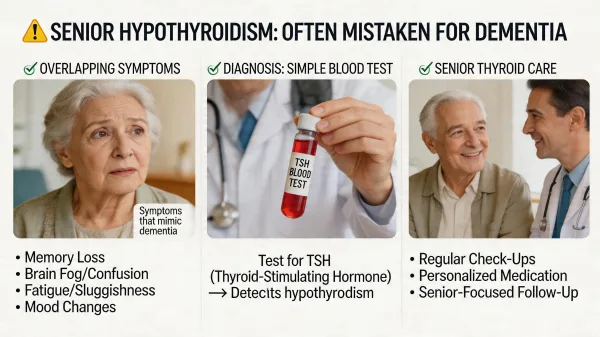
If you've been watching a parent slow down in ways that feel more like a shutdown than aging, and you're already bracing for a dementia diagnosis, there's something worth checking before anything else. Severe hypothyroidism is one of the most treatable causes of confusion, exhaustion, and depression in older adults, and it looks nearly identical to early cognitive decline. It's often missed for years, especially in patients who already carry the label of "declining" and whose families have started accepting that label along with the medical team.
I've worked in ERs and orthopedic settings for close to two decades, and I've seen how often an elderly patient gets labeled as declining when the real issue is a thyroid hormone level that hasn't been checked in far too long. Families walk in expecting to hear about dementia or depression, and sometimes the answer is a blood test and a medication adjustment. That doesn't mean every case of cognitive decline is thyroid-related, because it isn't. But hypothyroidism is common in older adults, and it's one of the few conditions where the improvement after treatment can be dramatic. Cognition clears, energy returns, and the parent you thought you were losing starts sounding like themselves again within a few months.
This article covers what severe hypothyroidism senior patients actually experience, how the condition overlaps with dementia, why long-term thyroid medication often becomes inadequate without anyone noticing, what senior living communities should be doing to monitor thyroid function, and what families can ask if something about their parent's decline doesn't add up. Your instinct that something is off matters. A missed thyroid diagnosis could be part of the answer.
What Severe Hypothyroidism Looks Like in Older Adults
Hypothyroidism means the thyroid gland isn't producing enough hormone to run the body's metabolic processes at a normal pace. In severe cases, especially when the condition has gone untreated or undertreated for years, the slowdown affects nearly every organ system, from the heart and digestive tract to the brain.
In younger adults, textbook symptoms include fatigue, weight gain, cold intolerance, dry skin, and constipation. In seniors the picture shifts in frustrating ways. Older patients often report fewer symptoms than younger patients with the same lab values, and the symptoms they do have get attributed to aging by patients, families, and sometimes physicians. Memory problems, slow speech, depression, and unsteady walking may be the main complaints, and the thyroid often isn't the first thing a doctor considers when those symptoms show up in an 80-year-old.
Up to 1 in 4 patients in nursing homes may have undiagnosed hypothyroidism, according to the American Thyroid Association, and skilled nursing facility screening studies have found roughly 7% to 12% of new admissions with previously undiagnosed hypothyroidism. That's a large population of seniors whose cognitive or functional changes might be explained by a condition the medical system overlooked. Autoimmune thyroiditis, most commonly Hashimoto's thyroiditis, is the most frequent cause of hypothyroidism in older adults, and its prevalence increases with age. The severity matters because mild or subclinical cases cause subtle shifts that may not require treatment, while severe or poorly managed cases can cause profound fatigue, cognitive impairment, facial swelling, slowed heart rate, and in the worst scenarios, myxedema, a life-threatening emergency that still carries a mortality rate of 25% to 60% even with hospital treatment. The gap between mild and severe cases is wide, and for families watching a parent slip, severity is usually what brings them to the question in the first place.
When Low Thyroid Mimics Dementia: The Symptoms Families Mistake for Aging
This is the section families need most. Severe hypothyroidism produces a cluster of symptoms that looks almost indistinguishable from early dementia, and the overlap is one of the main reasons the condition gets missed in seniors. Thyroid dysfunction may contribute to up to 10% of reversible cognitive impairment cases, which means testing for it should be routine whenever a family starts worrying about dementia. That's not a rare scenario tucked into a textbook. It's common enough that every neurologist and geriatrician sees it regularly.
The Cognitive and Emotional Overlap
Severe hypothyroidism can cause short-term memory loss, slowed thinking, difficulty concentrating, reduced attention span, flat or depressed mood, and in some cases, visual or auditory hallucinations. Apathy is common, along with the blunted affect that families often interpret as giving up on life. Executive function falls apart, and your parent may stop managing bills, stop answering the phone, and stop keeping up with appointments. Published case reports document patients scoring in the mild cognitive impairment or dementia range on standardized tests like the Montreal Cognitive Assessment, then recovering to nearly normal scores after thyroid hormone replacement, sometimes within a few months. The cognitive picture really can look like dementia until the labs come back.
The Physical Overlap
Physical symptoms feed the dementia picture too. Slow speech, gait instability, facial puffiness, reduced facial expression, and low body temperature all track with what people expect from advanced aging. Hearing can blur and reflexes can slow. The whole body runs at half speed, because in a real metabolic sense, it is running at half speed, and that's exactly the point.
Why This Condition Is Frequently Missed
Older adults tend to report fewer symptoms, blame aging for the ones they do have, and see multiple providers who each focus on a different complaint. Cognitive changes get referred to neurology, depression gets referred to psychiatry, and fatigue gets written off as normal aging. Nobody connects the dots to the thyroid. In the hospital setting, I've seen patients cycle through specialists for months before anyone orders a TSH, and by that point families are already grieving a diagnosis that hasn't actually been confirmed.
The Simple Blood Test That Identifies It
A TSH and free T4 blood panel takes minutes, costs very little, and identifies overt hypothyroidism with a high degree of confidence. The American Academy of Family Physicians considers TSH the primary screening test, with free T4 used to distinguish clinical from subclinical hypothyroidism. A TSH above the normal range combined with a low free T4 confirms overt hypothyroidism and tells the physician that replacement therapy should begin.
The Typical Timeline for Improvement
Once levothyroxine replacement starts, families often see meaningful changes within 4 to 8 weeks. Energy returns first, mood usually follows, and cognition typically improves over 2 to 6 months. Some deficits in memory or processing speed may linger if the condition went untreated for years, but the improvement is often significant enough that families describe getting their parent back. Skipping the test costs almost nothing. Missing the diagnosis can cost a family years of unnecessary grief and misdirected care decisions. If your parent is being evaluated for dementia and a thyroid panel hasn't been done, ask for one before agreeing to more expensive testing or before accepting a dementia label that may not be accurate.
The Scenario Families Keep Seeing
Imagine your mother is 78 and has been living independently. Over six months, you notice she's sleeping 12 hours a day, forgetting conversations you had the week before, and losing interest in activities she used to love. She's gained weight despite eating less, her skin looks dry and puffy, and she tells you the house always feels cold even when the thermostat reads 74 degrees. Her voice sounds slower on the phone than it used to, and you find yourself asking her to repeat things that should have been simple answers.
You start booking a neurologist appointment, you tour memory care facilities, and you prepare yourself for the diagnosis you think is coming. The family conversations shift toward power of attorney paperwork and whether she can safely stay in her home without someone with her during the day.
A new primary care doctor runs a full panel before the neurology referral. Her TSH comes back at 45 mIU/L, roughly 10 times the upper limit of normal, and her free T4 is barely detectable. She starts on a low dose of levothyroxine, titrated up over the next few months under the primary care doctor's supervision. Six weeks later, she's awake during the day and calling you to talk instead of going to bed at dinnertime. Four months later, she's back to managing her own bills and reading books again. The memory care tour never happens.
This pattern plays out often enough that no family should assume cognitive decline means dementia until thyroid function has been fully ruled out.
Why the Medication Dose That Worked Five Years Ago May Be Wrong Now
In practice, this is where things break down for seniors already on thyroid medication. A person gets diagnosed in their 60s, starts levothyroxine, feels better, and assumes the problem is solved. Years pass. The dose stays the same, nobody orders a follow-up TSH, weight changes, kidney function shifts, new medications get added, and the body's response to the same pill becomes less reliable over time. Symptoms creep back slowly enough that no single visit raises alarms, energy drops, mood flattens, and thinking slows until something forces the issue.
Doing mobile X-ray work at rest homes and nursing facilities, I saw this pattern repeatedly. Residents on thyroid medication whose labs hadn't been rerun in years, charts with TSH values from four or five years back still being used to guide care, and medication regimens that were set in motion long before the person's body had changed into whatever it had become. The system assumes that stable medication means stable levels, but in older bodies that's often not true. Nobody catches the drift until symptoms become severe, and at that point families are usually being told their parent is declining. What I was watching in those buildings wasn't always decline. Some of it was undertreatment that nobody had thought to check, and some of it was the kind of slow quiet worsening that only shows up when someone from the outside asks a direct question about when labs were last drawn and gets a vague answer back.
Standard clinical practice calls for TSH rechecks 4 to 8 weeks after any dose change, and annual monitoring once levels are stable. Many medications and conditions common in older adults affect levothyroxine absorption or metabolism, including calcium supplements, iron, acid reducers, new blood pressure drugs, weight loss, and worsening kidney function. Any of these can shift the picture in ways that a stable pill bottle won't correct. The dose that worked at 65 may be wildly inadequate at 80. If your parent has been on the same thyroid dose for years without recent labs, asking for a fresh TSH and free T4 should be at the top of your list before the next medication review.
What Thyroid Care Should Look Like in a Senior Living Community
Any senior living community, whether independent living, assisted living, or memory care, should have a clear plan for managing thyroid conditions. Medication management is usually the baseline service, which means staff make sure the pill gets taken at the right time, ideally on an empty stomach with enough spacing from calcium and iron supplements. But medication delivery isn't the same as monitoring, and the difference matters more than it sounds.
Ask the community how they coordinate lab work with the primary care physician. Ask how often TSH levels get checked for residents on long-term thyroid medication, who reviews the results, and whether families are notified of significant changes. In well-run communities these processes are documented and routine, and the care coordinator can answer those questions in a single conversation. In poorly run ones lab work falls through the cracks, and a thyroid medication that worked for a decade keeps being dispensed long after it has stopped working at the right dose.
For residents with memory care needs, monitoring matters even more. A resident with cognitive impairment can't report new fatigue or depression the way a cognitively intact person could, and staff may not recognize subtle changes in someone whose baseline already includes slowed thinking. The only way to catch declining thyroid function in that population is through periodic labs. If the community can't tell you when the last TSH was drawn, that's a gap worth raising before move-in, not after.
When Myxedema Becomes an Emergency
Myxedema coma is the most severe form of untreated hypothyroidism, and it's a medical emergency with a 25% to 60% mortality rate, according to the American Academy of Family Physicians. It occurs most often in older patients with long-standing primary hypothyroidism, especially when triggered by infection, cold exposure, surgery, or certain medications like lithium and amiodarone. The name refers to the severe tissue swelling and mental status changes that define the condition, and it can progress quickly in a frail senior.
Warning signs include profound lethargy, confusion progressing toward unresponsiveness, very low body temperature, slow breathing, slow heart rate, and diffuse facial swelling. If your parent with known or suspected hypothyroidism shows any of these signs, this isn't a next-day issue. Call 911 or head to the nearest ER immediately, and tell the intake team about the hypothyroidism history on arrival. Every hospital I've worked in has seen this presentation at some point. It's uncommon, but it's not rare, and early recognition saves lives because intravenous thyroid hormone replacement can be started in the ER while lab results are still pending.
Questions Families Ask About Hypothyroidism and Senior Living
Can hypothyroidism really cause dementia-like symptoms?
Yes. Severe or long-standing untreated hypothyroidism produces cognitive impairment that can be significant enough to meet clinical definitions of dementia, and in many cases, treatment with thyroid hormone replacement partially or fully reverses those deficits. This is why a thyroid panel is standard in a dementia workup and why skipping it can lead families down the wrong road.
How often should thyroid levels be checked in an older adult on medication?
After any dose change, TSH should be rechecked in 4 to 8 weeks. Once stable, annual checks are the minimum standard, though many providers recheck every 6 months for older adults, especially when other health conditions are shifting or new medications are being added to the regimen.
Can a memory care community handle thyroid medication management?
Yes. Any licensed community that offers medication management should be equipped for it, but the issue isn't pill delivery. The real question is whether labs are monitored on a regular schedule and whether dose adjustments are coordinated with the prescribing physician rather than left to drift.
What if my parent is already on levothyroxine but still has symptoms?
Ask for a fresh TSH and free T4 before anything else. If the dose is wrong, adjustment is usually simple and noticeable within weeks. If the levels come back optimal and symptoms persist, other causes should be evaluated, including anemia, vitamin B12 deficiency, depression, and sleep apnea, which all produce similar symptoms in seniors and frequently coexist with thyroid disease.
Does Medicare cover thyroid testing?
Yes. Diagnostic thyroid labs are covered under Medicare Part B when ordered by a provider for a medical reason. Your parent's doctor can order a TSH with free T4 at any visit if there's clinical concern, and the patient cost is typically minimal.
Bringing It All Together
Severe hypothyroidism is one of the few causes of cognitive and functional decline in seniors that responds dramatically to treatment. The labs are simple, the medication is inexpensive, and the improvement, when it happens, can be life-changing for both the patient and the family. The catch is that the condition gets missed too often, and seniors already on medication get left on outdated doses for years while their symptoms worsen.
If your parent is showing signs of cognitive decline, fatigue, depression, or general slowing down, a thyroid panel belongs at the top of the workup. If your parent is already on thyroid medication and hasn't had labs in a year or more, raising that with their doctor this week is worth your time. If you're touring senior living communities, ask directly how thyroid care is monitored and documented, not just how medication is delivered. The answers will tell you a lot about how the community approaches the rest of medical care.
You know your parent better than any chart does. Trust that, push for the blood test, and ask about the medication review. The goal isn't to rule out dementia so you can feel better. It's to give your parent the best chance of keeping the cognition, energy, and independence they still have. That's worth fighting for.