
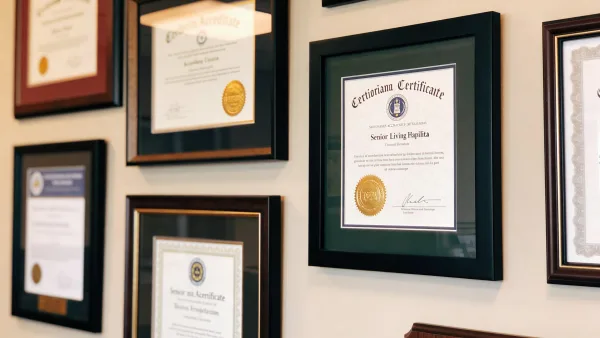
Do those certificates on the wall actually mean anything?
When you tour a memory care community, you'll almost certainly notice framed certificates, accreditation logos, and credential badges displayed in the lobby or marketing materials. "Certified Memory Care Community." "Accredited by [organization]." "Dementia Care Certified Staff." The implication is clear: this place has been evaluated, approved, and verified by someone who knows what good dementia care looks like.
But here's the question most families never think to ask: who issued that certificate, what did the community actually have to do to earn it, and does it tell you anything meaningful about the quality of care your parent will receive?
The answer varies enormously. Some memory care certifications represent rigorous, independent evaluation with on-site inspections and ongoing accountability. Others require little more than paying a fee and completing an online module. And some are internal designations created by the community itself, with no outside verification at all.
This article breaks down the certifications you're most likely to encounter, separates the meaningful ones from the marketing, and gives you a framework for asking the right questions when a community waves its credentials in front of you.
Two Types of Credentials: Community-Level vs. Staff-Level
Before getting into specifics, it helps to understand that memory care certifications fall into two distinct categories, and they measure very different things.
Community-level accreditation evaluates the organization as a whole. It looks at the physical environment, care protocols, staffing patterns, safety measures, quality improvement processes, and resident outcomes. These are typically issued by independent accrediting bodies after an on-site survey.
Staff-level certification credentials individual caregivers, nurses, or administrators. These certify that a person has completed a specific training program in dementia care. They say something about the individual's knowledge base, but nothing about the community's systems, culture, or actual care delivery.
Both can be valuable. But families often conflate them. A community that says "our staff are certified in dementia care" is making a claim about individual training. It is not making a claim about the community's overall quality, safety, or operational standards. Those are separate questions.
Community-Level Accreditations: What's Rigorous and What's Not
The Joint Commission Memory Care Certification
This is one of the most rigorous memory care certifications available. The Joint Commission is the same independent organization that accredits hospitals, and their Memory Care Certification was developed in collaboration with the Alzheimer's Association.
To earn it, a community must first achieve The Joint Commission's Gold Seal accreditation for its overall operations as an assisted living or nursing care community. Only then can it apply for the additional Memory Care Certification. The certification requires the community to demonstrate a structured plan for care, treatment, and services based on the Alzheimer's Association Dementia Care Practice Recommendations. An on-site evaluation by Joint Commission reviewers assesses compliance.
What makes this credential meaningful: it requires an existing base of organizational accreditation, involves independent on-site evaluation, aligns with evidence-based practice recommendations, and must be maintained through ongoing compliance.
CARF Accreditation (Aging Services)
CARF (Commission on Accreditation of Rehabilitation Facilities) is an independent, nonprofit accrediting body that has been setting quality standards in health and human services since 1966. CARF's Aging Services accreditation covers the full continuum of senior care, including memory care programs.
The process is substantial. Communities must meet over 1,500 standards, undergo on-site surveys conducted by independent expert practitioners, and demonstrate a commitment to continuous quality improvement. CARF accreditation is renewed every three years, requiring ongoing compliance.
What makes this credential meaningful: it is independent, comprehensive, involves on-site evaluation by trained surveyors, and applies a broad quality framework that goes beyond just dementia-specific practices to evaluate the organization's operations, safety, ethics, and outcomes. Only a small fraction of senior living communities hold CARF accreditation. As of recent data, only about 81 Life Plan communities in the U.S. are CARF-accredited.
Alzheimer's Foundation of America (AFA) Excellence in Care
The AFA's Excellence in Care (EIC) Dementia Care Program of Distinction evaluates memory care settings against dementia-care best practices, including person-centered care and safety protocols. What sets this program apart from many others is that every prospective site is evaluated through an on-site, in-person visit, and the same is required for each renewal.
What makes this credential meaningful: the mandatory on-site evaluation distinguishes it from programs that rely solely on documentation review. The AFA specifically emphasizes that live evaluation is essential because dementia-care best practices evolve, and what a community submitted on paper last year may not reflect what's happening on the ground today.
Meaningful vs. Marketing: Where Things Break Down
In practice, this is where things break down. The certifications above represent the high end of rigor. But a significant number of the credentials you'll encounter during your search don't meet that standard, and the way communities present them can be misleading.
Here's what to watch for.
"Certified Memory Care" with no accrediting body named
Some communities use phrases like "Certified Memory Care Community" or "Certified Dementia Care Program" in their marketing without identifying who issued the certification. In many cases, this is an internal designation. The community decided to call its memory care wing "certified" based on its own criteria. There is no external organization that evaluated or approved the claim.
This isn't necessarily fraudulent. Some communities genuinely have strong internal standards. But without independent verification, the word "certified" is doing marketing work, not quality assurance work. Always ask: "Certified by whom? What organization issued this, and what did the process involve?"
Pay-to-play badges and seals
A growing number of organizations offer badges, seals, or "designations" to memory care communities that pay a membership fee, complete a self-assessment, or submit documentation. Some of these programs involve no on-site visit, no independent verification, and no ongoing accountability. The community fills out a form, pays the fee, and receives a logo it can display on its website and lobby wall.
These aren't useless. Completing a self-assessment can prompt a community to review its practices. But they carry a fundamentally different weight than certifications that involve independent, on-site evaluation. A badge purchased for a few hundred dollars is not the same as accreditation earned through a multi-day on-site survey against 1,500 standards.
Staff certifications presented as community credentials
This is one of the most common sources of confusion. A community might prominently display that its staff hold certifications like CDP (Certified Dementia Practitioner) from the National Council of Certified Dementia Practitioners (NCCDP), or credentials from other training organizations. These certifications mean individual staff members completed a training program and passed an assessment.
That's good. Trained staff are better than untrained staff. But the community is presenting an individual credential as if it's an organizational one. Having certified staff does not mean the community has been evaluated for its care systems, safety protocols, staffing ratios, or quality outcomes. One trained nurse does not make a certified memory care program.
The "Best of" lists and consumer awards
Many communities display awards from consumer rating sites, "best of" lists, or satisfaction survey platforms. Some of these are legitimate reflections of resident and family feedback. Others are paid placements or awards that any community can receive by meeting minimal participation criteria. These are marketing assets, not clinical certifications. They may reflect something real about a community's reputation, but they're not a substitute for independent quality accreditation.
The key question: was there an on-site evaluation?
This is the single most important question you can ask about any memory care certification. If the answer is "yes, an independent evaluator came to our community and assessed our care delivery in person," the credential carries weight. If the answer is "we completed a training program" or "we submitted documentation," the credential is informational, not evaluative. It tells you the community knows what good care looks like on paper. It doesn't tell you they're delivering it.
Staff-Level Certifications Worth Knowing About
While staff certifications don't evaluate the community, they do indicate that individual caregivers have received focused dementia training. Here are the ones you're most likely to encounter:
CDP (Certified Dementia Practitioner) from the NCCDP. Requires completion of an approved training program and a written exam. Covers dementia types, communication techniques, behavioral management, and person-centered care.
CADDCT (Certified Alzheimer's Disease and Dementia Care Trainer) also from the NCCDP. A higher-level credential for those who train other staff members.
NCBAC certifications from the National Certification Board for Alzheimer Care. This is the only independent national board that follows a healthcare certification/licensure model with standardized examinations in dementia care.
Alzheimer's Association training recognition. The Alzheimer's Association offers training pathways and recognizes certain programs that meet their standards. Staff or organizations that complete these pathways demonstrate alignment with evidence-based care recommendations.
When a community tells you its staff are "dementia certified," ask which certification, how many staff hold it, and whether it's required for all direct-care staff or just a few administrators.
What Certifications Can't Tell You
Even the best memory care certifications have limits. Here's what they won't reveal:
Day-to-day care quality. A certification captures a snapshot. It tells you what was true during the survey period. It doesn't tell you what happens on a random Tuesday afternoon when the surveyor isn't there. The community that passed its accreditation review six months ago may have experienced significant staff turnover since then.
Staff-to-resident ratios at all hours. Accreditation standards may require adequate staffing, but they don't always specify exact ratios, and staffing on the night shift (when many dementia-related crises occur) may look very different from daytime staffing.
Culture and compassion. No certification can measure whether caregivers genuinely care about the people they serve. A community can meet every standard on paper and still feel cold, rushed, or impersonal. Conversely, a community without formal accreditation can have staff who are deeply committed and skilled.
How the community handles difficult situations. What happens when a resident becomes aggressive? When a family has a complaint? When a medication error occurs? Certifications evaluate systems and protocols. They don't capture how those protocols play out in high-pressure moments.
This is why certifications should be one input into your decision, not the entire basis for it.
A Practical Framework for Evaluating Credentials
When you're touring memory care communities and trying to make sense of the certificates on the wall, use this framework:
Step 1: Identify the issuing organization. Is the certification from an independent, recognized accrediting body (The Joint Commission, CARF, AFA)? Or is it an internal designation, a membership badge, or a training completion certificate?
Step 2: Ask whether an on-site evaluation was conducted. If yes, ask when it was performed and what it covered. If no, understand that the credential reflects self-reported information.
Step 3: Determine whether it's community-level or staff-level. Community accreditation evaluates the organization. Staff certification evaluates individuals. Both matter, but they answer different questions.
Step 4: Look at what the certification doesn't cover. Then fill those gaps yourself. Visit unannounced. Observe how staff interact with residents. Ask about staffing ratios, turnover, and how care plans are individualized. Request the most recent state inspection report. Talk to families of current residents.
Step 5: Weight the certification appropriately. A Joint Commission Memory Care Certification or CARF accreditation is a strong positive signal. A self-designated "certified memory care" label with no external verification is neutral. Neither one replaces what you learn from direct observation.
The Bottom Line
Memory care certifications range from genuinely rigorous to essentially decorative. The ones that involve independent, on-site evaluation against evidence-based standards (The Joint Commission Memory Care Certification, CARF accreditation, AFA Excellence in Care) carry real weight. They indicate that a community has voluntarily submitted to external scrutiny and met benchmarks set by organizations with legitimate expertise in care quality.
The ones that involve paying a fee, completing a self-assessment, or applying an internal label carry less weight. They're not necessarily dishonest, but they don't provide the independent verification that families need when making one of the most consequential decisions of their lives.
Use certifications as a starting point, not a finish line. The credential on the wall tells you something about the community's intentions. What you observe during your visits tells you about its reality. Both matter. Neither one alone is enough.