
Few things are more frightening than watching your parent stop caring about life. When someone you love won't get out of bed, barely eats, and tells you they don't see the point anymore, the fear can be paralyzing. You're left wondering whether this is depression, dementia, or something worse, and every option feels like a guess.
Here's what I need you to hear: severe late-life depression is one of the most treatable conditions that leads families to consider senior living. That's not wishful thinking. Research consistently shows that comprehensive treatment, including medication, therapy, and changes to the care environment, produces meaningful improvement in the majority of older adults with major depression. When I was caring for my first husband through his cancer battle, I watched depression layer on top of his physical illness in ways that made everything harder. The hopelessness it projected was more frightening than the diagnosis itself. That experience taught me something families dealing with an aging parent's depression need to know: what looks like giving up isn't always permanent. It's often a medical condition with real solutions.
This article covers what late-life major depression actually looks like when it causes functional impairment, how to tell whether your parent is dealing with depression or dementia (or both), why the right senior living environment can be part of the treatment, and what to expect from the recovery process. If your parent has withdrawn from life and you're scared of making the wrong call, you're in the right place.
What Is Late-Life Major Depression?
Late-life major depression is a clinical depressive disorder occurring in adults aged 65 and older that goes far beyond ordinary sadness or grief. It involves persistent changes in mood, energy, motivation, and cognitive function that impair a person's ability to manage daily life. For more than half of older adults who develop it, this is their first episode of depression, which catches families completely off guard. Unlike a temporary period of grief after losing a spouse or adjusting to retirement, major depression persists for weeks or months and worsens without treatment.
What makes late-life depression different from depression in younger adults is the way it presents. Older adults are less likely to say they feel sad. Instead, they show cognitive changes like confusion and memory problems, physical symptoms like fatigue and unexplained pain, and a pronounced loss of interest in activities they used to enjoy. These symptoms overlap heavily with other conditions common in aging, which is why depression in older adults goes undiagnosed roughly half the time. An estimated 15% of adults over 65 experience depression, with rates climbing much higher in institutional settings, where nearly half of nursing home residents show significant depressive symptoms. Despite those numbers, about one in three older adults with major depression receives no treatment at all.
Part of the problem is cultural. Many older adults grew up in an era where depression carried heavy stigma, and they may describe what they're feeling in purely physical terms: "I'm just tired," "My body hurts," "I don't have any appetite." Family members, too, sometimes mistake depression for normal aging. They see a parent slowing down and assume it's just what happens when you get older. It isn't. A parent who was active and engaged six months ago and now barely leaves the bedroom is showing signs of a medical condition, not an inevitable stage of life.
When Depression Causes Your Parent to Stop Functioning
Depression becomes a senior living conversation when it crosses the line from emotional suffering into functional impairment. That line is crossed when your parent can no longer manage the basic activities that keep them safe and healthy.
Imagine your parent hasn't left their bedroom in two weeks. Food sits untouched unless someone brings it directly to them and practically insists they eat. They've stopped bathing, stopped answering the phone, and when you visit, they tell you they don't see the point in anything anymore. This isn't just a bad week. This is depression causing a level of self-neglect that puts their health at serious risk. The terrifying part for families is that this kind of withdrawal can accelerate other health problems rapidly. Poor nutrition weakens the immune system, immobility increases the risk of blood clots and pressure sores, and missed medications can destabilize chronic conditions like diabetes or heart disease within days.
The functional impairments that signal danger include refusing or forgetting to eat (leading to significant weight loss), neglecting personal hygiene and grooming, staying in bed for most of the day, stopping all medications, withdrawing completely from social contact, and letting the home environment deteriorate. Research published in the American Journal of Psychiatry found that older adults with clinically significant depressive symptoms were more than twice as likely to develop self-neglect compared to those without depression. When depression and cognitive impairment occur together, the risk increases even further. These aren't problems that resolve with encouragement or willpower. They require a change in the care environment.
There's a pattern I've seen repeatedly as a healthcare professional: families try to manage this at home for weeks or months before acknowledging it's bigger than what they can handle. They bring meals, they call every day, they hire a home aide for a few hours. And sometimes that works for mild depression. But when your parent has stopped performing basic self-care, when the mail is piling up and the fridge is empty and they won't open the curtains, the level of support they need is more than periodic check-ins can provide. The question isn't whether your parent needs help. The question is whether the current arrangement is delivering enough of it.
Depression vs. Dementia: The Critical Distinction Families Must Get Right
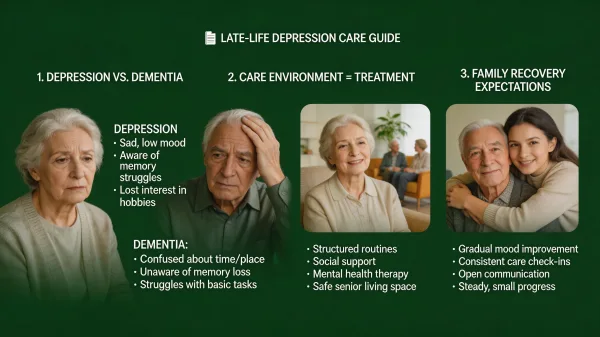
This is where families get stuck, and the stakes are enormous. Depression and dementia in older adults can look nearly identical from the outside. Both cause memory problems, confusion, difficulty concentrating, loss of motivation, and withdrawal from activities. A parent who sits in a chair all day staring at nothing could be experiencing either condition. But the treatment paths are completely different, and getting the diagnosis wrong has serious consequences.
When depression is mistaken for dementia, a treatable condition goes untreated. The family accepts the decline as permanent and shifts into management mode instead of pursuing aggressive treatment. The parent continues to deteriorate not because they have a degenerative brain disease, but because nobody recognized that their cognitive symptoms were being driven by a mood disorder. This phenomenon, sometimes called depressive cognitive disorder (previously known as pseudodementia), affects a significant number of older adults, and it's reversible with proper treatment.
There are patterns that can help distinguish the two conditions, though they aren't foolproof. Depression-related cognitive decline tends to develop over weeks to months, while dementia typically progresses slowly over years. People with depression are usually painfully aware of their memory problems and are distressed about them. People with dementia often minimize or don't recognize their deficits. In depression, a person might give up on a memory test and say "I don't know" without trying. In dementia, they're more likely to try but get the answer wrong or confabulate. Depression often affects both recent and remote memory, while Alzheimer's disease typically impairs recent memory first while leaving older memories relatively intact early on.
But here's the complication that makes all of this harder: depression and dementia frequently occur together. Depression affects roughly half of people with Alzheimer's disease. Early dementia can trigger depression as the person becomes aware of their declining abilities. And depression itself, when left untreated in older adults, may increase the risk of developing dementia later. So the answer isn't always one or the other. It can be both.
I've seen this confusion play out in my own family. When our family member's cognitive decline accelerated, the early signs looked a lot like depression. The withdrawal, the loss of interest, the not caring about things that used to matter. Our instinct was to explain it away or wait for it to pass. By the time we understood what was happening, we'd lost valuable time. That experience is why I push families so hard on this: don't guess. Get a comprehensive evaluation from a geriatric psychiatrist who specializes in distinguishing these conditions. They'll use a combination of cognitive testing, brain imaging, detailed patient history, and depression screening tools like the Geriatric Depression Scale to determine what's driving the symptoms.
Even when dementia is suspected or confirmed, treating the depression component is still critical. Depression layered on top of early dementia is common, and antidepressant treatment can improve functioning, mood, and quality of life even when the underlying cognitive disease is present. A treatment trial for depression should be attempted in nearly every case where depressive symptoms are present, regardless of whether dementia is also in the picture.
How a Senior Living Environment Can Break the Depression Cycle
What most people don't realize until they're in it is that changing the care environment itself can be therapeutic for late-life depression. This isn't just about having someone available to help with meals and medication. The structure of a senior living community directly addresses the factors that make depression worse and harder to treat at home.
Severe depression creates a vicious cycle. Your parent stops eating properly, which worsens fatigue and cognitive function. They stop moving, which accelerates physical decline and disrupts sleep. They withdraw from people, which deepens isolation, and isolation is one of the strongest risk factors for worsening depression in older adults. They stop taking medications, which can destabilize both their mental and physical health. At home, especially if your parent lives alone, there's nobody to interrupt this cycle on a daily basis. Family members who visit periodically can't provide the consistent, structured intervention that breaking this pattern requires.
A senior living community addresses each of these factors simultaneously. Nutritious meals are prepared and served at consistent times, removing the barrier of having to plan, shop for, and cook food when you can barely get out of bed. Physical activity is built into the daily routine through walking, group exercise classes, and simply moving between common areas and your living space. Social interaction happens organically in dining rooms, activity spaces, and hallways, providing the kind of low-pressure human contact that isolated older adults desperately need but won't seek out on their own. Working in hospital settings for nearly two decades, I've seen how dramatically a patient's outlook can shift simply because they're around other people who check on them, talk to them, and notice when something is off. That consistency of human presence is something a home environment rarely provides when a person lives alone.
Many assisted living communities now offer on-site or visiting mental health services, including psychiatrists, psychologists, and counselors who specialize in geriatric care. Medication management ensures that antidepressants are taken consistently and at the correct dose, which is critical because inconsistent medication use is one of the primary reasons depression treatment fails in older adults living at home. Staff members who see your parent every day can also notice subtle changes in mood, appetite, and behavior that family members visiting once or twice a week might miss, allowing for faster treatment adjustments.
The realistic timeline for improvement matters here, because families often expect results too quickly and lose hope when they don't see them. Antidepressant medications typically take four to six weeks to reach their full effect in older adults, and sometimes longer. Research shows that approximately 51% of older adults respond to antidepressant treatment alone. But when medication is combined with structured social support, consistent nutrition, physical activity, and psychotherapy, response rates climb significantly, with some stepped-care models achieving improvement in roughly 80% of patients. That difference between medication alone and comprehensive treatment is exactly what a senior living environment can provide. The improvement may be gradual, starting with your parent getting dressed without being asked, joining a meal in the dining room, or making eye contact during a conversation. These small changes are real progress, and they tend to build on each other.
Treatment Options That Work for Late-Life Depression
Effective treatment for severe depression in older adults almost always involves more than one approach. SSRIs (selective serotonin reuptake inhibitors) are the most commonly prescribed first-line medications because they're effective and generally better tolerated than older antidepressant classes. Response rates in older adults are comparable to those in younger populations, though side effects like falls, blood pressure changes, and low sodium levels require closer monitoring. If one SSRI doesn't produce results after an adequate trial period (typically eight to twelve weeks at a therapeutic dose), switching to a different antidepressant class or adding an augmentation strategy is the standard next step. Giving up after one medication failure is a mistake families and even some clinicians make too often.
Psychotherapy is underused with older adults but highly effective. Cognitive behavioral therapy helps your parent identify and change the negative thought patterns that depression feeds on. Problem-solving therapy is particularly well-suited to older adults because it focuses on practical, concrete challenges rather than abstract emotional processing. Life review therapy, which helps older adults find meaning and coherence in their life experiences, has also shown strong results. These approaches work best when combined with medication, and many senior living communities can arrange for regular therapy sessions either on-site or through telehealth.
For older adults with depression who don't respond to medication and therapy, electroconvulsive therapy (ECT) remains one of the most effective treatments available. Despite its reputation, modern ECT is safe and well-tolerated, achieving remission in roughly 60% to 75% of older patients with severe or treatment-resistant depression. It's often considered earlier in the process when a person is in immediate danger from self-neglect or has expressed suicidal thoughts. Transcranial magnetic stimulation (TMS) is another option that has shown promise in some geriatric studies, though results vary more widely. The combination of medication, therapy, and environmental change gives your parent the best chance at recovery.
What to Look for in a Senior Living Community
Not every assisted living community is equipped to support a resident with severe depression. When you're evaluating options, the questions you ask should go beyond the standard tour checklist. Depression-related placement has different requirements than a move driven by physical care needs alone.
Ask specifically about mental health services. Does the community have access to a geriatric psychiatrist? Is there a psychologist or licensed counselor on staff or available regularly? How does the staff handle residents who are resistant to participating in activities or meals? What training do caregivers receive about recognizing changes in mood and behavior? How is medication management handled, and how quickly can medication adjustments be implemented? From my years doing mobile X-ray work inside care facilities, I've learned that the gap between what a community advertises and what actually happens on the units can be significant. Pay attention to how staff interact with residents during your visit, not just what the marketing materials say.
A community that takes depression seriously will have specific protocols for monitoring mood, encouraging engagement without forcing it, and communicating changes to the treatment team. Ask what happens if a resident refuses to come to meals three days in a row. Ask how they track weight changes. Ask whether the activity programming includes quiet, low-stimulation options for residents who aren't ready for group activities. A depressed person isn't going to jump into a lively bingo game on day one. The community needs to understand that recovery is gradual and meet your parent where they are.
The Cost of Senior Living for Depression-Related Placement
The financial reality of senior living is something families need to face with clear numbers. As of 2025, the national median cost of assisted living is approximately $6,200 per month, or about $74,400 per year, according to CareScout's 2025 Cost of Care Survey. Costs vary dramatically by state, ranging from roughly $4,500 per month in lower-cost states to over $9,600 in the most expensive markets.
If your parent needs memory care services in addition to depression treatment (because they have both depression and cognitive decline), costs run higher, typically $7,000 to $8,500 per month nationally. That translates to $84,000 to $102,000 annually. When our family faced these numbers during a loved one's dementia journey, the financial shock was almost as overwhelming as the diagnosis. Nobody had prepared us for what this would actually cost, and I don't want that to happen to your family.
Medicare does not cover assisted living room and board, though it may cover some mental health treatment costs like psychiatrist visits and prescribed medications under Part B. Medicaid coverage for assisted living varies significantly by state through Home and Community-Based Services waiver programs, and not all states cover assisted living at all. Long-term care insurance, VA Aid and Attendance benefits for eligible veterans, and personal savings are the primary funding sources most families rely on. Some families also use the proceeds from selling a parent's home to fund the initial years of care. Start the financial planning conversation early. These numbers add up fast.
One financial consideration specific to depression-related placement: if treatment is successful (which it often is), your parent's care needs may decrease over time. A parent who entered assisted living unable to manage daily activities may, after several months of treatment, regain enough function to require less hands-on support. This doesn't necessarily mean they should return home, especially if isolation was a contributing factor, but it may affect the level of care and the associated cost going forward. That's a different trajectory than dementia-related placement, where costs generally increase as the disease progresses.
When It's Time to Make the Move
There's no clinical threshold that makes this decision for you, but certain situations should accelerate your timeline. If your parent is losing weight because they won't eat, if they've stopped taking medications that manage serious health conditions, if they're staying in bed most of the day, or if they've expressed hopelessness about the future, the risk of waiting is greater than the risk of acting.
A practical way to think about timing: ask your parent's primary care physician or a geriatric specialist whether the current level of support is adequate for the severity of the depression. If the answer is no, don't wait for a crisis to force the decision. Hospital admissions for dehydration, malnutrition, or falls related to medication non-compliance are common among older adults with untreated severe depression. Those emergencies are more traumatic and more expensive than a planned transition into assisted living, and they often result in a worse outcome because treatment begins from a more deteriorated baseline.
Many families hesitate because they worry that moving a depressed parent will make the depression worse. That concern is understandable, but the evidence suggests the opposite for most people. Isolation is what makes depression worse. A parent who is alone in a house they can't maintain, eating poorly, and refusing to engage with the world is already in the worst-case scenario. Moving them into a structured, supportive environment gives treatment a chance to work in a way that home care often can't replicate.
Your parent may resist the idea. That's normal. Depression distorts thinking and makes everything feel hopeless and pointless, including the possibility of getting better. I've worked with enough patients over my career to know that the person depression has turned your parent into is not who they really are. Don't let their depression make the decision for the family.
Your Parent Can Get Better
Late-life depression is frightening for families, but it responds to treatment in the majority of cases. The combination of proper medical care, consistent support, and the structured environment that senior living provides gives your parent the best chance at not just surviving, but actually enjoying life again. You're not giving up on your parent by considering a move. You're giving them access to the comprehensive care that depression requires.
Trust what you're seeing. If your parent has stopped taking care of themselves, don't wait for it to resolve on its own. Talk to their doctor. Get a geriatric psychiatry evaluation. Visit communities that have strong mental health support. The process of recovery from severe depression takes time, but it's a realistic goal, not a fantasy. Many families describe the moment their parent started re-engaging with life as one of the most relieving experiences they've ever had. That moment is worth fighting for, and the right care environment is often what makes it possible.