
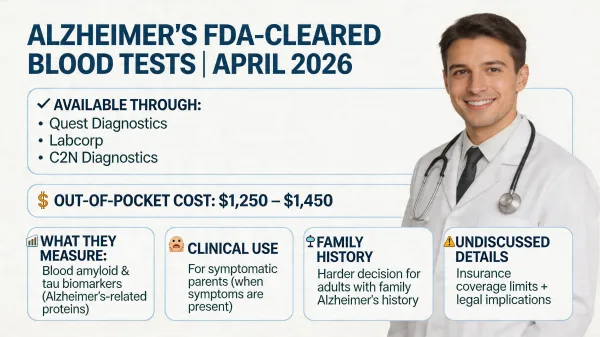
Yes, Alzheimer's blood tests exist, and they're commercially available right now. As of April 2026, the FDA has cleared the Lumipulse G pTau 217/?-Amyloid 1-42 Plasma Ratio for marketing through Quest Diagnostics and Labcorp, and C2N Diagnostics' PrecivityAD2 blood test is available nationwide through physician order. Both measure proteins in plasma that correlate with the amyloid pathology associated with Alzheimer's disease. For families watching a parent's memory slip, this is new ground: a year ago, sorting out whether a parent's symptoms came from Alzheimer's or something else usually required a $5,000 PET scan or a spinal tap. Now it can start with a vial of blood.
The Alzheimer's blood test changes what families can know and when they can know it, and that shifts the decisions that follow. With two FDA-approved disease-modifying therapies on the market for early Alzheimer's, an accurate diagnosis isn't just clarifying anymore. It opens or closes a treatment door. In hospitals for nearly 20 years, I've watched diagnostic technology move from research labs into clinical practice. Blood-based Alzheimer's testing is doing that right now, and the speed of the change is real.
This article walks through what the tests measure, who they're appropriate for, what they cost, what insurance does and doesn't cover, and the harder question families with strong family history are asking: should an asymptomatic adult get tested? It also covers the insurance and legal implications most articles skip, because they matter and they don't have clean answers yet.
What Alzheimer's Blood Tests Are Available Right Now
Two blood tests dominate clinical use right now, and a third FDA clearance arrived in late 2025.
The Lumipulse G pTau 217/?-Amyloid 1-42 Plasma Ratio, made by Fujirebio, received FDA 510(k) clearance on May 16, 2025. It's the first blood-based in-vitro diagnostic test cleared by the FDA to aid in diagnosing Alzheimer's disease. The test measures the ratio of two proteins in plasma: phosphorylated tau 217 (p-tau217) and beta-amyloid 1-42. That ratio correlates with the presence of amyloid plaques in the brain, which is one of the hallmark pathological signs of Alzheimer's. Quest Diagnostics began offering the FDA-cleared Lumipulse test in summer 2025 through its network of about 2,000 patient service centers and 8,000 patient access points. Labcorp launched its FDA-cleared Lumipulse test in August 2025, available nationwide through Labcorp's patient service centers.
C2N Diagnostics' PrecivityAD2 blood test is a laboratory-developed test, not FDA-cleared, but it's been clinically available since 2023 and is now offered in all 50 states and the District of Columbia. It measures the A?42/40 ratio plus the p-tau217/non-phosphorylated tau 217 ratio, then combines them into an Amyloid Probability Score 2 (APS2). C2N also offers it through Mayo Clinic Laboratories, which expanded access starting in 2024.
In October 2025, the FDA cleared a third option: Roche's Elecsys pTau181 plasma assay, indicated as an aid in the initial assessment of cognitive decline in adults 55 and older. It uses a different biomarker (p-tau181 rather than p-tau217), and it's positioned more as a triage tool: a negative result effectively rules out amyloid pathology, while a positive or indeterminate result calls for follow-up.
What do these tests actually measure? Beta-amyloid is a protein fragment that, in its toxic form, begins to accumulate in the brain up to 20 years before symptoms appear, eventually clumping into the plaques that disrupt neuron function. Tau is a different protein that accumulates later, forming tangles inside neurons. Phosphorylated tau 217 in plasma correlates strongly with the brain's amyloid burden, which makes it a useful indirect marker.
These tests don't measure symptomatic disease itself. A positive result doesn't diagnose Alzheimer's. It tells the physician that amyloid pathology is likely present, which is one piece of evidence in a clinical evaluation that also includes cognitive testing, medical history, and sometimes imaging. The Lumipulse validation study of 499 patients found that 92% of people who tested positive on the blood test had amyloid plaques confirmed by PET or cerebrospinal fluid testing, and 97% of those who tested negative had negative findings on confirmatory tests. About one in five results came back indeterminate, meaning further testing was needed for clarity. In my experience working alongside hospital diagnostic teams, indeterminate results are where families and clinicians most often get stuck, and that one-in-five rate is worth knowing before you order the test.
When the Alzheimer's Blood Test Makes Clinical Sense
The FDA clearance and product labeling are specific: these tests are intended for adults 50 and older who are presenting with signs or symptoms of cognitive decline. They are not screening tests. They aren't meant for healthy adults curious about their future risk. The Alzheimer's Association has been emphatic on this point.
Clinical reasoning for testing a symptomatic parent has shifted in the last three years, and the reason is treatment. Lecanemab (brand name Leqembi, made by Eisai) received traditional FDA approval in July 2023 for early symptomatic Alzheimer's, meaning mild cognitive impairment or mild dementia stage with confirmed amyloid pathology. Donanemab (brand name Kisunla, made by Eli Lilly) followed in July 2024 with the same indication. Both are anti-amyloid monoclonal antibodies given by IV infusion. Both modestly slow cognitive and functional decline. Both require biomarker confirmation of amyloid pathology before a physician can prescribe them, because they don't help patients whose cognitive symptoms come from something other than Alzheimer's, and they carry real side-effect risks (brain swelling and microbleeds, called ARIA, occur in roughly one in five treated patients).
That last detail is the one families miss. Five years ago, telling Alzheimer's apart from other causes of dementia was important for prognosis but didn't change what a family could do about it. Now it does. Lecanemab and donanemab work only against amyloid pathology, which means an accurate biomarker-confirmed diagnosis is now the gateway to treatment access. Without it, a physician can't responsibly prescribe these drugs, and Medicare won't cover them. From my clinical observation across multiple hospital settings, the families who understood this distinction earliest were the ones who got their parent into evaluation faster, and that timing matters when treatment effectiveness depends on starting in the mild stage.
The dedicated personal note here, drawn from years inside hospitals and from a family member's dementia journey: I've watched the diagnostic side of medicine evolve in stops and starts, and what's happening with Alzheimer's blood testing right now is one of the more meaningful shifts I've seen in my career. When a family member of mine went through cognitive decline, the differential diagnosis process took months and involved equipment that wasn't available in every clinic. Some of that ambiguity is now lifted by a blood draw. The technology is real. What I've also seen, working in hospitals long enough to watch new diagnostics roll out, is that capability arriving in a clinic doesn't mean every clinic is ready to use it well. The conversation that should follow a positive result is harder than the test itself, and not every primary care physician has time to hold it.
What about asymptomatic adults? That's where the clinical picture gets more complicated, and it deserves its own section below. For a parent showing real cognitive symptoms (forgetting recent conversations, getting lost on familiar routes, having trouble managing finances they used to handle without thinking), the blood test is now a reasonable conversation to have with their physician. Whether to actually order one depends on the parent's overall health, the physician's clinical judgment, and what the family plans to do with the information.
The Cost, the Coverage, and the Reality of Getting One
The pricing on Alzheimer's blood tests is moving, but here's the snapshot as of April 2026.
C2N Diagnostics' PrecivityAD test costs about $1,250 out of pocket. PrecivityAD2 costs about $1,450 when a positive result triggers the additional Precivity-ApoE follow-up; when the result is negative and no follow-up is needed, the bill is lower. The Quest and Labcorp Lumipulse tests are priced similarly, generally in the $1,200-$1,500 range out of pocket, though list prices vary by lab and region.
Insurance coverage is patchy. As of early 2026, the Precivity tests aren't covered by private insurance, Medicare, or Medicaid as a matter of policy, though commercial and Medicare Advantage plans may pay on a case-by-case basis when the physician submits a letter of medical necessity. Medicare reimbursement codes for blood-based amyloid testing were expected to become available in early 2026, which should expand coverage through the year, but it isn't a guarantee. C2N Diagnostics offers a financial assistance program based on federal poverty guidelines, plus a six-month interest-free payment plan. From years working inside hospital systems, I've seen families assume diagnostic tests would be covered the way other lab work is, and the bill arriving weeks later is its own kind of shock.
Compare that with the alternative: an amyloid PET scan typically costs around $5,000, with some estimates running to $8,000 depending on the facility. Medicare expanded coverage of amyloid PET in 2023 after years of restricting it, but coverage is still limited to specific clinical scenarios and prior authorization is common. PET also exposes patients to radiation and requires a specialized facility. A spinal tap (lumbar puncture) for cerebrospinal fluid amyloid testing is another option, generally cheaper than PET and often covered by insurance, but invasive and uncomfortable.
To order a blood test, you need a physician order. These aren't direct-to-consumer products. Once ordered, the blood draw can happen at a Quest, Labcorp, or affiliated patient service center, or through mobile phlebotomy in some cases. Results typically come back in 2 to 14 days, depending on the lab. The Mayo Clinic reports Lumipulse results within 2 to 5 days in its system.
The Decision When Your Parent Is Showing Symptoms
If your parent is showing real cognitive symptoms and is being evaluated, the blood test is reasonable to ask their physician about. The benefits are practical. An accurate, biomarker-confirmed diagnosis tells the family what they're dealing with, which informs everything from treatment options to long-term planning to how the family communicates about the situation.
Treatment access is the most concrete benefit. Lecanemab and donanemab are most effective when started early, when amyloid burden is lower and cognitive reserves are higher. A physician can't responsibly prescribe either drug without biomarker confirmation, and Medicare won't cover the infusions without it. For a parent in the mild cognitive impairment or mild dementia stage of Alzheimer's, getting that confirmation through a blood draw rather than waiting weeks for a PET scan can mean starting treatment months sooner.
The risks are less concrete but real. A positive result carries psychological weight, both for the patient and for adult children who now know what's coming. There's also the insurance question, covered in detail later in this article: a positive amyloid biomarker result entered into the medical record can affect future life insurance, long-term care insurance, and disability insurance applications, and federal law doesn't protect against that.
Some families ask whether they should pursue testing if they aren't planning to use the disease-modifying therapies. That's a fair question. The infusions require regular trips to an infusion center, carry serious side-effect risks, and offer modest benefits (slowing decline by roughly 25% over 18 months in clinical trials, not stopping it). For a parent who is older, has multiple health conditions, or has a family preference against aggressive treatment, the calculus may not favor pursuing therapy. In that case, a blood test still has value for clarity and planning, but the urgency drops, and so does the case for the out-of-pocket spend.
Talk with the physician directly. Most neurologists and a growing number of primary care physicians are now familiar with these tests, and they can help frame what a result would mean for your specific situation. The questions worth asking: What would we do differently with a positive result? What about a negative one? Is the parent a candidate for disease-modifying therapy if amyloid is confirmed? Is the family prepared for what either result will mean?
The Different Decision for Adults With Family History
For a 45-year-old whose mother has Alzheimer's, the testing question is genuinely different, and the answer is harder.
Amyloid pathology can begin accumulating in the brain 10 to 20 years before symptoms appear. A blood test could, in theory, detect that pathology in an asymptomatic adult years before any cognitive change. The February 2026 WashU study published in Nature Medicine demonstrated that p-tau217 blood levels in cognitively unimpaired older adults can predict the age of symptom onset within a margin of 3 to 4 years. That's a remarkable scientific finding, and it points toward a future where testing asymptomatic at-risk adults makes clinical sense.
The problem, right now, is that there's no proven intervention that changes the trajectory for an asymptomatic adult who tests positive. Lecanemab and donanemab aren't approved for asymptomatic patients. Lifestyle interventions (exercise, sleep, blood pressure control, diet, cognitive engagement) are recommended for everyone over 50 regardless of testing status, so a positive result doesn't change the prevention playbook. Prevention trials in asymptomatic adults are ongoing, but enrollment in those trials is the main clinical pathway for testing in this population, not standalone diagnostic testing.
That gap, between what a test can reveal and what medicine can do about it, is the heart of the asymptomatic testing dilemma. Knowing you're likely to develop Alzheimer's symptoms in 8 to 12 years is a heavy thing to carry, especially when the action items (live healthier, plan financially, have hard conversations with family) are the same ones recommended for any midlife adult.
Some adults with strong family history want to know anyway, for reasons that are valid: financial planning, decisions about long-term care insurance while still insurable, choices about retirement timing, or simply the desire to live with eyes open. Others find that the absence of a clear treatment pathway makes the knowledge more burden than benefit. There's no right answer here, but the asymmetry between knowledge and action is worth understanding before deciding.
The Insurance and Legal Implications Most Families Don't Hear About
This is the section your insurance broker won't volunteer and your physician may not bring up.
The Genetic Information Nondiscrimination Act of 2008 (GINA) protects Americans from discrimination by health insurers and employers based on genetic information. It's an important law. It also doesn't apply to Alzheimer's blood biomarker tests in two distinct ways.
First, p-tau217 and beta-amyloid blood tests aren't genetic tests under GINA's definition. GINA covers analyses of DNA, RNA, chromosomes, or proteins and metabolites that detect genotypes, mutations, or chromosomal changes. Amyloid biomarker tests measure proteins associated with disease pathology that's already underway, not genetic predisposition. They fall outside GINA entirely.
Second, even if they were genetic tests, GINA only covers health insurance and employment. It explicitly does not cover life insurance, long-term care insurance, or disability insurance. Those insurers can use genetic, family history, and biomarker information when making coverage and pricing decisions, and they often do. A positive amyloid biomarker result entered into a medical record is potentially visible to underwriters during the application process for those products, which can mean denial, higher premiums, or exclusions.
Some states have stronger protections. California's CalGINA, Florida's 2020 law banning life insurance use of DNA test results, and a handful of other state laws extend genetic nondiscrimination protections beyond the federal floor. Coverage varies by state and by insurance product. Before pursuing testing, especially for an adult who hasn't yet bought life or long-term care insurance, it's worth understanding what protections (or gaps) exist where you live.
The Affordable Care Act provides a separate protection: health insurers can't use pre-existing conditions to deny coverage or set premiums. So a positive biomarker result won't affect health insurance access. Life, LTC, and disability are the categories where families need to think ahead.
Where This Leaves Your Family
Alzheimer's blood testing is real, available, and changing how families confront cognitive decline. For a parent showing symptoms and being evaluated, it's a reasonable test to ask about, especially given the new disease-modifying therapies that require biomarker confirmation. For an adult with family history but no symptoms, the decision is harder and the benefits less clear. The technology is moving faster than the insurance and legal frameworks around it, which means families pursuing testing should understand what they're stepping into.
The clearest advice is also the simplest: talk to the physician. Ask what a result would mean for your specific situation. Understand the cost and coverage before the blood is drawn. Think about insurance implications before adding a biomarker result to the medical record, particularly if life or long-term care insurance is part of the family's plan.
Expect more change. The next two years will probably bring expanded insurance coverage, additional tests, and clearer clinical guidelines. What's true today may not be true in 2027. That's the nature of frontier medicine. For families facing real decisions right now, the available tools are useful, the limitations are real, and the conversation belongs in your physician's office with all of it on the table.